
Physics: Faraday’s Law: EMF, Turns, and Withdrawal Speed
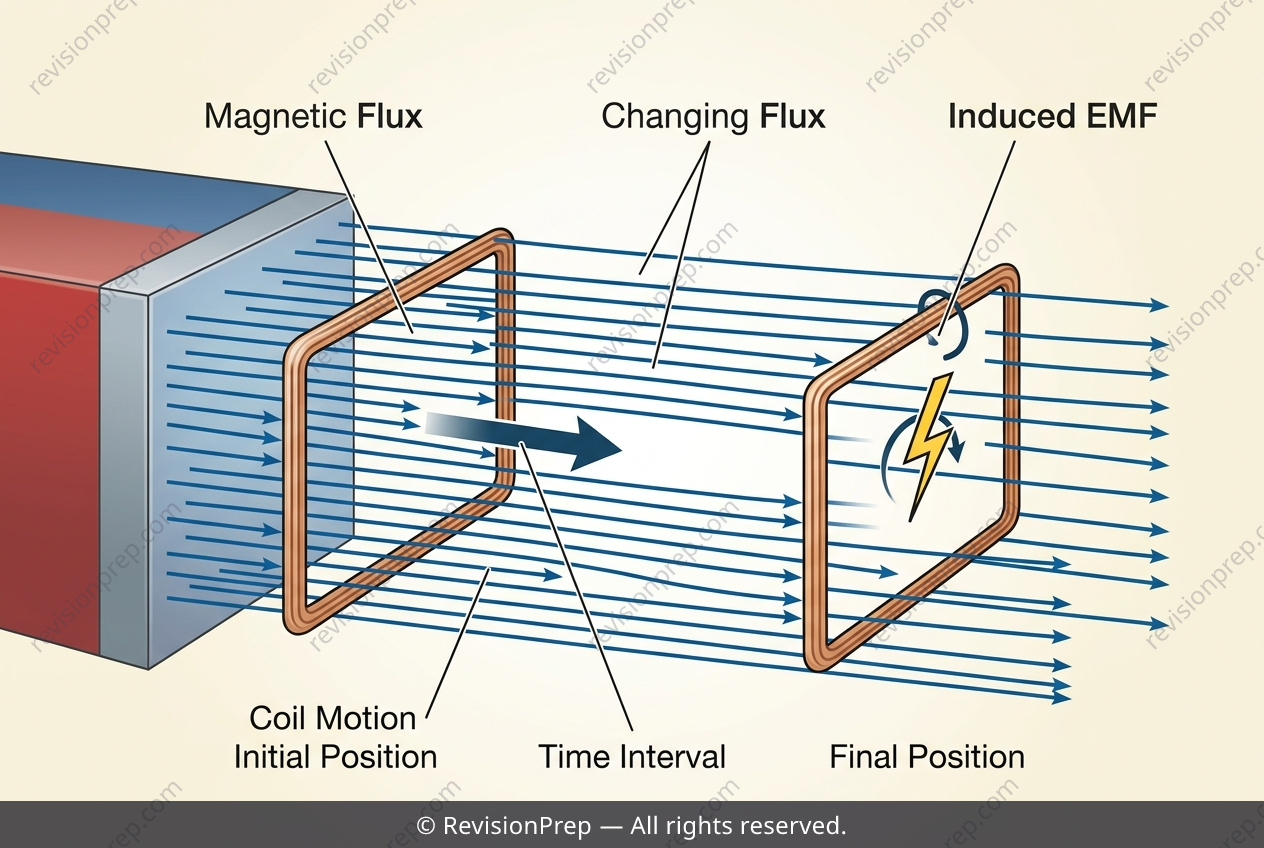
Faraday’s Law of Electromagnetic Induction is the engine behind generators, transformers, and countless everyday technologies—yet at its heart, it’s beautifully simple: a changing magnetic flux linkage through a coil produces an electromotive force (EMF). In this question, a rectangular coil is pulled out of a uniform magnetic field, and the key idea is that as the coil’s area within the field shrinks, the magnetic flux linkage (NΦ = NBA) decreases over time. Faraday’s law states that the induced EMF equals the rate of change of this flux linkage, ε = N(ΔΦ/Δt), so the faster the coil is withdrawn, the larger the EMF. The relationship between motion, time, and induced voltage becomes clear when you break it down: flux linkage depends on the product of the number of turns, the magnetic flux density, and the area still inside the field. Withdrawing the coil changes that area, and the speed of withdrawal sets how quickly that change happens. Doubling the speed halves the time interval, which doubles the rate of flux change—and therefore doubles the EMF. However, the direction of withdrawal only flips the sign of the induced current (as Lenz’s law reminds us), not the magnitude of the EMF, which depends solely on how fast the flux linkage changes, not which way the coil moves.
Start practising IB questions today
150,000+ IB-styled questions, criteria-mapped and instantly accessible.