
Physics: Faraday’s Law with Real-World Wind Turbine Applications
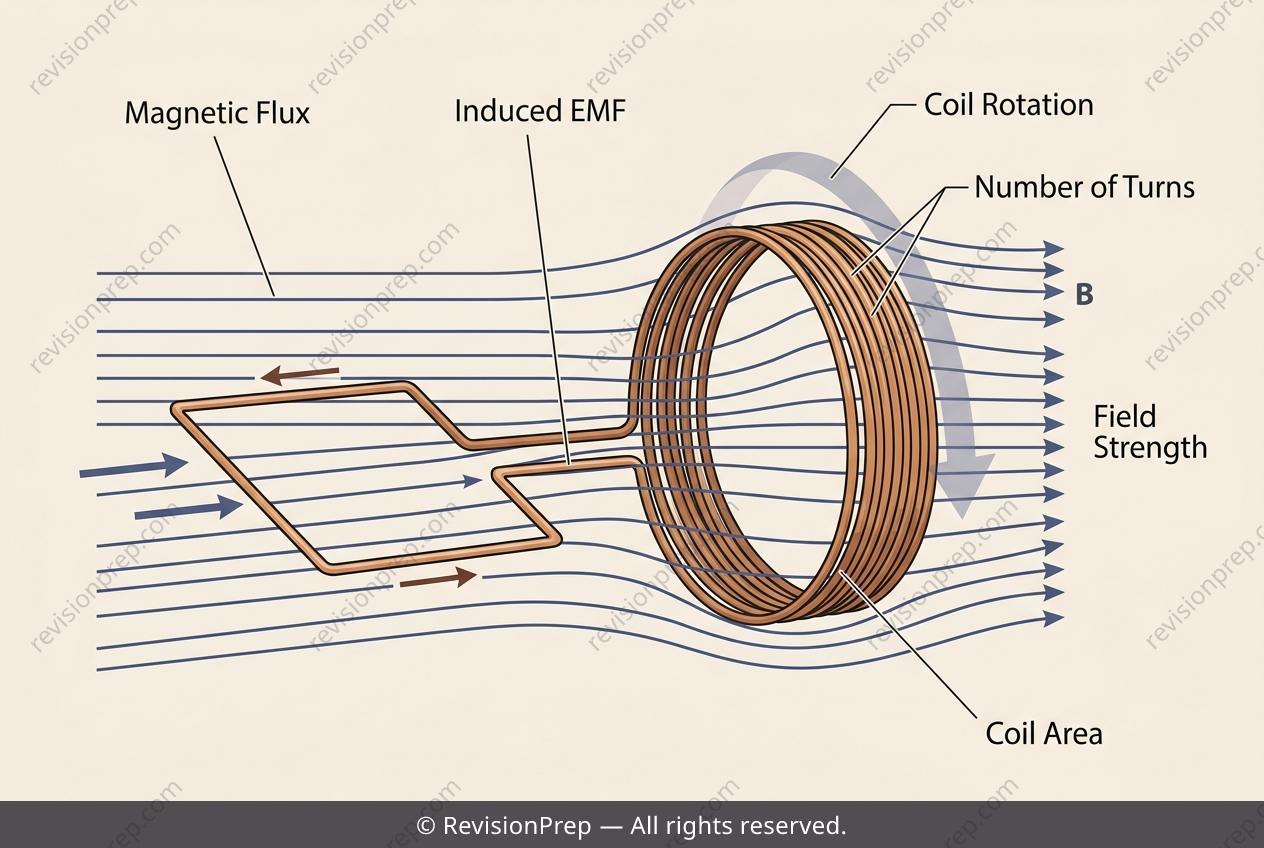
Faraday’s Law of Electromagnetic Induction is the quiet engine behind much of the modern world—from the spinning coils in wind turbines to the transformers that step voltage up and down along power lines. At its heart, the law tells us that a changing magnetic flux through a coil produces an electromotive force (EMF), with the magnitude of that EMF proportional to both the number of turns in the coil and the rate at which the flux changes. In a wind turbine, a rectangular coil rotates inside a magnetic field; as its orientation shifts, the angle between the coil’s plane and the field changes, so the flux through it continuously varies. That variation is what drives the induced EMF, which ultimately powers homes. The relationship is beautifully direct: EMF = −N × (ΔΦ/Δt), where N is the number of turns and ΔΦ/Δt is the rate of flux change. This means that if rotation slows—say, in low wind—the EMF drops because the flux changes more slowly. But the equation also reveals two levers to restore it: strengthen the magnetic field (raising Φ for a given angle) or add more turns (increasing N). Both boost the induced EMF without needing faster rotation. Understanding these connections lets engineers design turbines that stay efficient across varying wind speeds, and it shows how a single physical law ties together motion, magnetism, and electricity in everyday technology.
Start practising IB questions today
150,000+ IB-styled questions, criteria-mapped and instantly accessible.