
Physics: Half-Life, High Stakes: Imaging with Tc-99m
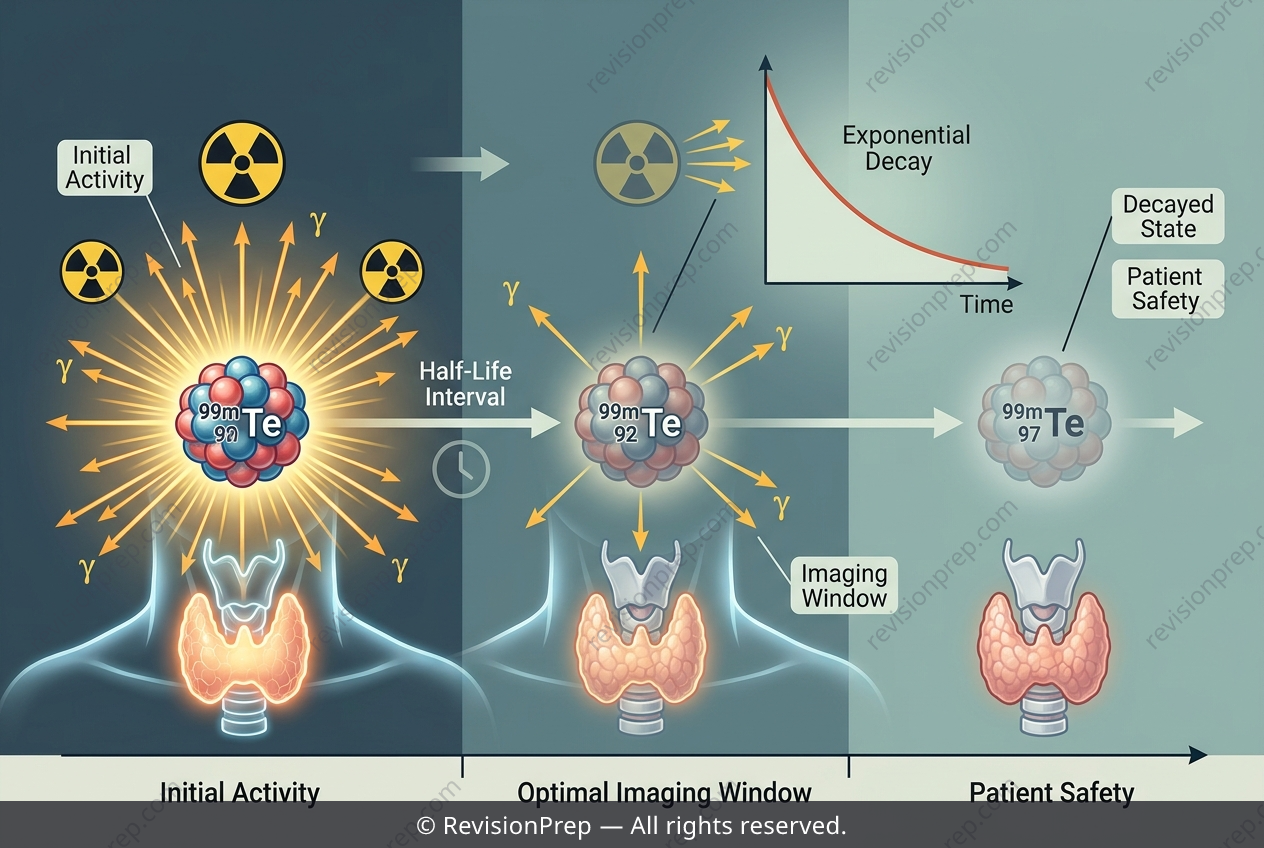
Radioactive half-life is the time it takes for half of the unstable nuclei in a sample to decay, and it governs how long a radioactive tracer remains useful inside the body. In medical diagnostics, this concept is brought to life by technetium-99m, a gamma-emitting isotope with a half-life of 6 hours, used to image organs like the thyroid. The core idea is that activity—the number of decays per second—falls exponentially, so after each 6-hour interval, only half of the original tracer remains active. This matters because the tracer’s suitability hinges on a delicate balance. Gamma radiation’s high penetrating power allows it to escape the body and be detected externally, avoiding invasive procedures. However, that same radiation is ionising, meaning it can strip electrons from atoms in cells, potentially damaging DNA and elevating cancer risk. The short half-life compounds this: it ensures the patient isn’t exposed to lingering radioactivity, but it also forces the hospital to act quickly. If transport or scheduling delays occur, the activity drops too low for a clear image, wasting the dose and requiring a repeat—doubling both cost and radiation exposure. Thus, half-life links the physics of decay directly to clinical logistics, safety, and image quality.
Start practising IB questions today
150,000+ IB-styled questions, criteria-mapped and instantly accessible.