
Physics: Half-Life, Imaging & Patient Safety
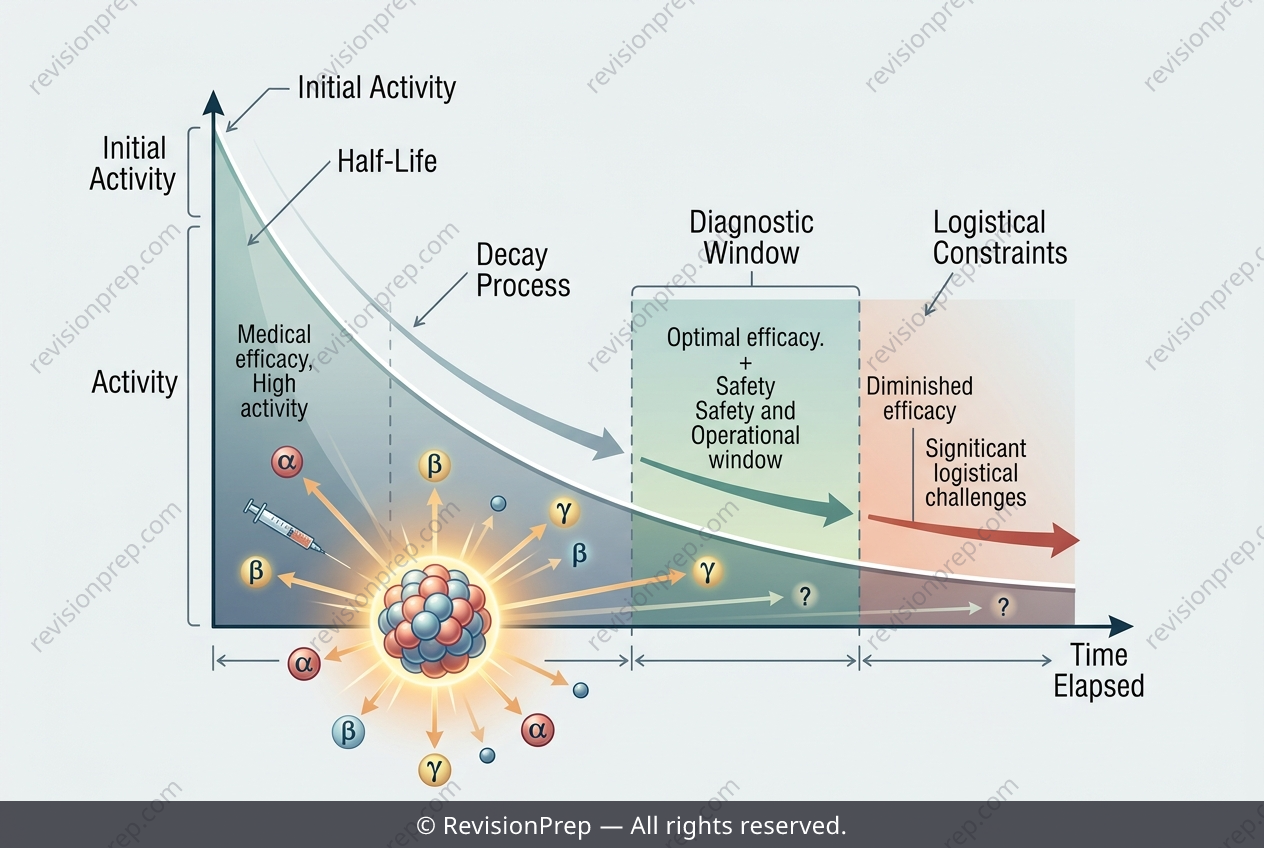
Radioactive decay kinetics governs how unstable isotopes lose activity over time, and it is the invisible engine behind modern medical imaging. At its heart lies the half-life — the time taken for half of a radioactive sample to decay — expressed through the relationship A = A₀ × (1/2)ⁿ, where n is the number of elapsed half-lives. This simple exponential law dictates everything from the brightness of a diagnostic scan to the logistics of hospital supply chains. The concept becomes tangible with technetium-99m, a workhorse isotope in nuclear medicine. With a half-life of 6 hours and a neutron-to-proton ratio of 1.54, it sits in a delicate balance: unstable enough to emit detectable gamma rays, yet short-lived enough to minimise patient radiation exposure. That same brevity, however, creates operational friction. Activity decays continuously during transport, forcing regional facilities to over-produce and hospitals to schedule scans within narrow windows. And while a short half-life reduces internal dose — a clear benefit — it also means that if a scan is delayed, the isotope may fall below diagnostic usefulness. Thus, the half-life is not merely a number; it is a trade-off between image quality, patient safety, and practical feasibility.
Start practising IB questions today
150,000+ IB-styled questions, criteria-mapped and instantly accessible.