
Physics: Half-Life & the Chernobyl Paradox
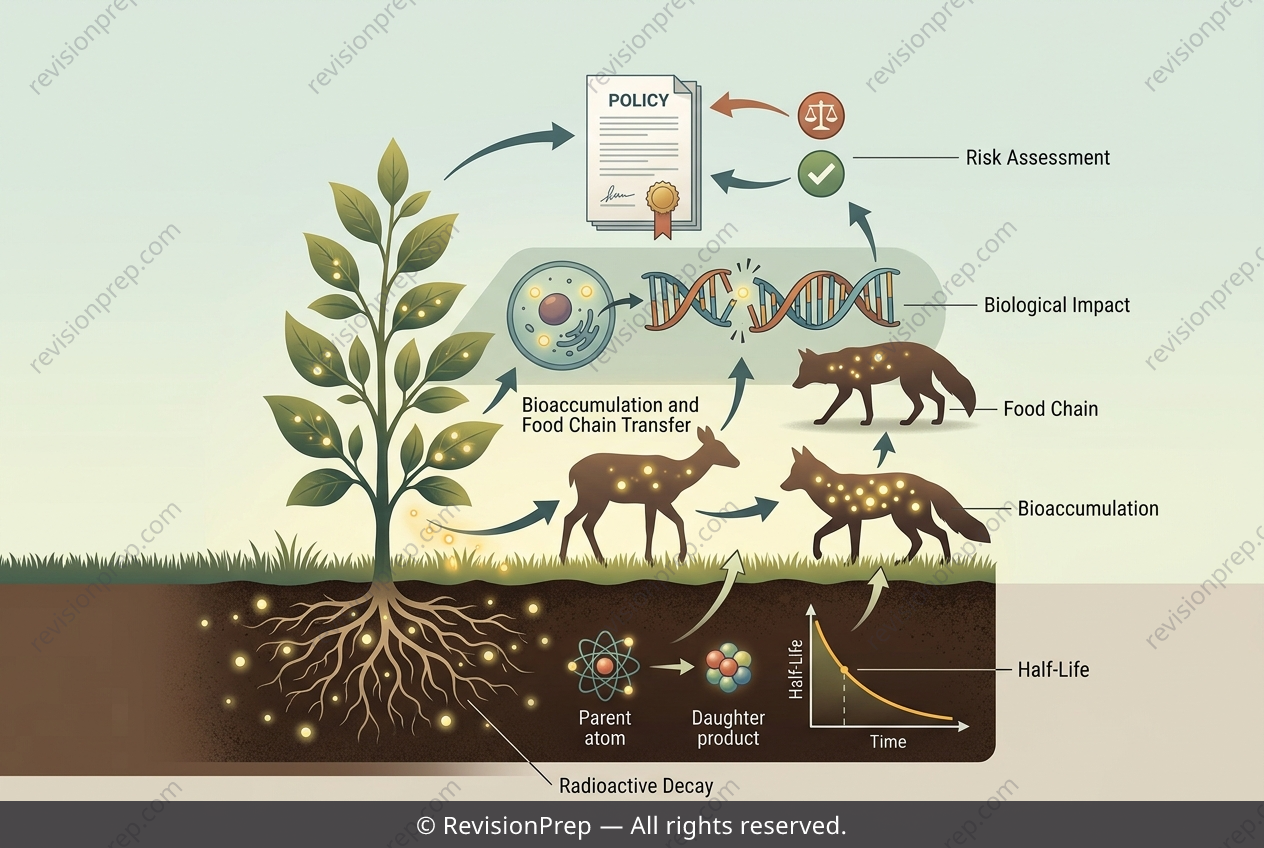
Radioactive contamination is not a static hazard—it is a ticking clock governed by the physics of decay. At the heart of this topic lies the half-life concept: the time taken for half of a radioactive isotope’s nuclei to disintegrate, expressed as fraction remaining = (1/2)^(t / T½). For long-lived fission products like cesium-137 and strontium-90, with half-lives around 30 years, this means that even decades after a disaster, a significant portion of the original activity persists—roughly 40% after 39 years, not the near-zero many assume. This matters because radiation’s biological impact is cumulative and dose-dependent. Chronic exposure, even at low dose rates, damages DNA, elevates mutation rates, and shortens lifespans—effects observed in Chernobyl’s wildlife. Yet the same zone shows thriving wolf and lynx populations, revealing a crucial tension: the absence of human disturbance can outweigh radiation stress at the population level, while individual health still suffers. Understanding this balance—between physical decay, biological risk, and ecological recovery—is essential for any risk assessment of reoccupying contaminated land, where current dose rates of 1–10 mSv/year must be weighed against the 1 mSv/year public safety limit.
Start practising IB questions today
150,000+ IB-styled questions, criteria-mapped and instantly accessible.