
Physics: How Neutron Speed Drives Fission
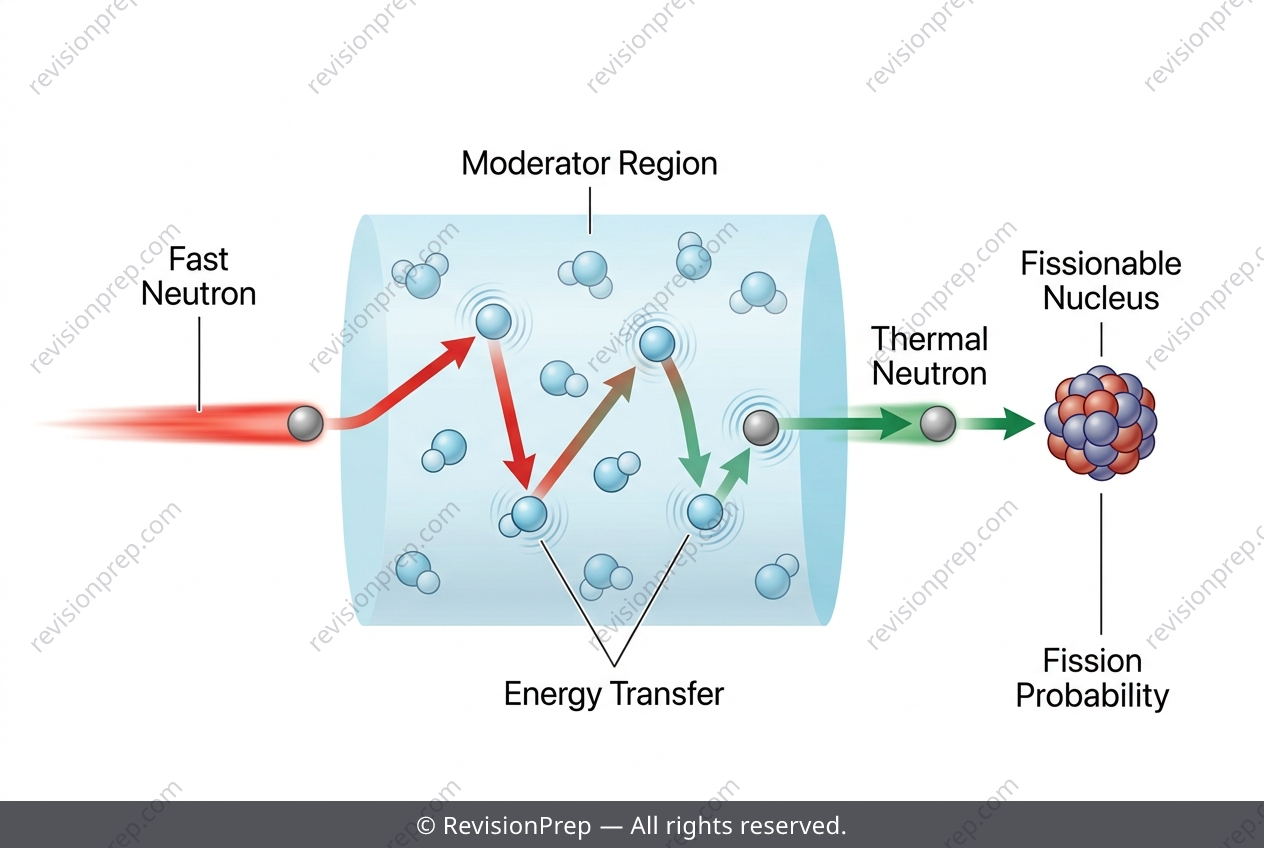
In a nuclear reactor, the chain reaction hinges on a delicate balance of neutron energies. Fission of uranium-235 releases neutrons at extremely high speeds—known as fast neutrons—but these are inefficient at triggering further fissions. The fission cross-section, a measure of probability, is dramatically lower for fast neutrons than for their slower, thermal counterparts. This is where the moderator steps in: a material like light water that absorbs the kinetic energy of fast neutrons, slowing them down to thermal energies where the fission cross-section for U-235 peaks. The physics of this moderation is rooted in kinetic energy. Since kinetic energy is proportional to the square of velocity (E_k = ½mv²), the dramatic drop from mega-electronvolt energies to fractions of an electronvolt translates into a speed reduction of several orders of magnitude. This connection between energy and speed is central to understanding why the moderator is not just helpful, but essential: without it, fast neutrons would escape or be absorbed without causing fission, and the self-sustaining chain reaction would quickly die out.
Start practising IB questions today
150,000+ IB-styled questions, criteria-mapped and instantly accessible.