
Physics: How Stars Evolve from Fusion to Giants
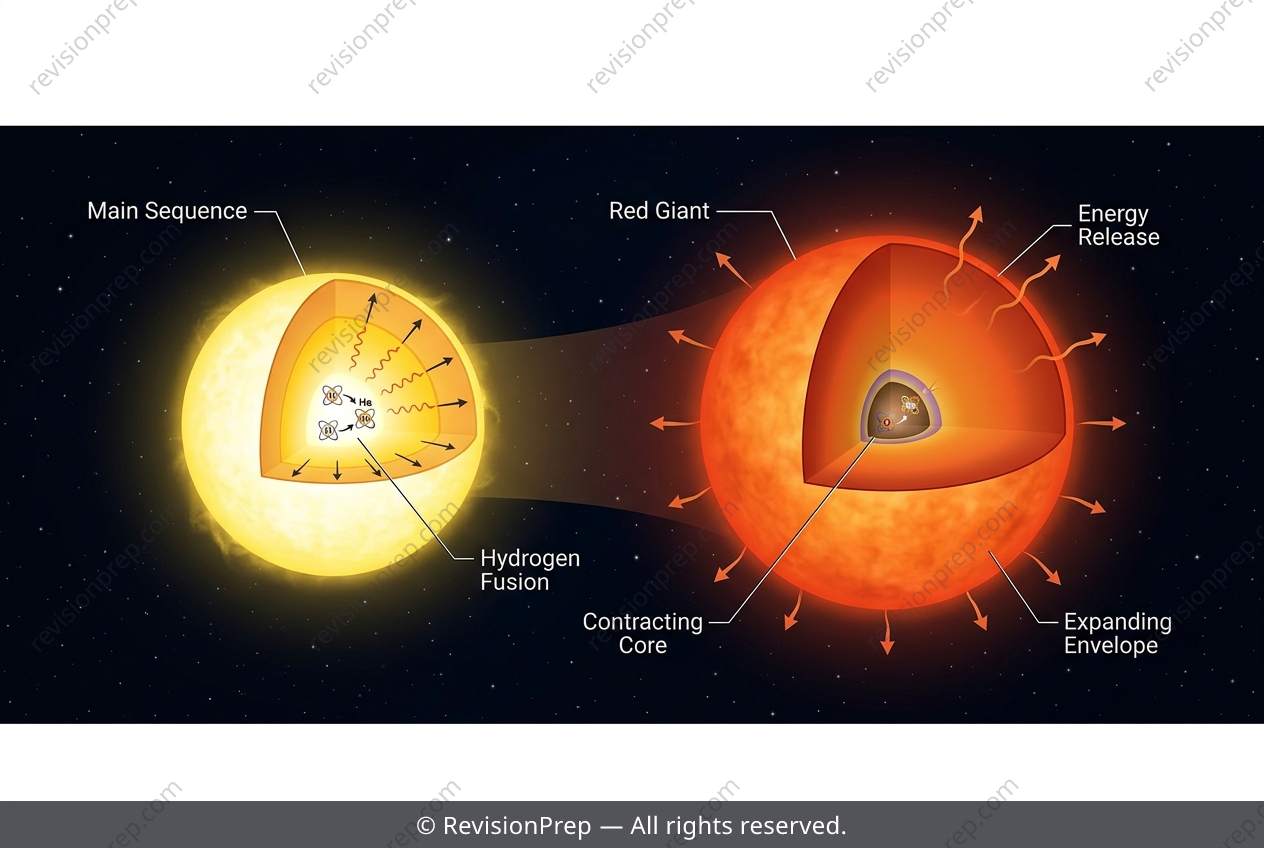
A star’s life is a delicate balance between the inward pull of gravity and the outward push of radiation pressure from nuclear fusion. In this Physics SL topic, we trace how a main sequence star’s internal structure dictates its evolution — from stable hydrogen burning to the dramatic red giant phase. The core concept here is stellar evolution: how mass, luminosity, and fusion efficiency combine to set a star’s lifetime, and how the exhaustion of core fuel triggers a structural shift. The key relationship is simple: total energy available from fusion equals the mass available for fusion multiplied by the energy released per kilogram (E = m·ε). Dividing that energy by the star’s luminosity (L) gives its main sequence lifetime. But the story deepens when core hydrogen runs out. Without fusion, radiation pressure drops, gravity compresses the core, and the released gravitational energy ignites a hydrogen shell around it. This shell burning increases thermal pressure, pushing the outer envelope outward — the star swells into a red giant. Its luminosity then follows the Stefan-Boltzmann law, scaling with radius squared and temperature to the fourth power, explaining why a cooler but vastly larger star can outshine its main sequence self.
Start practising IB questions today
150,000+ IB-styled questions, criteria-mapped and instantly accessible.