
Physics: Inelastic Collisions: Momentum and Energy in IB Physics HL
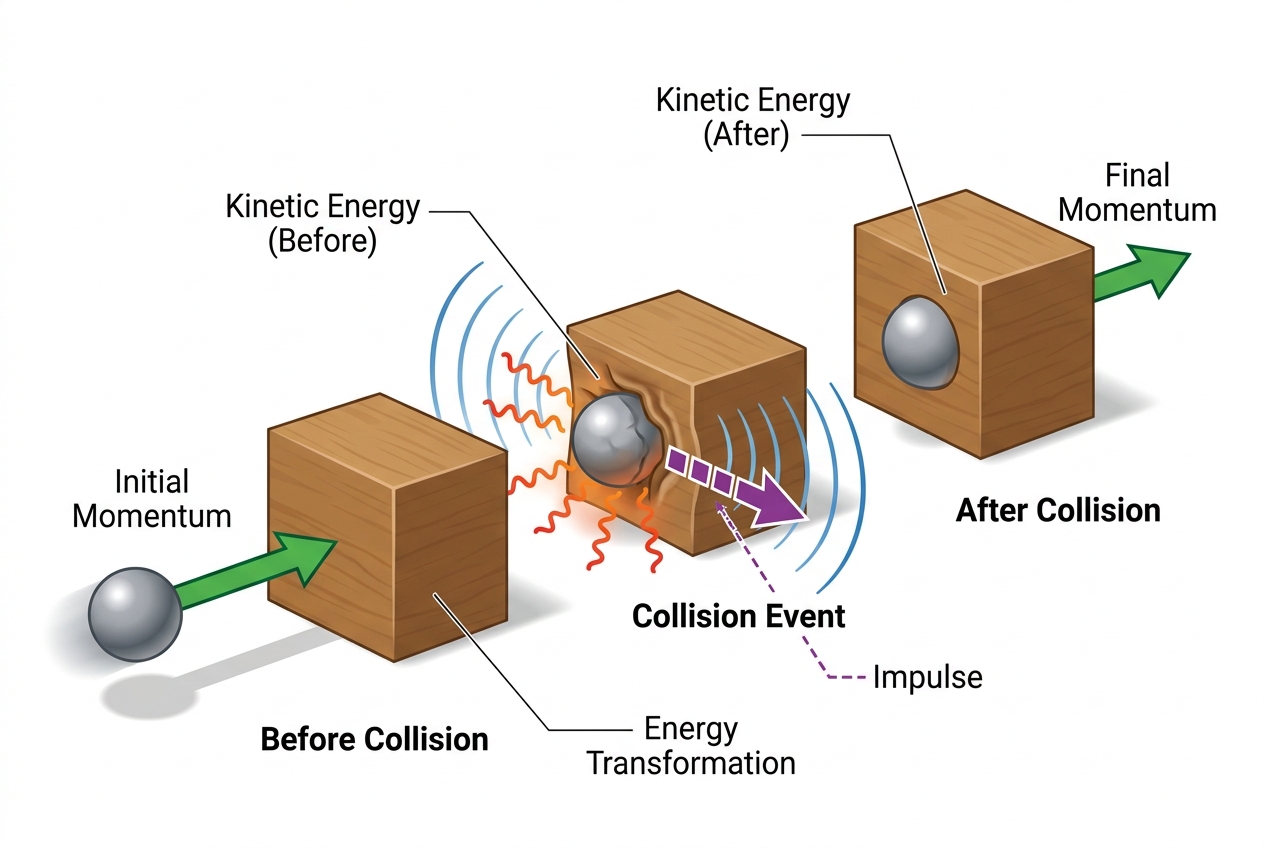
Inelastic collisions are the perfect gateway into the heart of mechanics, because they force you to confront a deceptively simple question: where does the energy go? In this classic setup, a projectile embeds itself in a stationary block, and the two move off together. The core concept here is the conservation of momentum, expressed as mp up = (mp + mb)v, which holds true even when kinetic energy is not conserved. This single equation lets you trace the projectile’s speed before impact, while the impulse imparted to the block—calculated as the block’s mass times its change in velocity—reveals the force-time story of the collision. What makes this topic so powerful is the contrast between momentum and energy. Before the collision, the projectile carries a large amount of kinetic energy (½mv²). After the collision, the combined system moves slower, and its kinetic energy is dramatically smaller. That “lost” energy isn’t destroyed; it transforms into internal energy—heat, sound, and permanent deformation of the block and projectile. This is the essence of a perfectly inelastic collision: momentum is always conserved, but macroscopic kinetic energy is converted into microscopic forms, linking Newton’s laws to the broader principle of energy conservation.
Start practising IB questions today
150,000+ IB-styled questions, criteria-mapped and instantly accessible.