
Physics: Iodine-131’s Journey Beyond the Hospital
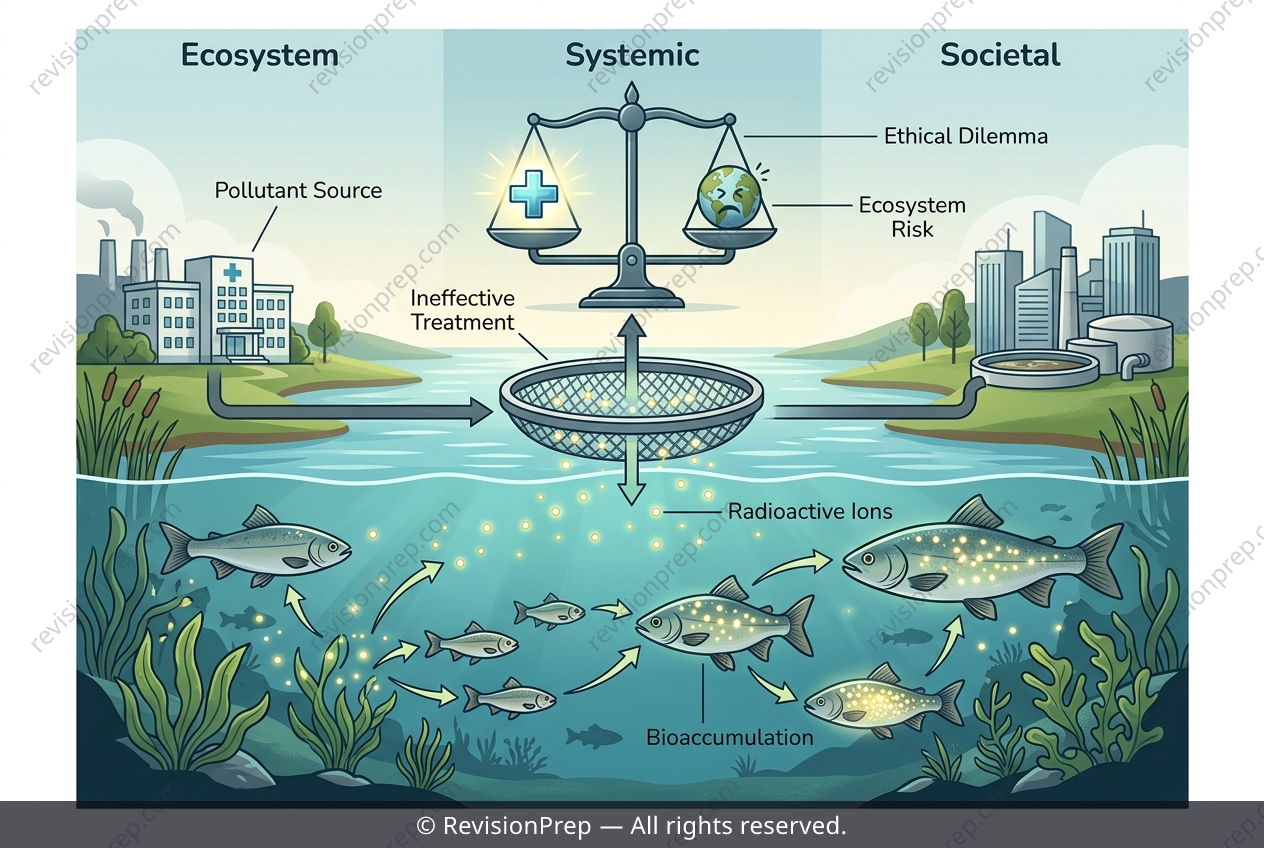
When a hospital treats thyroid cancer with iodine-131, the story doesn’t end at the patient’s recovery—it continues down the drain and into the wider environment. This is the core of anthropogenic radioactive isotope pathways: the journey of a medical radioisotope from a clinical setting into natural water systems, where its decay and biological behaviour dictate its ecological footprint. Iodine-131 has a half-life of 8 days, meaning that after each week-plus, half of its radioactive atoms have decayed. While this relatively short half-life prevents decades-long contamination, it still leaves significant activity lingering for four to six weeks—enough time for the isotope to move through ecosystems. The key mechanism here is bioaccumulation. Iodine is biologically active, so aquatic organisms like algae and filter-feeders absorb it selectively, concentrating the radioactivity as it moves up the food chain. At higher trophic levels, organisms receive progressively larger radiation doses, risking DNA damage and reduced reproductive success. This connects the physics of decay (the exponential halving of activity) to the biology of uptake, showing how a single medical treatment can create a diffuse, non-consented risk for an entire ecosystem. Understanding this pathway matters because it reveals the hidden environmental cost of life-saving procedures—and the ethical tension between individual benefit and collective harm.
Start practising IB questions today
150,000+ IB-styled questions, criteria-mapped and instantly accessible.