
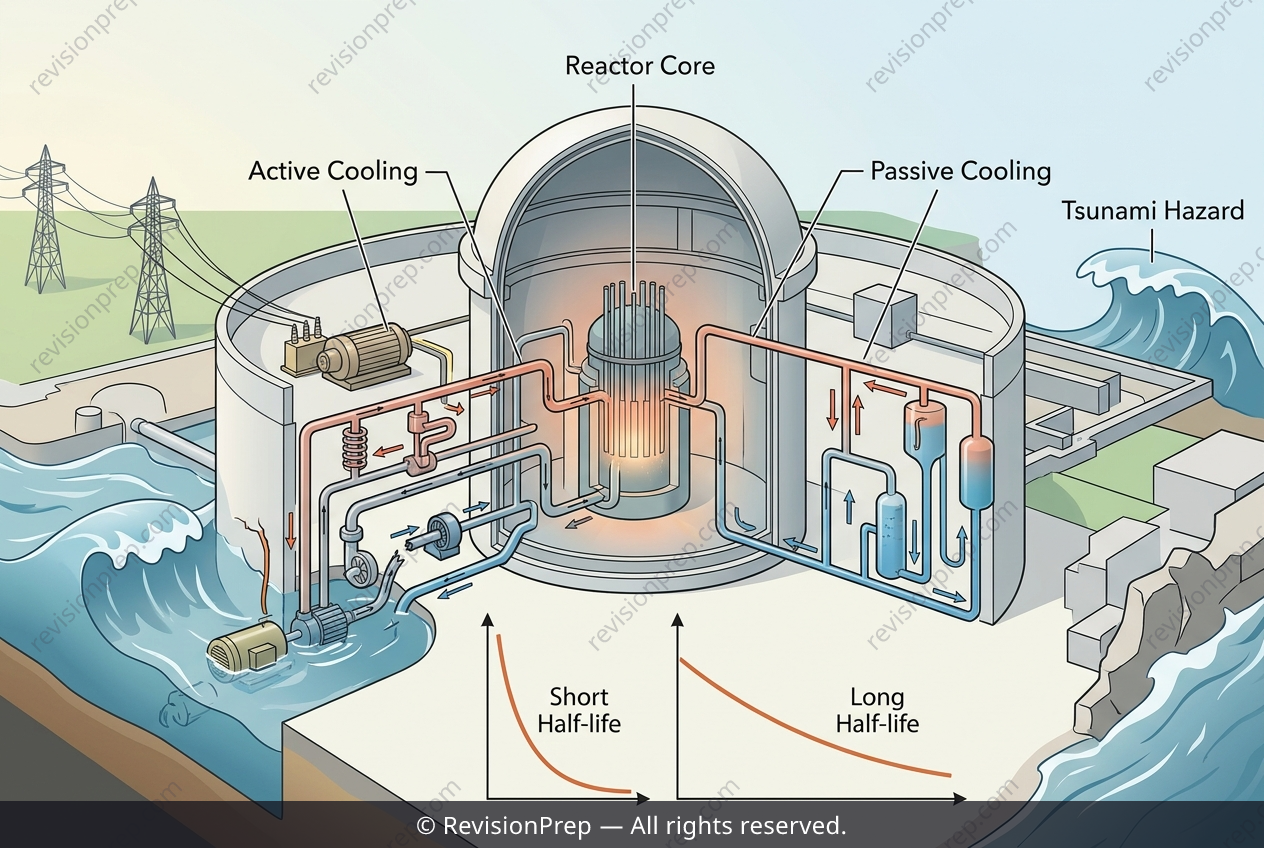
Physics: Iodine vs Caesium — Fukushima's Legacy
When a reactor fails, the immediate danger is obvious—but the true scale of the hazard often unfolds over decades. The Fukushima disaster in 2011 illustrates this starkly: while iodine-131 vanished within weeks due to its 8-day half-life, caesium-137’s 30-year half-life means it takes roughly ten half-lives—about 300 years—for its activity to become negligible. This contrast in decay rates is the core of understanding long-term environmental risk. The faster a nuclide decays, the sooner its radiation ceases; the slower it decays, the longer it persists in soil, water, and food chains, continuously irradiating living organisms. Yet the story of nuclear safety is not just about isotopes—it is about engineered resilience. At Fukushima, the tsunami flooded backup diesel generators, cutting power to cooling pumps and causing core overheating. This reveals a fundamental relationship: safe operation depends on active cooling, which requires reliable electricity. Nuclear power’s advantage—continuous, high-capacity baseload output (80–90%)—also becomes its vulnerability when backup systems fail. Unlike intermittent solar or wind, nuclear offers dense, steady energy, but that density demands layered defence-in-depth: redundant power sources, passive cooling, and containment. Understanding half-life mathematics and system failure modes together explains why some risks are short-lived while others reshape landscapes for generations.
Start practising IB questions today
150,000+ IB-styled questions, criteria-mapped and instantly accessible.