
Physics: Mastering Traveling Waves: Direction, Speed, Wavelength & Frequency
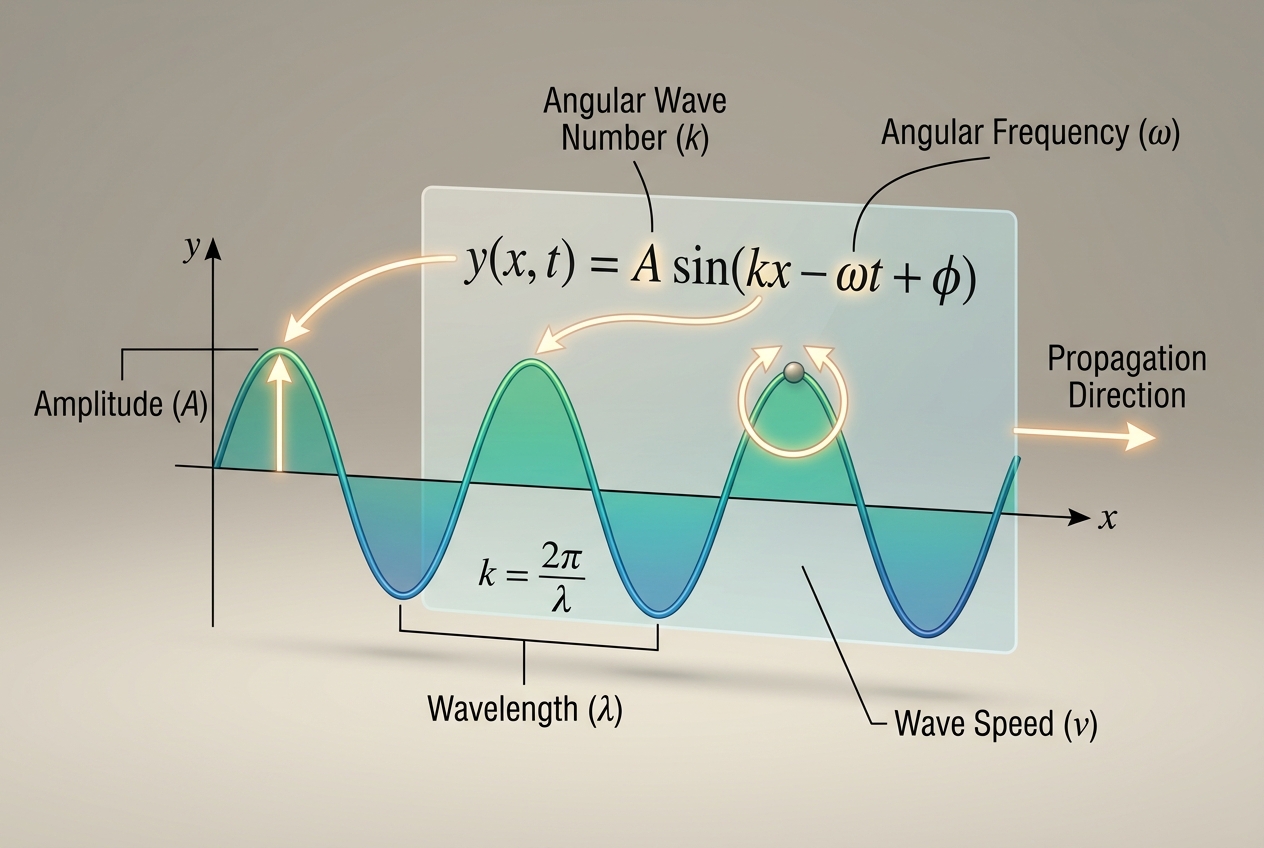
When a wave travels through a medium, its motion can be captured by a single mathematical function that links both space and time. The equation y(x,t) = A sin(kx − ωt) is the standard form for a traveling wave, where the sign between the spatial term (kx) and the temporal term (ωt) reveals the direction of propagation. A negative sign, as seen here, indicates the wave moves in the positive x-direction, while a positive sign would imply the opposite. This representation is powerful because it condenses all key wave properties—speed, wavelength, and frequency—into two fundamental parameters: the wave number k and the angular frequency ω. Understanding how to extract these parameters is essential for interpreting wave behaviour. The wave number k = 2π/λ relates directly to the wavelength λ, while the angular frequency ω = 2πf connects to the ordinary frequency f. The speed of propagation v is then given by the ratio v = ω/k, which is equivalent to the familiar relationship v = fλ. By identifying k and ω from the given equation, you can determine how fast the disturbance travels, how often particles oscillate, and the distance between successive wave crests. Mastering this decoding process turns a symbolic expression into a complete physical picture of the wave’s motion.
Start practising IB questions today
150,000+ IB-styled questions, criteria-mapped and instantly accessible.