
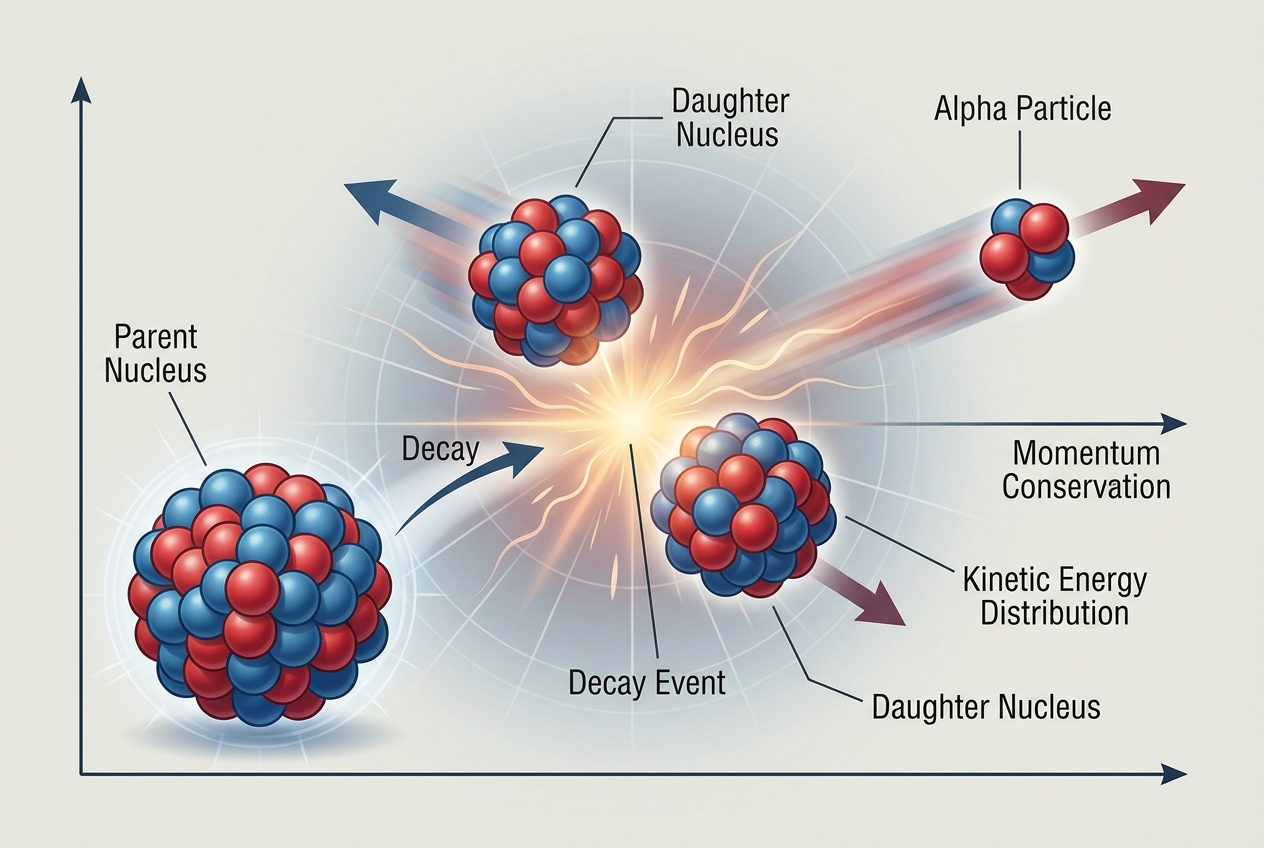
Physics: Momentum and Energy in Nuclear Decay
When a radioactive nucleus at rest decays, the event is a perfect stage for two of physics’ most powerful conservation laws: momentum and energy. In this case, a polonium-210 nucleus spontaneously splits into a much lighter alpha particle and a heavier lead-206 daughter nucleus, and the entire process is governed by the fact that the initial momentum is zero. Because the parent is stationary, the total momentum after the decay must also be zero, meaning the alpha particle and the lead nucleus fly apart with equal and opposite momenta — a relationship expressed as malpha * valpha = md * vd. This single condition, combined with the conservation of total kinetic energy, reveals a beautiful asymmetry: since kinetic energy is given by E_k = p²/(2m), and both particles share the same momentum magnitude, the lighter alpha particle carries away the vast majority of the released energy. The daughter nucleus, being roughly 52 times more massive, recoils with a much smaller speed and a correspondingly tiny share of the kinetic energy. By calculating the alpha’s speed from its known kinetic energy, then using momentum conservation to find the daughter’s speed, you can verify that the sum of both kinetic energies exactly matches the total energy released — a clean, quantitative proof that both laws hold simultaneously in a single nuclear event.
Start practising IB questions today
150,000+ IB-styled questions, criteria-mapped and instantly accessible.