
Physics: Neutron Dynamics and Reactor Criticality
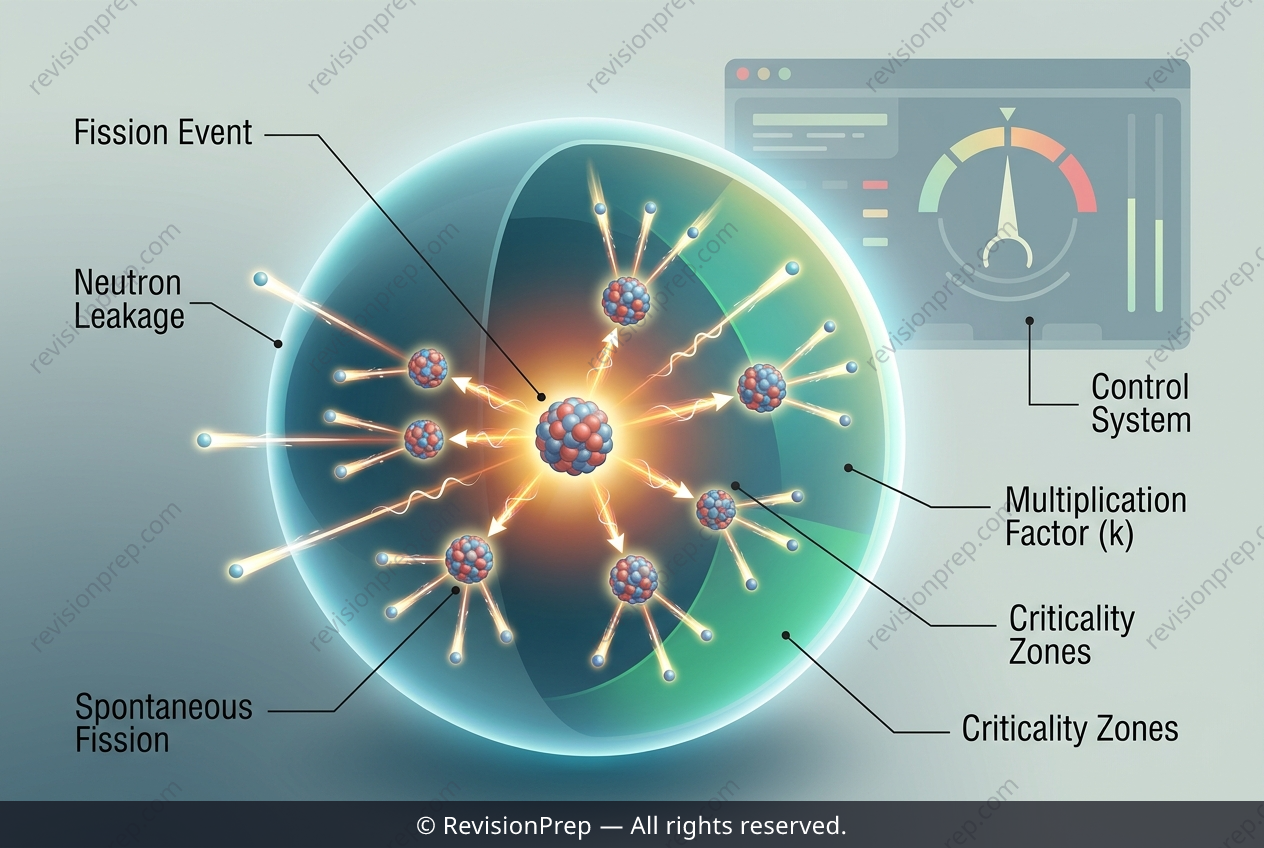
In a nuclear reactor, the balance between neutron production and loss dictates whether a chain reaction sustains, grows, or dies. For a fast-neutron core, this balance hinges on two competing factors: the multiplication of neutrons from fission and the probability that neutrons escape the fuel before causing another split. The key relationship is the effective multiplication factor, k = ν(1 − Pleak), where ν is the neutrons emitted per fission and Pleak is the geometric leakage probability—itself derived from the mean free path of neutrons, λf = 1/(nσf), and the core radius. This concept matters because a reactor must be precisely controlled: if k exceeds 1, the neutron population grows exponentially, and the timescale of that growth is set by the neutron generation time, τ = λ_f/v. In a plutonium core, even tiny impurities like ⁴⁰Pu introduce a continuous source of stray neutrons via spontaneous fission. These stray neutrons can trigger an uncontrolled surge if the core is already near criticality, meaning control systems must act faster than the neutron generation time to prevent a runaway reaction. Understanding this interplay between cross-sections, density, geometry, and neutron lifetime is essential for safe reactor design.
Start practising IB questions today
150,000+ IB-styled questions, criteria-mapped and instantly accessible.