
Physics: Neutron Energy, Moderation & Reactor Control
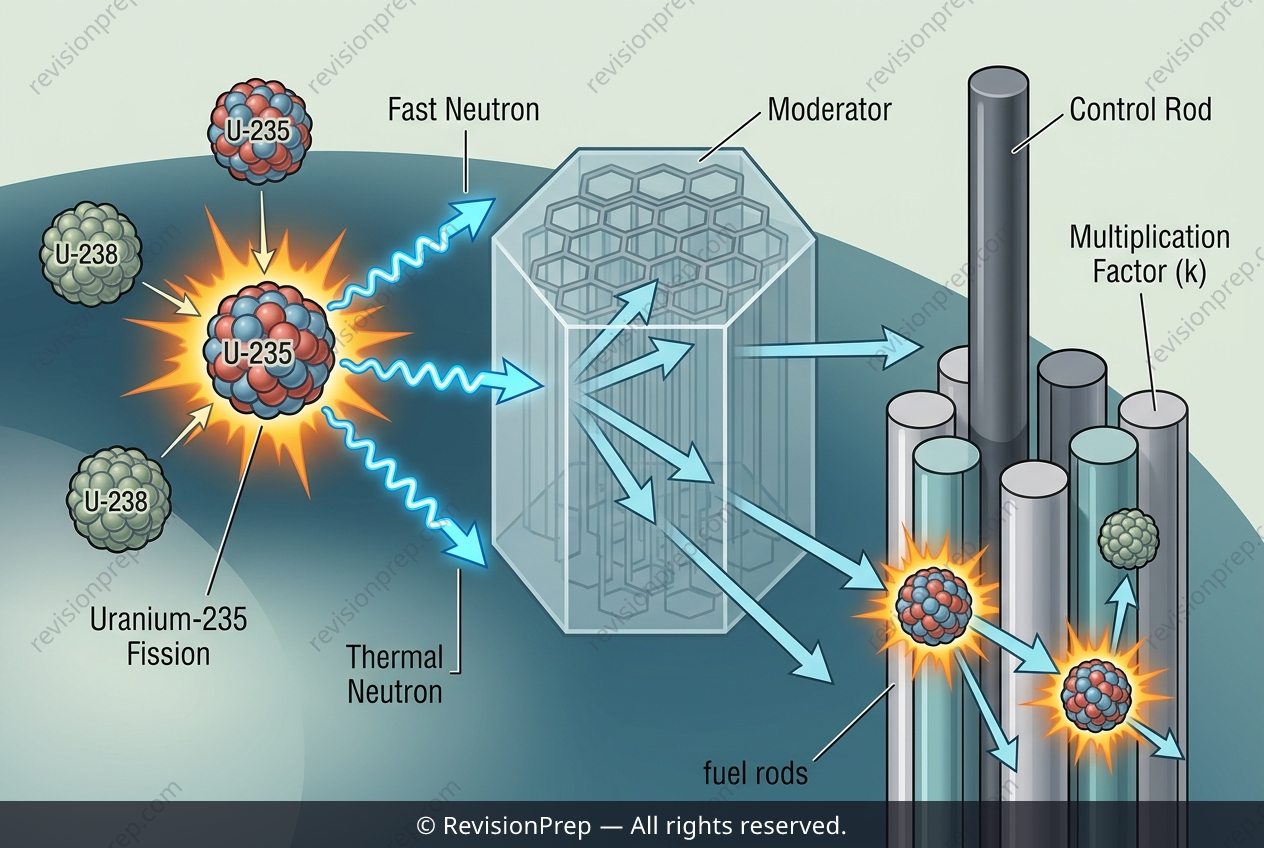
Nuclear chain reactions are the engine of both nuclear power and atomic weapons, but their behaviour hinges on a delicate balance between neutron energy and material composition. In a reactor using natural uranium—which is mostly non-fissile uranium-238 with only a tiny fraction of uranium-235—the key is understanding how neutron speed dictates the likelihood of further fission. Fast neutrons, carrying energy in the mega-electronvolt (MeV) range, are produced directly by fission, while thermal neutrons have been slowed to roughly 0.025 eV, the energy of random thermal motion at room temperature. This energy difference is not trivial: thermal neutrons have a far higher probability of being absorbed by uranium-235 nuclei, making them dramatically more effective at sustaining the chain reaction. The multiplication factor, k, quantifies this sustainability—it is the ratio of neutrons that cause a new fission to the total neutrons produced per fission. Without any moderation, fast neutrons dominate, and the system may fail to sustain itself. Introducing a moderator slows neutrons into the thermal range, boosting the effective fission rate. If k exceeds 1, the reactor is supercritical, meaning the neutron population grows exponentially—a condition that must be controlled. This is where control rods enter the picture: they absorb excess neutrons to bring k back to exactly 1, achieving a stable, critical state for continuous power generation. The entire design of a nuclear reactor, therefore, is a careful orchestration of neutron speed, fuel composition, and absorption to maintain that fragile equilibrium.
Start practising IB questions today
150,000+ IB-styled questions, criteria-mapped and instantly accessible.