
Physics: Positron Annihilation Powers PET Scans
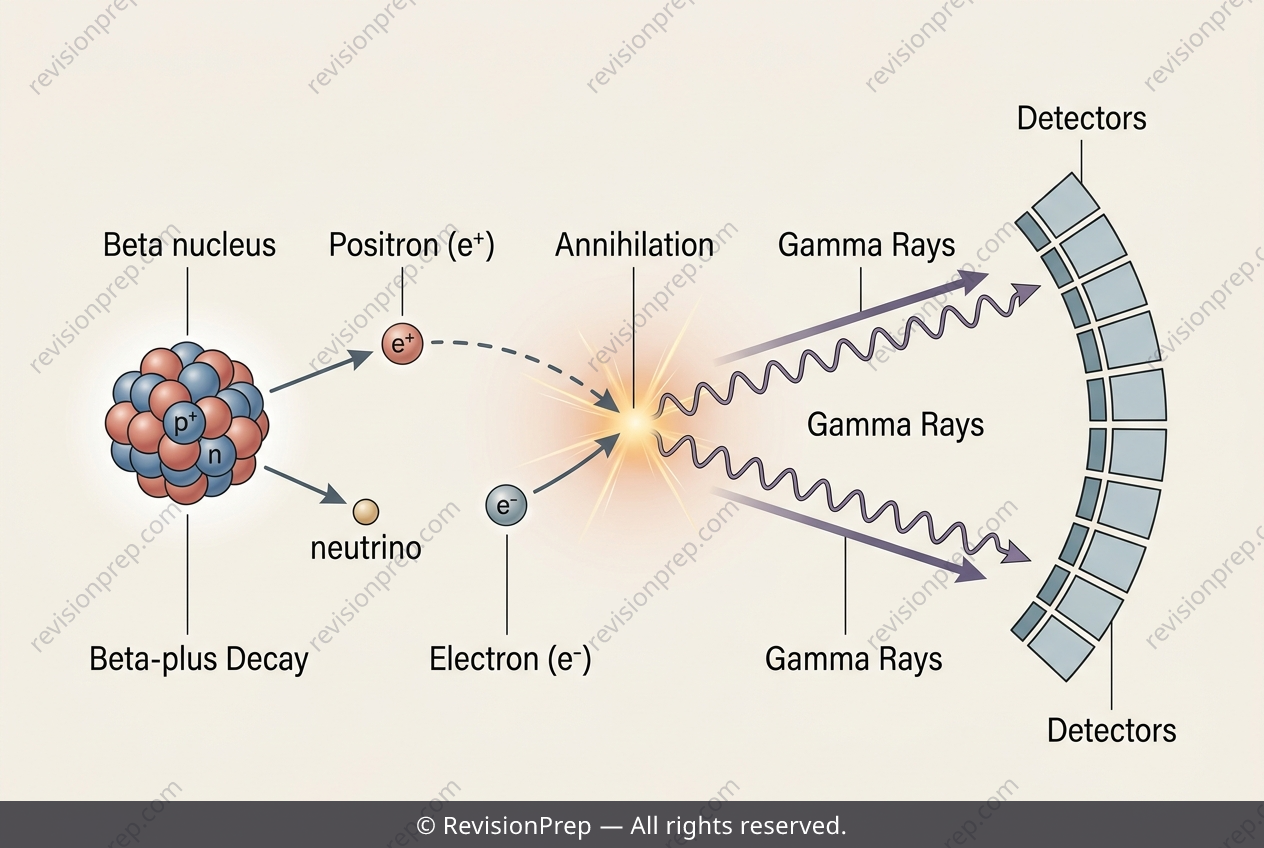
Beta-plus decay is a form of radioactive decay where a proton inside an unstable nucleus transforms into a neutron, releasing a positron (the electron’s antimatter counterpart) and an electron neutrino. This process is the engine behind Positron Emission Tomography (PET), a medical imaging technique that lets doctors observe metabolic activity in living tissue without invasive surgery. The key to PET lies in what happens after the positron is emitted. Because it is antimatter, the positron travels only a few millimetres before colliding with an ordinary electron in the surrounding tissue. This encounter triggers matter–antimatter annihilation, where the entire mass of both particles is converted into pure energy according to E = mc². The result is two gamma-ray photons that fly off in exactly opposite directions, 180° apart. A PET scanner detects these back-to-back gamma rays simultaneously, and by tracing their line of travel, it pinpoints the exact location of the decay event inside the body. This elegant chain—proton conversion, positron emission, annihilation, and paired photon detection—turns a subatomic event into a precise, three-dimensional medical image.
Start practising IB questions today
150,000+ IB-styled questions, criteria-mapped and instantly accessible.