
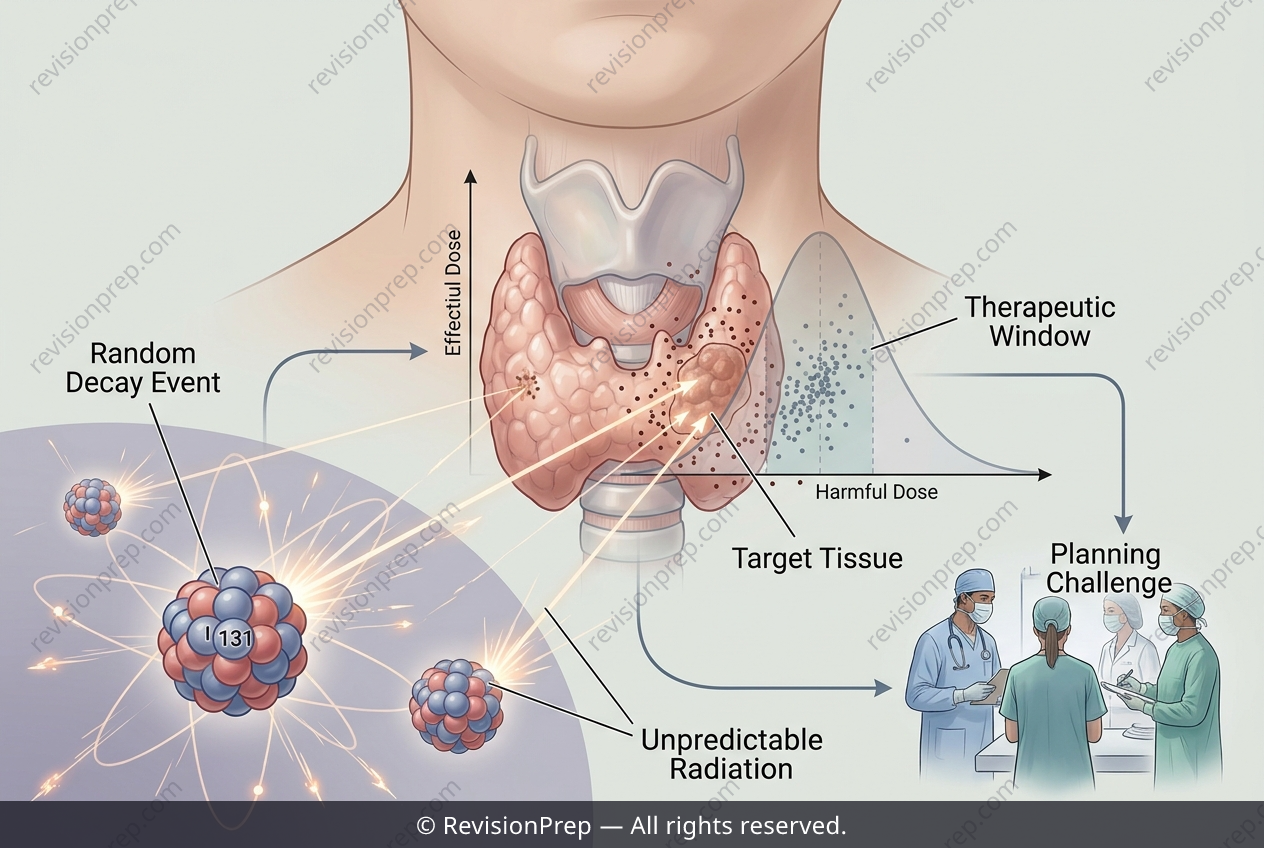
Physics: Random Nuclei, Predictable Decay
Radioactive decay is a process governed by probability, not precision. For any individual nucleus of iodine-131 (¹³¹I), the moment of decay is entirely unpredictable—it is spontaneous and random, meaning no physical signal can tell us when a specific atom will emit its beta or gamma radiation. This fundamental uncertainty lies at the heart of nuclear physics, and it directly shapes how we use radioactive isotopes in medicine. The key relationship here is the half-life (T₁/₂), which for ¹³¹I is about 8 days. The half-life tells us the time for half of a large sample to decay, but it says nothing about any single nucleus. In a thyroid cancer treatment, millions of atoms decay continuously, so clinicians can only rely on statistical averages—the overall activity (A = λN, where λ is the decay constant and N is the number of nuclei) decreases predictably, yet each individual emission event remains a surprise. This unpredictability matters enormously in practice: because radiation cannot be “switched off” or scheduled, patients must be isolated after treatment to protect others from random exposure. Hospitals must enforce monitoring and safety protocols, and patients face temporary separation from family and work—a societal cost born directly from the inherent randomness of the nucleus.
Start practising IB questions today
150,000+ IB-styled questions, criteria-mapped and instantly accessible.