
Physics: Series vs Parallel Circuits: Bulb Failure and Home Wiring
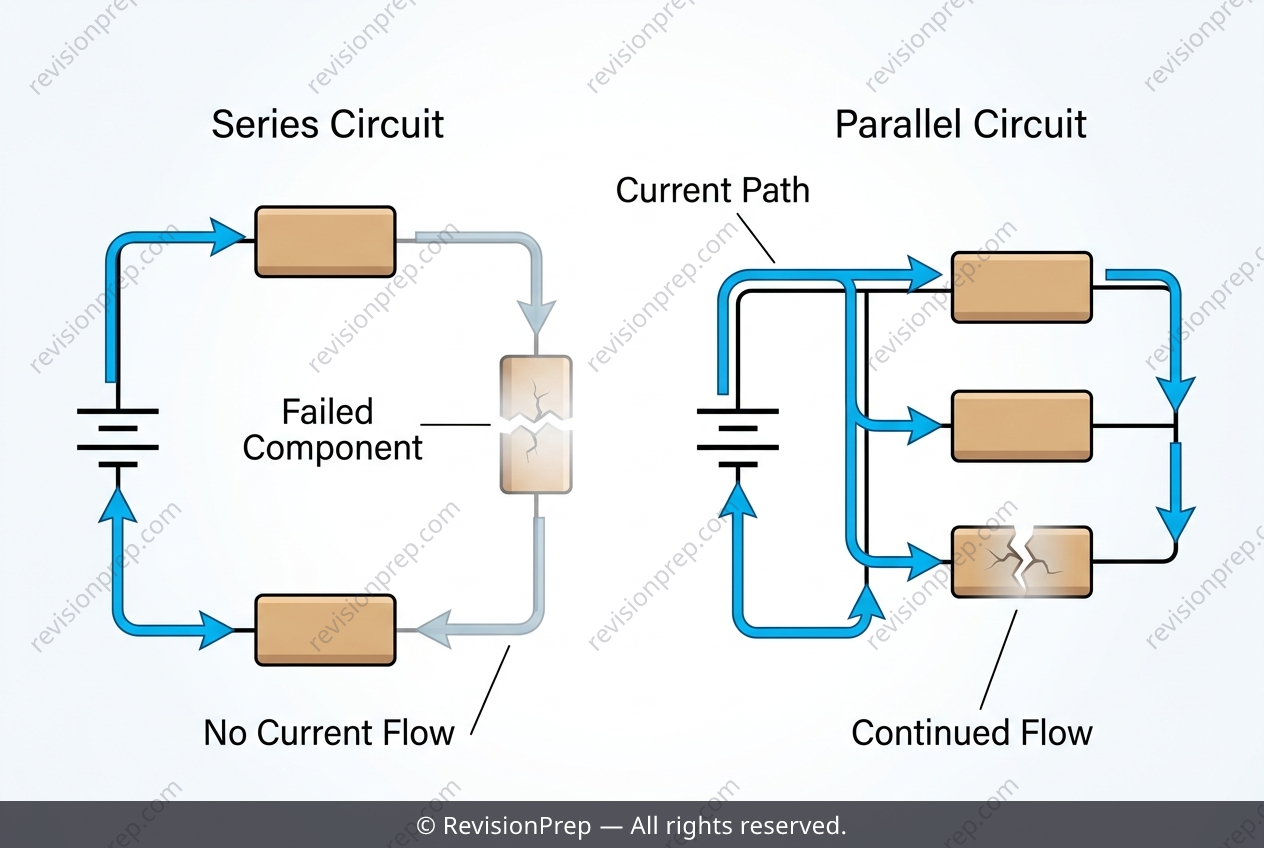
When a string of decorative lights is wired in series, every bulb shares the same single path for electric current. This means the current that flows through one bulb must flow through all of them, and the total resistance of the circuit is simply the sum of each bulb’s resistance (Rtotal = R₁ + R₂ + R₃ + …). The same current passes through every component, while the supply voltage is divided across them according to their individual resistances (Vtotal = V₁ + V₂ + V₃ + …). This arrangement is simple but fragile: if one filament burns out, it breaks the conducting path, creating an open circuit. With no complete loop, current drops to zero everywhere, and every remaining bulb goes dark instantly. In contrast, a parallel circuit gives each bulb its own independent branch connected directly to the power supply. Here, the voltage across each branch equals the supply voltage, while the total current is the sum of the branch currents (I_total = I₁ + I₂ + I₃ + …). Because each branch is separate, a failure in one does not interrupt current flow in the others, keeping the rest of the system lit. This fundamental difference—shared path versus independent paths—explains why parallel wiring is preferred for home lighting, where reliability matters far more than simplicity.
Start practising IB questions today
150,000+ IB-styled questions, criteria-mapped and instantly accessible.