
Physics: Stellar Evolution: The Fusion Clock
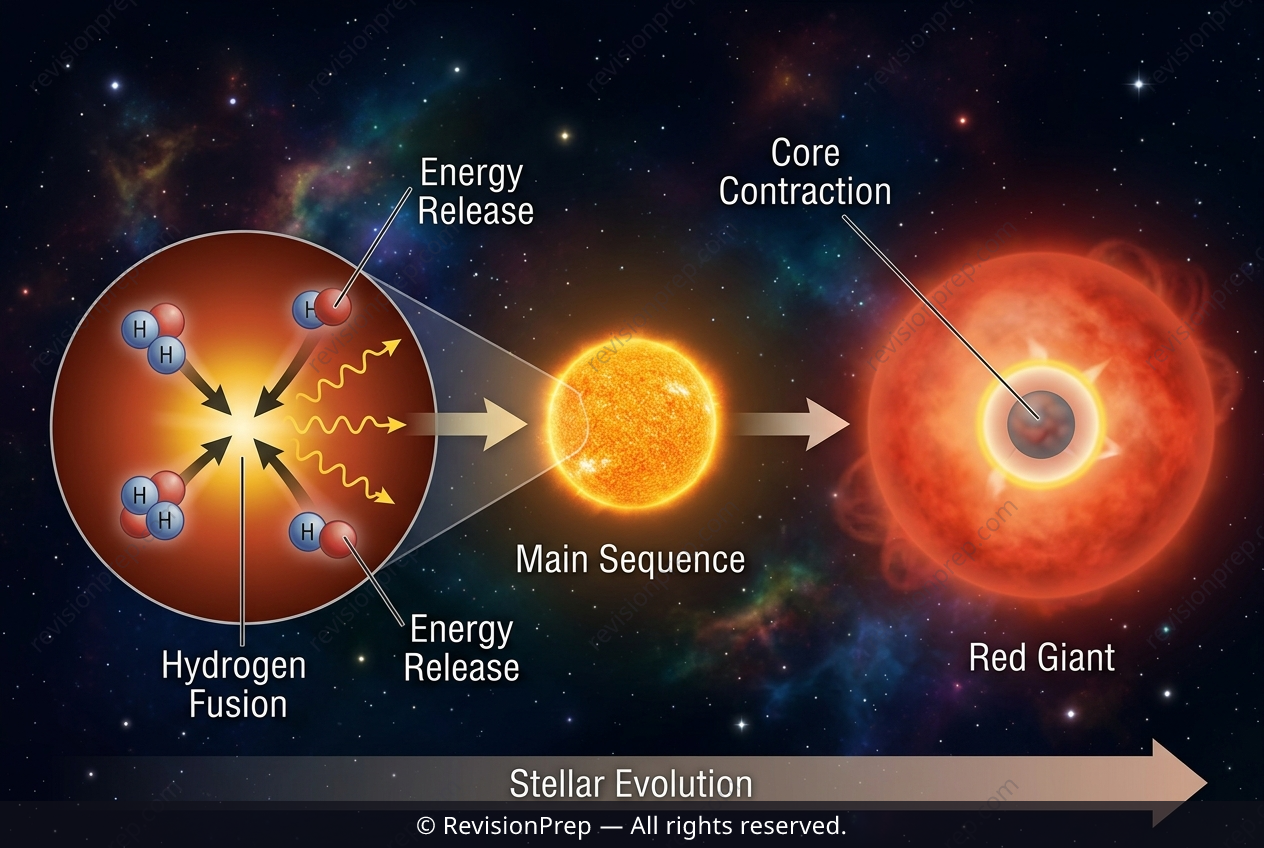
Stars are not static; they are arenas where gravity and nuclear energy battle for billions of years. In this post, we explore stellar evolution and the nuclear fusion lifespan of a main-sequence star like Procyon A, using its mass and luminosity to trace how long it can sustain itself. The core idea is simple yet profound: a star’s lifetime is set by the fuel it can fuse and the rate at which it burns that fuel. At the heart of this is Einstein’s E = mc². In each fusion event, four protons combine into one helium-4 nucleus, but the product is slightly lighter than the sum of its parts. That tiny mass defect—about 4.0 × 10⁻²⁹ kg per event—is converted into a burst of energy. Over a star’s life, only about 10% of its mass is available for fusion, so the total energy reservoir equals the number of fusion events times the energy per event. That total energy, divided by the star’s luminosity (its power output), gives its main-sequence lifetime. When hydrogen runs out, the balance between outward radiation pressure and inward gravity collapses, triggering core contraction and the expansion into a red giant—the next dramatic chapter in stellar evolution.
Start practising IB questions today
150,000+ IB-styled questions, criteria-mapped and instantly accessible.