
Physics: Stellar Nucleosynthesis & Fusion Lifetimes
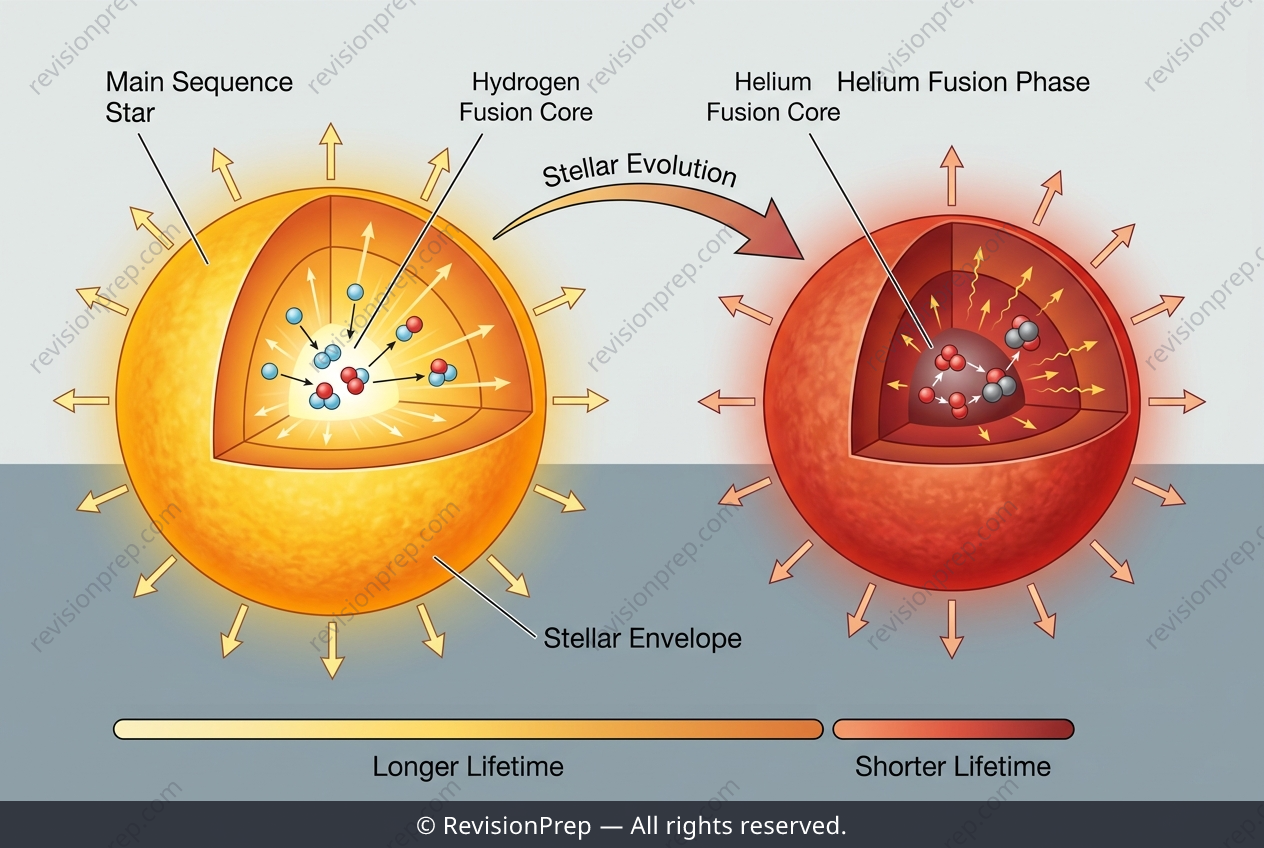
A star’s life is a balancing act between gravity pulling inward and the outward pressure of fusion energy. In nuclear and quantum physics, stellar nucleosynthesis explains how stars forge heavier elements, and the duration of each fusion phase is set by a simple competition: how much fuel is available versus how fast the star burns it. For a star like the one in this question, only the core—about 12% of its total mass—actually undergoes fusion, so the main-sequence time depends directly on that core mass divided by the hydrogen consumption rate. Once hydrogen runs out, the core contracts, heats up, and helium fusion begins, but the timescale shifts dramatically because the energy released per kilogram of helium is roughly ten times smaller than for hydrogen, while the star’s luminosity (power output) jumps far higher. That means the helium phase burns through its fuel much faster, even though the available mass is the same. The ratio of these two lifetimes—hydrogen to helium—emerges from combining the fuel mass, the fusion rate, the energy yield per kilogram, and the luminosity, showing how a star’s most dramatic changes are often the shortest-lived.
Start practising IB questions today
150,000+ IB-styled questions, criteria-mapped and instantly accessible.