
Physics: Stirling Engine Cycles: Mastering the First Law of Thermodynamics
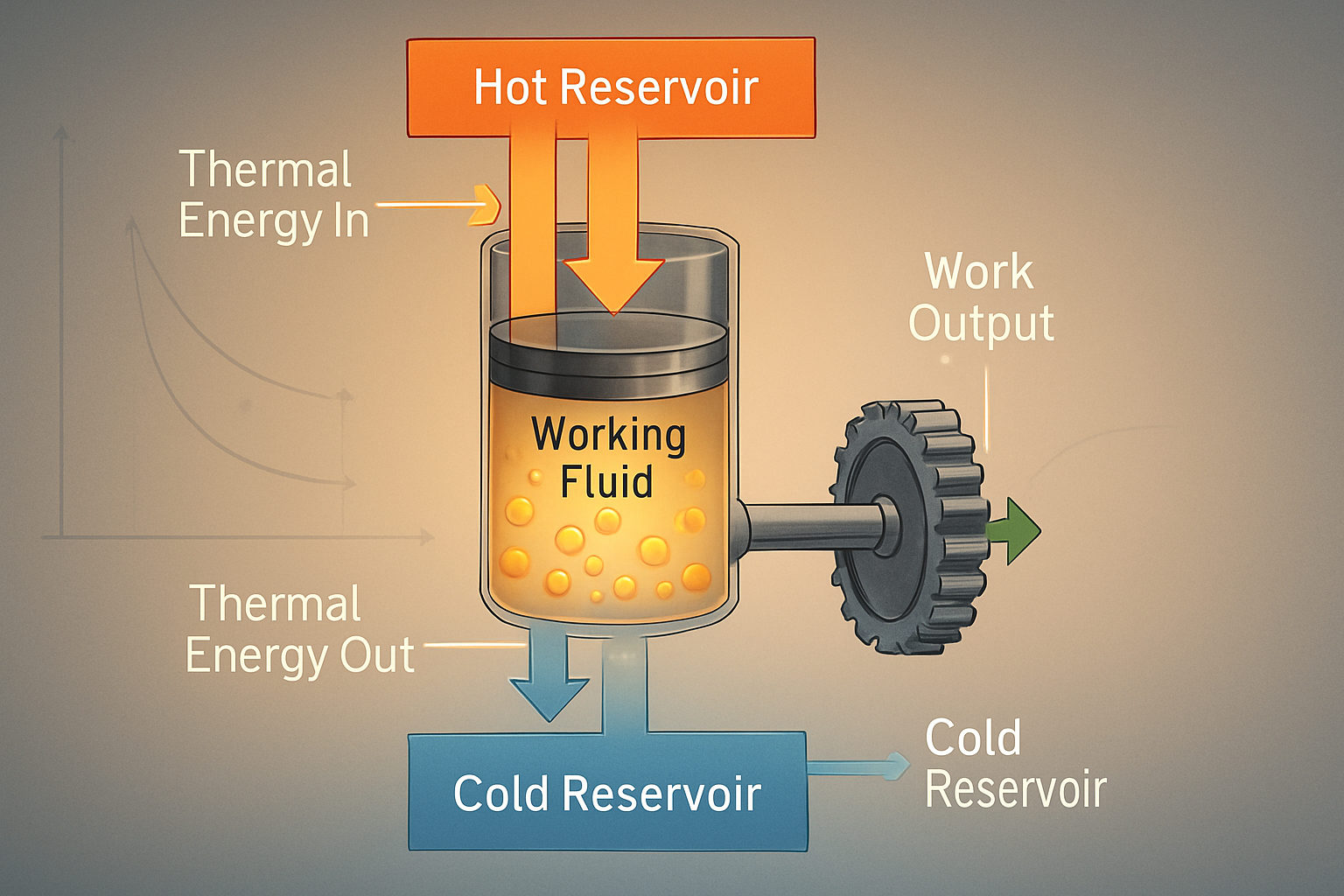
The First Law of Thermodynamics is the engine behind every heat engine: energy cannot be created or destroyed, only transferred as heat (Q) or work (W), with any change stored as internal energy (ΔU = Q – W). In the context of an ideal gas undergoing a Stirling cycle, this law governs how thermal energy is converted into mechanical output. The cycle cleverly pairs isothermal processes—where temperature stays constant, so ΔU = 0 and all absorbed heat becomes work—with constant-volume processes, where no work is done (W = 0) and any heat transfer directly changes internal energy. Understanding these relationships is crucial for analysing real-world systems like solar power demonstrations. For instance, during an isothermal expansion at 500 K, the gas absorbs 400 J of heat and does 400 J of work, confirming ΔU = 0. Later, constant-volume cooling loses 200 J of heat, meaning ΔU = –200 J. The cycle’s efficiency (η = 0.25) then links the net work output to the heat input, allowing you to calculate the heat rejected to the surroundings. By tracing how Q and W flow through each step, the First Law reveals the complete energy budget of the engine.
Start practising IB questions today
150,000+ IB-styled questions, criteria-mapped and instantly accessible.