
Physics: The Balance Behind Nuclear Stability
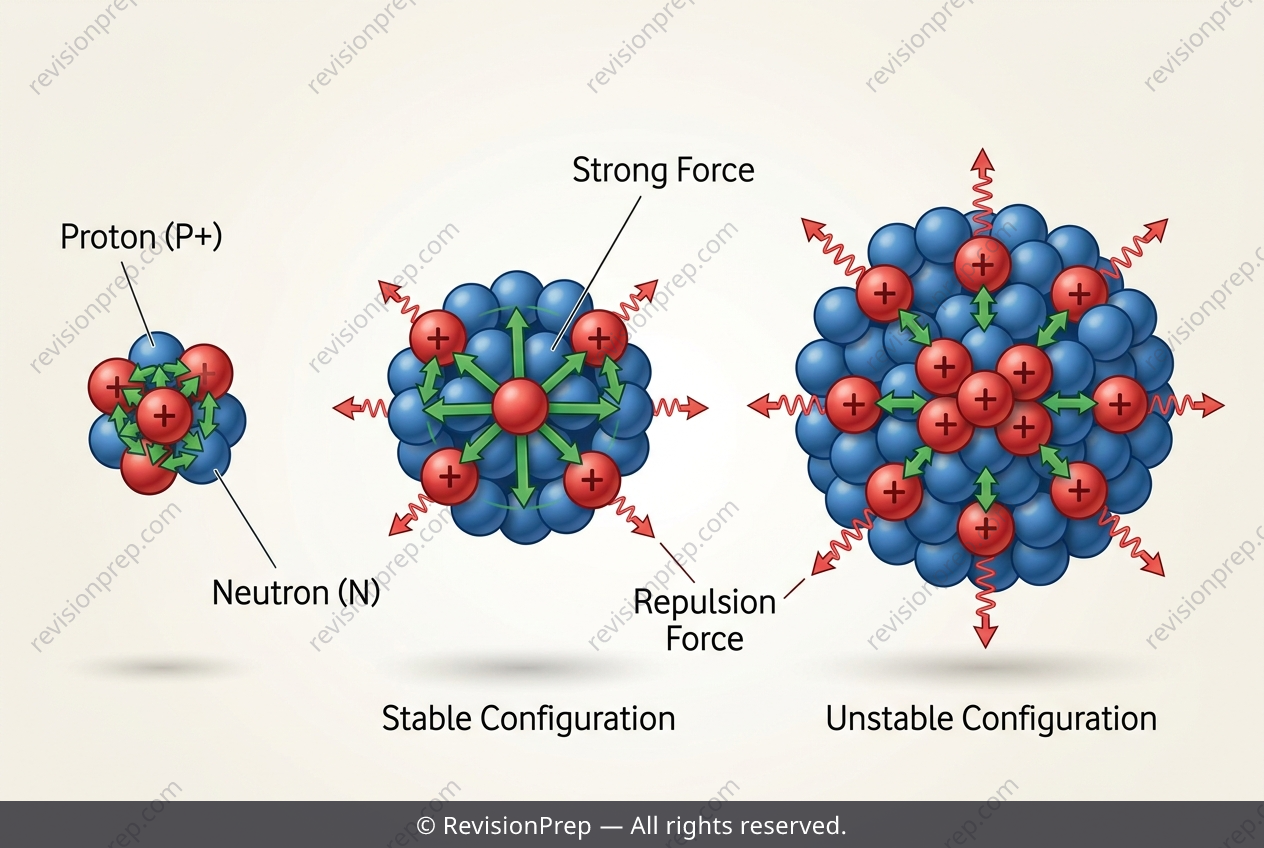
The valley of stability is the narrow band of neutron-to-proton ratios (N/Z) where atomic nuclei resist flying apart—and for elements from hydrogen to calcium, that band tells a clear story. For light nuclei (Z ≤ 10), stable isotopes hug the N = Z line, meaning roughly equal numbers of protons and neutrons. This balance arises because the electrostatic (Coulomb) repulsion between so few protons is weak, so the strong nuclear force alone can hold the nucleus together without needing extra neutrons. As Z climbs toward 20, however, the picture shifts. Proton repulsion grows sharply—scaling with Z²—while neutrons add only attractive strong-force binding, no extra electrical push. To counteract that growing instability, stable nuclei must pack in progressively more neutrons, pushing N/Z above 1 and curving the stability band upward from the dashed N = Z reference. This interplay between the short-range strong force and the long-range Coulomb force is the core mechanism behind nuclear stability, explaining why calcium’s stable isotopes sit at roughly N/Z ≈ 1.4 while carbon’s sit near 1.0.
Start practising IB questions today
150,000+ IB-styled questions, criteria-mapped and instantly accessible.