
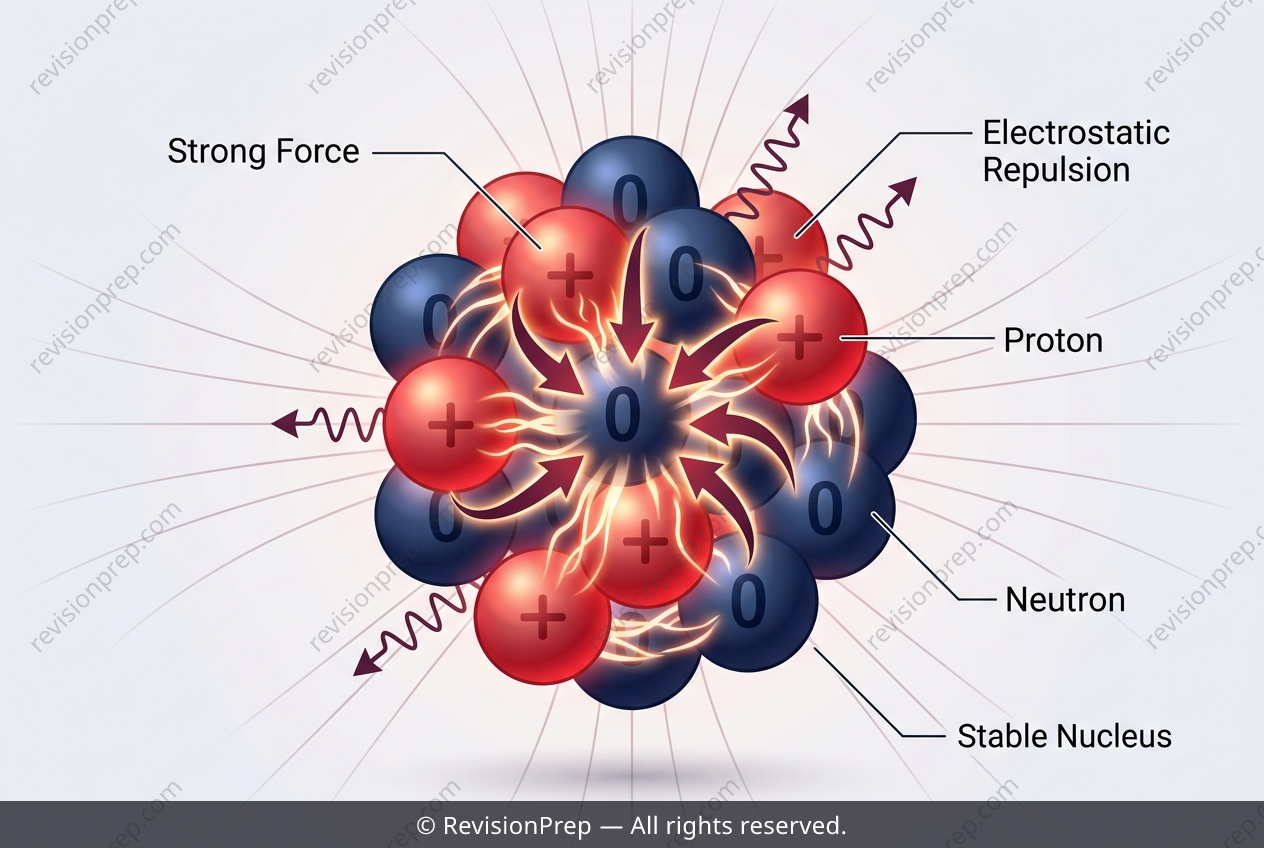
Physics: The Battle of Forces Inside the Nucleus
Deep inside every atom, a delicate tug-of-war determines whether a nucleus will hold together or fly apart. At the heart of this balance lies the strong nuclear force, the fundamental interaction that binds protons and neutrons into a stable whole. Without it, matter as we know it could not exist—the positive charges packed into a nucleus would violently repel one another, and every element heavier than hydrogen would instantly disintegrate. The key to understanding nuclear stability is recognizing the opposing forces at play. Protons, carrying identical positive charges, experience electrostatic repulsion that pushes them apart. Yet the strong nuclear force, acting attractively between all nucleons at extremely short ranges, overwhelms this repulsion. It operates only when particles are nearly touching, which is why it can hold a tiny helium-4 nucleus together while leaving distant atoms unaffected. This interplay—repulsion fighting attraction—explains why some isotopes are stable and others decay, and why heavier nuclei require a careful balance of neutrons to survive. The same principle governs everything from the carbon in our bodies to the uranium in nuclear reactors.
Start practising IB questions today
150,000+ IB-styled questions, criteria-mapped and instantly accessible.