
Physics: The Isotope Fingerprint
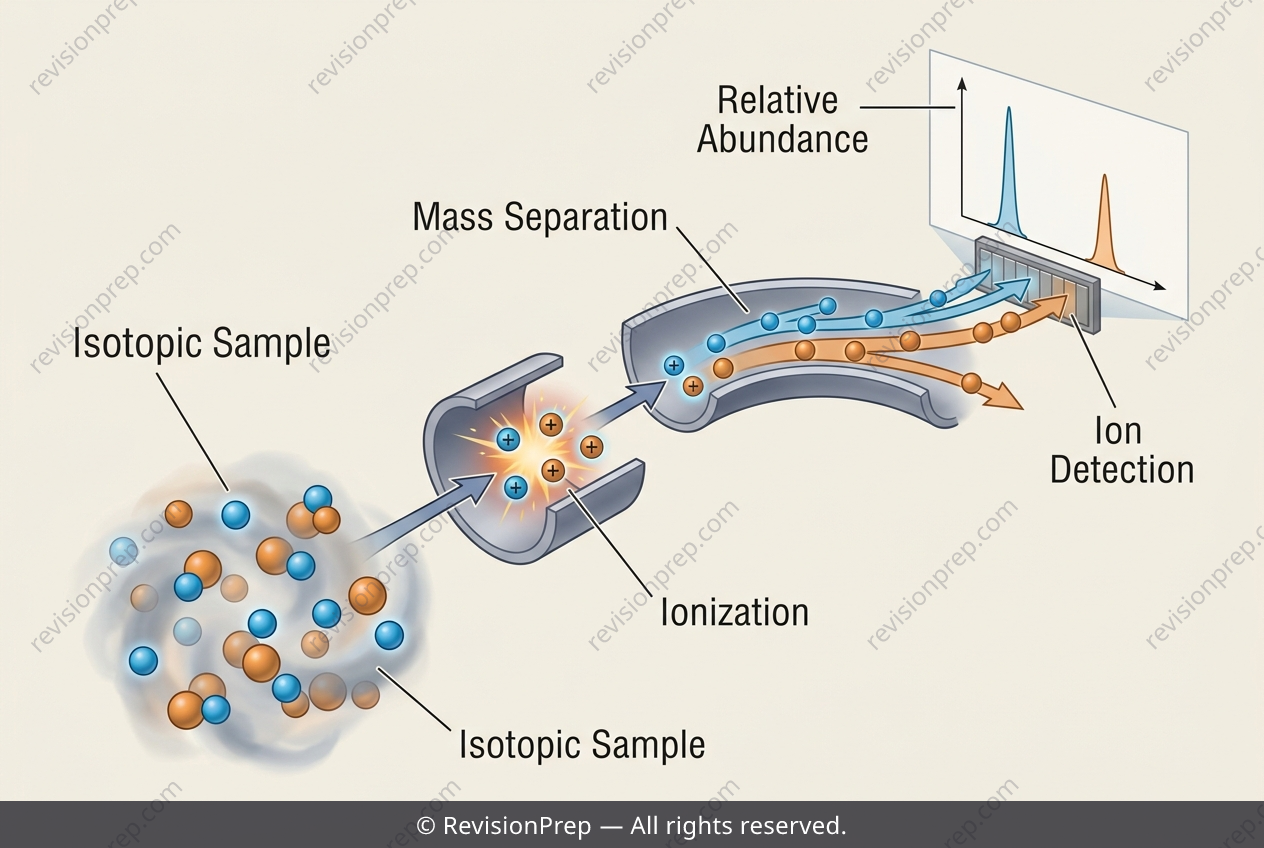
Isotopic analysis sits at the heart of how we identify the elemental fingerprint of a material, and mass spectrometry is the tool that makes it visible. In this topic, you’ll learn how a simple weighted-average equation—relative atomic mass = (mass of isotope 1 × abundance 1) + (mass of isotope 2 × abundance 2)—unlocks the hidden proportions of isotopes like gallium-69 and gallium-71. Because these isotopes differ only in neutron number, their masses differ slightly, yet that tiny difference is enough to separate them in a spectrometer and calculate their percentage abundances with precision. Why does this matter? Because isotopic ratios aren’t just abstract numbers—they reveal geological origins, fuel authenticity, and even medical tracer behaviour. The key relationship to grasp is that isotopes of the same element share identical proton and electron counts, so their chemistry is indistinguishable; only their mass (and thus density) changes. This dual nature—same reactivity, different mass—is exactly what mass spectrometry exploits, though it’s not a perfect tool for every sample. Understanding this balance between precision and limitation is central to mastering nuclear and quantum physics at SL.
Start practising IB questions today
150,000+ IB-styled questions, criteria-mapped and instantly accessible.