
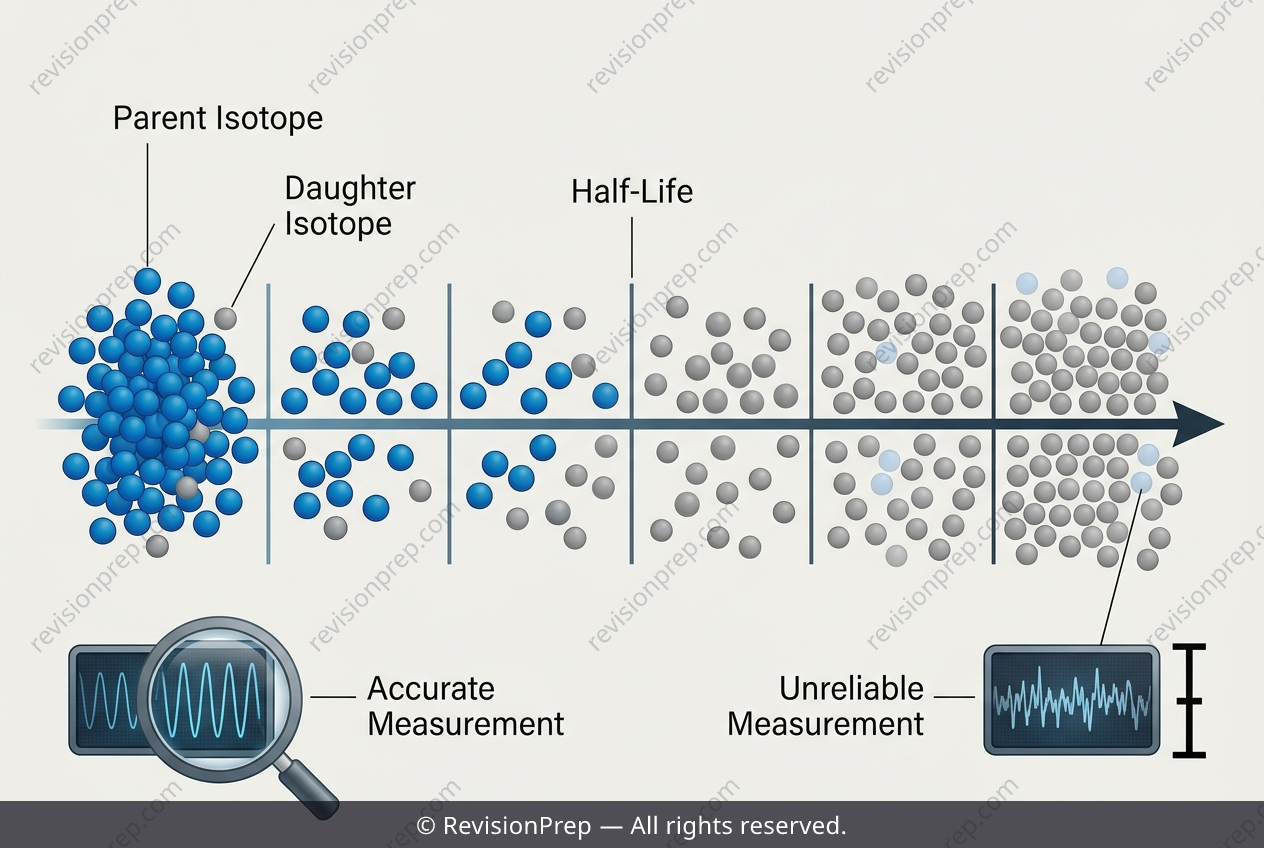
Physics: The Limits of the Carbon-14 Clock
Carbon-14 dating is one of the most famous applications of nuclear physics, yet its power comes with strict limits. At its heart, the method relies on the radioactive decay of the isotope carbon-14 (¹⁴C), which is continuously formed in the atmosphere and absorbed by living organisms. Once an organism dies, it stops exchanging carbon with its environment, and the trapped ¹⁴C begins to decay at a known rate—its half-life of 5730 years. By measuring the remaining activity, scientists can estimate how long ago the organism died. However, the accuracy of this technique hinges on several fragile assumptions. The atmospheric concentration of ¹⁴C must have remained constant over time, and the sample must have been completely sealed off from any external carbon after death—no contamination, no further uptake. Moreover, the mathematics of decay reveals a practical ceiling: after roughly eight to nine half-lives, the remaining ¹⁴C fraction drops below 0.2% of the original. At that point, the sample’s activity becomes so faint that it is nearly indistinguishable from background radiation, making any measured count rate subject to huge statistical uncertainty. This is why age estimates beyond about 50,000 years—around 8.7 half-lives—are inherently unreliable, no matter how carefully the sample is prepared. The very decay that makes dating possible also sets its ultimate horizon.
Start practising IB questions today
150,000+ IB-styled questions, criteria-mapped and instantly accessible.