
Physics: The Long-Term Challenge of Nuclear Waste
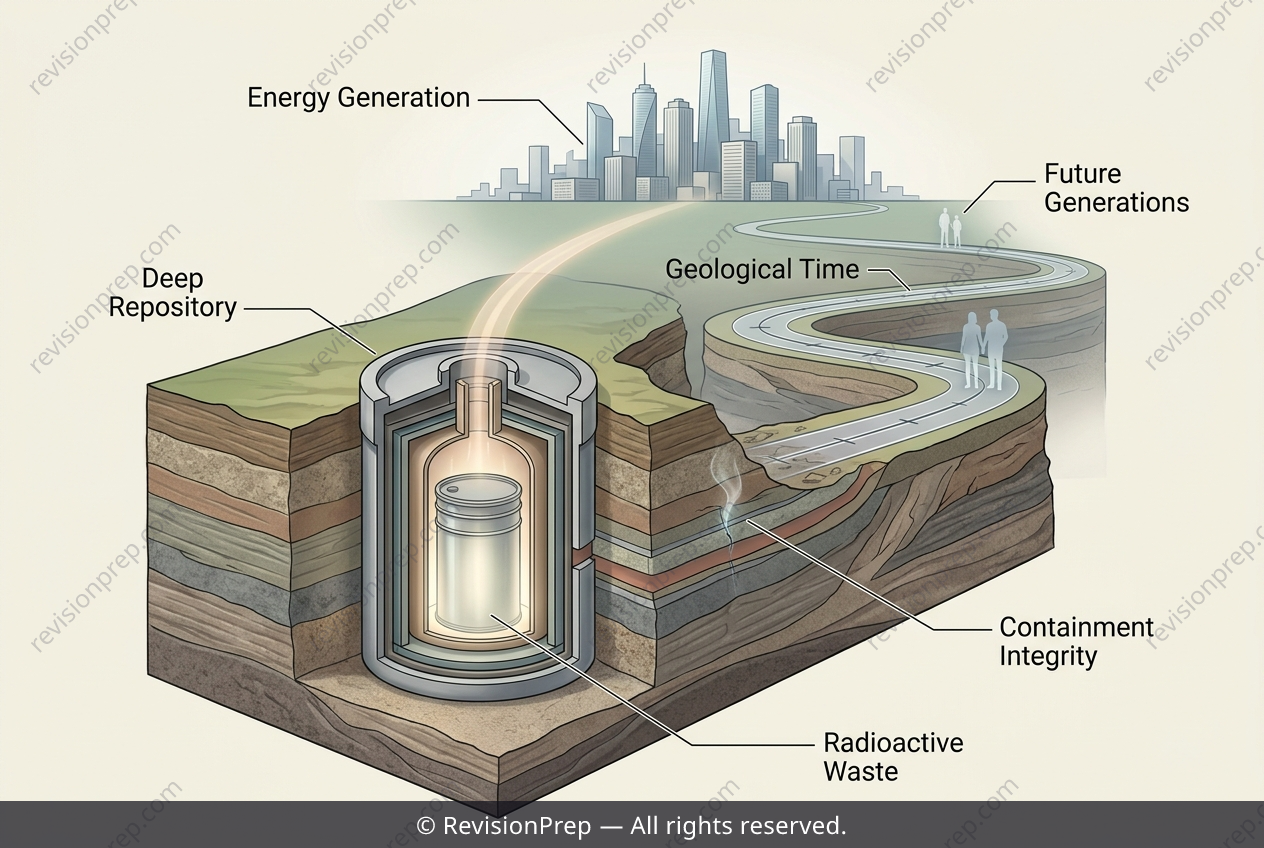
Nuclear fission in a reactor splits uranium-235 nuclei, releasing energy that is harnessed as electricity—but it also leaves behind isotopes whose half-lives stretch beyond 10,000 years. This timescale, far longer than any human institution or engineered barrier, sits at the heart of the ethical and environmental debate around nuclear power. The core tension is intergenerational: today’s low-carbon electricity benefits current populations, while the waste’s containment burden falls on future generations who gain nothing from that energy. Deep geological repositories aim to resolve this by sealing corrosion-resistant containers in stable rock formations, isolating radioactive material from the biosphere and preventing atmospheric release. Yet the same long half-lives that make the waste hazardous also make predictive models unreliable—container integrity over millennia depends on extrapolations beyond any experimental data, with risks of groundwater contamination if chemical interactions or seismic events compromise the barriers. The physics of exponential decay (N = N₀e^(−λt)) dictates that while activity decreases, it never reaches zero, meaning stewardship is not a finite problem but a permanent one. Balancing the climate benefit of low-carbon baseload power against this enduring risk requires weighing measurable present-day gains against unknowable future consequences—a judgment that blends physics, ethics, and environmental foresight.
Start practising IB questions today
150,000+ IB-styled questions, criteria-mapped and instantly accessible.