
Physics: The Nuclear Clock Behind Carbon Dating
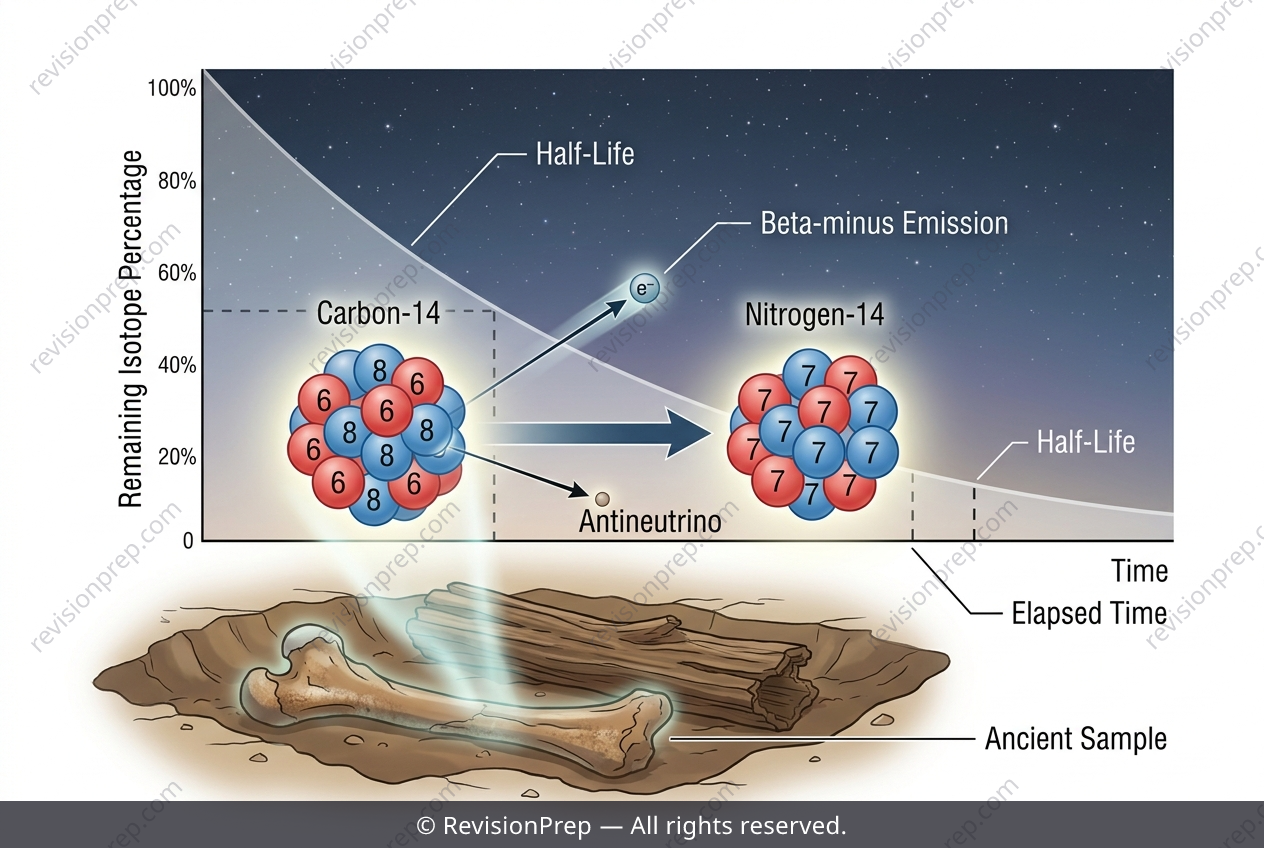
Carbon-14 dating is one of archaeology’s most powerful clocks, but it ticks in a very specific way. At its heart lies radioactive decay: an unstable nucleus spontaneously changes into another element, releasing energy and particles. For carbon-14, that change is beta-minus decay, where a neutron transforms into a proton, ejecting an electron (the beta particle) and an antineutrino. The result is nitrogen-14, with the same mass number but an atomic number increased by one. This transformation follows a strict conservation law—mass number and atomic number must balance on both sides of the equation—which is why the nuclear equation for this process is both simple and unforgiving. The rate of this decay is governed by half-life, the time it takes for half of the remaining radioactive atoms to decay. For carbon-14, that’s 5730 years. By measuring the current activity of carbon-14 in an organic sample and comparing it to the expected initial activity, scientists can estimate how many half-lives have passed since the organism died. However, the method has limits: contamination with younger or older carbon skews the measured activity, and beyond roughly 50,000 years, the remaining signal becomes too faint to detect reliably. Understanding these mechanisms—decay, half-life, and measurement—is what turns a simple count of particles into a window into the past.
Start practising IB questions today
150,000+ IB-styled questions, criteria-mapped and instantly accessible.