
Physics: The Physics of Chain Reactions
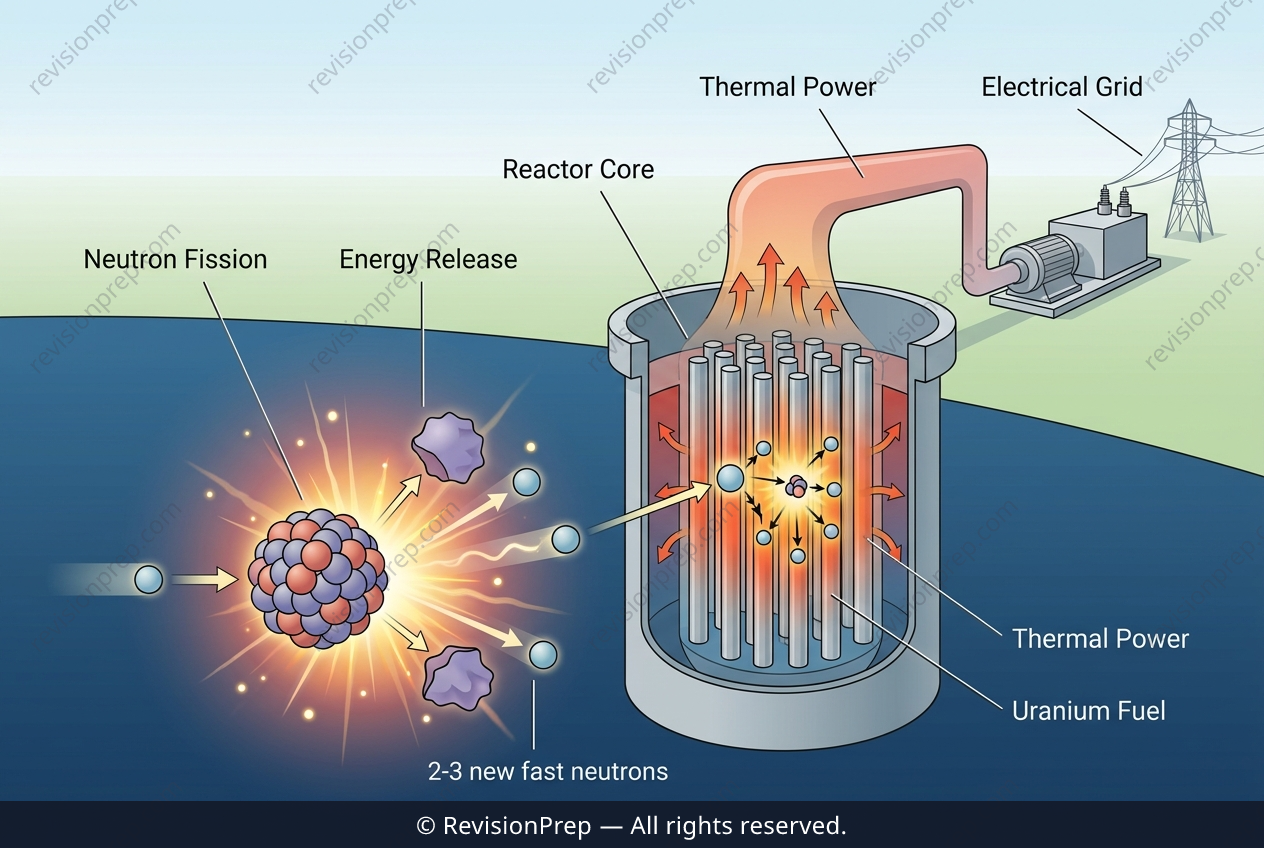
Nuclear fission lies at the heart of both the destructive power of atomic weapons and the steady hum of a commercial power plant. In this Physics SL topic, you’ll explore how a controlled chain reaction in enriched uranium converts mass into usable thermal energy, and ultimately into electricity. The core idea is simple: when a uranium-235 nucleus absorbs a neutron, it splits, releasing energy and more neutrons—which can trigger further fissions. But engineering a reactor requires precise control of this cascade, balancing neutron production with absorption and leakage. The mathematics behind this is beautifully compact. The fission rate per unit volume is given by R = φ · N₂₃₅ · σf, where φ is the neutron flux, N₂₃₅ is the number density of fissile uranium-235 atoms, and σf is the microscopic fission cross-section—a measure of how likely a neutron is to cause a split. To find N₂₃₅, you first calculate the total number of uranium atoms from the reactor’s mass and molar mass, then multiply by the enrichment fraction (here 3.5%) and divide by the core volume. Once you have the total fission rate, multiplying by the energy released per fission (3.2 × 10⁻¹¹ J) gives the thermal power. A typical plant converts only about a third of that into electrical power, so you can quickly estimate whether a given core design meets a city’s demand—connecting atomic-scale physics to real-world infrastructure decisions.
Start practising IB questions today
150,000+ IB-styled questions, criteria-mapped and instantly accessible.