
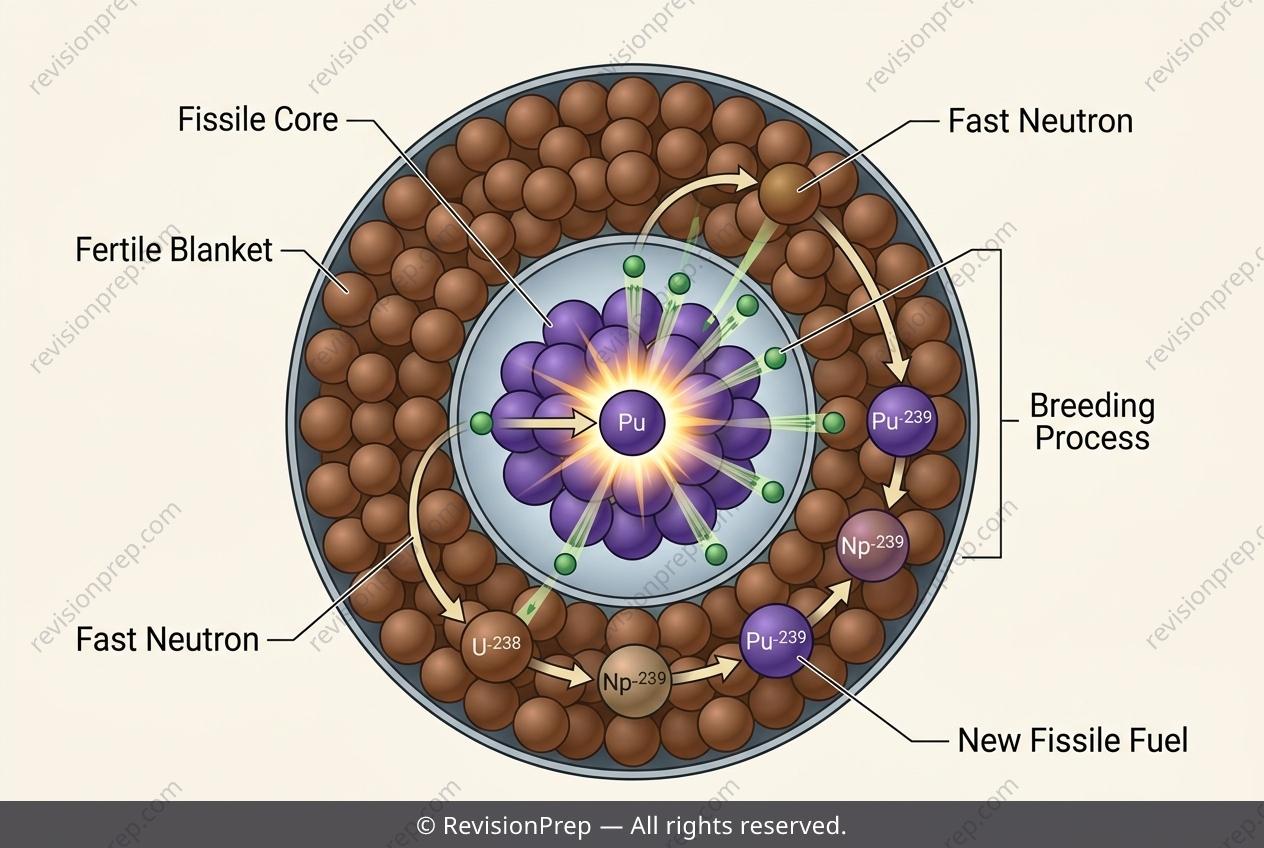
Physics: The Science of Nuclear Breeding
Nuclear and quantum physics often feels abstract, but few ideas are as tangible—or as futuristic—as nuclear breeding. At its heart lies a simple yet powerful loop: a fast breeder reactor (FBR) uses plutonium-239 as fuel, but instead of merely burning it, the reactor transforms otherwise inert uranium-238 into new plutonium-239. This means the core can produce more fissile material than it consumes, a concept that challenges the usual image of fuel running out. The mechanism hinges on energy and neutron speed. Each fission of Pu-239 releases about 210 MeV, which converts to roughly 3.4 × 10⁻¹¹ J—a tiny amount per atom, yet multiplied by the staggering number of atoms in a 2000 kg core (around 5 × 10²⁷), the total energy becomes enormous. Crucially, no moderator is used: fast neutrons are essential because they are captured efficiently by U-238, triggering beta decays that yield new Pu-239. Over a year of steady 800 MW operation, the mass of plutonium consumed can be calculated from the total energy divided by energy per fission, then converted to mass via Avogadro’s number. With a breeding ratio above 1, the net gain in fissile mass means the reactor becomes self-sustaining—a cornerstone for long-term nuclear fuel sustainability.
Start practising IB questions today
150,000+ IB-styled questions, criteria-mapped and instantly accessible.