
Physics: Time, Distance, Shield — The ALARA Rule
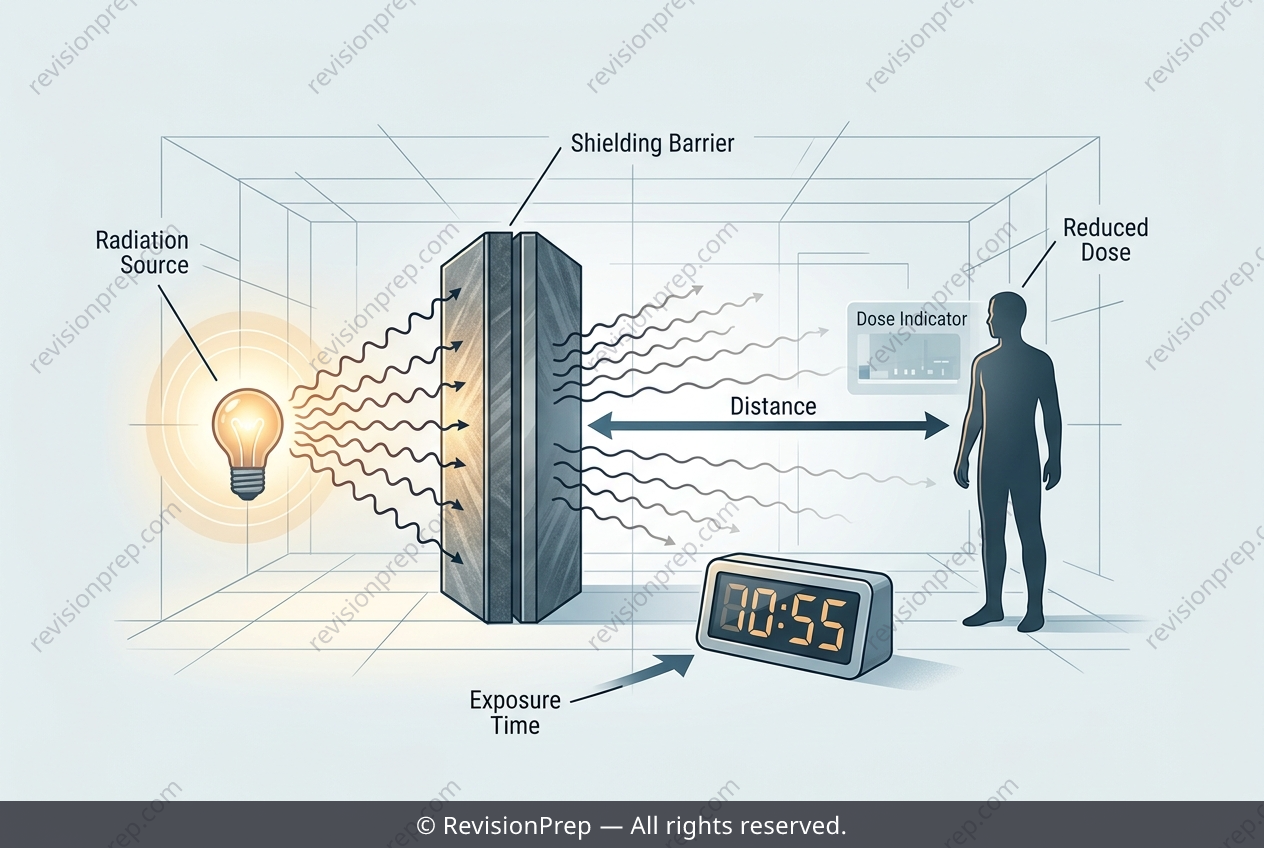
When a radiographer steps into a nuclear medicine ward, the invisible threat of ionising gamma radiation is met by three silent defenders: time, distance, and shielding. This trio forms the foundation of the ALARA principle—As Low As Reasonably Achievable—which guides every decision in radiation protection. The goal is not to eliminate exposure entirely, but to minimise it to a level where the societal benefit of medical imaging clearly outweighs the biological risk. The physics is straightforward: gamma intensity falls off with the square of distance (inverse square law), while lead-lined walls absorb photons before they reach human tissue. Reducing exposure lowers the probability of DNA double-strand breaks, which in turn reduces the long-term risk of cancer among hospital staff. This protects not just the individual worker, but the entire healthcare system—fewer occupational illnesses mean lower treatment costs and a more stable, experienced workforce. Yet the strategy has a critical flaw: some procedures demand that the radiographer stand close to the patient, making distance physically impossible. In those moments, shielding alone cannot eliminate residual dose, and only the third pillar—minimising time near the source—can close the gap.
Start practising IB questions today
150,000+ IB-styled questions, criteria-mapped and instantly accessible.