
Physics Uncertainty, Significant Figures, and Precision in Motion
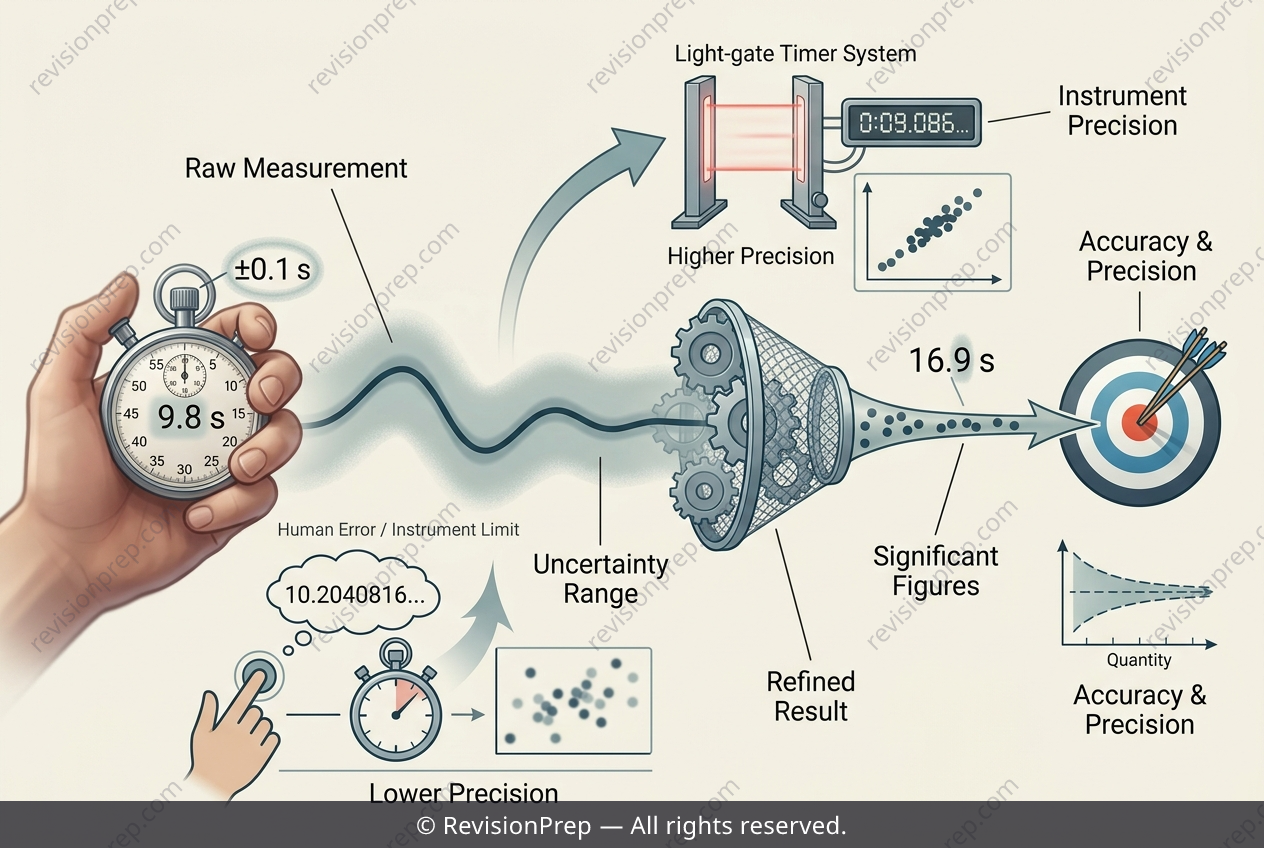
Speed, velocity, and acceleration form the backbone of kinematics, but in IB Sciences, the numbers you calculate are only as meaningful as the measurements behind them. This topic pairs the simple formula for average speed (distance divided by time) with the often-overlooked discipline of quantifying uncertainty. When a runner covers 100 m in under ten seconds, the stopwatch’s precision to the nearest tenth of a second might seem sufficient—yet that tiny rounding interval, combined with human reaction time, can shift the calculated speed by more than a tenth of a metre per second. The core concept here is that every measurement carries inherent limits, expressed through significant figures, accuracy (how close to the true value), and precision (how reproducible the reading is). A stopwatch precise to 0.1 s does not guarantee an accuracy of 0.1 s, because the person pressing the button introduces a reaction-time error of roughly 0.2–0.3 s. Converting between m/s and km/h (multiplying by 3.6) is straightforward, but deciding how many digits to report requires understanding the uncertainty range. A light-gate timer, triggered automatically by the athlete breaking a beam, removes the human error entirely, tightening the uncertainty and making the speed calculation genuinely more accurate—not just more precise.
Start practising IB questions today
150,000+ IB-styled questions, criteria-mapped and instantly accessible.