
Continuity and Change
Water potential, DNA replication, inheritance, reproduction and climate change — the fidelity-vs-variation core of IB DP Biology Topic D.
Quick facts
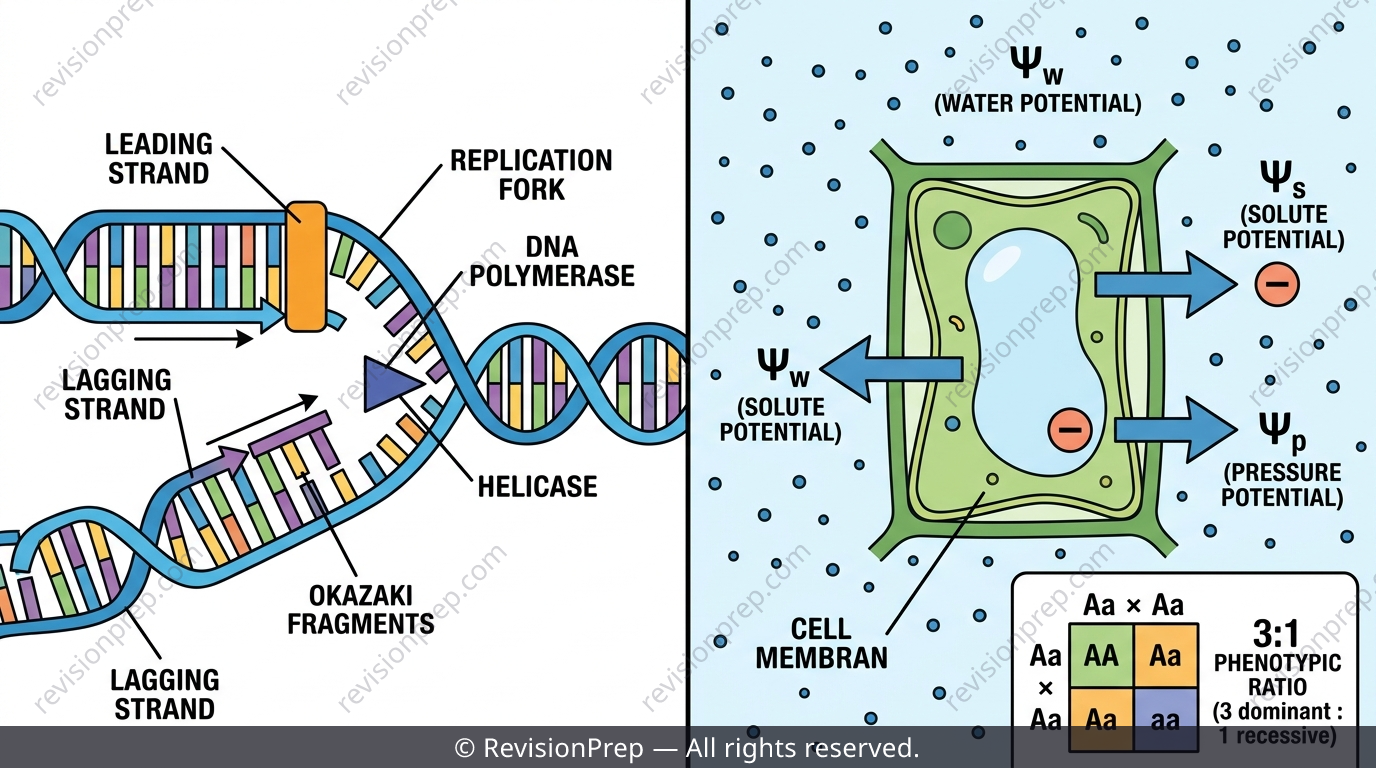
IB DP Biology's Continuity and Change strand keeps asking one of two questions: is this process about copying information accurately, or about generating and filtering variation? Water potential explains how cells survive before any genetics can happen. DNA replication is the ultimate fidelity story — semi-conservative copying with almost no errors. Inheritance and reproduction sit on the 'variation' side, using meiosis, fertilisation and Punnett squares to predict outcomes. Climate change closes the loop by showing what happens when environmental conditions shift faster than biological systems can adapt. This teaser pulls out the five most exam-relevant ideas — the formulas, definitions and traps examiners love to test — so you know exactly where to focus before diving into the full revision notes for complete worked examples and past-topic patterns.
What you’ll be able to do
Water Potential: The Rule That Answers Almost Every Question
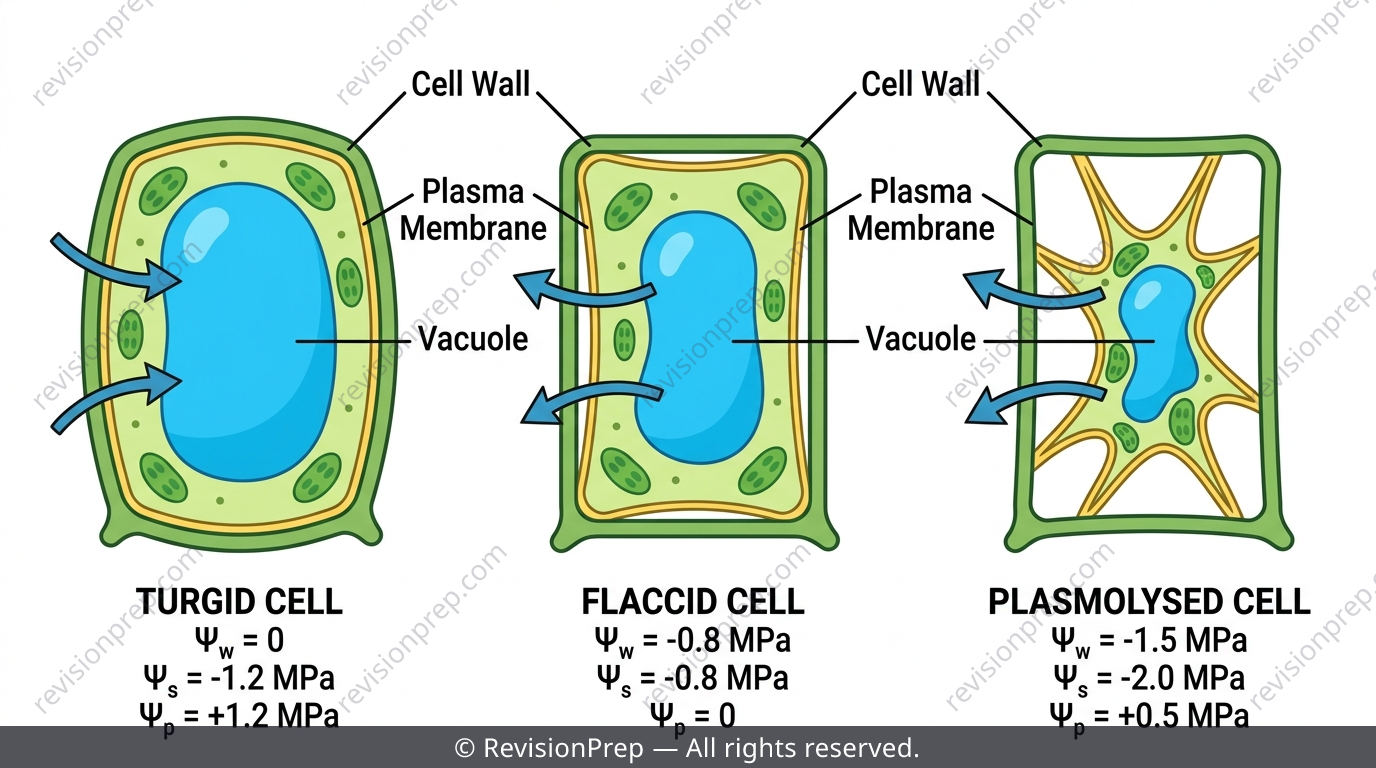
Water potential () measures water's tendency to move out of a solution: pure water is , and solutes always make it more negative. Water moves from high to low across a partially permeable membrane — memorise this single rule and most exam questions solve themselves. Total water potential is the sum of solute potential (, always negative) and pressure potential (, positive in a turgid walled cell). At incipient plasmolysis, exactly 50% of cells show plasmolysis, meaning the external solution's equals the cell's at that point.
Exam tip
Always convert concentrations to values before comparing solutions — never compare raw molarity or 'concentration' directly to predict water movement.
Common mistake
Assuming 'more concentrated' automatically means 'more negative water potential' without checking pressure potential, or treating water potential and solute concentration as numerically interchangeable.
Mini summary
Water always moves from high to low ; at incipient plasmolysis, external = cell .
DNA Replication: Semi-Conservative Fidelity
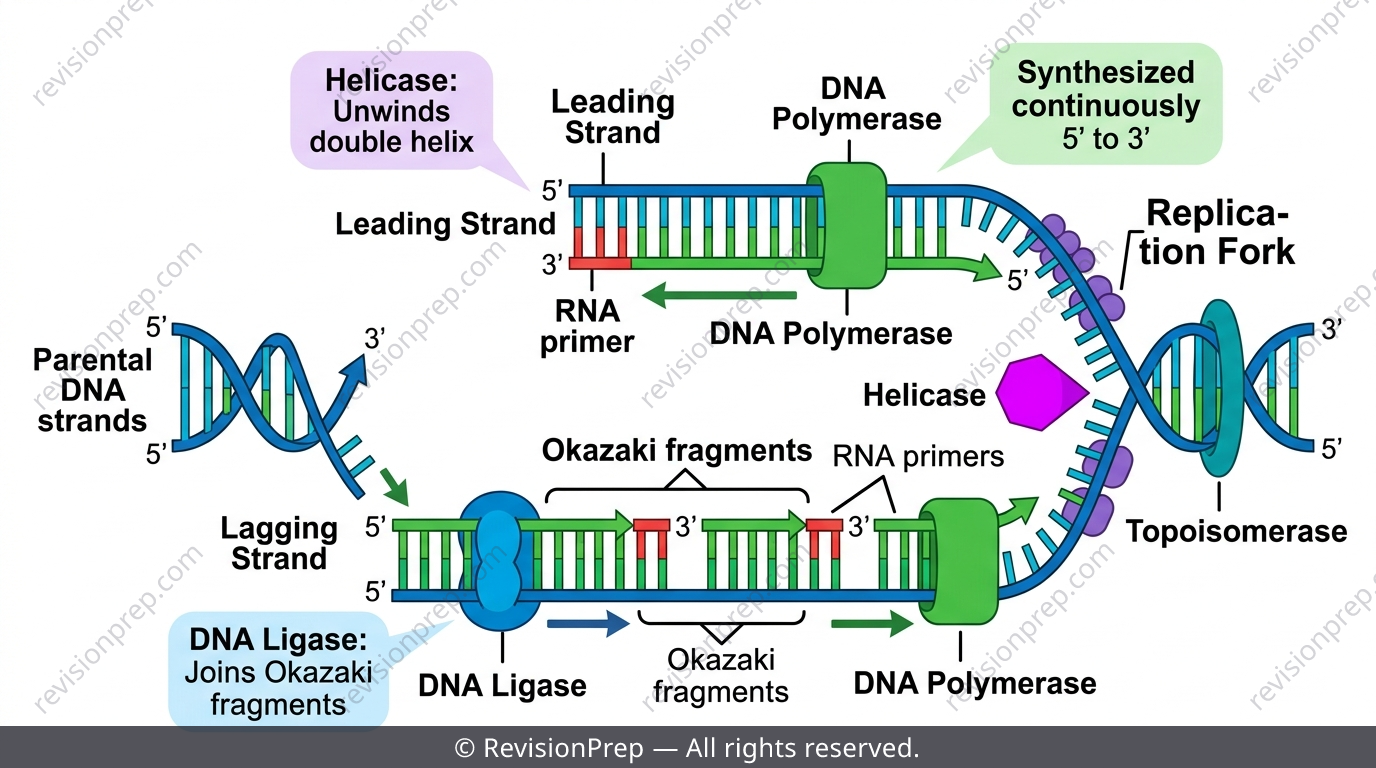
DNA replication is semi-conservative: each new double helix keeps one original template strand and gains one newly synthesised strand. Helicase unwinds the double helix at the replication fork, and DNA polymerase adds nucleotides only in the 5' to 3' direction — forcing continuous synthesis on the leading strand and fragmented synthesis (Okazaki fragments) on the lagging strand. Short RNA primers give DNA polymerase a starting point, and DNA ligase later joins the Okazaki fragments together.
Exam tip
Link every enzyme to its exact job: helicase unwinds, DNA polymerase extends 5' to 3', ligase joins fragments — mixing these up costs easy marks.
Mini summary
One template strand + one new strand = semi-conservative replication; direction 5' to 3' explains leading vs lagging strand synthesis.
Inheritance: Predicting Ratios With Punnett Squares
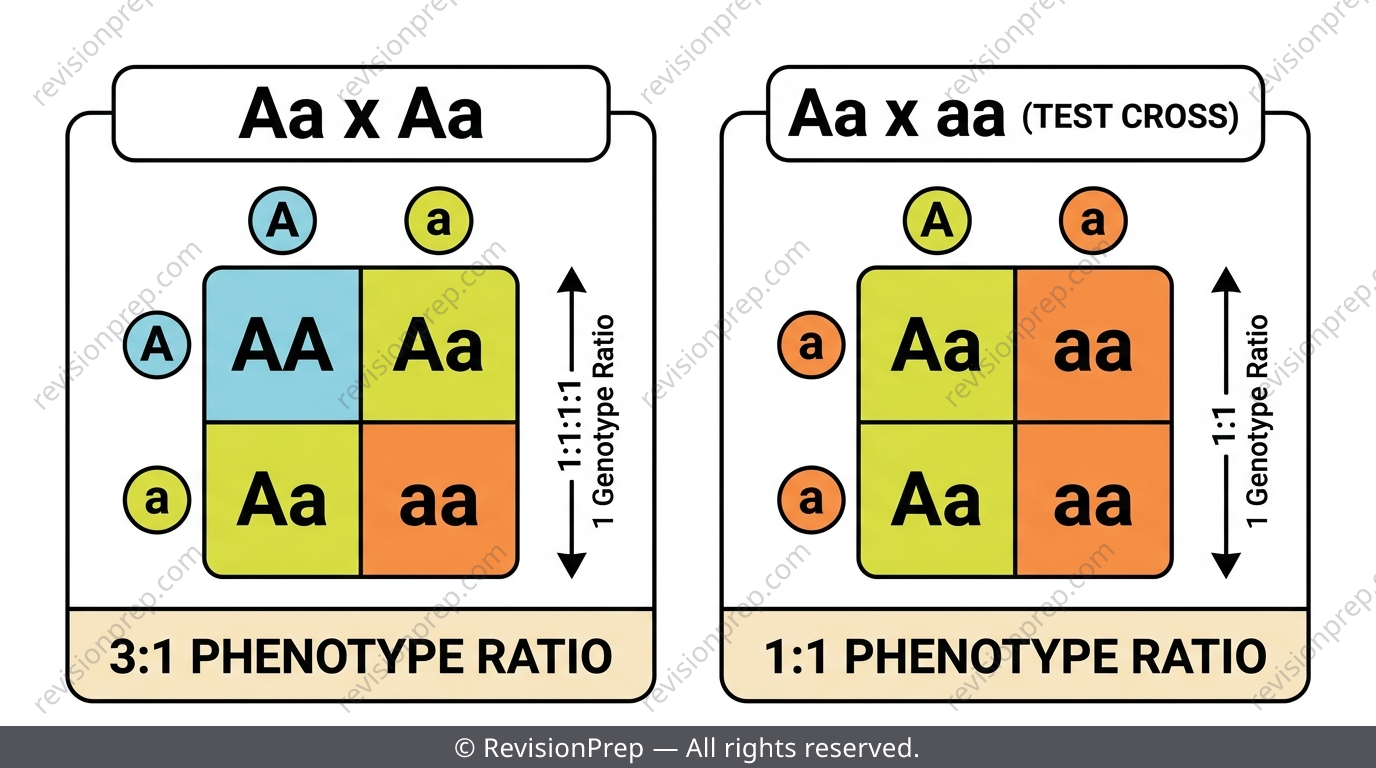
Genotype (the allele combination) determines phenotype through dominance relationships, and Punnett squares let you predict offspring ratios from known parental genotypes. A cross between two heterozygotes (Aa × Aa) gives a 3:1 phenotype ratio, while a test cross with a homozygous recessive (Aa × aa) gives 1:1 if the tested parent is heterozygous. Sex-linked genes on the X chromosome behave differently in males (XY) and females (XX), so recessive X-linked conditions show up more often in males.
| Cross type | Genotypes | Expected ratio |
|---|---|---|
| Monohybrid (heterozygous × heterozygous) | Aa × Aa | 3:1 |
| Test cross (heterozygous × homozygous recessive) | Aa × aa | 1:1 |
Common mistake
Writing 3:1 automatically for any monohybrid cross without first checking both parental genotypes — a test cross gives 1:1, not 3:1.
Mini summary
Confirm both parental genotypes first: Aa × Aa gives 3:1, Aa × aa gives 1:1.
Sexual vs Asexual Reproduction: Variation vs Speed
Sexual reproduction combines gametes from two parents via meiosis and fertilisation, producing genetically variable offspring through independent assortment, crossing over, and random fertilisation. Asexual reproduction copies a single parent's genome using mitosis alone, giving identical offspring fast but no new variation for natural selection to act on. Fertilisation restores the diploid chromosome number after haploid gametes fuse.
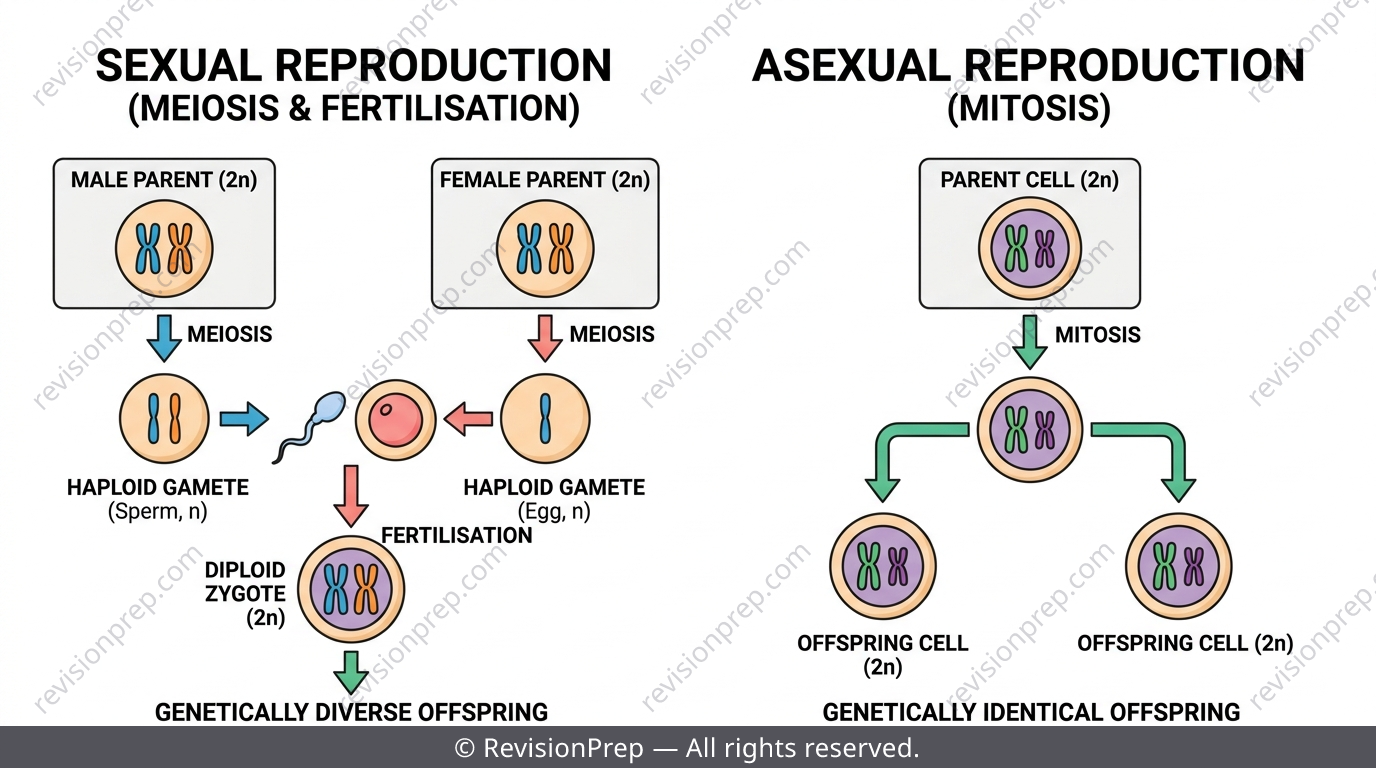
| Feature | Sexual reproduction | Asexual reproduction |
|---|---|---|
| Parents involved | Two | One |
| Genetic variation | High (meiosis + fertilisation) | None (mitosis only) |
| Speed | Slower | Faster |
Mini summary
Sexual reproduction trades speed for variation via meiosis and fertilisation; asexual reproduction trades variation for speed.
Climate Change: The Enhanced Greenhouse Effect
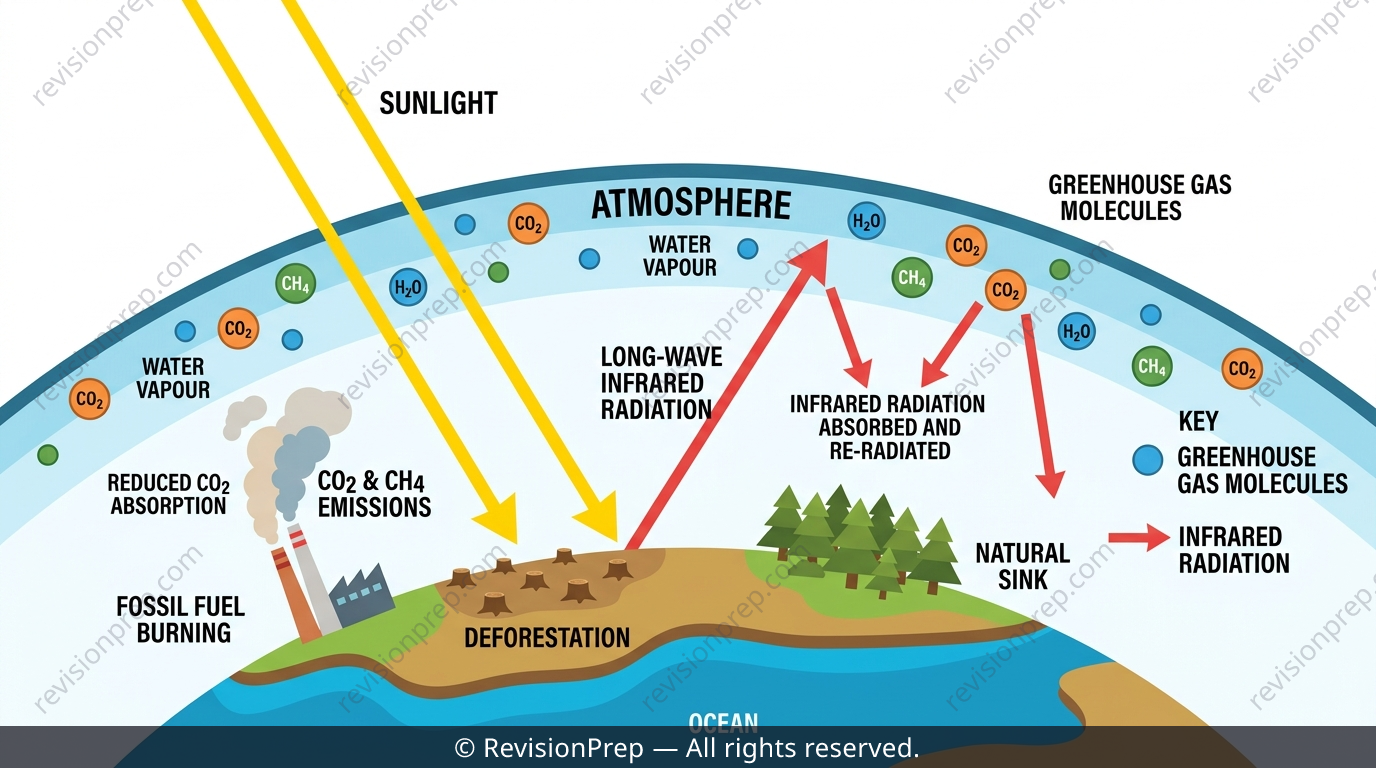
Greenhouse gases — CO2, CH4, N2O, and water vapour — absorb and re-radiate long-wave infrared radiation, warming the lower atmosphere. Human activity such as fossil fuel combustion, deforestation, and agriculture has pushed these gas concentrations beyond natural background levels, driving the enhanced greenhouse effect. Evidence includes ice core CO2/temperature records, glacial retreat, rising global temperatures, and ocean acidification, with biological consequences like range shifts, altered phenology, and coral bleaching.
Exam tip
Distinguish CO2 and CH4 clearly: methane traps more heat per molecule but persists in the atmosphere for a shorter time than CO2.
Mini summary
Enhanced greenhouse effect = human-driven increase in IR-absorbing gases, evidenced by ice cores, ocean acidification and shifting species ranges.
Quick formula sheet
Practice questions
- Define water potential and state the water potential of pure water.
- What enzyme unwinds the DNA double helix during replication?
- State the expected phenotype ratio from a cross between two heterozygous parents.
- Explain why incipient plasmolysis is used to estimate a plant cell's water potential.
- Describe why DNA polymerase produces the lagging strand as short fragments rather than continuously.
- A tall heterozygous pea plant is crossed with a short plant. Predict the offspring ratio and explain how it differs from an Aa × Aa cross.
- Potato tissue has . Predict and explain the mass change of cylinders placed in solutions of and .
- Explain why methane and carbon dioxide differ in their overall long-term contribution to the enhanced greenhouse effect.
- Compare the sources of genetic variation available to a sexually reproducing species versus an asexually reproducing species, and explain the ecological trade-off involved.
Frequently asked questions
What is the difference between solute potential and pressure potential?+
Solute potential () is always negative or zero and reflects how solutes lower water potential; pressure potential () is the physical push of the cell wall against the contents, usually positive in a turgid walled cell and near zero or negative in animal or plasmolysed cells.
Does a potometer measure water potential?+
No — a potometer measures the rate of water uptake, which acts as a proxy for transpiration rate, not water potential itself. Don't conflate the two in exam answers.
Why is DNA replication called semi-conservative?+
Because each new DNA double helix contains one original template strand and one newly synthesised strand, so genetic information is conserved while still being duplicated.
How do I know whether to use a 3:1 or 1:1 ratio in genetics questions?+
Check both parental genotypes first. Two heterozygotes (Aa × Aa) give 3:1; a test cross with a homozygous recessive (Aa × aa) gives 1:1 if the tested parent is heterozygous.
Why does methane matter less over time than CO2 for climate change?+
Methane traps more heat per molecule than CO2 but breaks down faster in the atmosphere, while CO2 persists much longer, so both matter but on different timescales.
Why does asexual reproduction not generate variation?+
Asexual reproduction relies on mitosis alone from a single parent, producing genetically identical offspring with no meiosis, crossing over, or fertilisation to introduce new allele combinations.
Get the Full Continuity and Change Revision Notes
Related articles