
Unity and Diversity: IB DP Biology Theme A Essentials
Water, evolution and speciation — the foundations every other Biology theme builds on
Quick facts
Unity and Diversity is the foundation of IB DP Biology — it sets up the water chemistry, evolutionary mechanisms and classification logic that every later theme quietly relies on. This is also one of the most heavily numerical parts of SL Biology: water potential calculations, specific heat capacity and latent heat problems, and evolution-based data questions all show up across Paper 1, Paper 2 and Paper 3. Examiners love testing whether you can tell cohesion apart from adhesion, specific heat capacity apart from latent heat, and homologous structures apart from analogous ones. This teaser walks through the five ideas that generate the most exam marks and the most common mistakes, then points you to the full revision notes for worked examples, the complete natural selection causal chain, and every formula you need.
What you’ll be able to do
Water's Dipole: The Root of Every 'Special' Property
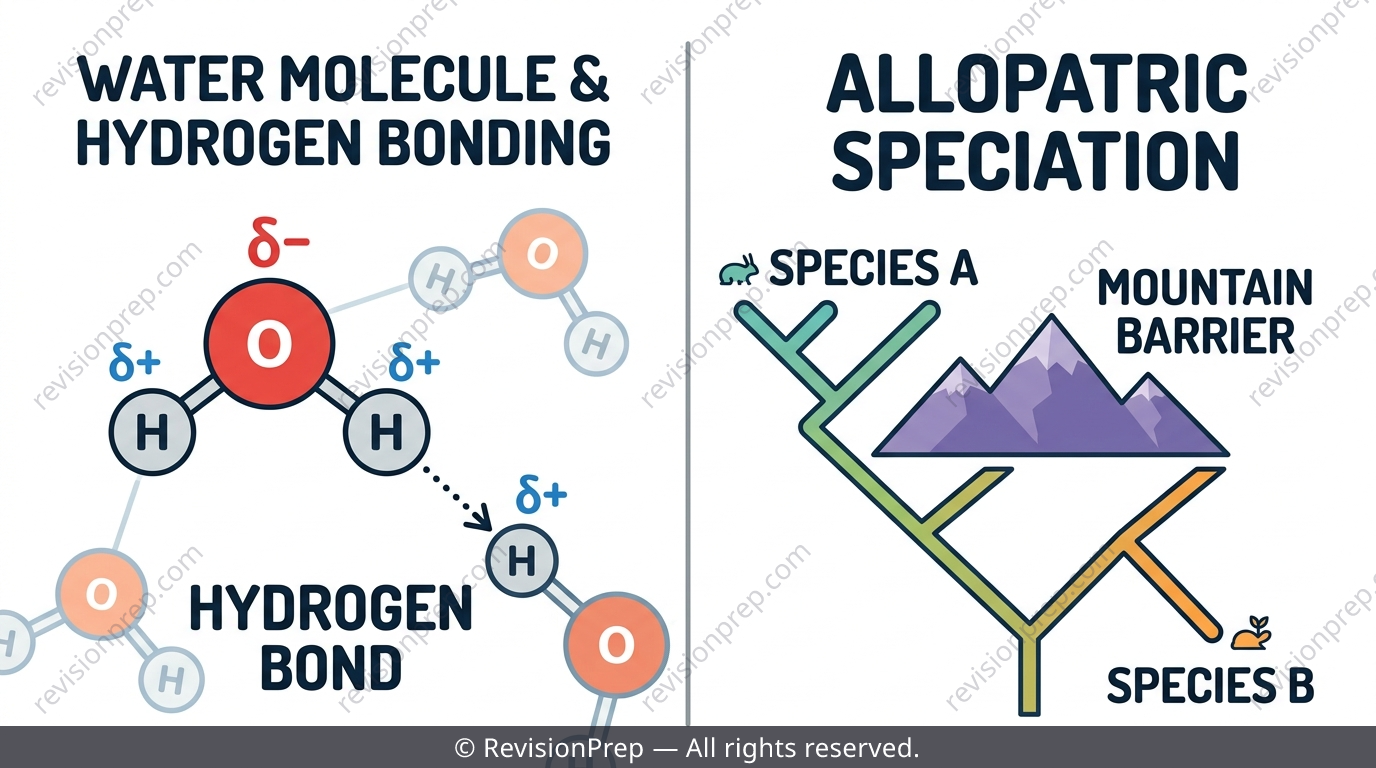
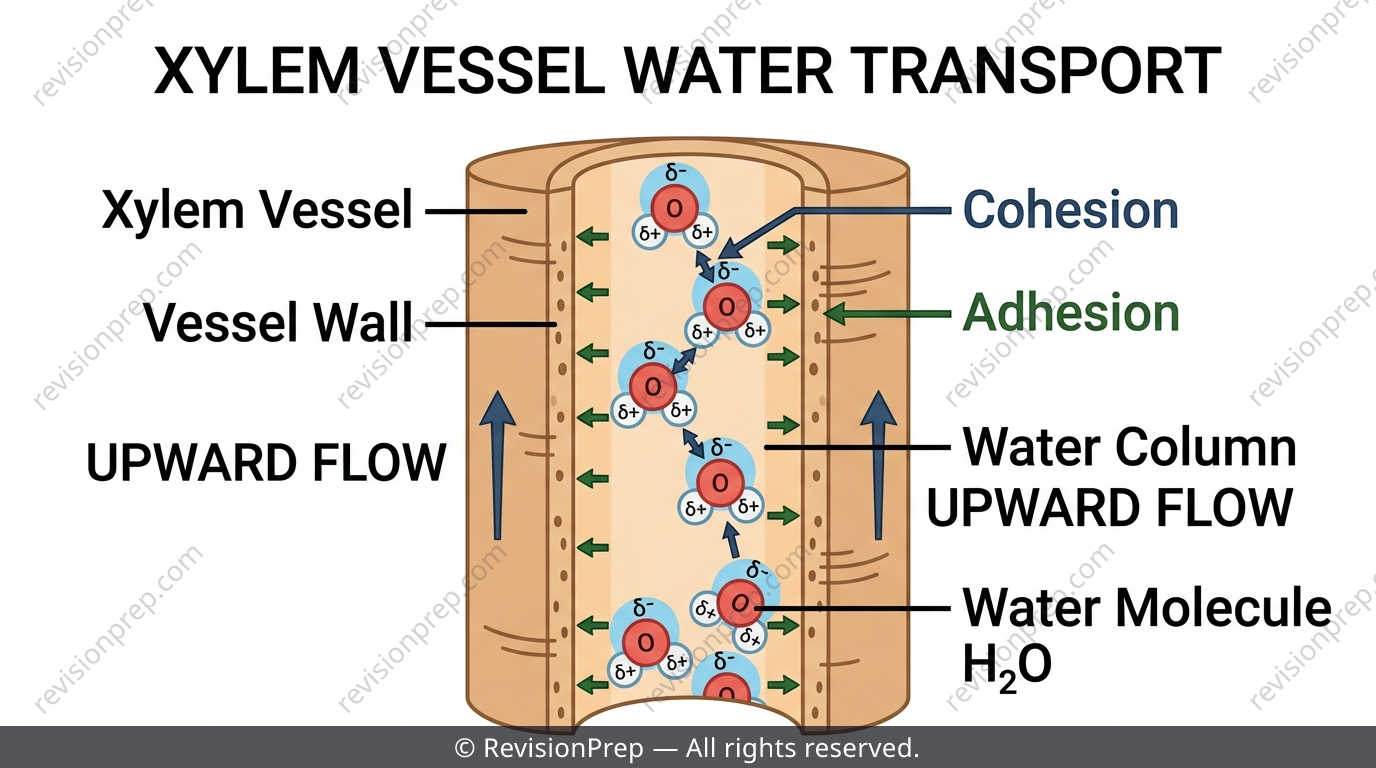
Oxygen is more electronegative than hydrogen, so each water molecule carries a permanent dipole — on oxygen, on the hydrogens. This lets molecules hydrogen-bond to each other, and almost every unusual property of water traces back to that one fact. Cohesion (water molecules attracting each other) supports the water column in xylem; adhesion (water attracting other polar surfaces) drives capillary action; the dipole also lets water form hydration shells around ions, making it an excellent solvent.
Exam tip
Keep cohesion, adhesion and solvent action structurally separate — examiners routinely test whether you can match each term to the right phenomenon.
Common mistake
Confusing cohesion (water–water) with adhesion (water–other surface) — they sound similar but describe different interactions.
Mini summary
Water's polarity → hydrogen bonding → cohesion, adhesion, solvent power, thermal buffering and the ice-floats anomaly, all from one dipole.
Specific Heat Capacity vs Latent Heat of Vaporization
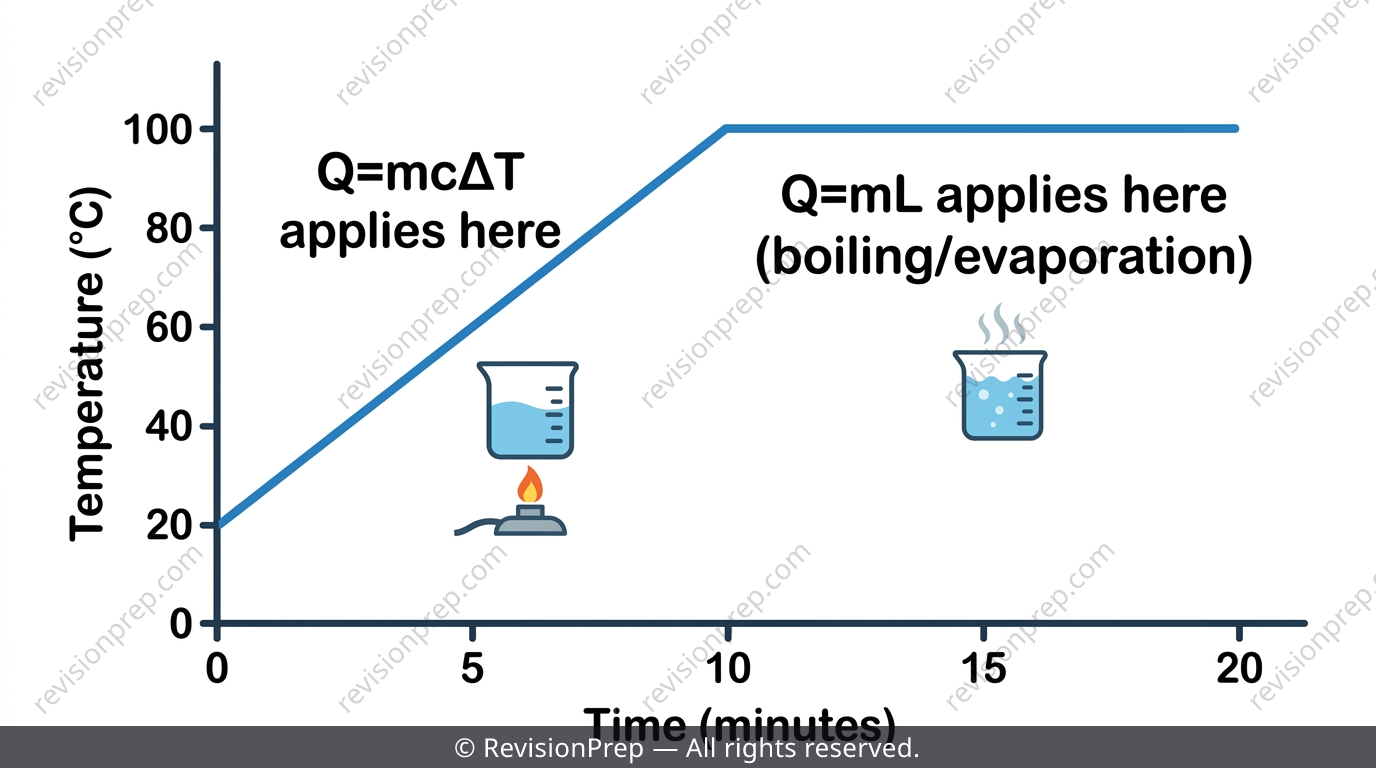
High specific heat capacity means water absorbs a lot of energy before its temperature rises much, buffering cells and water bodies against rapid swings. High latent heat of vaporization means converting liquid to vapour requires breaking all the hydrogen bonds holding a molecule in the liquid, so evaporation removes a large amount of heat — this is exactly why sweat cools your skin. These two formulas, and , are tested with real numbers, not just definitions.
Exam tip
Ask yourself: is the water changing state in this scenario? If yes, the relevant property is latent heat, not specific heat capacity.
Common mistake
Explaining sweat cooling with 'high specific heat capacity' — this is a common wrong-property distractor; sweating involves evaporation, so latent heat is the correct explanation.
Water Potential and Osmosis
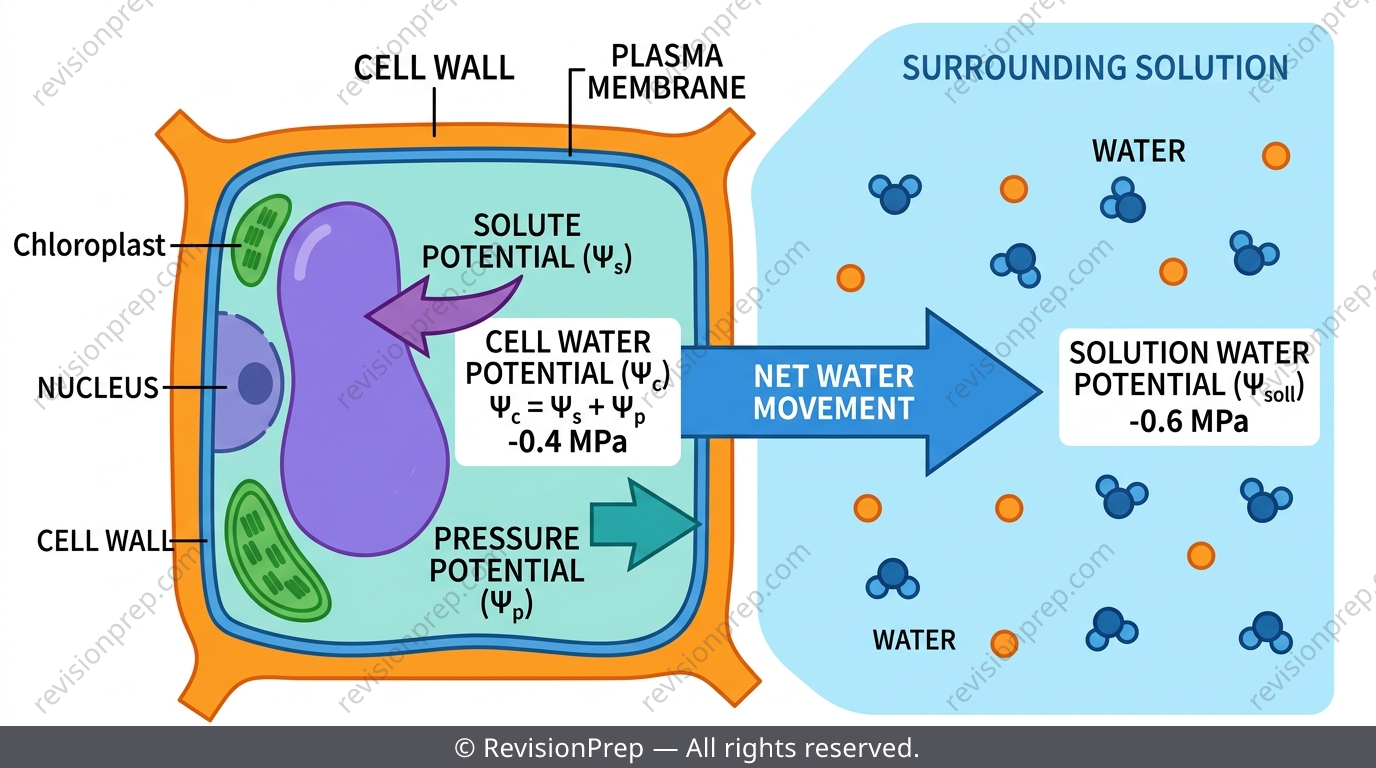
Osmosis is the net movement of water across a selectively permeable membrane, from higher to lower water potential (). Water potential is made up of solute potential (, always zero or negative) and pressure potential (, positive under turgor or negative under tension): . Pure water has ; everything else is usually negative unless under positive pressure.
Exam tip
Equilibrium means the two sides have EQUAL water potentials — not that either side equals zero. Set , not .
Common mistake
Setting the cell's water potential to zero at equilibrium instead of setting it equal to the surrounding solution's water potential.
Mini summary
; water always moves toward the more negative .
Natural Selection: The Full Causal Chain and Evidence for Evolution
Evolution is cumulative, heritable change in a population's characteristics across generations. Natural selection drives it through a specific chain: overproduction of offspring → heritable variation → a struggle for survival under limited resources → differential reproductive success of individuals with advantageous traits → a shift in allele frequency across generations. Evidence includes the fossil record, selective breeding, homologous structures (shared ancestry, e.g. the pentadactyl limb in whales, bats and humans) versus analogous structures (shared function only, e.g. insect and bird wings, from convergent evolution), and molecular sequence comparison.
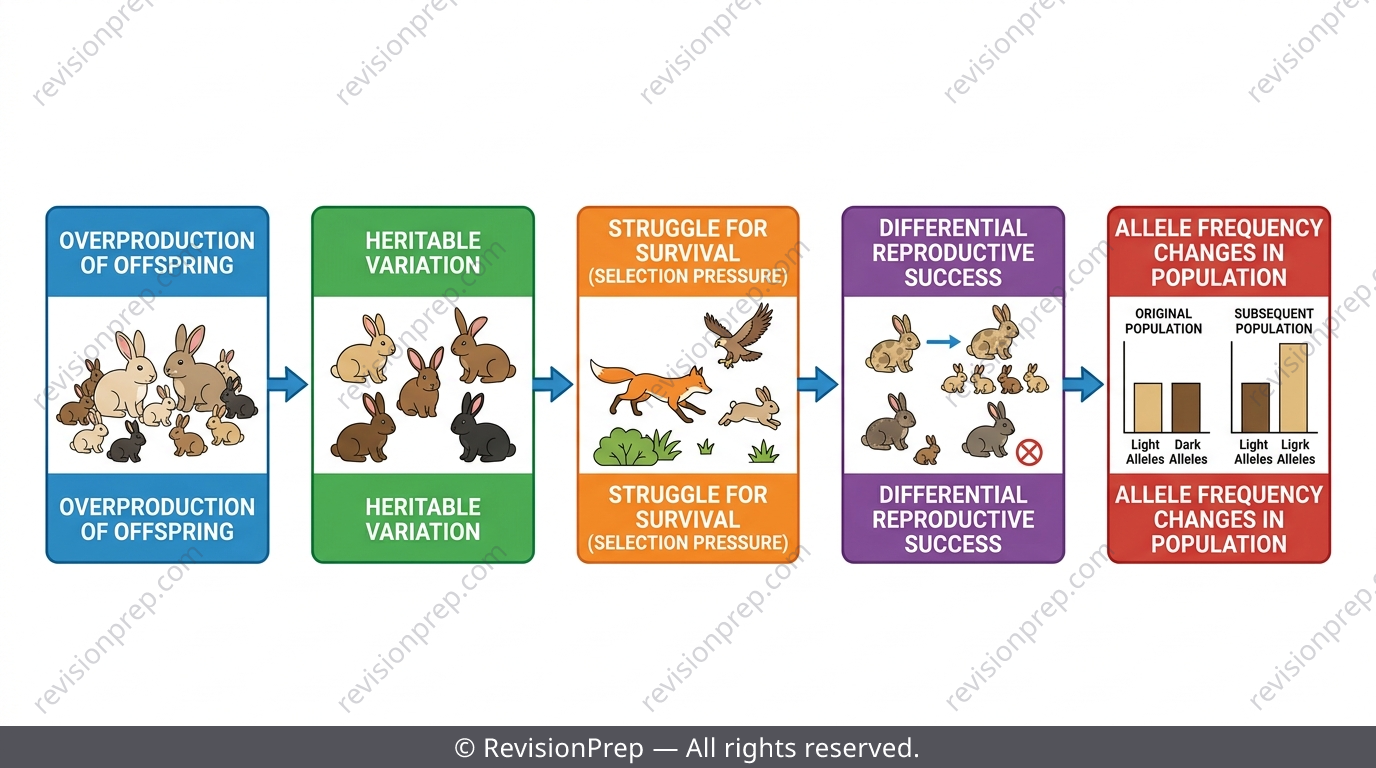
Exam tip
'Explain natural selection' is marked on the full causal chain, not on vocabulary — missing any single step costs marks.
Common mistake
Writing that organisms 'adapted because they needed to' or 'developed' a trait (Lamarckian phrasing) instead of describing pre-existing variation being selected.
Speciation and Patterns of Selection
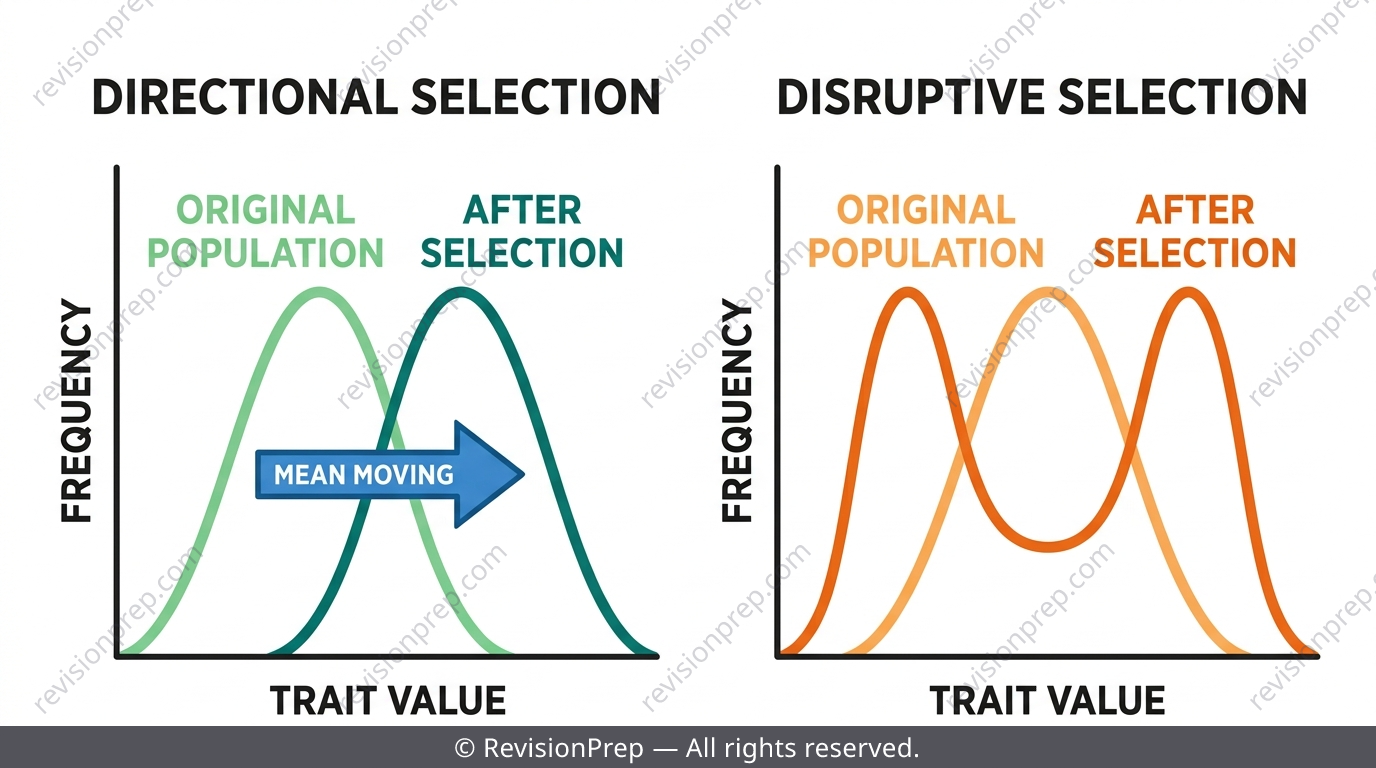
Speciation happens when reproductive isolation stops gene flow between diverging populations long enough for genetic differences to build up until they can no longer interbreed to produce fertile offspring. Allopatric speciation requires a geographic barrier like a mountain range or river; sympatric speciation occurs without one, for example via polyploidy in plants or disruptive selection within the same range. On a continuously varying trait, selection can be directional (mean shifts), stabilising (extremes removed, variance narrows) or disruptive (middle removed, population splits toward two extremes).
Exam tip
On selection-graph questions, name the TYPE of selection (directional, stabilising or disruptive) — 'natural selection occurred' alone earns no credit.
Common mistake
Describing a mean shift and a narrowing spread but failing to identify it specifically as directional selection with reduced variance.
Mini summary
Allopatric = geographic barrier; sympatric = no barrier, e.g. polyploidy or disruptive selection.
Quick formula sheet
Practice questions
- State two properties of water that result from hydrogen bonding between molecules.
- Define water potential and state the value for pure water.
- List the five steps in the causal chain of natural selection.
- Explain, in terms of hydrogen bonding, why sweat evaporation cools the skin.
- A cell has MPa and MPa. Calculate its water potential.
- Distinguish between homologous and analogous structures using one example of each.
- A population's beak-depth distribution shows a mean shift with no change in variance after a drought. Identify the type of selection and justify your answer.
- Explain how allopatric speciation could occur in a population split by a newly formed river, referencing reproductive isolation.
- A cell placed in a solution with MPa reaches equilibrium. If the cell's stays at MPa, calculate the pressure potential the cell must reach.
Frequently asked questions
What is water potential in IB Biology?+
Water potential () measures the tendency of water to move out of a solution. It equals solute potential plus pressure potential (), and water always moves toward the more negative value.
What's the difference between specific heat capacity and latent heat of vaporization?+
Specific heat capacity buffers temperature change without a state change; latent heat of vaporization is the energy needed to change liquid to vapour at constant temperature, which is why evaporation (like sweating) cools you.
What are the steps of natural selection?+
Overproduction of offspring, heritable variation, a struggle for survival under limited resources, differential reproductive success of advantageous individuals, and a resulting shift in allele frequency across generations.
How do homologous and analogous structures differ?+
Homologous structures share a common ancestor but may differ in function (like the pentadactyl limb in humans, bats and whales); analogous structures share function but evolved independently, showing convergent evolution.
What is the difference between allopatric and sympatric speciation?+
Allopatric speciation requires a geographic barrier separating populations; sympatric speciation happens without a barrier, for example through polyploidy in plants or disruptive selection within the same area.
Why is Unity and Diversity important for the rest of IB Biology?+
It introduces water chemistry, cell theory and evolution — the molecular, structural and process foundations that every later Biology theme builds directly on.
Get the Full Unity and Diversity Revision Notes
Related articles