
Continuity and Change
How life copies itself faithfully and adapts flexibly — from the lac operon to natural selection
Quick facts
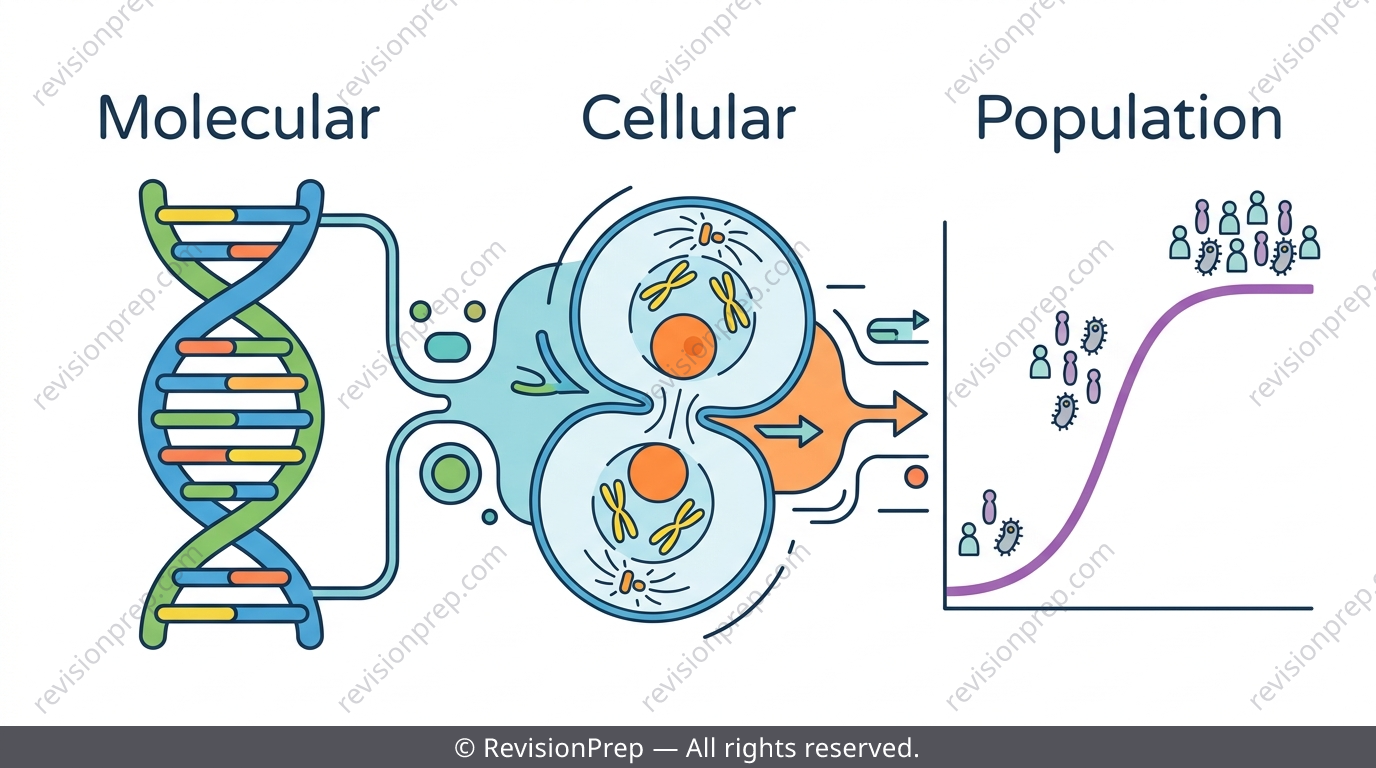
Continuity and Change is one of the highest-yield topics in IB DP Biology because it threads through Paper 1 data questions, Paper 2 extended response and Paper 3 option links. At its core, the topic asks one repeated question: how does biology copy information faithfully while still allowing controlled, adaptive change? You'll meet the lac operon as the model for gene expression control, negative feedback as the engine of homeostasis, mitosis and meiosis as two very different division strategies, and inheritance patterns tested with the chi-squared statistical test. Examiners love to block a single component — a promoter, a repressor, an operator — and ask you to trace the consequence downstream. This teaser walks through the five concepts that appear most often in past exam-style questions, flags the classic traps, and points you to the full revision notes for worked examples, complete diagrams and definitions you'll need for the real thing.
What you’ll be able to do
Gene Expression: The Lac Operon
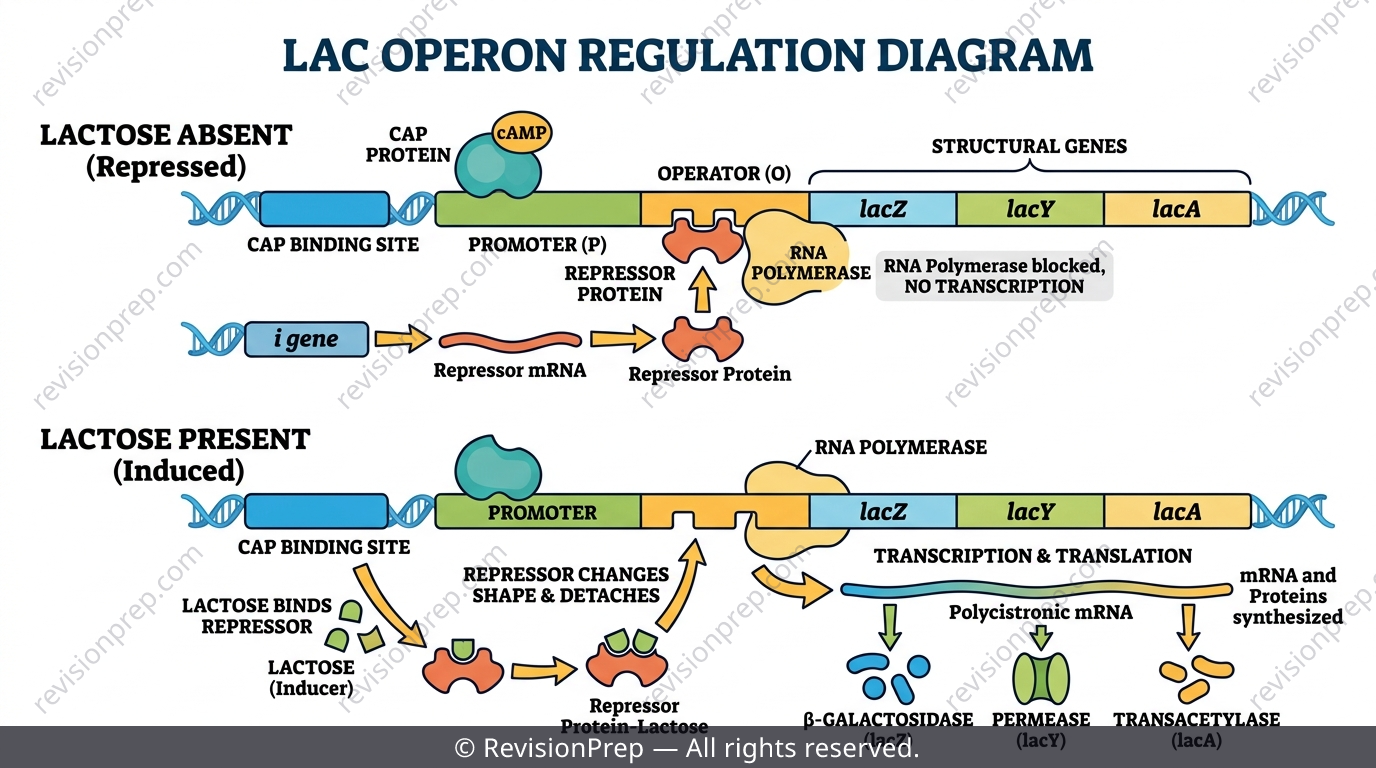
The lac operon is the model system for understanding how genes get switched on and off. It is inducible, meaning its default state is OFF and lactose (via allolactose) triggers it ON by inactivating the repressor bound to the operator. A second layer, CAP bound to cAMP, gives positive control that boosts transcription only when glucose is scarce — this is why lactose alone produces a much stronger response than lactose plus glucose. In eukaryotes, transcription factors and alternative splicing add further layers, letting one gene generate multiple distinct proteins.
Exam tip
If a question blocks a eukaryotic transcription factor from binding the promoter, the answer is always 'no pre-mRNA produced' — don't overthink into splicing or translation.
Common mistake
Treating a promoter deletion and an operator deletion as equivalent. A promoter deletion stops RNA polymerase binding at all (no transcription); an operator deletion removes the repressor's blocking site, giving constant ON expression.
Mini summary
Lac operon default = OFF; lactose removes the block (induction); CAP+cAMP adds positive control when glucose is low.
Homeostasis and Negative Feedback
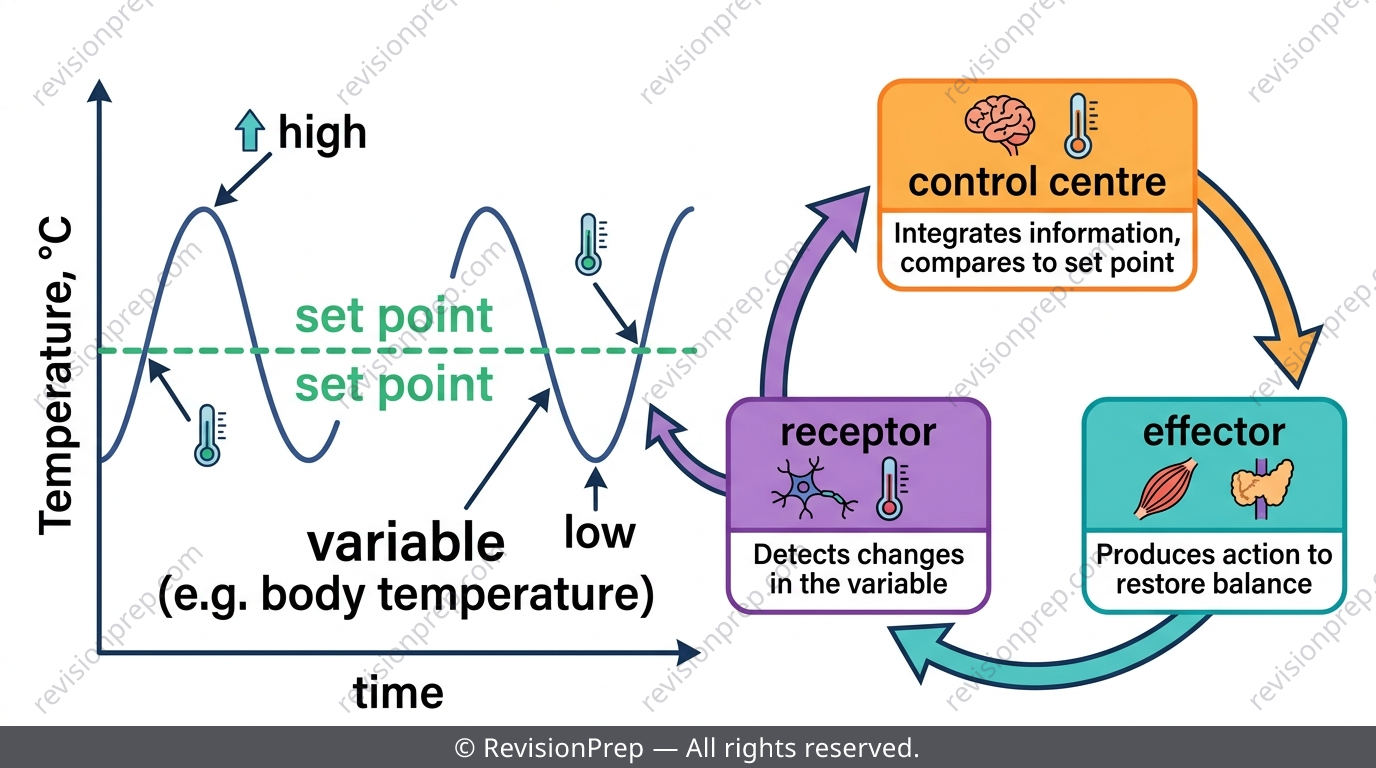
Homeostasis keeps internal conditions stable using a receptor to detect deviation from a set point, a control centre to process it, and an effector to correct it. Negative feedback dominates — it counteracts and reduces the original deviation, restoring the set point — while positive feedback amplifies change and is rare and short-lived, as in childbirth. Graphs of homeostatic variables typically oscillate around the set point, and examiners often ask you to read amplitude or lag time directly from such data.
Common mistake
Calling any fast physiological response 'positive feedback'. Check the direction: if the change is being corrected back toward the set point, it's negative feedback, not positive.
Mini summary
Receptor → control centre → effector; negative feedback restores the set point, positive feedback amplifies away from it.
Cell and Nuclear Division: Mitosis vs Meiosis
Mitosis produces two genetically identical diploid daughter cells for growth, repair and asexual reproduction, while meiosis involves two divisions to produce four genetically unique haploid gametes. Variation in meiosis comes from two named sources you must cite explicitly: crossing over in prophase I and independent assortment at metaphase I. Checkpoints at G1, G2 and metaphase halt the cycle if DNA damage or spindle errors are detected, and failure here is linked to cancer.
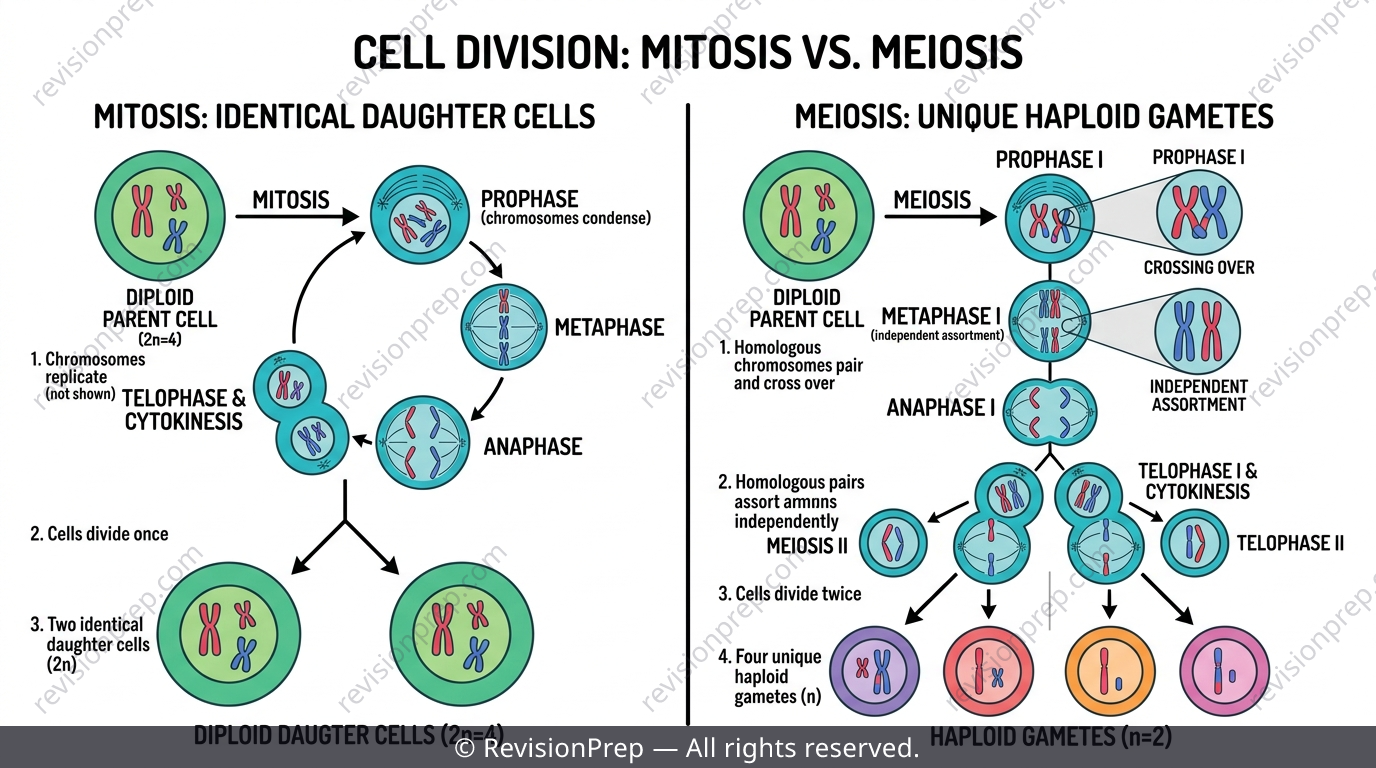
| Feature | Mitosis | Meiosis |
|---|---|---|
| Divisions | One | Two |
| Daughter cells | 2, diploid | 4, haploid |
| Genetic identity | Identical | Unique (variation) |
| Purpose | Growth, repair, asexual reproduction | Gamete formation |
Exam tip
Always name both crossing over AND independent assortment when asked for sources of variation in meiosis — one alone loses marks.
Mini summary
Mitosis maintains chromosome number and identity; meiosis halves chromosome number and generates variation.
Reproduction, Population Growth and Sustainability
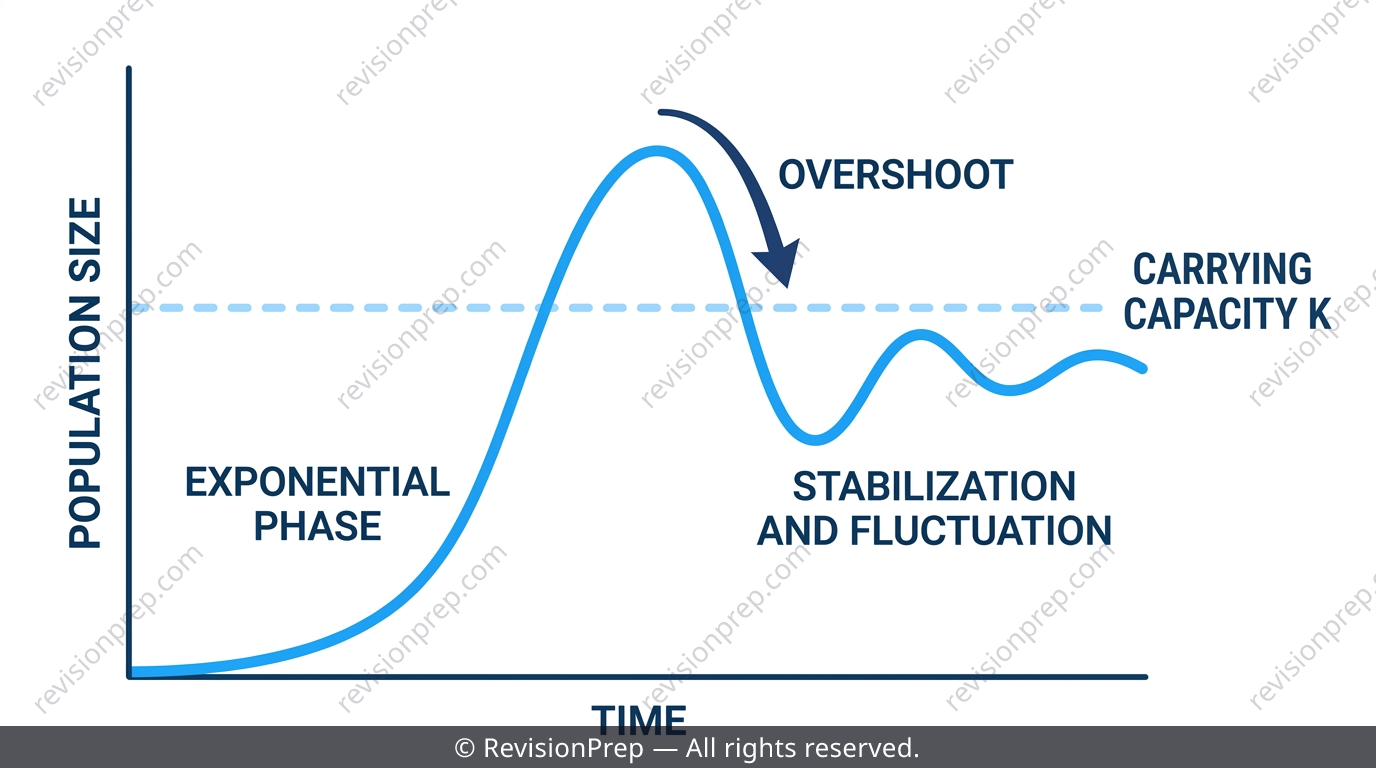
Asexual reproduction (one parent, mitosis-based) produces genetically identical clones fast but with no variation, while sexual reproduction (meiosis + fertilisation) is slower but supplies the genetic variation natural selection needs. This choice of strategy connects directly to population growth: populations grow exponentially while resources are abundant, then slow as density-dependent factors bite, levelling off at carrying capacity . Overshoot beyond triggers a population crash if resources can't regenerate fast enough — the sustainability failure mode examiners like to test.
Mini summary
Asexual = speed, no variation; sexual = variation for selection; populations plateau at carrying capacity unless resources fail to regenerate.
Inheritance and the Chi-Squared Test
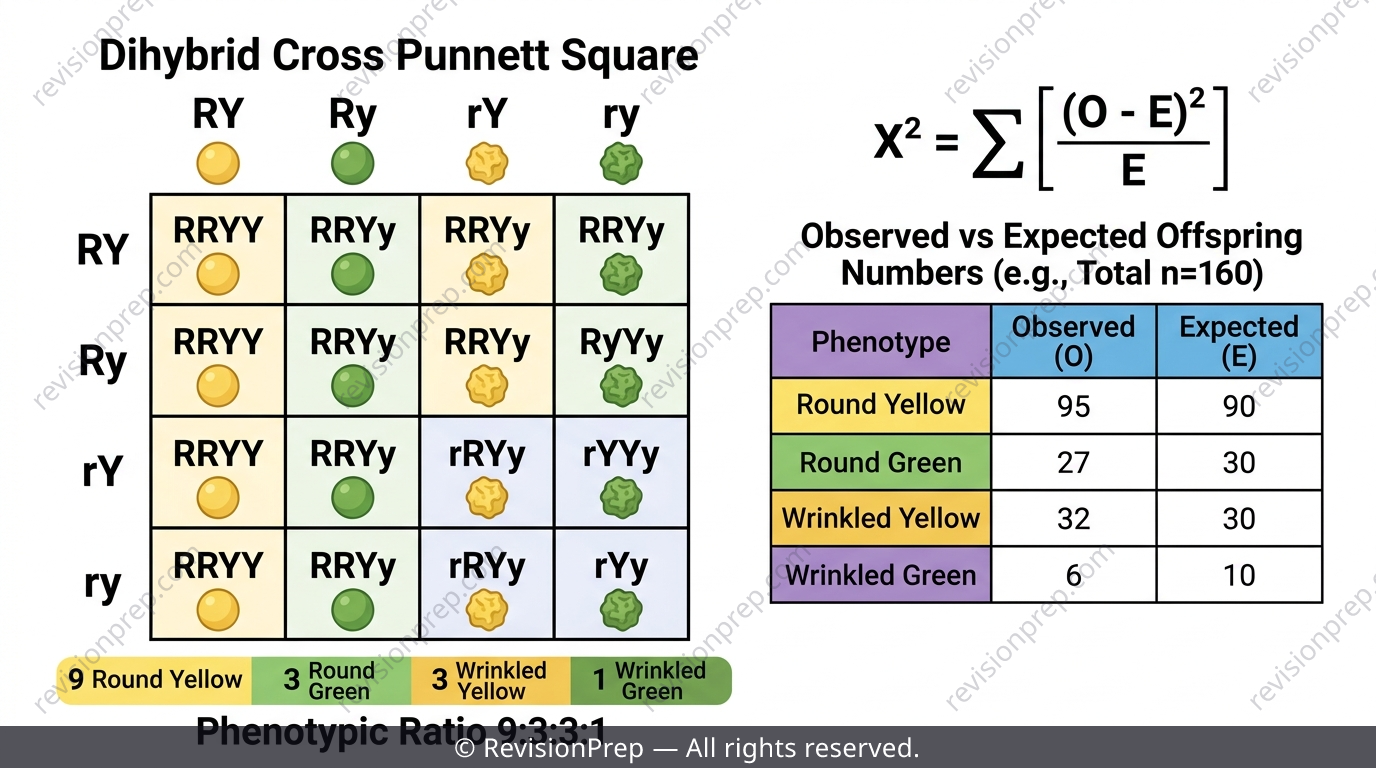
Monohybrid and dihybrid crosses use Punnett squares to predict ratios, with unlinked dihybrid crosses giving the classic 9:3:3:1 ratio. Linked genes on the same chromosome don't assort independently, skewing ratios away from 9:3:3:1, with recombinants arising only from crossing over. At HL, the chi-squared test compares observed offspring ratios to the expected Mendelian ratio to judge whether a deviation is due to chance or a real biological effect such as linkage.
Exam tip
When observed ratios deviate from 9:3:3:1, don't jump straight to 'mutation' — check whether linkage (genes on the same chromosome) explains the skew first.
Mini summary
Chi-squared compares observed vs expected ratios; large deviations point to real effects like gene linkage, not chance.
Quick formula sheet
Practice questions
- State whether the lac operon is inducible or repressible and explain what this means.
- Name the two feedback types found in homeostasis and give one example of each.
- State the number of daughter cells and their genetic identity produced by mitosis.
- Explain why lactose alone produces a stronger transcriptional response than lactose plus glucose.
- A root tip squash shows 12 dividing cells out of 240 counted. Calculate the mitotic index.
- Explain the difference in the outcome of a promoter mutation versus an operator mutation on lac operon expression.
- A dihybrid cross deviates from the expected 9:3:3:1 ratio. Explain how you would use the chi-squared test to decide whether this is due to chance or gene linkage.
- Explain why sexual reproduction is favoured evolutionarily despite being slower than asexual reproduction, linking your answer to natural selection.
- A population overshoots its carrying capacity K. Predict and explain the likely consequence for the population size over time.
Frequently asked questions
Why is the lac operon called inducible rather than repressible?+
Because its default state is OFF, and the presence of lactose (via allolactose) induces expression by removing the repressor — genes are switched ON by the inducer, not switched off by it.
What's the difference between negative and positive feedback in homeostasis?+
Negative feedback counteracts a deviation and restores the set point, dominating most homeostatic systems like blood glucose control. Positive feedback amplifies the change away from the set point and is rare and short-lived, as in childbirth.
What are the two sources of genetic variation in meiosis?+
Crossing over during prophase I and independent assortment during metaphase I. Both must be named explicitly in exam answers.
How do you calculate mitotic index?+
Divide the number of cells observed in mitosis by the total number of cells counted in the sample, giving a fraction or percentage of actively dividing cells.
When do you use the chi-squared test in genetics?+
Use it to compare observed offspring ratios against the expected Mendelian ratio and determine whether any deviation is likely due to chance or a real biological effect, such as gene linkage.
Does RevisionPrep provide past exam papers for this topic?+
No — RevisionPrep provides original mock papers and exam-style practice questions alongside full revision notes, not official past papers.
Master Continuity and Change with the full DP Biology revision notes
Related articles