
Interaction and Interdependence: Photosynthesis, Respiration & Energy Flow
The core DP Biology theme where energy conversion, signalling and ecosystems all run on the same logic
Quick facts
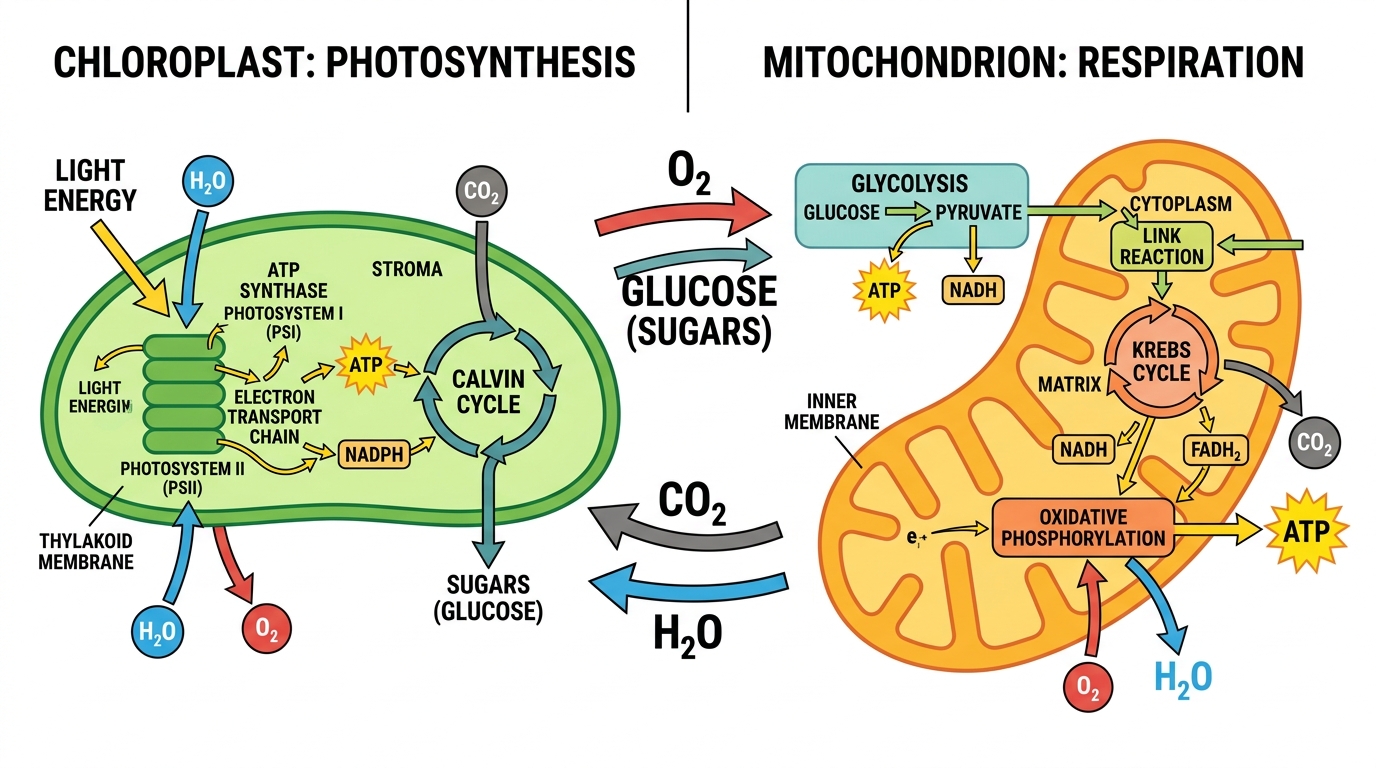
Interaction and Interdependence is one of the four core DP Biology themes, and at its heart sit two engines every exam question keeps returning to: photosynthesis and cell respiration. Both convert energy between light, chemical bonds and heat, and both are built from step-by-step pathways where blocking one link changes everything downstream — exactly the reasoning examiners test in data-based Paper 1 and Paper 3 questions. This teaser walks through the light reactions and Calvin cycle, the limiting-factor logic behind photosynthesis graphs, HL's C4/CAM adaptations, the full respiration chain from glycolysis to oxidative phosphorylation, and how respiratory quotient (RQ) data reveals which substrate a cell is burning. Master these five ideas and you'll be ready to read any graph, predict any 'what if you block X' question, and calculate RQ or ATP yield with confidence — the full revision notes go deeper into every mechanism, formula and worked example.
What you’ll be able to do
Light Reactions and the Calvin Cycle
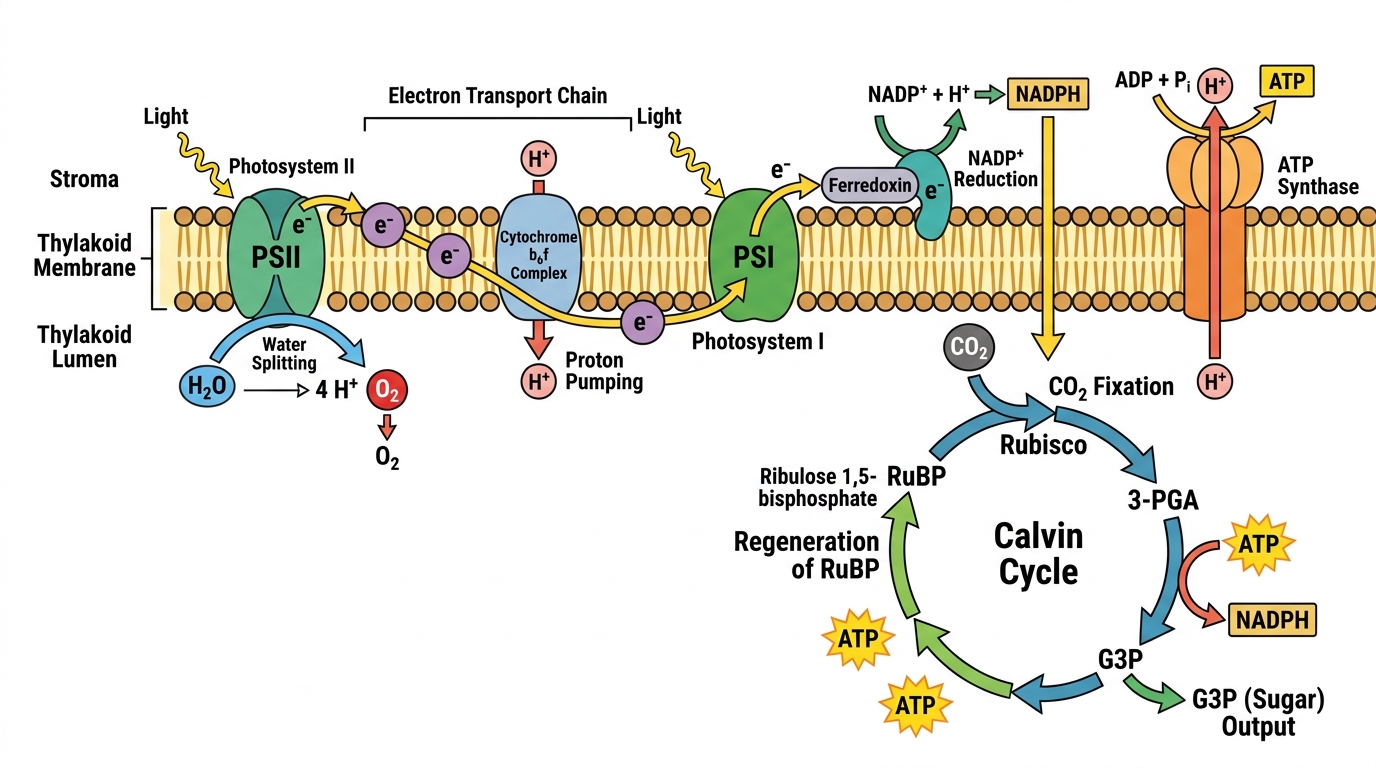
Photosystem II absorbs light, splits water to release , and feeds excited electrons into an electron transport chain that pumps into the thylakoid lumen, driving ATP synthase (photophosphorylation). Electrons re-excited at Photosystem I reduce to NADPH. The Calvin cycle, in the stroma, doesn't need light directly — it needs the ATP and NADPH just made, plus and rubisco, to turn RuBP into 3-PGA and eventually G3P.
Exam tip
If chloroplasts move into darkness, don't assume the Calvin cycle stops instantly — residual ATP and NADPH keep it running briefly until those pools run out.
Common mistake
Assuming a sudden rise in speeds up the whole cycle equally. In reality, fixation speeds up first, so 3-PGA rises and RuBP falls before ATP/NADPH-dependent regeneration catches up.
Mini summary
Light reactions make ATP + NADPH and release O2; the Calvin cycle uses those products (not light itself) to fix CO2 into sugar.
Limiting Factors, Photorespiration & C4/CAM (HL)
Light intensity, concentration and temperature each cap the rate of photosynthesis at a different step, so a rate-vs-factor graph plateaus once a different factor becomes limiting. At HL, when is low and is high (hot, dry, stomata closed), rubisco binds instead, wasting energy via photorespiration. C4 plants fix first with PEP carboxylase in mesophyll cells then shuttle it to bundle-sheath cells for the Calvin cycle; CAM plants use the same two-enzyme trick but separate it in time instead of space.
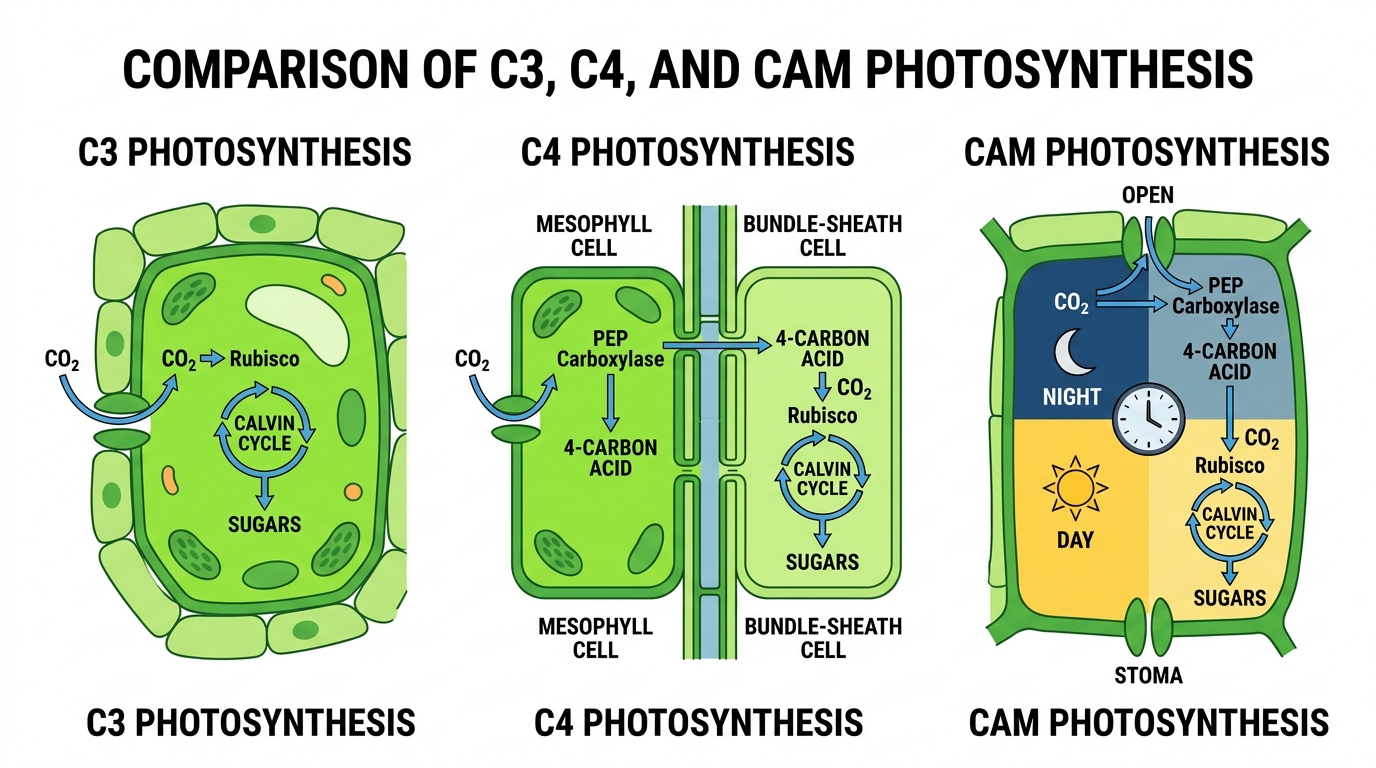
| Feature | C3 | C4 | CAM |
|---|---|---|---|
| Initial CO2-fixing enzyme | Rubisco | PEP carboxylase (mesophyll) | PEP carboxylase (night) |
| Where Calvin cycle runs | Mesophyll cells | Bundle-sheath cells | Same cells, by day |
| Separation strategy | None | Spatial (two cell types) | Temporal (night vs day) |
Exam tip
C4 and CAM solve the same problem — avoiding photorespiration when stomata must stay closed — using two different strategies: space vs time.
Mini summary
Limiting factors cap photosynthesis rate step by step; C4 and CAM both avoid photorespiration by keeping rubisco away from high O2/low CO2 conditions.
Cell Respiration: Glycolysis to Oxidative Phosphorylation
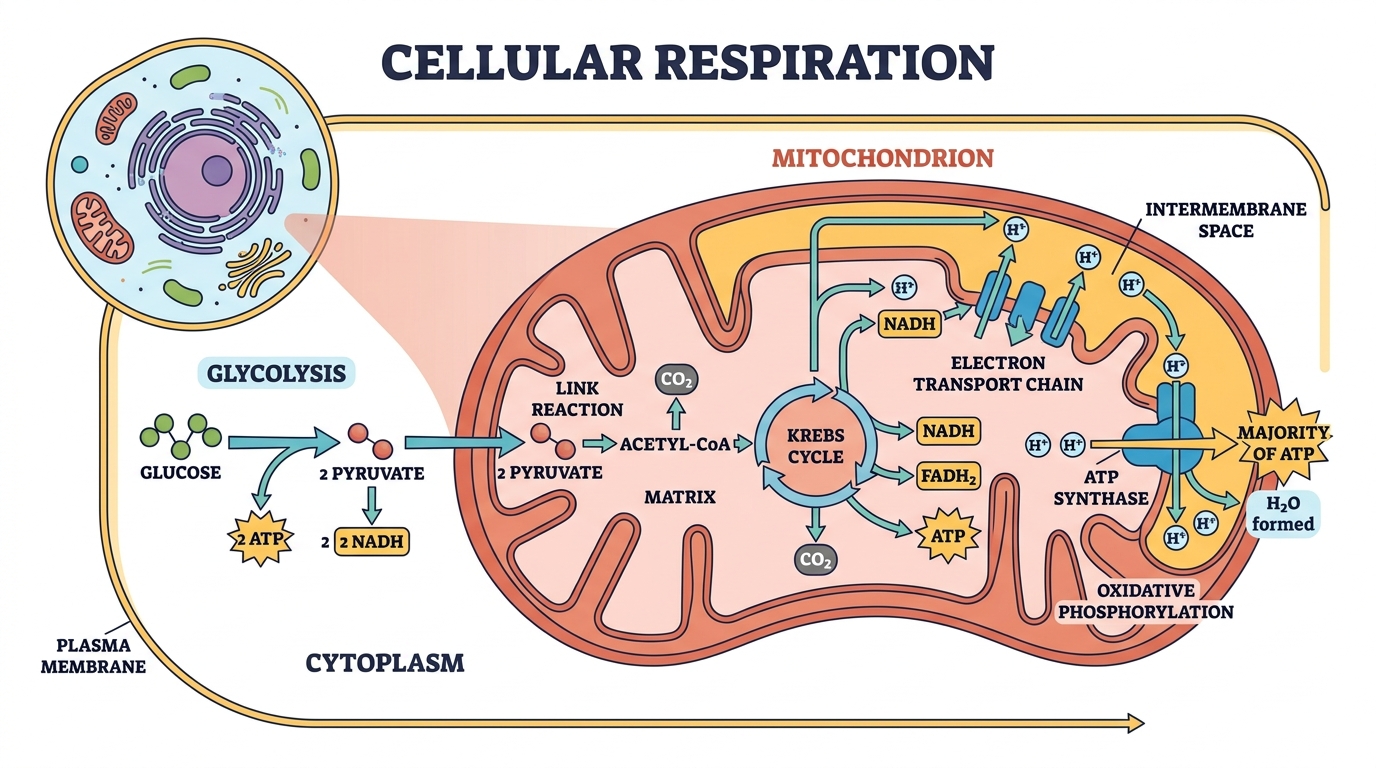
Glycolysis in the cytoplasm splits glucose into 2 pyruvate, netting 2 ATP and 2 NADH, with or without oxygen. If oxygen is present, the link reaction converts pyruvate to acetyl-CoA (releasing and NADH), and the Krebs cycle in the mitochondrial matrix fully oxidises it, generating NADH, and a little ATP. The real payoff comes from oxidative phosphorylation on the inner mitochondrial membrane, where NADH/ feed an electron transport chain that pumps protons and drives ATP synthase to make the bulk of the roughly 30 ATP per glucose.
Exam tip
Quote ATP yield per glucose as approximately 30 (sometimes 32) and focus on WHERE it comes from — oxidative phosphorylation, not substrate-level phosphorylation — rather than memorising an exact number.
Mini summary
Glycolysis, the link reaction and the Krebs cycle strip electrons onto NADH/FADH2; oxidative phosphorylation then converts that electron flow into the majority of the ATP yield.
Fermentation and the Respiratory Quotient (RQ)
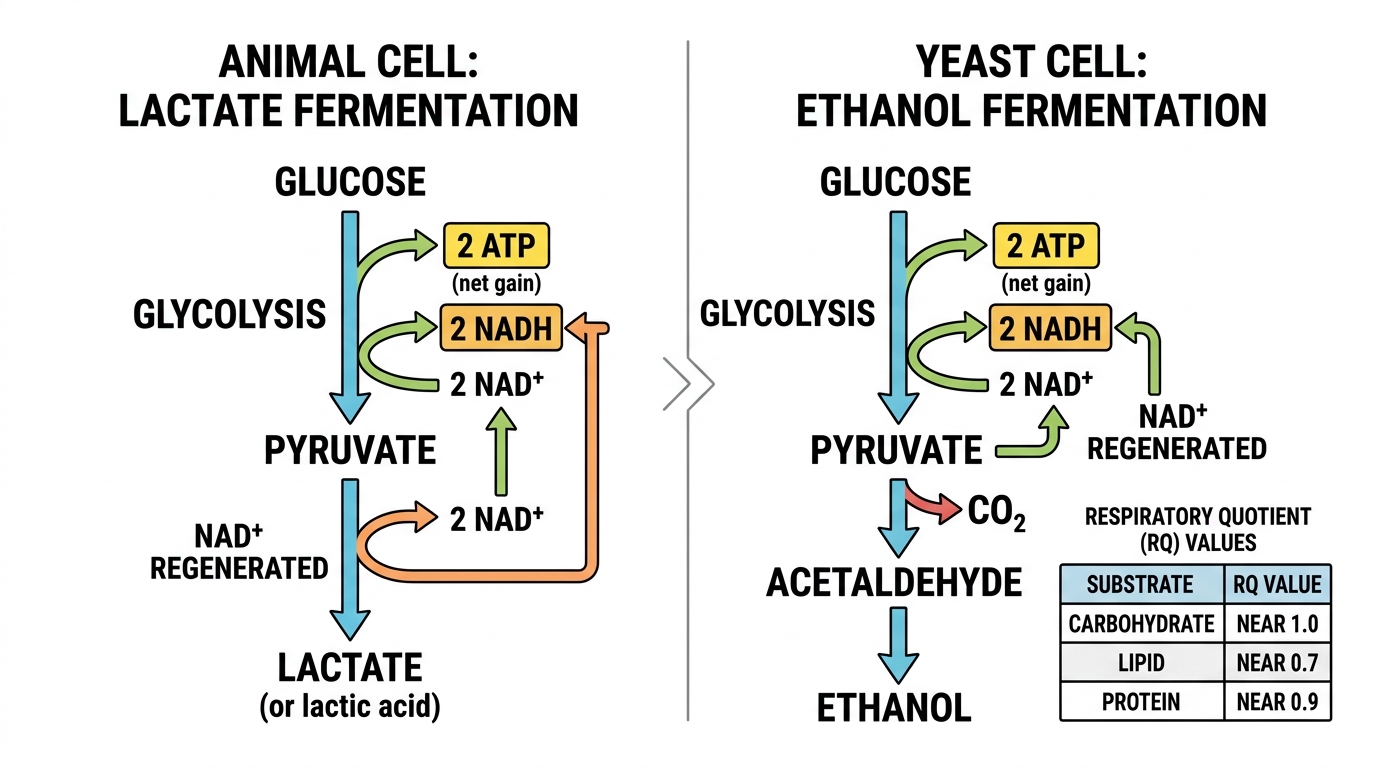
Without oxygen, the electron transport chain backs up, so cells regenerate via fermentation — lactate in animal muscle, ethanol in yeast and plants — which lets glycolysis (and its 2 ATP) keep running. The respiratory quotient, produced over consumed, reveals which substrate is being respired: close to 1.0 signals carbohydrate, around 0.7 signals lipid, around 0.9 signals protein.
Exam tip
Always check which gas is on top of the RQ fraction before interpreting a substrate — dividing O2 by CO2 instead of CO2 by O2 flips every conclusion.
Common mistake
Saying anaerobic respiration produces 'no ATP'. Glycolysis itself still nets 2 ATP regardless of oxygen — fermentation exists purely to regenerate NAD+, not to add extra ATP.
Mini summary
Fermentation regenerates NAD+ so glycolysis can continue; RQ data (CO2 produced / O2 consumed) identifies the respiratory substrate.
The 'Block Step X' Exam Skill
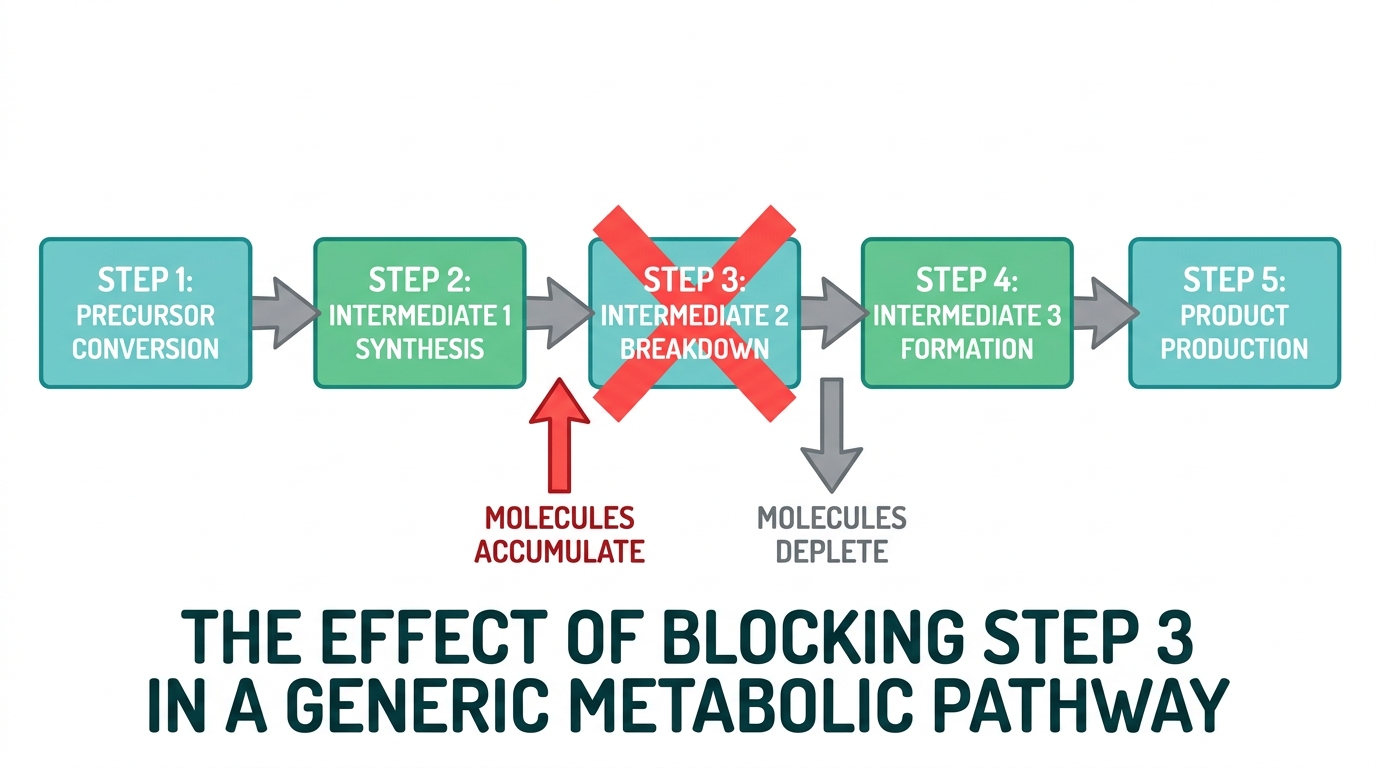
Across this whole theme, examiners repeatedly ask what happens if you remove one link in a chain — blocking a channel, moving chloroplasts into darkness, or raising suddenly. These questions reward tracing the pathway logically: identify which step is blocked, then reason forward about which products build up and which run out. Data-based questions (isotope ratios, dose–response curves, dye reduction rates) test the same skill through graphs and tables rather than diagrams.
Exam tip
Before answering a 'what if' question, sketch the pathway in order and mark exactly where the block occurs — the answer is almost always about what accumulates upstream and what depletes downstream.
Mini summary
Most exam questions in this theme test the same reasoning: locate the blocked step, then predict what builds up before it and what runs low after it.
Quick formula sheet
Practice questions
- Name the two products of the light-dependent reactions that the Calvin cycle depends on.
- State where in the cell glycolysis takes place.
- Define photorespiration.
- Explain why a sudden increase in CO2 concentration causes RuBP to fall and 3-PGA to rise before ATP/NADPH levels catch up.
- Explain why anaerobic respiration in muscle still nets ATP despite producing no ATP via oxidative phosphorylation.
- Calculate the RQ for a seed consuming 3.0 dm³ O2 and producing 2.1 dm³ CO2 per hour, and identify the likely respiratory substrate.
- Predict the immediate effect on stromal ATP and NADPH levels if a herbicide blocks electron flow between Photosystem II and Photosystem I.
- Explain how the spatial separation of PEP carboxylase and rubisco in C4 plants prevents photorespiration under hot, dry conditions.
- A yeast culture switches from aerobic to anaerobic conditions. Predict and explain the change in ATP yield per glucose and the fate of pyruvate.
Frequently asked questions
What is the Interaction and Interdependence theme in IB DP Biology?+
It's one of the four core DP Biology themes, linking photosynthesis, cell respiration, defence, neural signalling, energy/matter transfer, populations/communities and enzymes through a shared logic of signal recognition and controlled, reversible processes.
Why doesn't the Calvin cycle stop the instant light disappears?+
ATP and NADPH made during illumination persist briefly, so a few more turns of the Calvin cycle can run in darkness before those pools are used up.
What's the difference between C3, C4 and CAM photosynthesis?+
C3 fixes CO2 directly with rubisco. C4 pre-fixes CO2 with PEP carboxylase in mesophyll cells then releases it for rubisco in separate bundle-sheath cells (spatial separation). CAM does the same two-enzyme trick but fixes CO2 at night and runs the Calvin cycle by day (temporal separation).
Does anaerobic respiration really produce zero ATP?+
No — glycolysis nets 2 ATP with or without oxygen. Fermentation (lactate or ethanol) simply regenerates NAD+ so glycolysis can keep running; it doesn't add extra ATP itself.
How do I interpret a respiratory quotient (RQ) value?+
RQ is CO2 produced divided by O2 consumed. A value near 1.0 suggests carbohydrate substrate, around 0.7 suggests lipid, and around 0.9 suggests protein.
Why do examiners ask 'what happens if you block step X'?+
Because tracing a pathway logically — identifying what builds up before a block and what depletes after it — is the core skill tested throughout this theme, from Calvin cycle intermediates to ion channels in signalling.
Get the Full Interaction and Interdependence Revision Notes
Related articles