
Introduction to Economics
The scarcity, opportunity cost and PPC vocabulary that resurfaces in every IB DP Economics essay
Quick facts
Before you can tackle a Paper 1 essay on market failure or a Paper 2 data-response on trade, you need the reasoning toolkit examiners assume you already have. This IB DP Economics teaser covers the five ideas from Introduction to Economics that quietly resurface everywhere: how economists build simplified models using ceteris paribus, why statements split into positive (testable) and normative (value-laden), why scarcity forces every economic agent to accept an opportunity cost, how the production possibility curve models choice between two goods, and how tariffs, quotas and subsidies distort trade. Get these foundations solid and diagrams like the PPC, plus command terms like 'explain' and 'evaluate', stop feeling abstract. The full revision note goes deeper into worked PPC calculations, economic systems, and every trade protection tool with diagrams and exam-ready definitions.
What you’ll be able to do
How Economists Think: Models & Ceteris Paribus
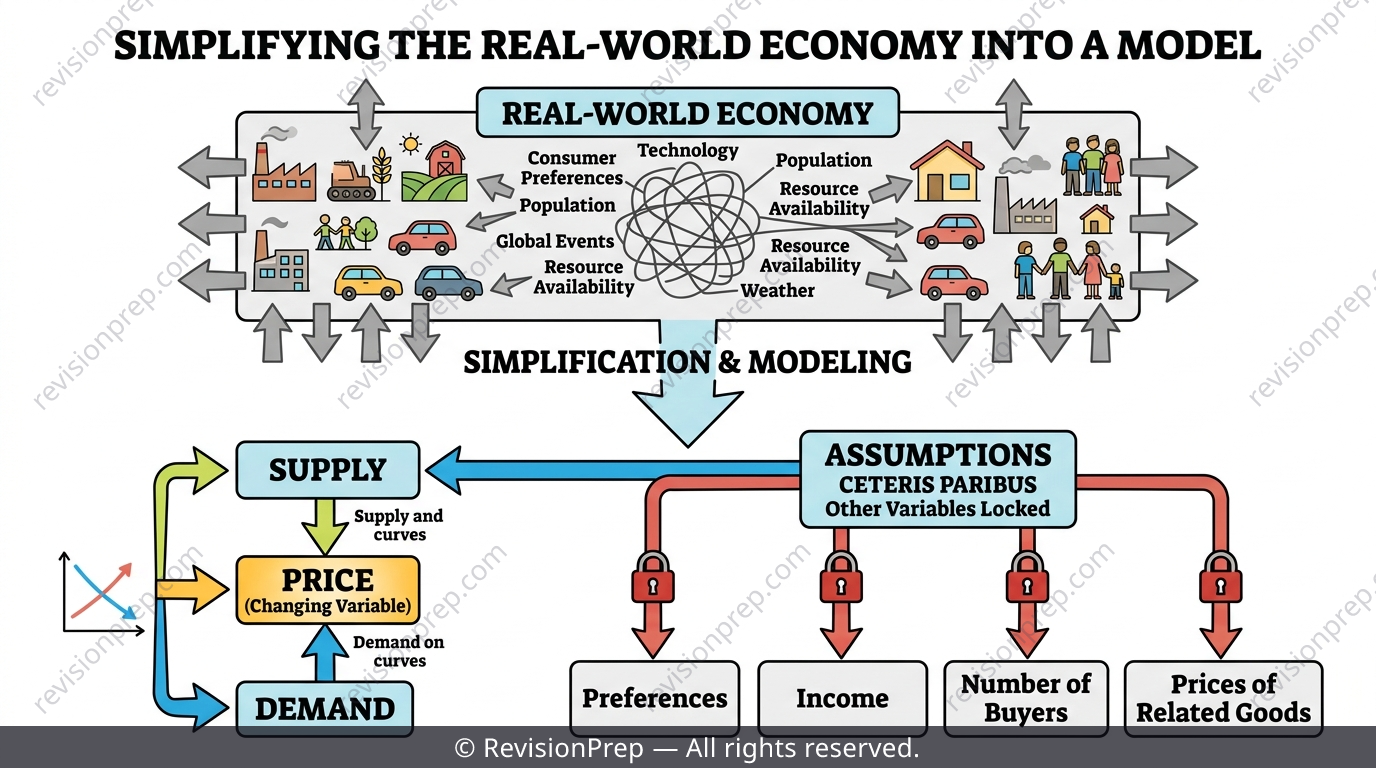
Economists can't run controlled lab experiments on a whole economy, so they build models — simplified representations of reality resting on stated assumptions. Ceteris paribus ('all other things held constant') lets you isolate one variable at a time, like asking what happens to quantity demanded when price alone changes. The rational agent assumption (firms maximise profit, consumers maximise utility) is a simplifying device, not a claim people never err — models are judged by usefulness, not photographic accuracy.
Exam tip
When a question asks you to 'explain the shift' of a demand or supply curve, state explicitly which other variables you're holding constant before describing the shift — markschemes often award a discrete point for this qualifier.
Positive vs Normative Economics
Positive statements describe what IS the case and can be tested against evidence, such as measuring unemployment or output. Normative statements involve a value judgement about what SHOULD happen — fair, best, too high, ought — and can't be settled by data alone. Most real policy debates blend both: a minimum wage rise has measurable positive effects on employment, plus a normative question of whether that trade-off is fair.

Common mistake
Students classify 'Unemployment of 12% is too high' as positive because it contains a statistic. Scan for evaluative language (should, fair, too high/low, best, ought) — its presence makes a statement normative regardless of the data around it.
Scarcity, Opportunity Cost & Economic Systems
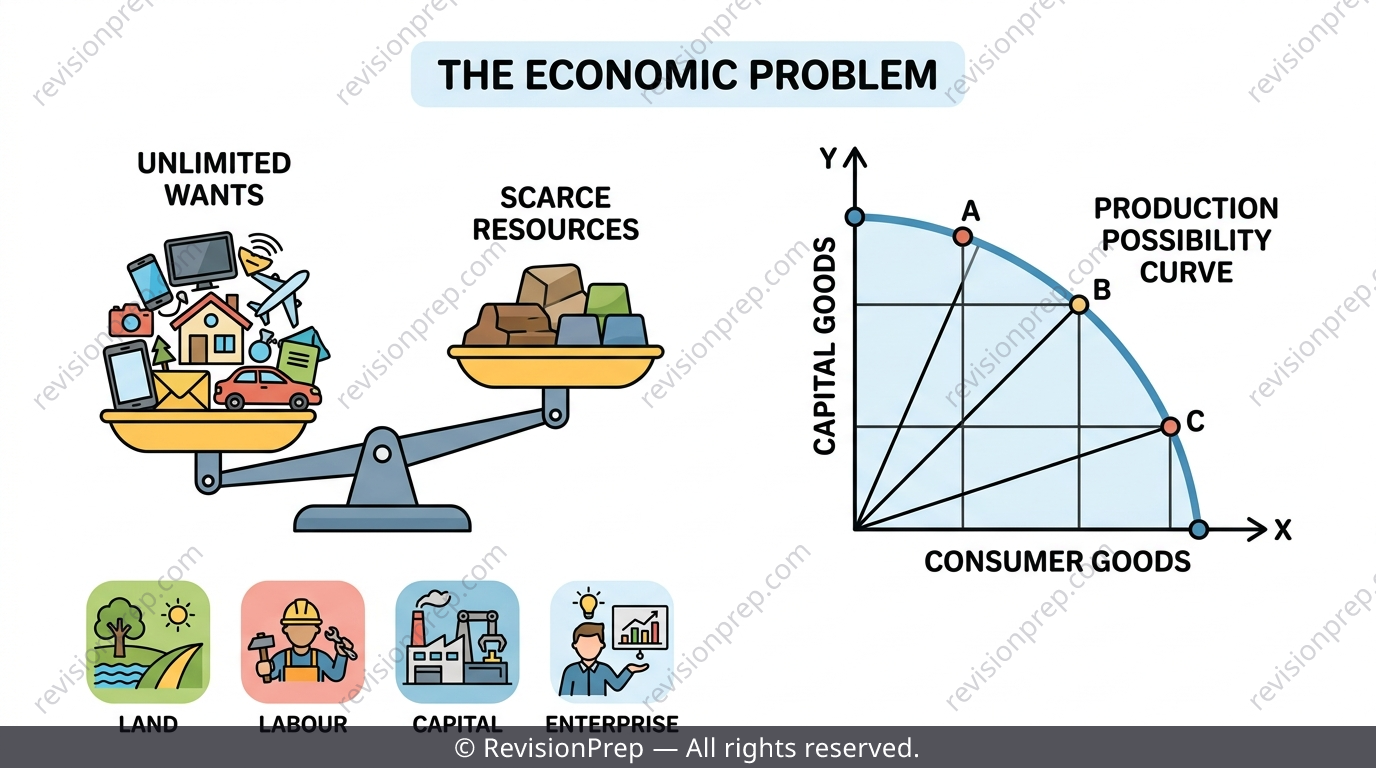
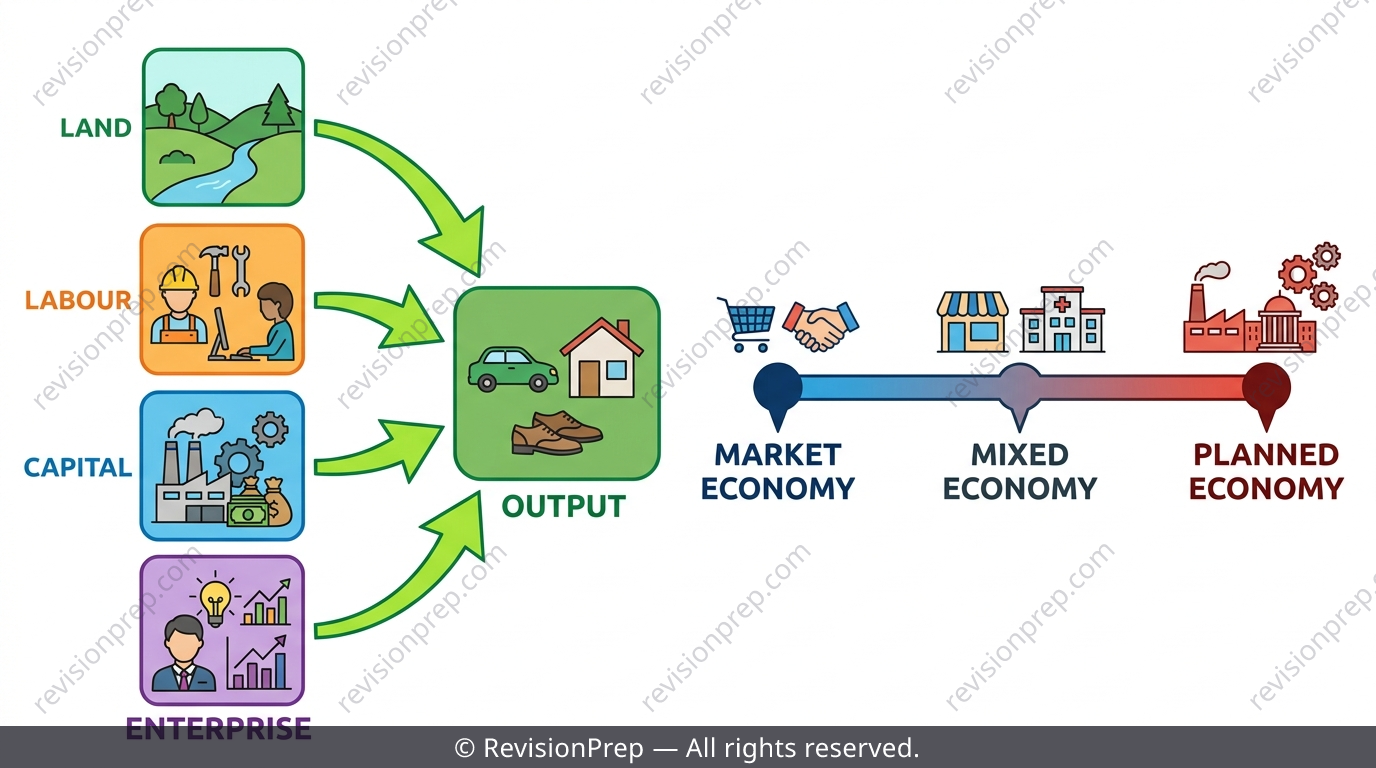
The fundamental economic problem is that human wants are unlimited but resources are scarce, so every choice forgoes an alternative — that forgone alternative is the opportunity cost. Four factors of production combine to create output: land, labour, capital and enterprise (the organiser who bears risk and earns profit). Every economy must decide what, how and for whom to produce, and the answer depends on its economic system: market (price mechanism decides), planned (central authority decides), or mixed (a blend, where every real economy actually sits).
The Production Possibility Curve (PPC)
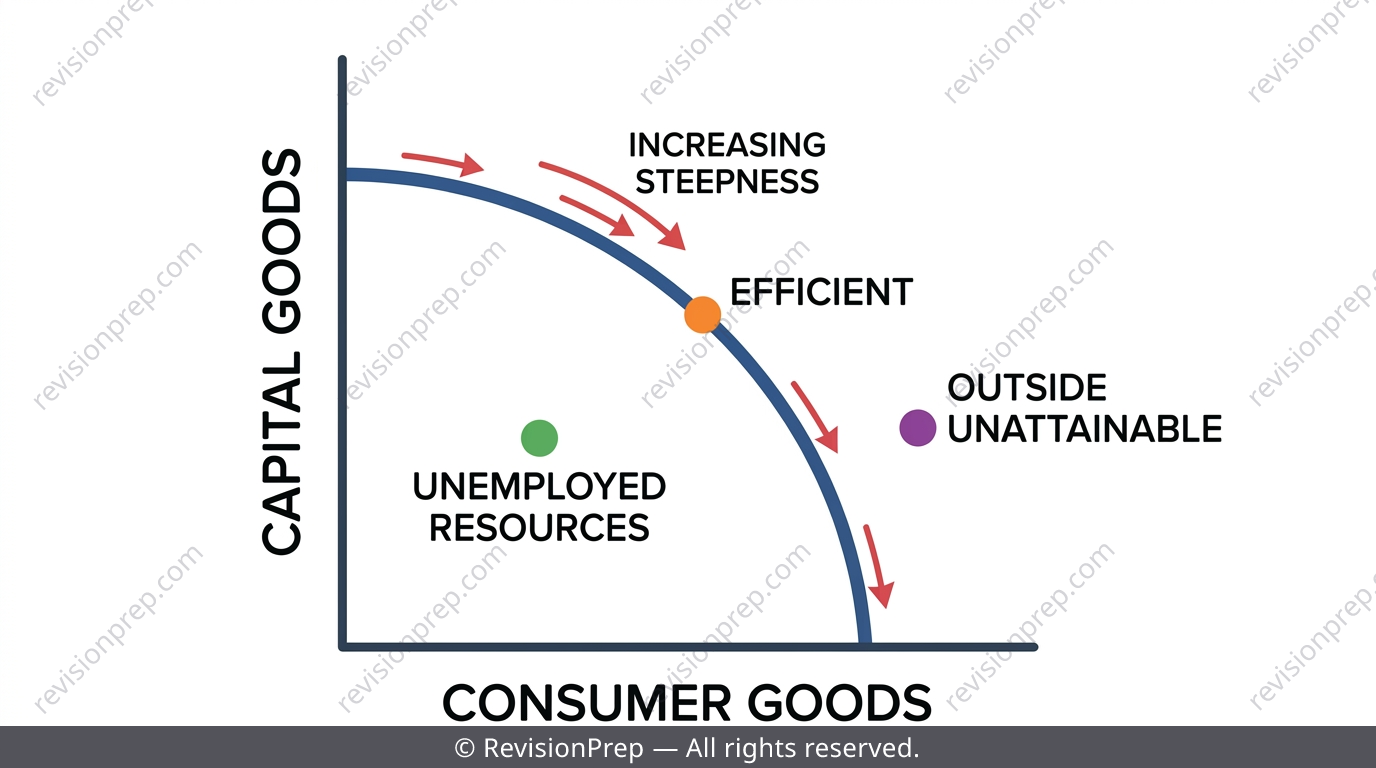
The PPC models scarcity and choice for an economy producing two goods: points ON the curve are productively efficient, points INSIDE show unemployed resources, and points OUTSIDE are currently unattainable. The curve is bowed outward because resources aren't perfectly substitutable between the two goods, so opportunity cost rises the further production is pushed toward one good — the law of increasing opportunity cost. Opportunity cost between two points equals the magnitude of the gradient, , so always convert to a per-unit ratio before comparing unequal intervals.
Common mistake
Drawing or describing the PPC as linear and stating opportunity cost is 'constant'. Always draw it bowed outward and link the increasing steepness to imperfect substitutability of resources between the two goods.
Types of Trade Protection
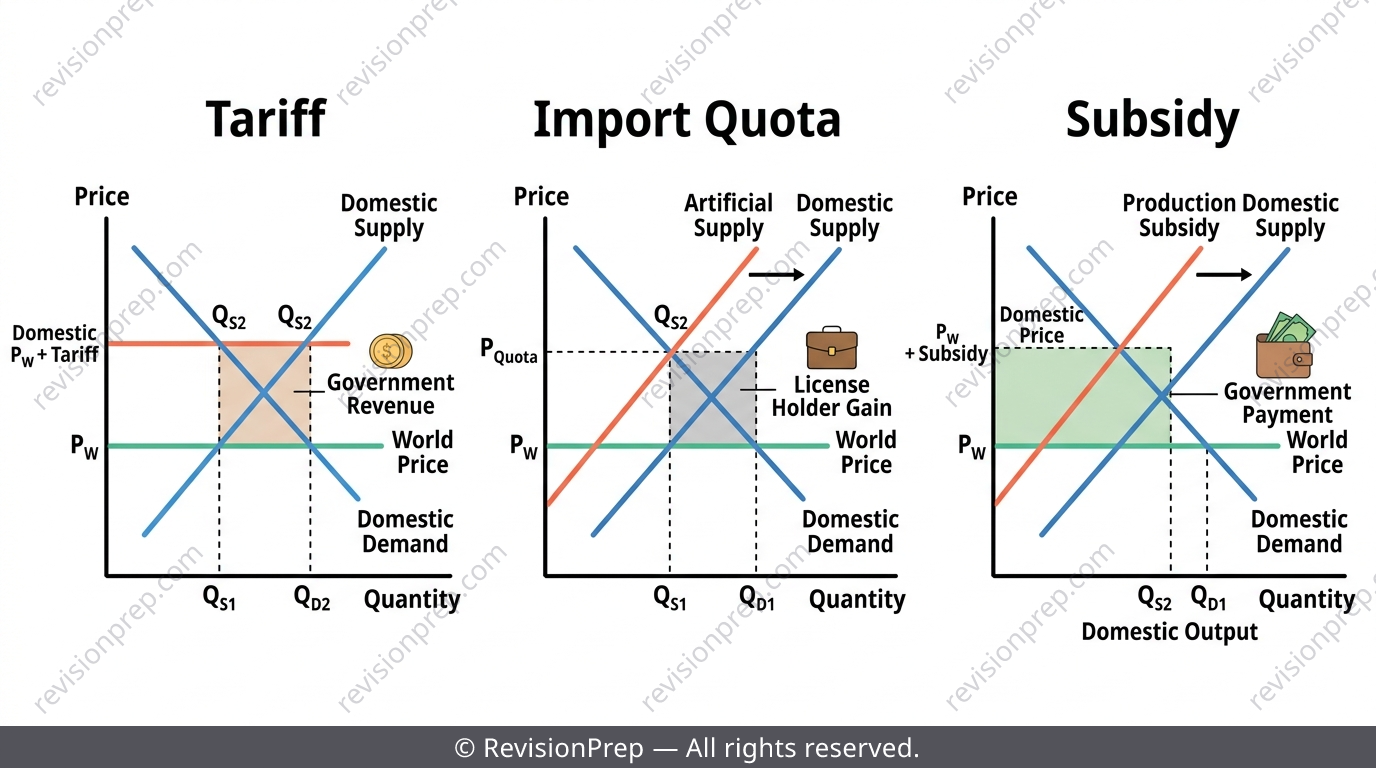
Trade protectionism is any government policy favouring domestic producers over foreign competitors, often justified by infant-industry, jobs, security or trade-deficit arguments — but most tools create a net welfare loss. A tariff (tax on imports) raises domestic price and output plus generates government revenue, but shrinks consumer surplus by more than producers and government gain combined. An import quota caps the physical quantity imported with similar price effects, but the government earns no automatic revenue — the 'quota rent' goes to whoever holds the import licence unless licences are auctioned. Subsidies pay domestic producers per unit, lowering their effective costs so they can compete with cheaper imports.
Quick formula sheet
Practice questions
- Define opportunity cost in your own words.
- Name the four factors of production.
- Give one example each of a positive and a normative economic statement.
- Explain why a production possibility curve is typically bowed outward rather than a straight line.
- Distinguish between a market economy, a planned economy and a mixed economy.
- Explain why an import quota does not automatically generate government revenue, unlike a tariff.
- Using two points on a curved PPC, explain why the opportunity cost of producing more of one good rises as more resources are shifted into it.
- Evaluate whether ceteris paribus makes economic models more useful or less realistic, using an example.
- Discuss why a tariff can raise government revenue and domestic output while still causing a net welfare loss for the economy.
Frequently asked questions
What is the fundamental economic problem?+
Human wants are unlimited but resources are scarce, so every choice forces society, firms and individuals to give up an alternative — that forgone alternative is the opportunity cost.
How do I tell a positive statement from a normative one?+
Look for evaluative language like 'should', 'fair', 'best' or 'too high' — if it's there, the statement is normative even if it also includes hard data; positive statements can be tested against evidence alone.
Why is the PPC curved instead of a straight line?+
Resources aren't perfectly substitutable between two goods, so pushing more resources into one good means using resources progressively less suited to it — this is the law of increasing opportunity cost, and it bows the curve outward.
What's the difference between a tariff and an import quota?+
A tariff is a tax on imports that raises government revenue; a quota is a physical limit on import quantity that generates no automatic government revenue, with the 'quota rent' instead going to licence holders.
Why do economists use ceteris paribus?+
Because economists can't run controlled experiments on a whole economy, ceteris paribus lets them isolate the effect of one variable — like price — while assuming everything else stays constant.
Is Introduction to Economics tested as its own exam question?+
Not as a standalone essay topic, but its concepts — scarcity, opportunity cost, positive/normative, data classification and trade protection — appear inside Paper 1 essays and Paper 2/3 data-response questions across all four syllabus sections.
Get the Full Introduction to Economics Revision Notes
Related articles