
Introduction to Economics
Scarcity, choice and the exam trap that costs marks all year: positive vs normative statements
Quick facts
Every IB Economics essay eventually comes back to one idea: resources are scarce, wants are not, so choices must be made — and every choice has an opportunity cost. This foundational unit sets up the vocabulary and diagrams (the PPC, the circular flow, the rational agent) that examiners expect you to use accurately from Paper 1 right through to your IA. It also hides one of the most heavily tested traps in the whole syllabus: separating positive statements (testable facts) from normative statements (value judgements) inside a single compound sentence. Get that split wrong and you can lose marks even when your economics is otherwise correct. This teaser walks through the five ideas worth locking down first — scarcity and opportunity cost, the three basic economic questions and economic systems, positive vs normative, the PPC, and the rational-agent assumption versus behavioural economics — before you head to the full revision notes for worked examples and the complete diagram set.
What you’ll be able to do
Scarcity: the problem every economy shares
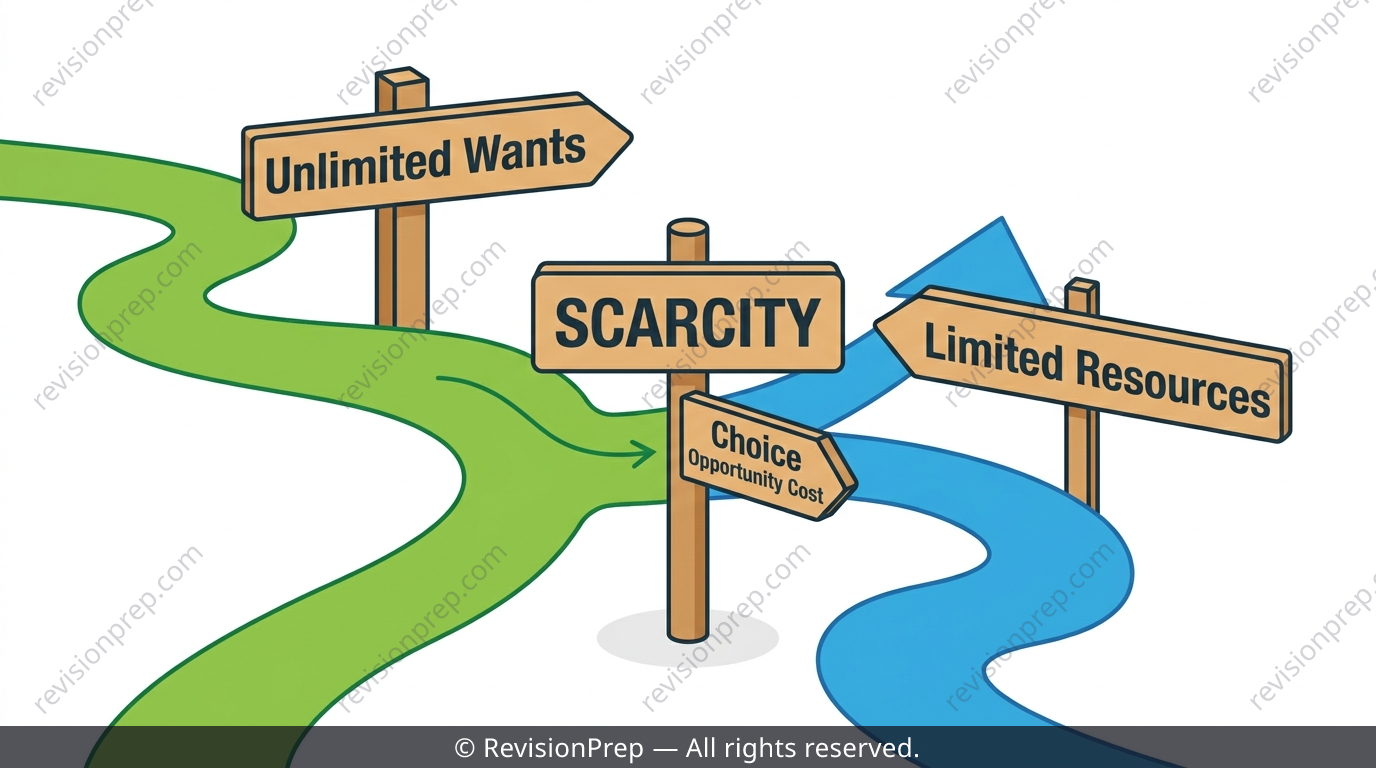
Human wants are unlimited, but land, labour, capital and enterprise are not — that gap is scarcity, and it's the reason economics exists at all. Because a resource used one way can't be used another way at the same time, every choice comes with an opportunity cost: the value of the next best alternative given up. This single idea underpins the PPC, trade-offs in government budgets, and almost every 'explain' question in the course.

Exam tip
Whenever a question asks you to 'explain the cost' of a decision, examiners want opportunity cost named explicitly, not just 'it costs money'.
Mini summary
Scarcity forces choice; choice always has an opportunity cost.
Three questions, three systems, four factors
Every economy — however it's organised — must answer what to produce, how to produce it, and for whom. Free market economies answer these through the price mechanism with private ownership; command economies use central state planning and state ownership; mixed economies, which almost every real-world country runs, blend the two. Output itself is created by combining land (rent), labour (wages), capital (interest) and enterprise (profit).
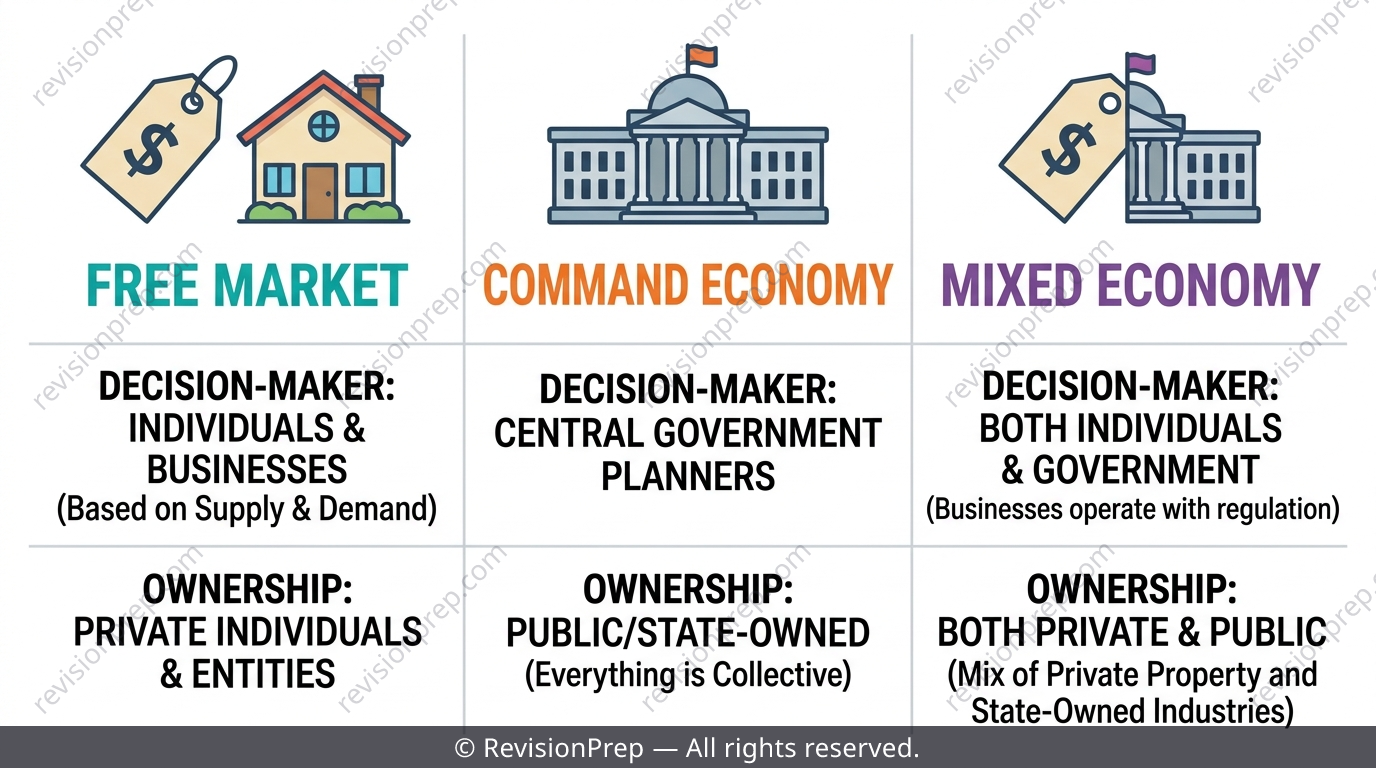
| System | Who decides? | Ownership |
|---|---|---|
| Free market | Price mechanism (supply & demand) | Private |
| Command/planned | Central authority (the state) | State |
| Mixed | Market forces + government intervention | Private and public |
Mini summary
Systems differ in who answers the three questions and who owns the factors of production.
Positive vs normative: the split that decides your marks
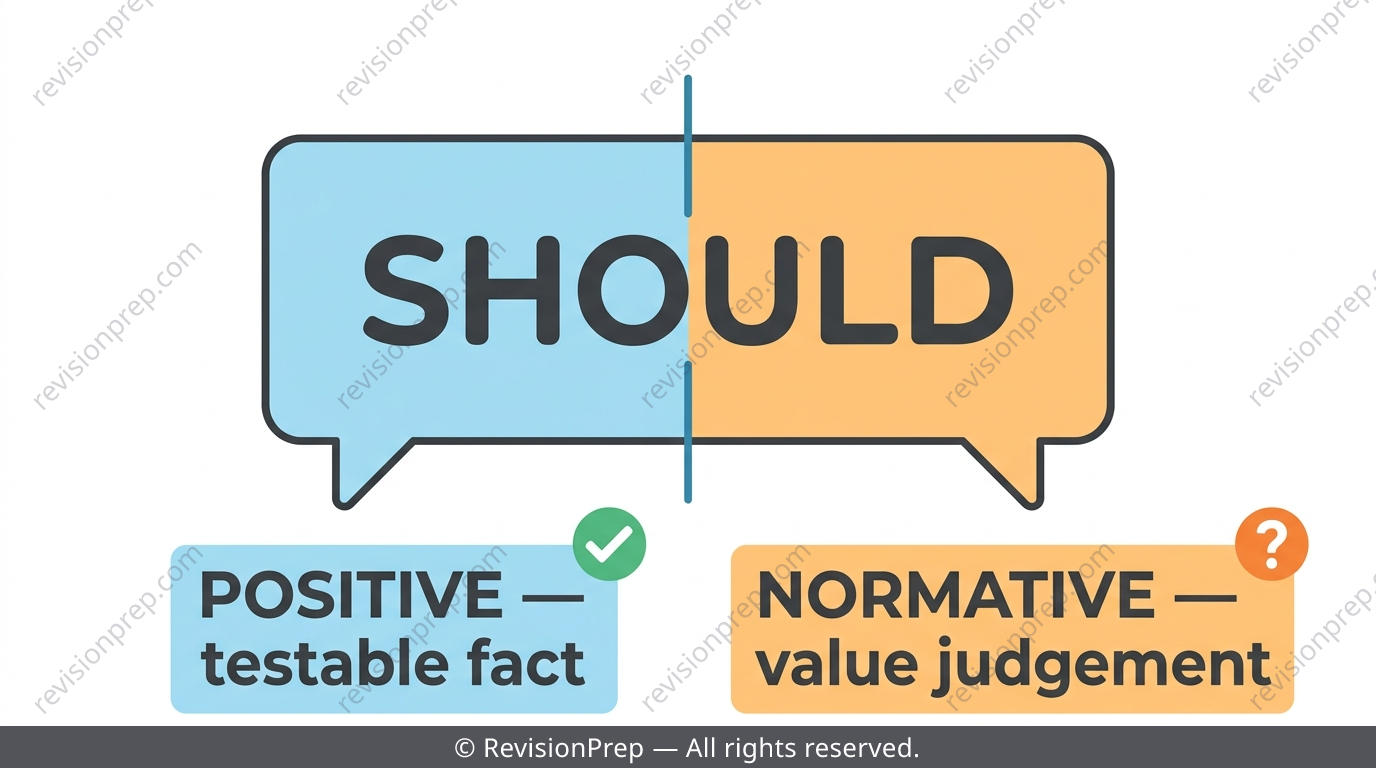
Positive economics deals with testable statements of fact; normative economics deals with value judgements about what 'should' happen. The exam skill isn't defining the two terms — it's spotting that real policy sentences almost always mix both, and cutting the sentence at the value-laden word ('too', 'should', 'must', 'fair').
Exam tip
When two economists disagree, name the type of disagreement explicitly: an empirical dispute (over data/estimates, resolvable — positive) or an ethical dispute (over fairness, never resolvable by data — normative).
Common mistake
Labelling any sentence with a statistic as automatically 'positive', even when a value judgement is attached in the same clause (e.g. '6.2% is too high').
Mini summary
Split compound statements at the value-laden word; positive = testable, normative = a judgement.
The PPC: opportunity cost you can draw
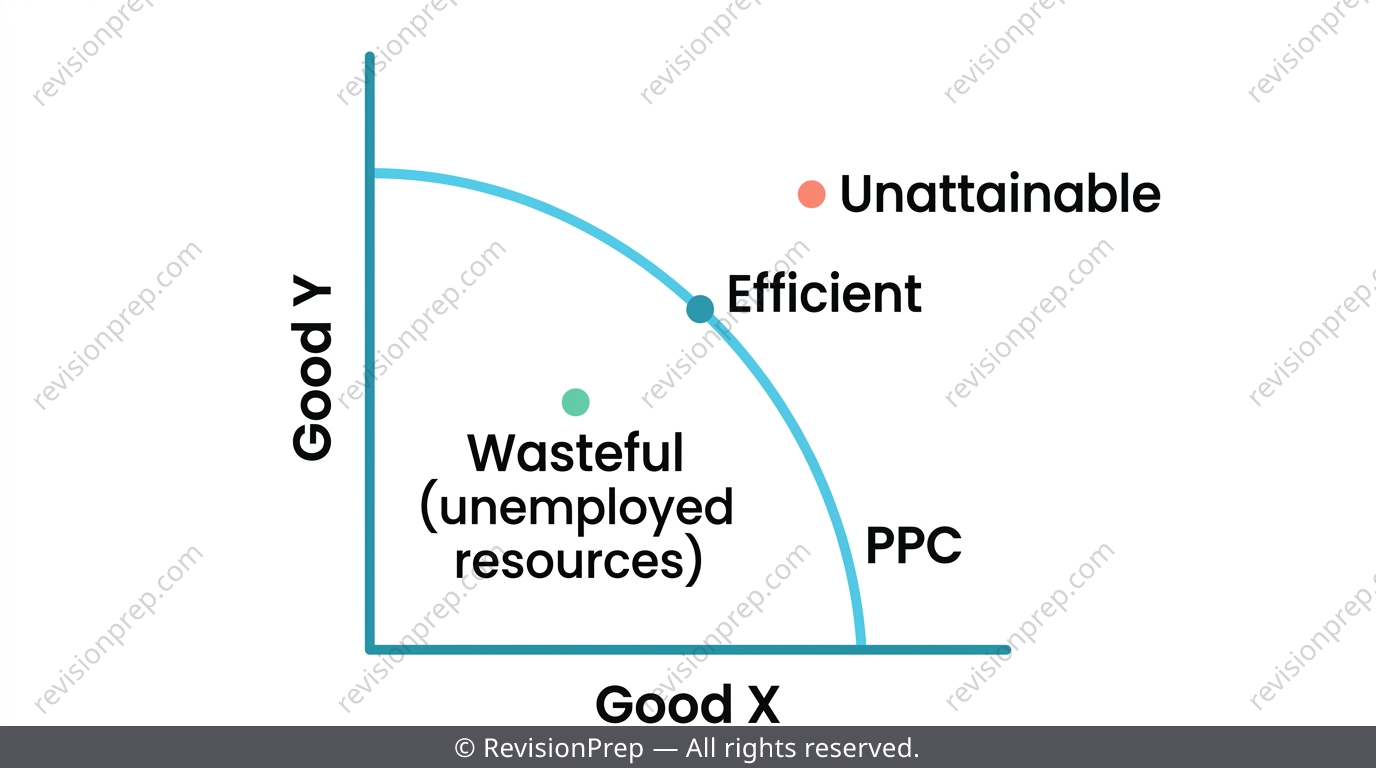
The production possibility curve shows the maximum combinations of two goods an economy can produce with fixed resources and technology. Points on the curve are efficient, points inside are attainable but wasteful (unemployed resources), and points outside are currently unattainable. The curve's outward bow reflects rising opportunity cost as resources aren't equally suited to producing both goods, and its slope at any point is the marginal rate of transformation.
Exam tip
If asked why opportunity cost differs at different points on the curve, explain the resource-suitability reason — don't just restate 'because the PPC is bowed outward'.
Common mistake
Calling a point outside the PPC merely 'inefficient' (that's a point inside) or a point inside the PPC 'impossible' (that's a point outside).
Mini summary
On the curve = efficient, inside = wasteful, outside = unattainable (for now).
Rational agents, ceteris paribus, and the behavioural pushback
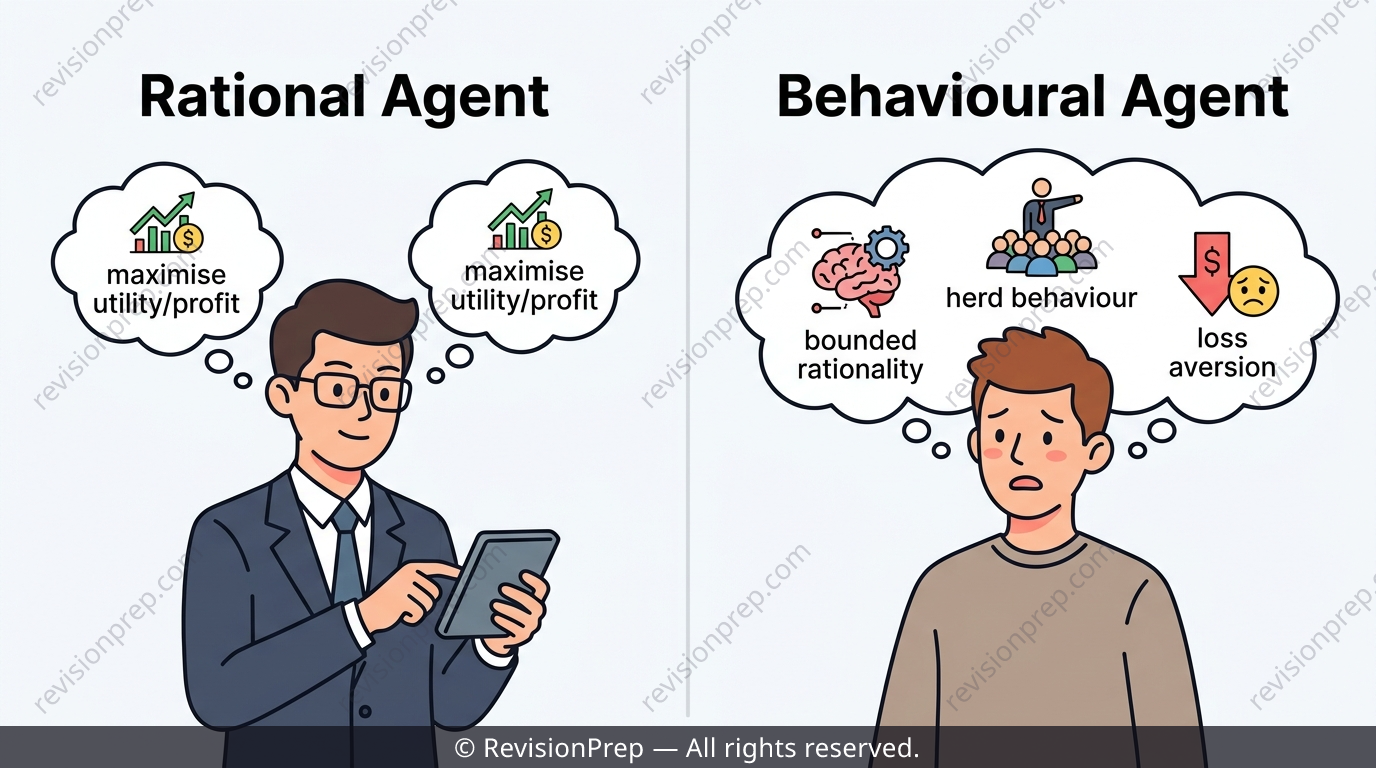
Economists build models using simplifying assumptions: ceteris paribus (holding all else constant) and a rational agent who always maximises utility or profit. That lets a testable, positive prediction be derived and checked against data. Behavioural economics challenges the rational-agent assumption, showing real people display bounded rationality, herd behaviour and loss aversion — meaning 'perfectly rational' models can miss real-world outcomes.
Mini summary
Traditional models assume rational agents under ceteris paribus; behavioural economics shows real deviations.
Quick formula sheet
Practice questions
- Define scarcity and opportunity cost in your own words.
- Name the four factors of production and the reward each one earns.
- State the three basic questions every economic system must answer.
- Explain the difference between a positive and a normative statement, using an example of each.
- Explain why a point inside the PPC is described as 'wasteful' rather than 'impossible'.
- Compare how a free market economy and a command economy answer the question 'what to produce?'
- A politician says: 'Inflation is currently 8%. This is too high, and the government should raise interest rates to bring it down.' Identify the positive and normative components of this statement.
- Explain why the opportunity cost of producing more of one good on a PPC tends to rise as production of that good increases.
- Discuss why two economists might disagree over whether a proposed tax policy will work, distinguishing between empirical and ethical sources of disagreement.
Frequently asked questions
What is the main difference between positive and normative economics?+
Positive economics deals with statements that can be tested against evidence and proved or disproved. Normative economics deals with value judgements about what 'should' happen, which data alone can never settle.
How do I split a compound statement into positive and normative parts?+
Look for the value-laden word — 'too', 'should', 'must', 'fair' — and cut the sentence there. Everything up to that word is usually positive; everything from that word onward is normative.
What is opportunity cost and why does it matter?+
Opportunity cost is the value of the next best alternative given up when a choice is made. It matters because scarcity forces choice, and every choice — by individuals, firms or governments — has one.
What's the difference between a point on, inside and outside the PPC?+
A point on the curve is efficient (resources fully and effectively used), a point inside is attainable but wasteful (unemployed or underused resources), and a point outside is currently unattainable given existing resources and technology.
Why does behavioural economics challenge the rational agent assumption?+
Because real people show bounded rationality, herd behaviour and loss aversion rather than perfectly maximising utility or profit, so models built purely on rational agents can fail to predict real outcomes.
What are the four factors of production?+
Land (rewarded with rent), labour (wages), capital (interest) and enterprise (profit) — combined to produce goods and services in every economic system.
Get the full Introduction to Economics revision notes
Related articles