
Macroeconomics: The Complete IB DP Revision Guide
AD/AS, monetary and fiscal policy, supply-side policy, and GDP measurement — the five ideas that carry ~30–35% of your SL syllabus.
Quick facts
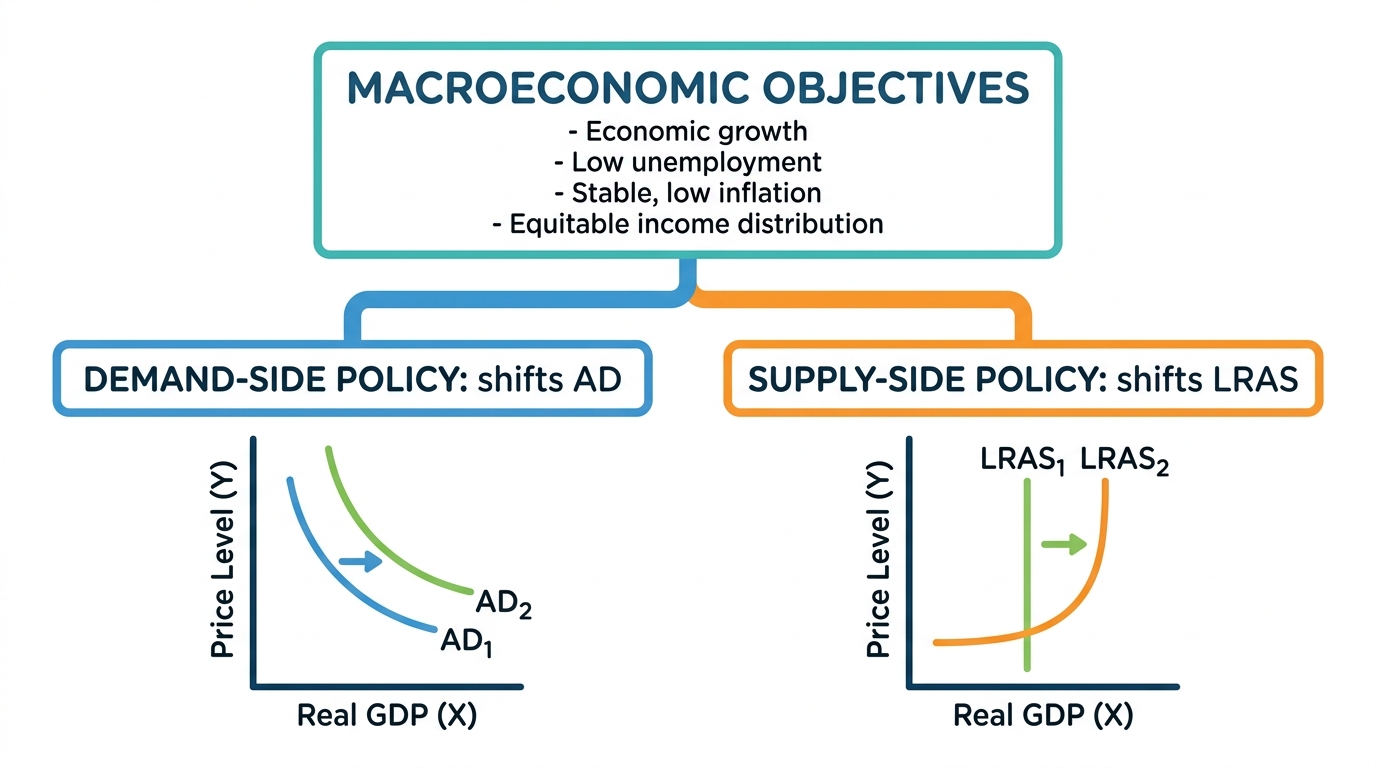
IB DP Macroeconomics asks you to trace how governments and central banks try to hit four often-conflicting objectives — growth, low unemployment, stable inflation and equitable income distribution — using two policy families. Demand-side tools (monetary and fiscal policy) shift aggregate demand quickly but risk inflation or crowding out; supply-side policy shifts long-run aggregate supply slowly but tackles the root cause of low growth. Add in how we actually measure the economy — GDP, GNI, real vs nominal figures, and the business cycle — and you have the core toolkit examiners test on both Paper 1 extended response and Paper 2 data response. This teaser walks through the five highest-yield concepts: the AD/AS toolkit, monetary policy transmission, fiscal policy and the multiplier, supply-side policy, and GDP/GNI measurement, with the exact traps examiners report students falling into.
What you’ll be able to do
1. The Macro Toolkit: AD, AS and the Four Objectives
Every macroeconomics question ultimately asks you to trace an intervention through to AD, AS, or both. Demand-side policies (monetary, fiscal) shift AD fast but can trigger inflation or crowding out; supply-side policies shift LRAS slowly but fix the underlying cause of low growth or structural unemployment. Because growth, unemployment, inflation and equity frequently conflict, a strong exam answer often ends by identifying the trade-off rather than claiming a policy 'solves everything'.
Exam tip
When an essay asks you to evaluate a policy, naming the specific trade-off it creates against another objective is usually the difference between a good and a top-band answer.
Mini summary
AD/AS is the shared framework: demand-side policy shifts AD, supply-side policy shifts LRAS — know which curve moves for which tool.
2. Monetary Policy: Interest Rates and QE
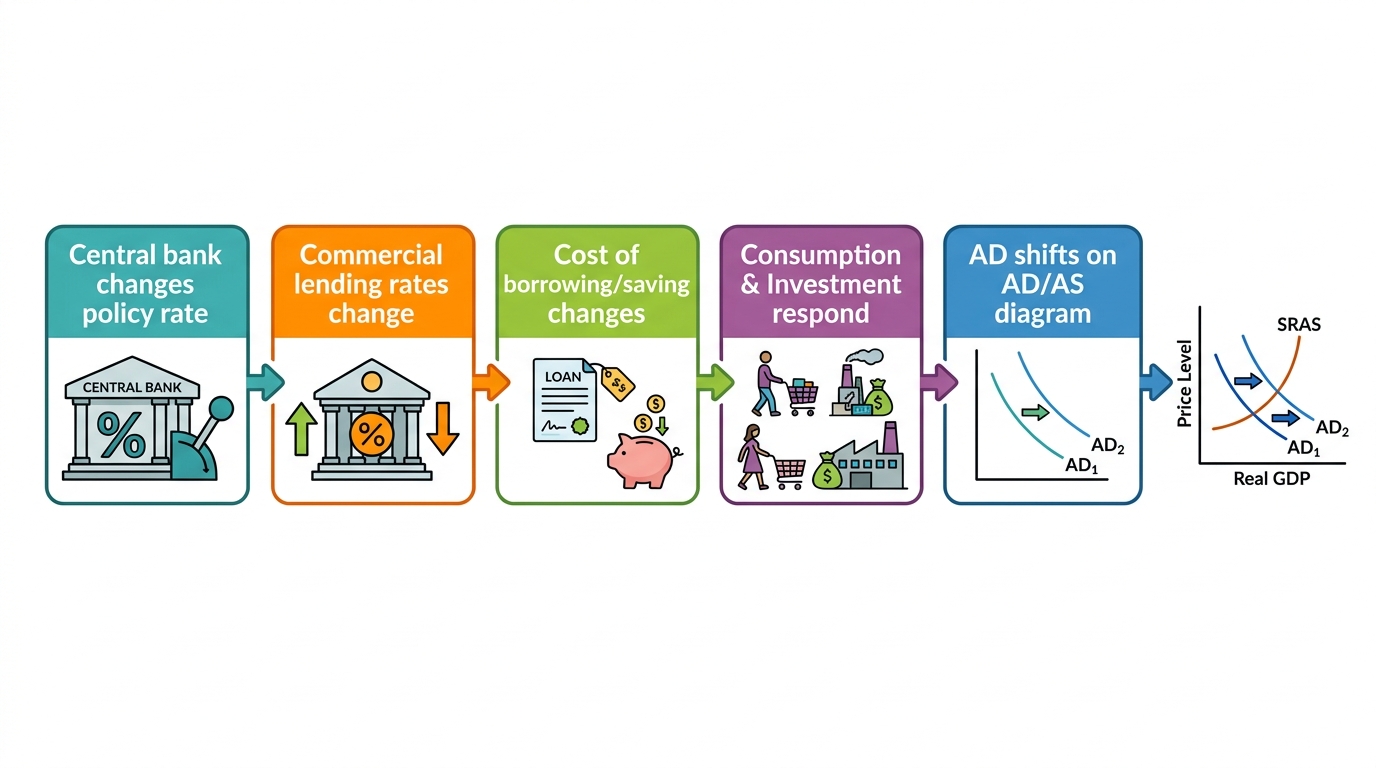
The central bank changes the policy interest rate, commercial lending rates follow, and the changed cost of borrowing alters consumption and investment, shifting AD. When the policy rate is already near zero, conventional cuts run out of room, so central banks turn to quantitative easing (QE) — buying bonds from commercial banks to push down long-term rates and expand the money supply. The real interest rate is the nominal rate minus inflation: .
Exam tip
A 4-mark 'using a diagram, explain' question needs the full chain: policy change → transmission → C/I → AD → diagram outcome, with a correctly labelled shift. Monetary policy is drawn as an AD shift, never a supply-side shift.
Common mistake
Assuming a central bank can always cut rates further to boost AD — once the policy rate is near 0%, state explicitly that conventional cuts are exhausted and unconventional tools like QE are needed.
Mini summary
Monetary policy always moves AD through the cost and availability of credit — the QE trigger is a near-zero policy rate.
3. Fiscal Policy and the Multiplier
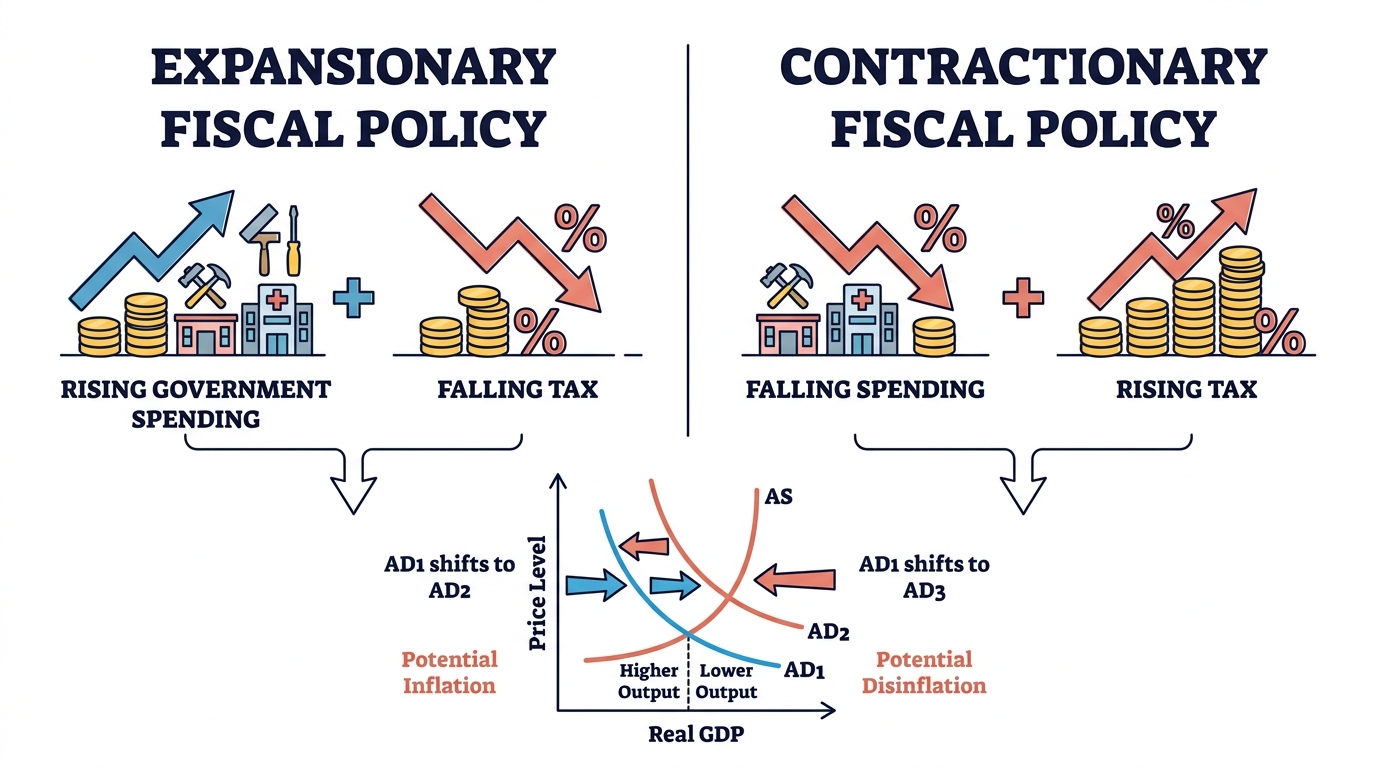
Fiscal policy uses government spending (G) and taxation (T) to shift AD: expansionary policy raises G and/or cuts T in a recession, contractionary policy does the reverse to cool inflation. Discretionary fiscal policy needs a deliberate budget decision and suffers recognition, decision and implementation lags, while automatic stabilisers like progressive tax and unemployment benefits smooth the cycle without new legislation. The multiplier, , shows the effect shrinks as leakages (savings, tax, imports) rise.
| Criterion | Monetary Policy | Fiscal Policy |
|---|---|---|
| Set by | Central bank (independent) | Elected government (budget) |
| Speed | Faster to implement | Slower — time lags |
| Precision | Broad, economy-wide | Can target sectors/groups |
Exam tip
For 'evaluate the use of fiscal policy' questions, give at least one strength AND one limitation (time lags, crowding out, multiplier size), then conclude using the specific context from the stem.
Common mistake
Forgetting the multiplier applies to the change in the injection, not to total GDP — never multiply the whole GDP figure by .
Mini summary
Fiscal policy shifts AD via G and T; discretionary policy is slower than automatic stabilisers, and its impact scales with the multiplier.
4. Supply-Side Policies: Shifting LRAS
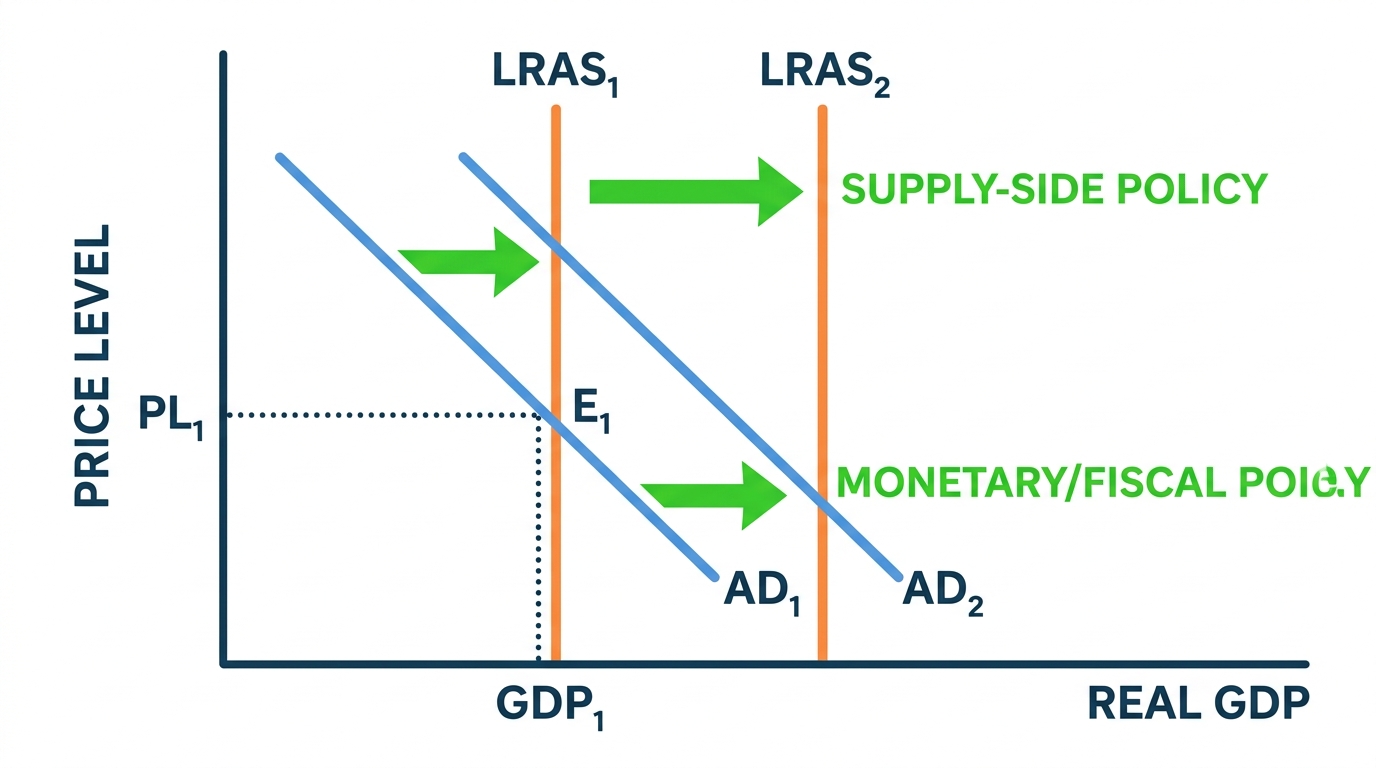
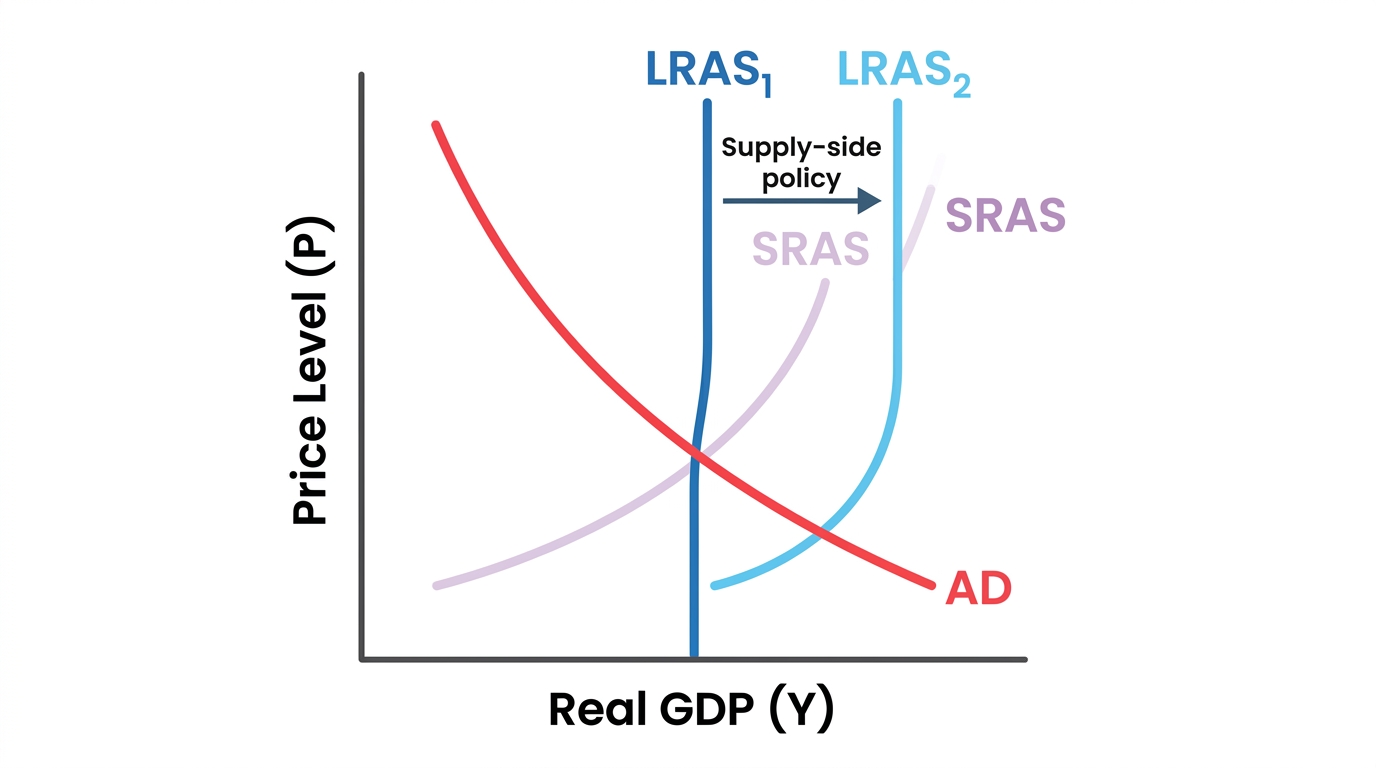
Supply-side policies raise an economy's productive capacity by shifting long-run aggregate supply (LRAS) rightward, rather than moving along the existing AD/AS curves. Market-based policies rely on incentives and deregulation, while interventionist policies rely on direct government spending — both trade speed for a more durable fix to structural unemployment and low sustainable growth.
| Type | Examples | Main critique |
|---|---|---|
| Market-based | Deregulation, tax incentives, labour market reform | Can widen inequality |
| Interventionist | Public infrastructure, education/training spending | Costly, slow, funded by taxes/borrowing |
Exam tip
Supply-side policy is the slower but structurally deeper answer: it avoids the inflation and crowding-out risks of demand management but takes longer to show results — a strong trade-off point for evaluation essays.
Common mistake
Drawing a shift in SRAS instead of LRAS for a supply-side policy — SRAS reflects temporary cost changes (like oil prices), not a permanent increase in productive capacity, and this is one of the most common diagram errors in this subtopic.
Mini summary
Supply-side policy shifts LRAS permanently; market-based policies use incentives, interventionist policies use direct spending.
5. Measuring Economic Activity: GDP, GNI and Real vs Nominal
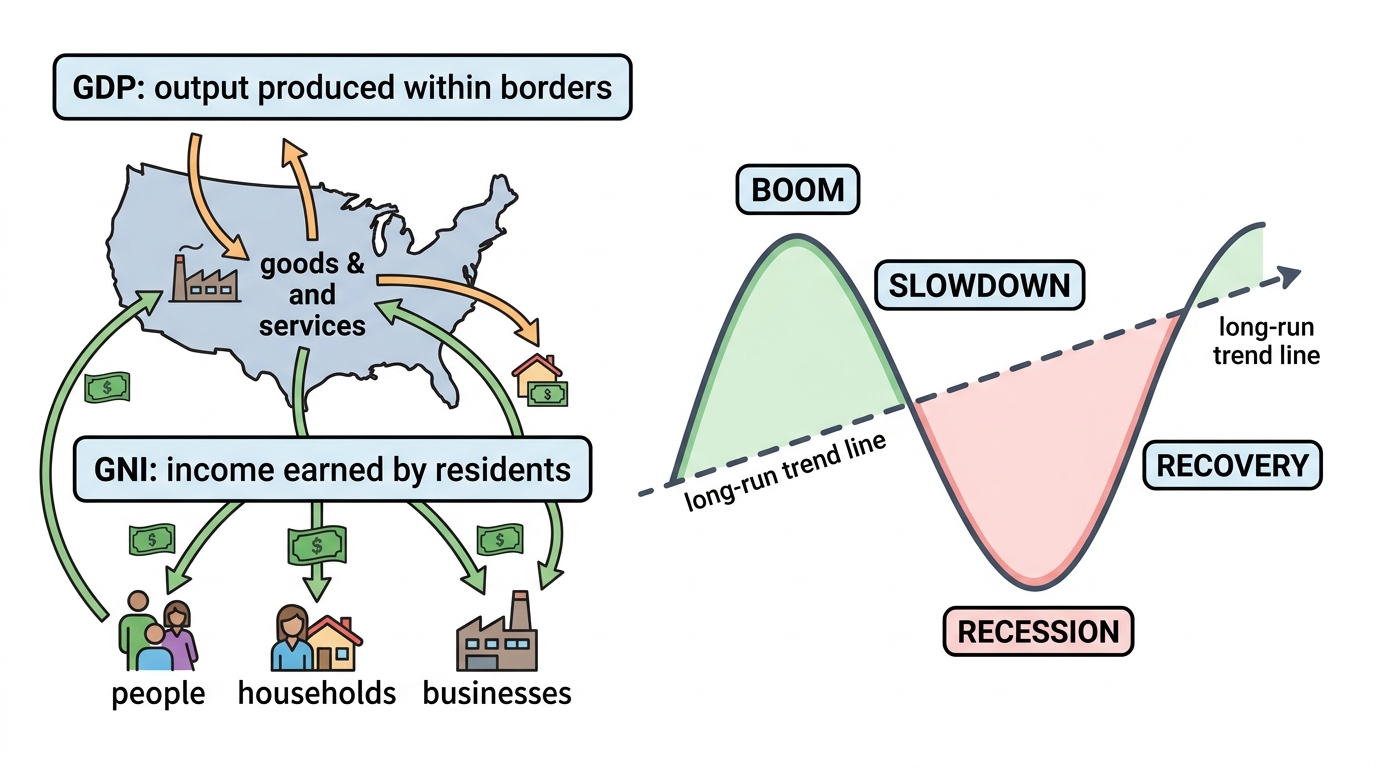
GDP measures the value of output produced within a country's borders; GNI measures the income earned by a country's residents wherever it is earned — they answer different questions: location of production vs ownership of income. Both can be nominal (current prices) or real (inflation-adjusted), and both fluctuate through the business cycle of expansion and contraction around a long-run trend. Real GDP is found using .
Exam tip
Always check whether a data response figure is nominal or real before comparing across years — nominal comparisons over time are meaningless once inflation is in the mix.
Common mistake
Multiplying nominal GDP by the deflator instead of dividing — this inflates the figure instead of correcting for price rises, the exact opposite of what real GDP should show.
Mini summary
GDP = where output happens; GNI = who earns the income. Always convert nominal to real before comparing across time.
Quick formula sheet
Practice questions
- Define monetary policy and fiscal policy in one sentence each.
- State whether expansionary fiscal policy involves rising or falling government spending and taxation.
- Explain the difference between GDP and GNI.
- Explain how a cut in the policy interest rate is transmitted through to aggregate demand.
- Distinguish between discretionary fiscal policy and automatic stabilisers, giving one example of each.
- Explain why supply-side policies shift LRAS rather than AD.
- A government increases spending by $20 billion; MPS = 0.15, MPT = 0.25, MPM = 0.1. Calculate the total change in real GDP.
- Evaluate the effectiveness of monetary policy compared to fiscal policy in responding to a recession.
- A country's nominal GDP is $600 billion with a GDP deflator of 120 (base year = 100). Calculate real GDP and explain what the deflator value indicates about the price level.
Frequently asked questions
What's the difference between monetary and fiscal policy?+
Monetary policy is run by the (typically independent) central bank using interest rates and tools like QE, while fiscal policy is run by the elected government using spending and taxation — both shift AD but differ in speed, precision and accountability.
Why do supply-side policies shift LRAS instead of AD?+
Supply-side policies aim to increase an economy's underlying productive capacity permanently, which is represented by a rightward shift of LRAS, rather than a temporary movement of AD or SRAS.
When do central banks use quantitative easing instead of interest rate cuts?+
QE is used when the policy interest rate is already near zero, leaving little room for further conventional cuts, so the central bank buys bonds from commercial banks to push down long-term rates and expand the money supply.
How do I calculate real GDP from nominal GDP?+
Divide nominal GDP by the GDP deflator and multiply by 100: .
What are automatic stabilisers?+
They are built-in fiscal mechanisms, like progressive income tax and unemployment benefits, that automatically reduce the size of economic fluctuations without any new government legislation.
Why do the four macroeconomic objectives conflict?+
Policies aimed at one objective, such as boosting growth, often worsen another, such as inflation or income equality, which is why exam answers that identify this trade-off tend to score highest.
Master Macroeconomics with the Full IB DP Revision Notes
Related articles