
Calculus
The biggest topic in IB Maths AA — limits, differentiation and integration, explained fast.
Quick facts
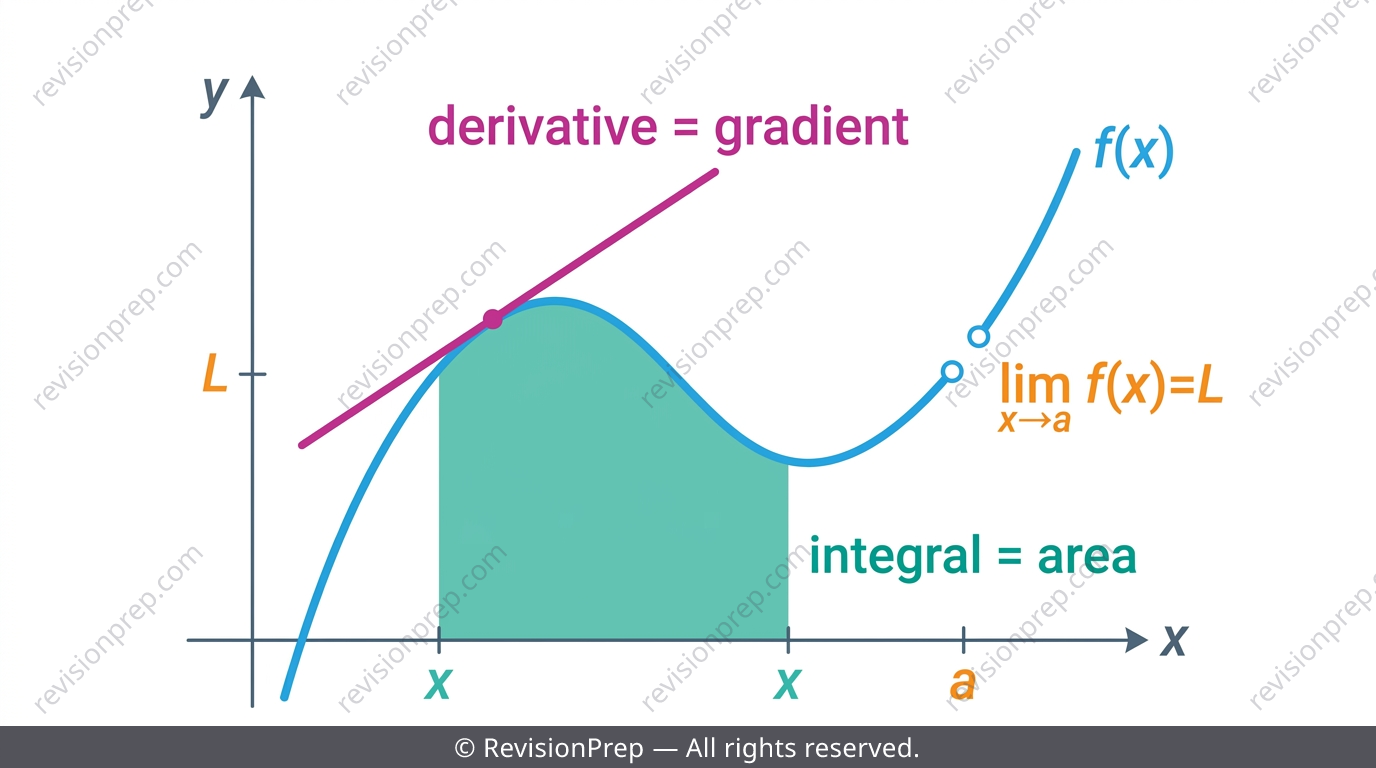
Calculus dominates IB Maths AA — it's the single largest topic and shows up in every Paper 1 and Paper 2, at both SL and HL. It's really three connected ideas: limits define what 'infinitely close' means, differentiation uses that to measure instantaneous rate of change, and integration reverses the process to recover total accumulated quantity. Students who treat these as separate topics tend to fall behind, because exam questions constantly move between them — a rate-of-change question might need a derivative, then a limit to interpret long-run behaviour, then an integral to find total change. This teaser walks through the five ideas examiners test most: limits and continuity, the 0/0 trick, differentiation rules, classifying stationary points, and definite integrals as signed area. The full revision note covers every rule, worked example and trap in depth.
What you’ll be able to do
Limits and Continuity
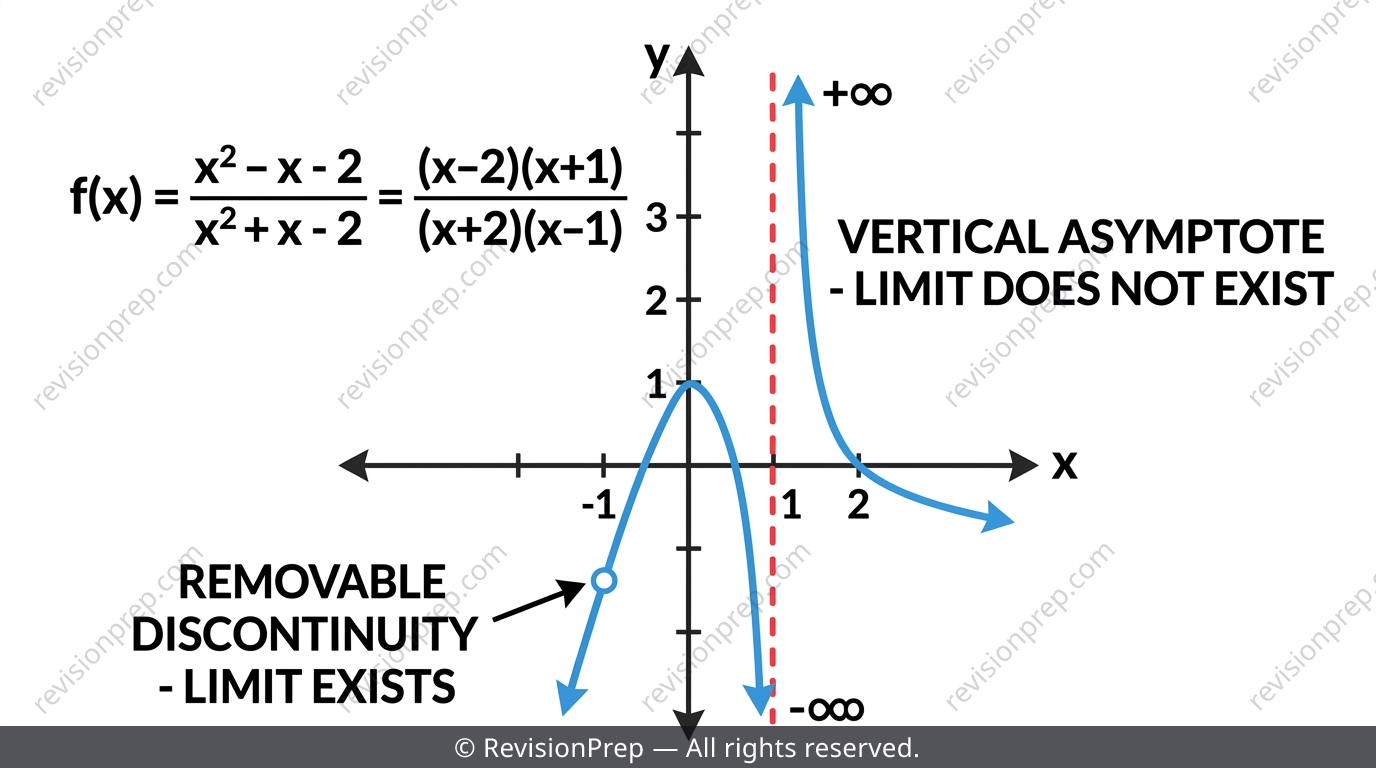
A limit describes what approaches as gets arbitrarily close to a value — it says nothing about itself, which is why limits can exist even where the function is undefined. Continuity at needs three things simultaneously: is defined, the limit exists (both one-sided limits agree), and the limit equals . Vertical asymptotes appear when the denominator hits zero but the numerator doesn't; horizontal asymptotes come from limits as , found by comparing the degrees of the top and bottom.
Exam tip
Check one-sided limits separately near any vertical asymptote or piecewise definition — if they disagree, the two-sided limit does not exist.
Common mistake
Treating every zero of the denominator the same way — one might cancel (removable, a 'hole') while another is a genuine asymptote where the limit doesn't exist.
Mini summary
Continuity = defined + limit exists + limit equals the value, all at once.
The 0/0 Trick and the Squeeze Theorem
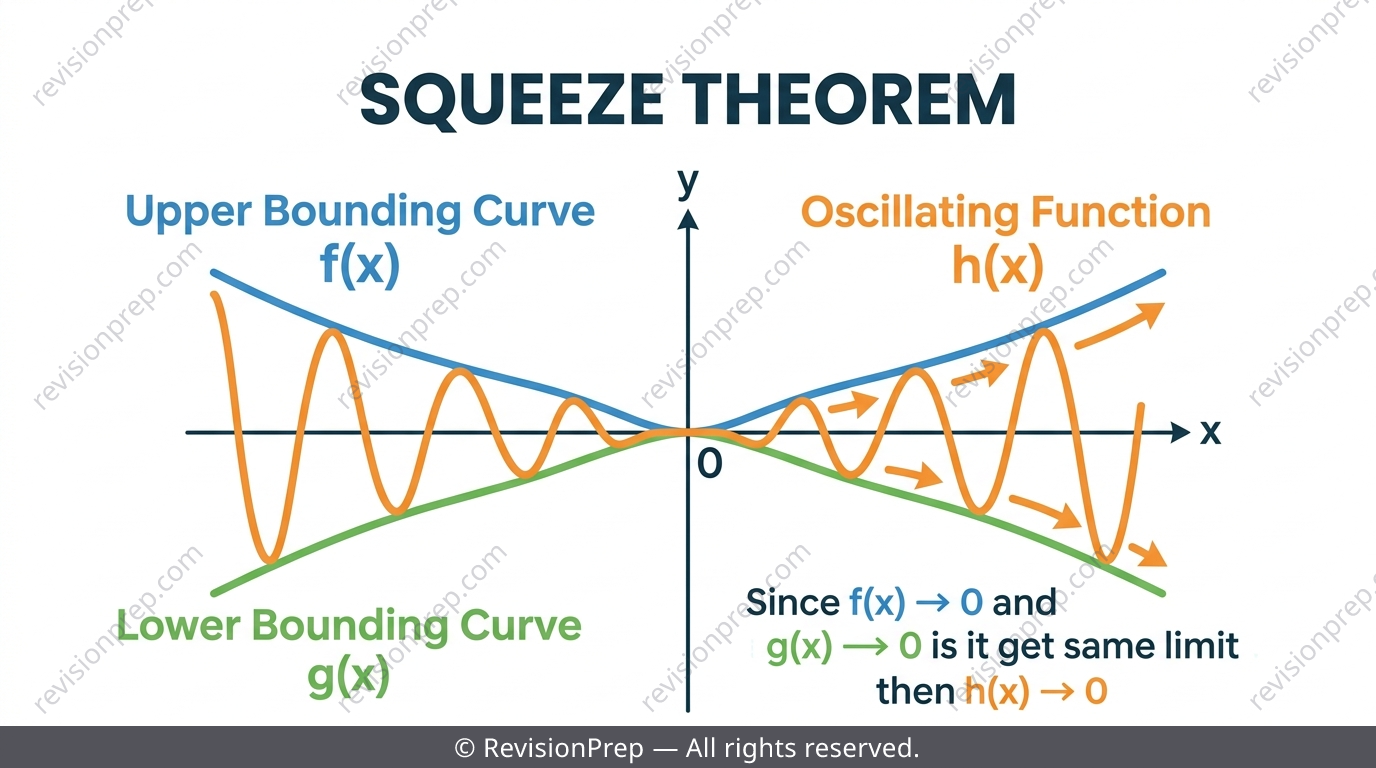
When direct substitution gives , the limit can still exist — this is the single most tested limit technique at SL. Factorise (polynomials) or rationalise (surds), cancel the common factor, then substitute — write out the algebra explicitly, because 'show that' questions are pure method marks. The squeeze theorem rescues limits with a bounded oscillating factor multiplied by something shrinking to zero: if near and both outer limits equal , then too.
Exam tip
For 'show that the limit equals ' questions, always write the factorising or rationalising step — a correct final answer with no algebra typically scores 0/2.
Common mistake
Cancelling and then claiming a value for itself — the simplified function is only equal to the original for .
Mini summary
0/0 → factorise or rationalise → cancel → THEN substitute.
Derivatives and Differentiation Rules
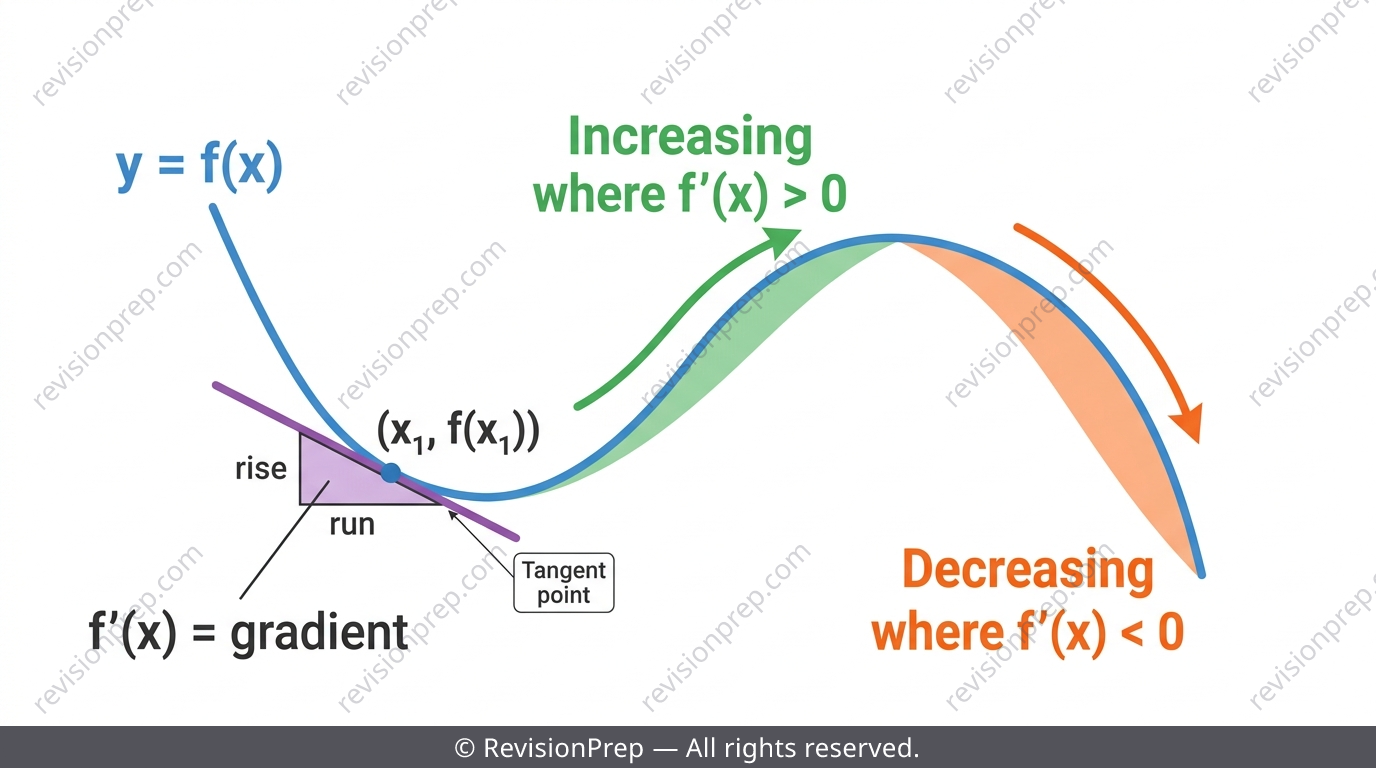
The derivative is a gradient function built from the limit , though you'll rarely use first principles unless a question explicitly demands it. Beyond the power rule, most real questions need the chain rule (derivative of the outside, inside left alone, times derivative of the inside), the product rule, or the quotient rule — and identifying the correct rule before substituting is half the battle. means increasing, means decreasing, and flags a stationary point that still needs classifying.
| Rule | Formula (informal) |
|---|---|
| Power rule | bring the power down, subtract 1 |
| Chain rule | outside derivative × inside derivative |
| Product rule | f'g + fg' |
| Quotient rule | (f'g − fg') ÷ g² — order matters |
Exam tip
A tangent/normal question always needs three things, in order: the point, the gradient from , then the line equation — skipping the point coordinates loses marks even with a perfect gradient.
Common mistake
Differentiating only the outside function in a chain rule problem and forgetting to multiply by the derivative of the inside function.
Mini summary
Write down which rule (chain/product/quotient) and which pieces before you differentiate — don't rush straight to substitution.
Stationary Points, Concavity and Inflection
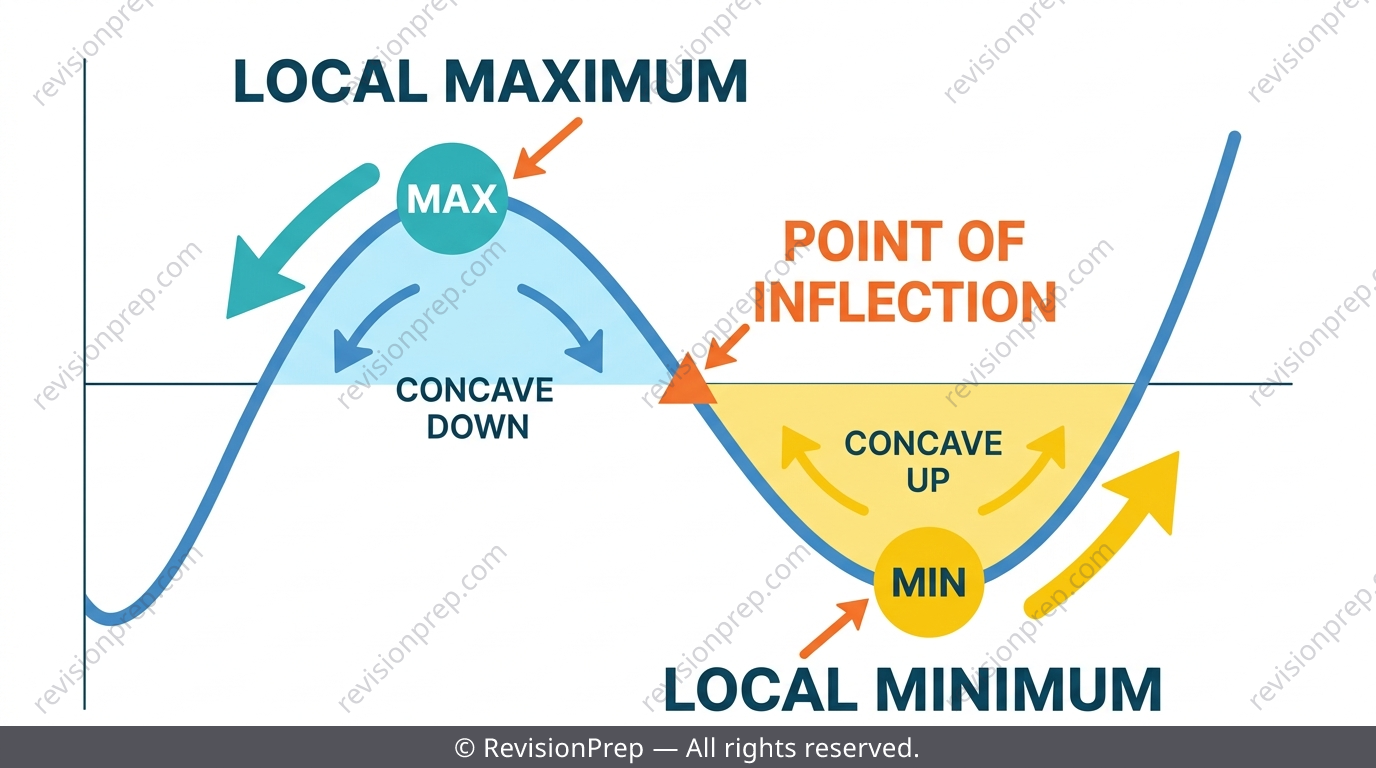
Where , you have a stationary point — the second derivative classifies it: means concave up (local minimum), means concave down (local maximum). A point of inflection is where concavity actually changes sign either side, not just where — that condition alone is not enough. The second derivative test is faster than checking the sign of on either side, but it's inconclusive whenever , in which case you must fall back on the first derivative test.
Exam tip
If the second derivative test is inconclusive (), switch to checking the sign of just either side of the point.
Common mistake
Concluding a point of inflection just because there, without checking that concavity actually changes sign on either side.
Mini summary
finds candidates; or a sign check classifies them; inflection needs concavity to genuinely flip.
Integration and Definite Integrals
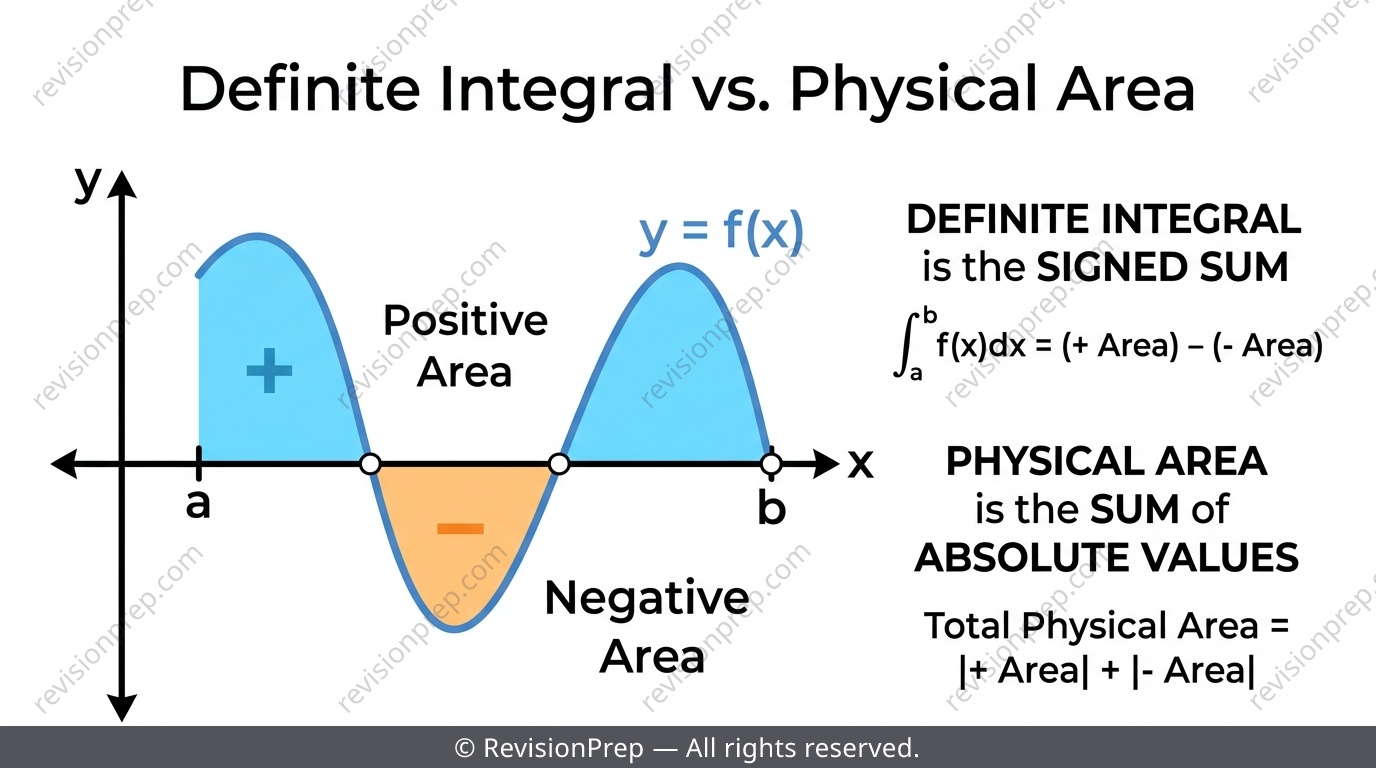
Indefinite integration reverses differentiation: , where represents the whole family of curves sharing that gradient function — always substitute a given boundary point in AFTER integrating to pin down . A definite integral is a single number equal to , representing signed area between the curve and the x-axis. If a question wants actual physical area (not signed), you must split at the roots of and add the absolute value of each piece — the same logic gives total distance travelled as , split at every root of .
Exam tip
Read carefully whether a question wants 'area' (always positive, split at roots) or the 'value of the integral' (signed, no splitting needed).
Common mistake
Forgetting that area below the x-axis contributes negatively to a definite integral, then reporting a signed integral as if it were the physical area.
Mini summary
Indefinite integral = family of functions + C; definite integral = one number = signed area = F(b) − F(a).
Quick formula sheet
Practice questions
- Evaluate .
- Differentiate .
- Find .
- Find for using the chain rule.
- Determine whether has a removable discontinuity or a vertical asymptote at , justifying your answer.
- Find and classify the stationary points of .
- Given , find , evaluate the rate of growth at with units, and interpret .
- Show that and hence determine whether (with ) is continuous at .
- A curve satisfies where has exactly one root in . Explain what this tells you about the areas above and below the x-axis, and describe how you'd find the actual (physical) area enclosed.
Frequently asked questions
How much of IB Maths AA is calculus?+
Calculus is the single largest topic in AA SL, making up roughly 27–30% of the assessment, and it's examined in every Paper 1 and Paper 2.
What's the difference between a limit and continuity?+
A limit describes what a function approaches near a point, regardless of whether the function is defined there. Continuity additionally requires the function to be defined at that point AND equal to the limit.
How do I solve a 0/0 limit?+
Factorise (for polynomials) or rationalise (for surds), cancel the common factor, then substitute — direct substitution comes last, not first.
How do I know if a stationary point is a maximum, minimum, or point of inflection?+
Use the second derivative test: positive means minimum, negative means maximum, but if you must check whether changes sign either side instead.
Why do we add +C when integrating?+
Because many functions share the same derivative, the indefinite integral represents a whole family of antiderivatives — is only fixed once you're given a boundary condition (a known point on the curve).
Is a definite integral the same as area?+
Not always — a definite integral gives signed area, so parts below the x-axis count as negative. For physical area you must split at the roots and add the absolute value of each piece.
Master Calculus with the Full IB Maths AA Revision Notes
Related articles