
Number and Algebra
Sequences, polynomials, logs and roots — the toolkit examiners lean on across both IB Maths AA papers.
Quick facts
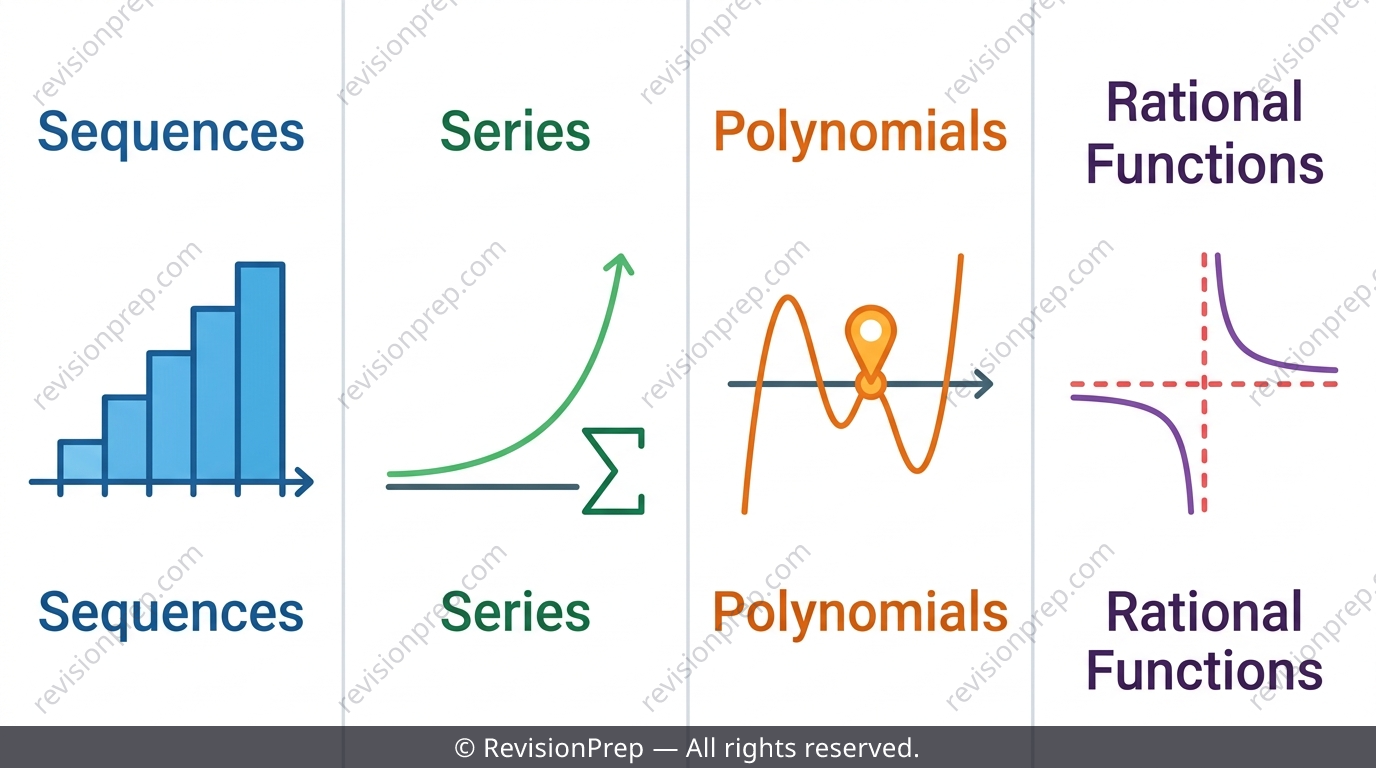
IB Maths AA Number and Algebra ties together sequences and series, polynomials, rational functions, and the connections between logs and exponentials — and it shows up everywhere, from Paper 1 algebra to Paper 2 financial-context problems. Almost every formula you need is already in the data booklet, so the real skill being tested is selecting the right one and substituting correctly, not memorising it. This makes 'show that' and 'hence' questions the biggest mark-losers in the whole topic: students often get the right number but skip the demonstration examiners are actually grading. This teaser walks through the five ideas that appear most often — arithmetic and geometric sequences, the log-arithmetic bridge, the factor and remainder theorems, and rational function asymptotes — with the traps IB examiners set most frequently. For the full formula derivations, worked 'show that' chains, and more practice, the complete revision note has you covered.
What you’ll be able to do
Arithmetic Sequences and Series
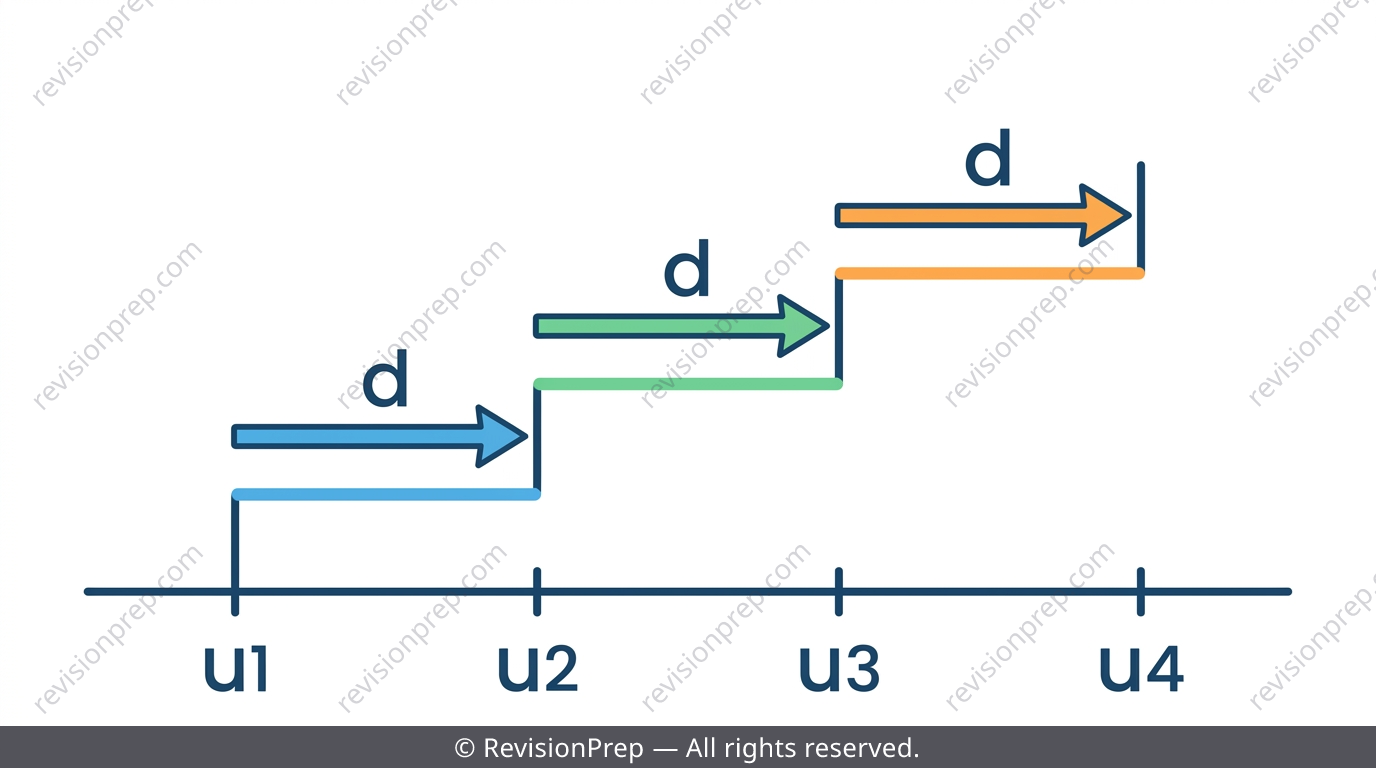
An arithmetic sequence has a constant difference between consecutive terms — growth is linear, not curved. The general term is , and the sum of the first terms can be written two equivalent ways depending on what you're given. Sigma notation is just shorthand for , so expand it mentally the first few times you see it in a question.
| Feature | Arithmetic sequence | Geometric sequence |
|---|---|---|
| Pattern | Constant difference | Constant ratio |
| Growth type | Linear | Exponential |
| General term |
Exam tip
On a 'show that' question worth 2 marks, write out the subtraction or division line explicitly — the demonstration itself carries the mark, not just the final number.
Common mistake
Writing only the final value of or with no working shown, which typically caps the mark at half credit on 'show that' questions.
Mini summary
Test for a constant difference first; if found, it's arithmetic — then pick the matching or formula.
Geometric Sequences and Sum to Infinity
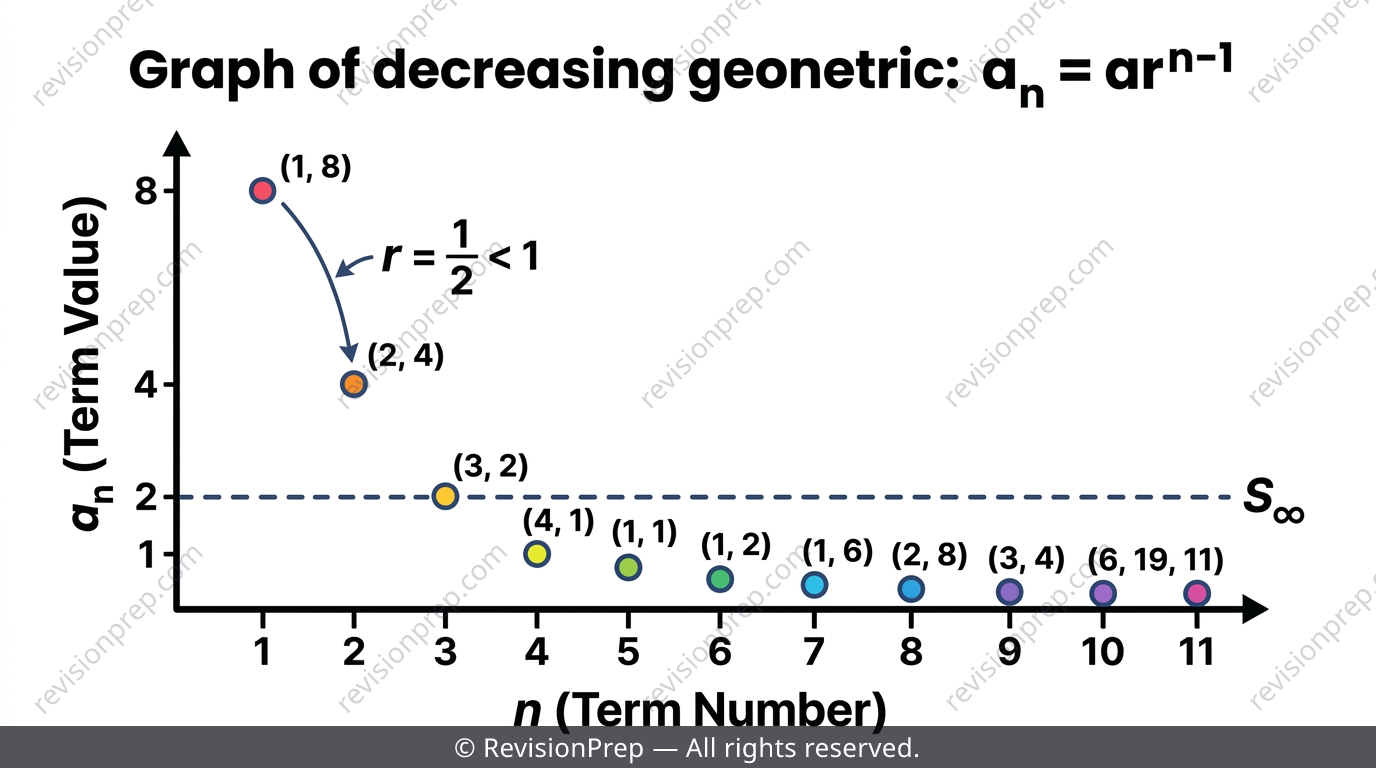
A geometric sequence multiplies each term by a constant ratio , giving . The sum of the first terms uses , but the sum to infinity only exists when — a convergent series. Bounce and repeated-percentage problems are classic GP applications where counting the right number of terms matters as much as the formula.
Exam tip
Always check before quoting — and when a question generates a quadratic in , test each root against the context before stating your final answer.
Common mistake
Treating a 'three consecutive terms in a geometric sequence' setup as if it were arithmetic, subtracting terms instead of equating ratios ().
Mini summary
GP growth is multiplicative; is a special case that only exists for .
The Sequence Bridge: Logs Turn a GP into an AP
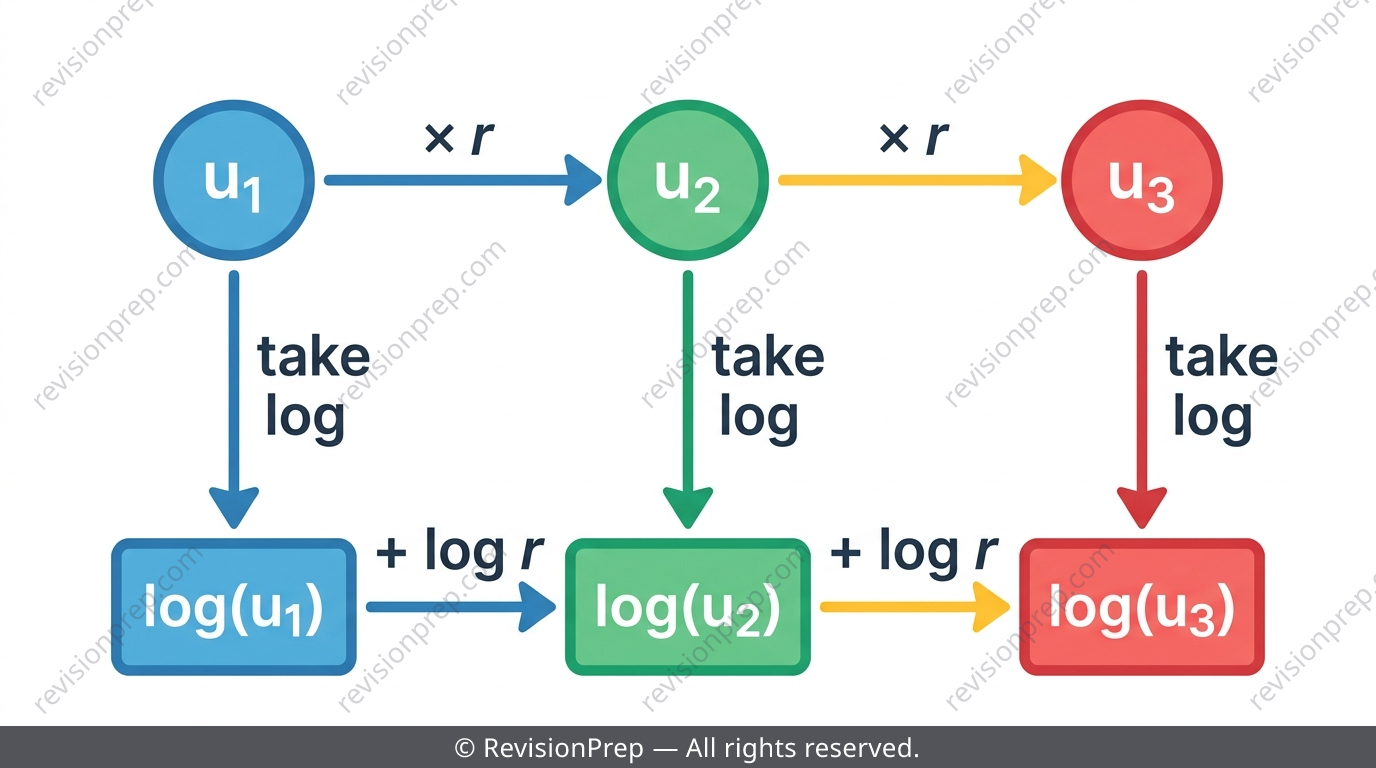
This is a genuinely examinable connection: if is geometric, then (or any base) forms an arithmetic sequence, because taking logs turns multiplication by into addition of . The reverse also holds — exponentiating an arithmetic sequence produces a geometric one. Questions asking for an 'exact form' answer expect something like , not a rounded decimal.
Exam tip
If the question says 'exact form', leave logs unevaluated — a decimal approximation loses the exactness mark even with otherwise perfect working.
Common mistake
Rounding an exact log answer to a decimal when the question explicitly asks for exact form.
Mini summary
GP → apply logs → AP; this bridge is a direct exam favourite linking the two sequence types.
Factor and Remainder Theorems
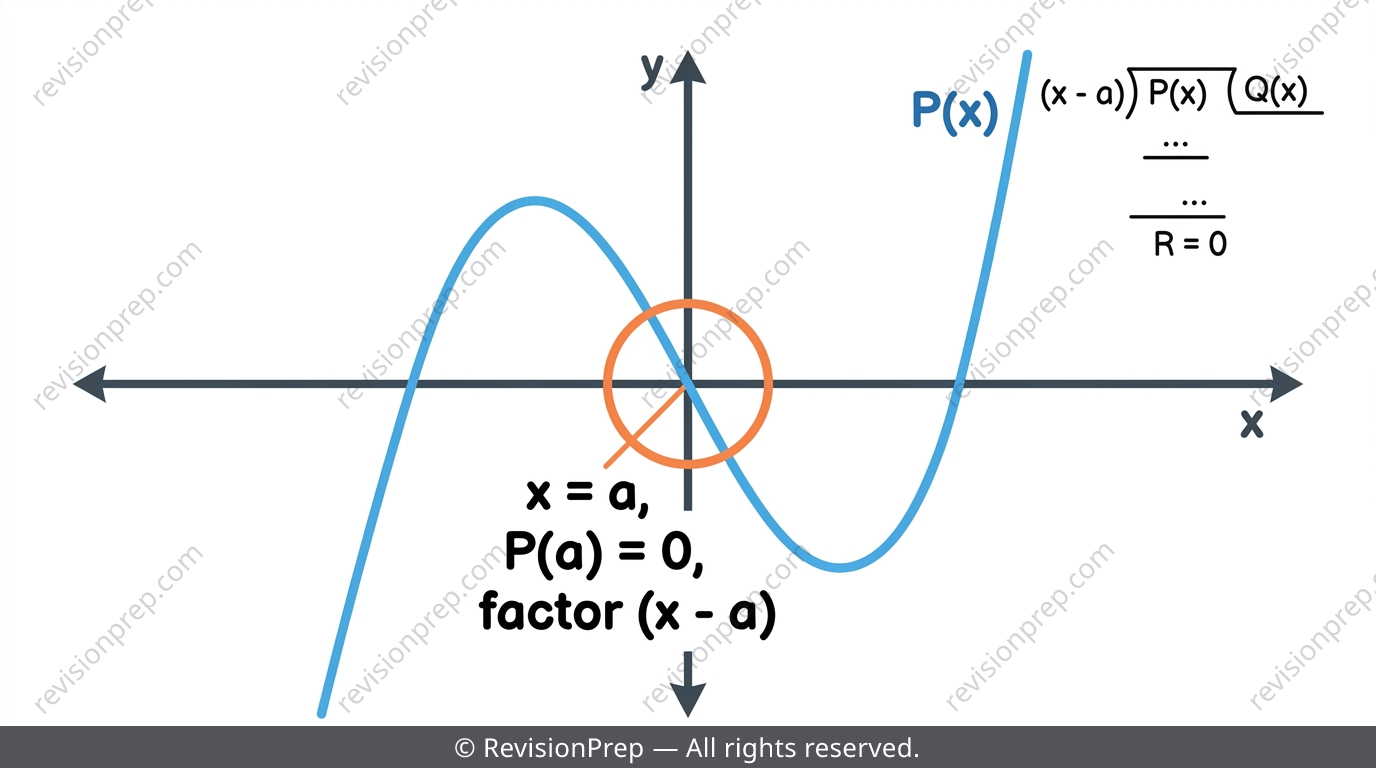
The remainder theorem says dividing by leaves a remainder of exactly — no division required if that's all you need. The factor theorem is the special case where that remainder is zero, confirming is a genuine factor. For quadratics, the discriminant tells you the number of real roots instantly, and , give root shortcuts without solving.
Exam tip
If a question only asks for a remainder, just evaluate directly — full polynomial division earns the same marks but costs valuable time.
Common mistake
Ignoring a 'hence' instruction by solving a cubic from scratch on the GDC instead of building on the factor you just proved — this can score zero even with correct roots.
Mini summary
confirms a factor; alone gives the remainder for any value of .
Rational Functions and Asymptotes
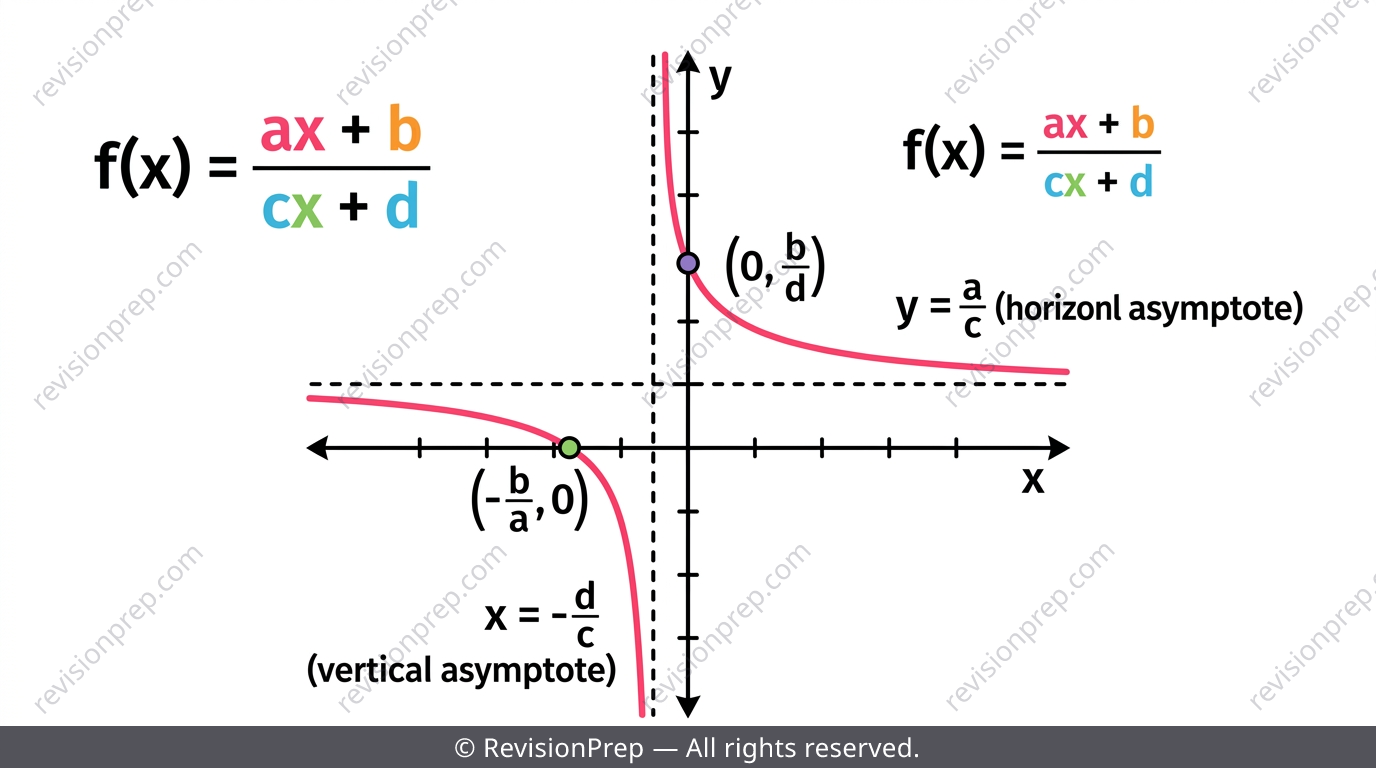
A rational function divides one polynomial by another; at SL you mostly meet the linear-over-linear form . The vertical asymptote comes from setting the denominator to zero (), while the horizontal asymptote comes from the ratio of leading coefficients as (). Keep numerator-zero (x-intercept) and denominator-zero (vertical asymptote) firmly separate in your head.
Exam tip
The horizontal asymptote from is exact and instant — reading it off a GDC table risks being misled by too few decimal places.
Common mistake
Setting the numerator to zero when looking for the vertical asymptote — that actually finds the x-intercept, not the asymptote.
Mini summary
Denominator = 0 gives the vertical asymptote; leading coefficients' ratio gives the horizontal one.
Quick formula sheet
Practice questions
- An arithmetic sequence has and . Find .
- A geometric sequence has and . Find .
- State the number of real roots of using the discriminant.
- Find the sum of the first 20 terms of the arithmetic sequence with , .
- A geometric series has and . Find .
- Given , show that is a factor and find the remaining roots.
- A geometric sequence has , . Let . Show that is arithmetic and find its common difference.
- Sketch , stating both asymptotes and both axis intercepts.
- A ball dropped from 3 m rebounds to of its previous height each bounce. Find the total vertical distance travelled until it hits the ground for the 4th time.
Frequently asked questions
What's the difference between an arithmetic and a geometric sequence?+
An arithmetic sequence has a constant difference between consecutive terms (linear growth), while a geometric sequence has a constant ratio between consecutive terms (exponential growth). Always test which pattern applies before choosing a formula.
When does a geometric series have a sum to infinity?+
Only when the common ratio satisfies , making the series convergent. If , does not exist.
How is the factor theorem different from the remainder theorem?+
The remainder theorem says dividing by leaves remainder for any . The factor theorem is the special case where , confirming is an exact factor.
How do you find the asymptotes of a rational function?+
For , set the denominator to zero for the vertical asymptote (), and take the ratio of leading coefficients for the horizontal asymptote ().
Why is the log of a geometric sequence always arithmetic?+
Because taking logs converts multiplication by a constant ratio into addition of a constant , which is exactly the defining property of an arithmetic sequence.
Do I need to memorise all these formulas for IB Maths AA?+
No — nearly all of them are in the data booklet. The exam actually tests whether you can select and substitute the right formula correctly, especially in 'show that' and 'hence' questions.
Get the Full Number and Algebra Revision Notes
Related articles