
IB Maths AA Calculus: Limits, Derivatives & Differential Equations
The single biggest HL topic — here's what actually shows up in Paper 1, Paper 2 and long-response questions
Quick facts
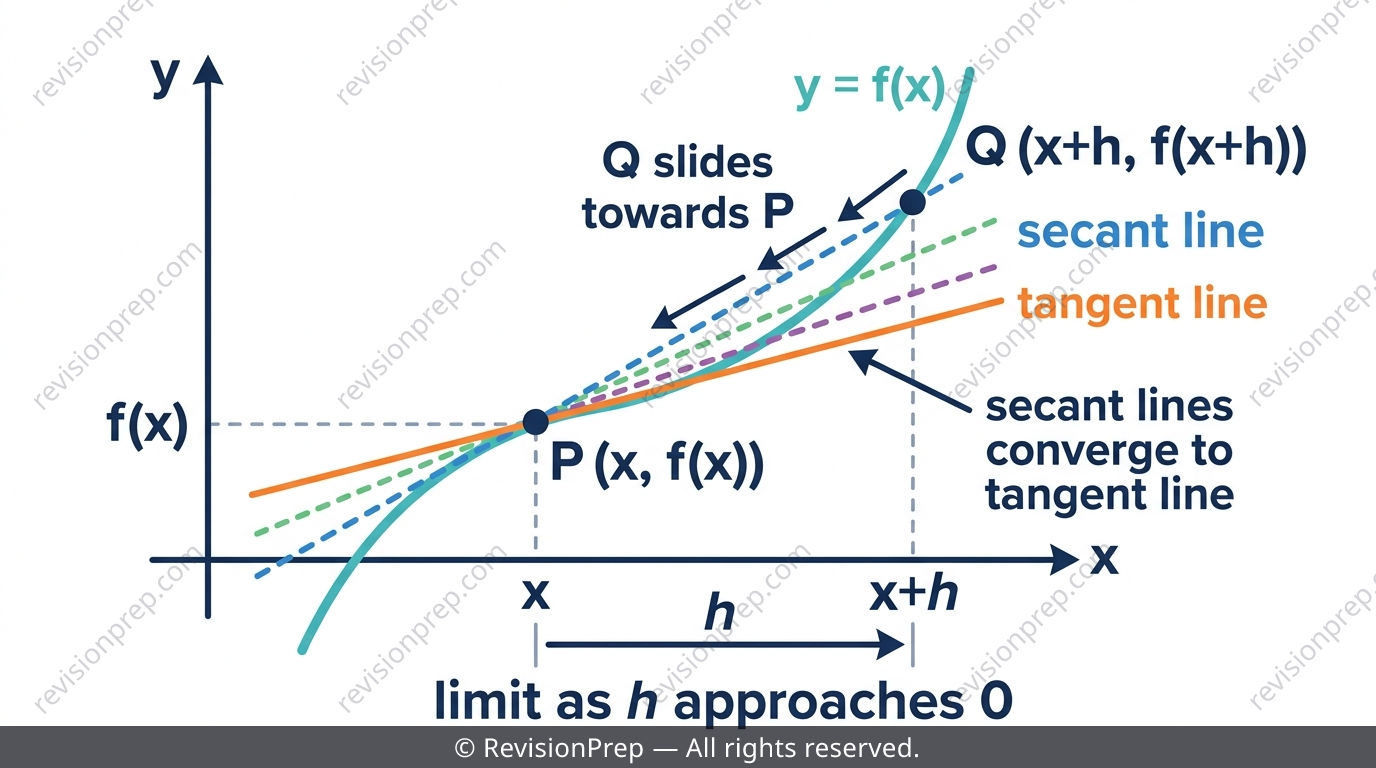
Calculus is the backbone of IB Maths AA HL — it makes up around a quarter of all HL teaching hours and almost always anchors a Section B long-response question. Everything traces back to one idea: the limit. Continuity, differentiation, and integration are all defined using limits, which is why examiners love testing whether you actually understand the definition, not just the shortcut rules. This teaser walks through the five ideas that come up again and again: the three-condition continuity test, the derivative as a limit, the HL-only differentiation toolkit (implicit differentiation, inverse trig, related rates), stationary points and optimisation, and the leap into HL differential equations. Each one carries its own classic examiner trap. Master these five, and you'll be ready for the calculus questions that decide grades — the full revision notes go much deeper into every worked example and technique.
What you’ll be able to do
Limits and the Three-Condition Continuity Test
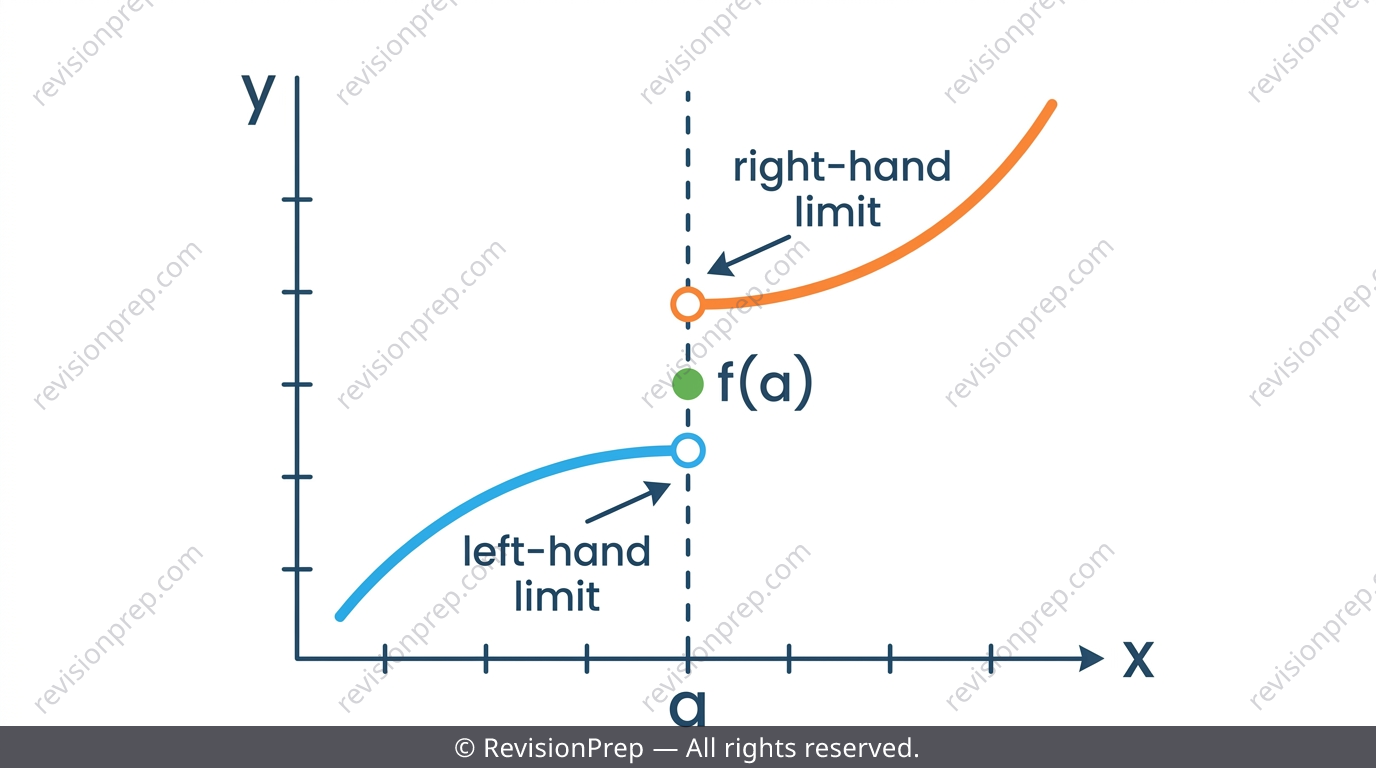
A limit describes what approaches as gets arbitrarily close to a value, regardless of what happens exactly at that point. IB doesn't ask for formal proofs — it wants algebraic evaluation (factor and cancel, rationalise with a conjugate, or use a standard trig/exponential limit) and reasoning about continuity. A function is continuous at only if all three conditions hold: exists, the two-sided limit exists, and the limit equals .
| 0/0 situation | Technique |
|---|---|
| Polynomial fraction | Factor and cancel the common root |
| Surd expression | Multiply by the conjugate |
| sin, tan, arctan, or e^x-1 form | Engineer into a standard limit shape |
| Bounded oscillating factor × something → 0 | Squeeze theorem |
Exam tip
For 'show that' limit questions, you must factor/rationalise/rewrite algebraically before substituting — typing the unsimplified fraction into a GDC and stating the answer scores 0/2, even if the number is right.
Common mistake
Treating 'the two branch limits agree' as the whole continuity check. Always write out all three conditions explicitly, even if the algebra collapses two of them into one equation.
Mini summary
Continuity needs all three conditions to hold; standard limits and the squeeze theorem solve almost every trig/exponential 0/0 case.
The Derivative as a Limit, Then the Rule Toolkit
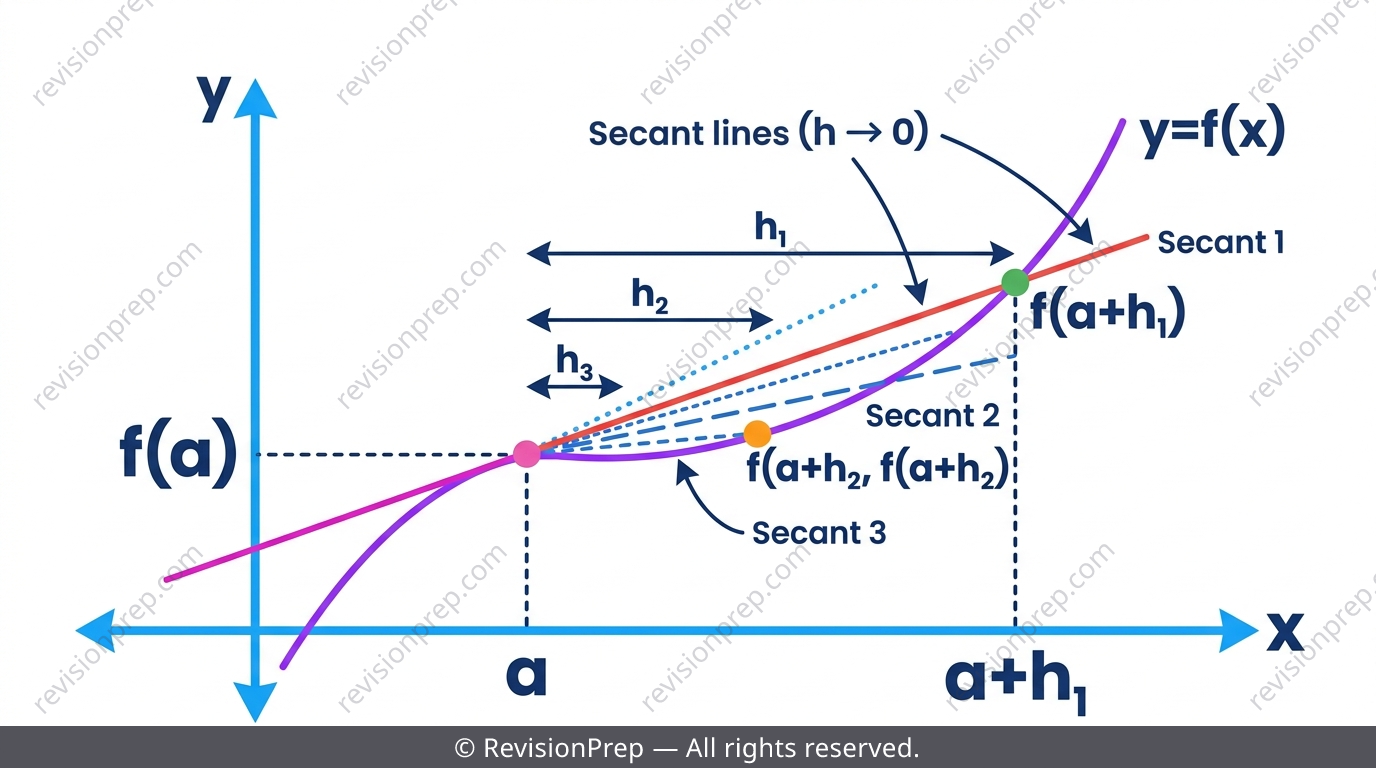
The derivative is officially defined as , and you're expected to use this definition directly whenever a question demands it — it's the only legal method at points where shortcut rules don't apply. Everywhere else, you reach for the chain rule for composite functions, and the product or quotient rule for two functions multiplied or divided together. Mixing up the product and quotient rule under time pressure is the single most common HL differentiation error.
Exam tip
Say the rule out loud as you write it ("derivative of first times second, plus first times derivative of second") to stop product/quotient signs blurring together under exam pressure.
Common mistake
Forgetting the chain rule inside a composite trig function, or swapping the sign pattern between the product and quotient rules.
Mini summary
Use the first-principles definition when told to; otherwise apply chain, product, and quotient rules carefully and deliberately.
HL-Only Extras: Inverse Trig, Implicit Differentiation, Related Rates
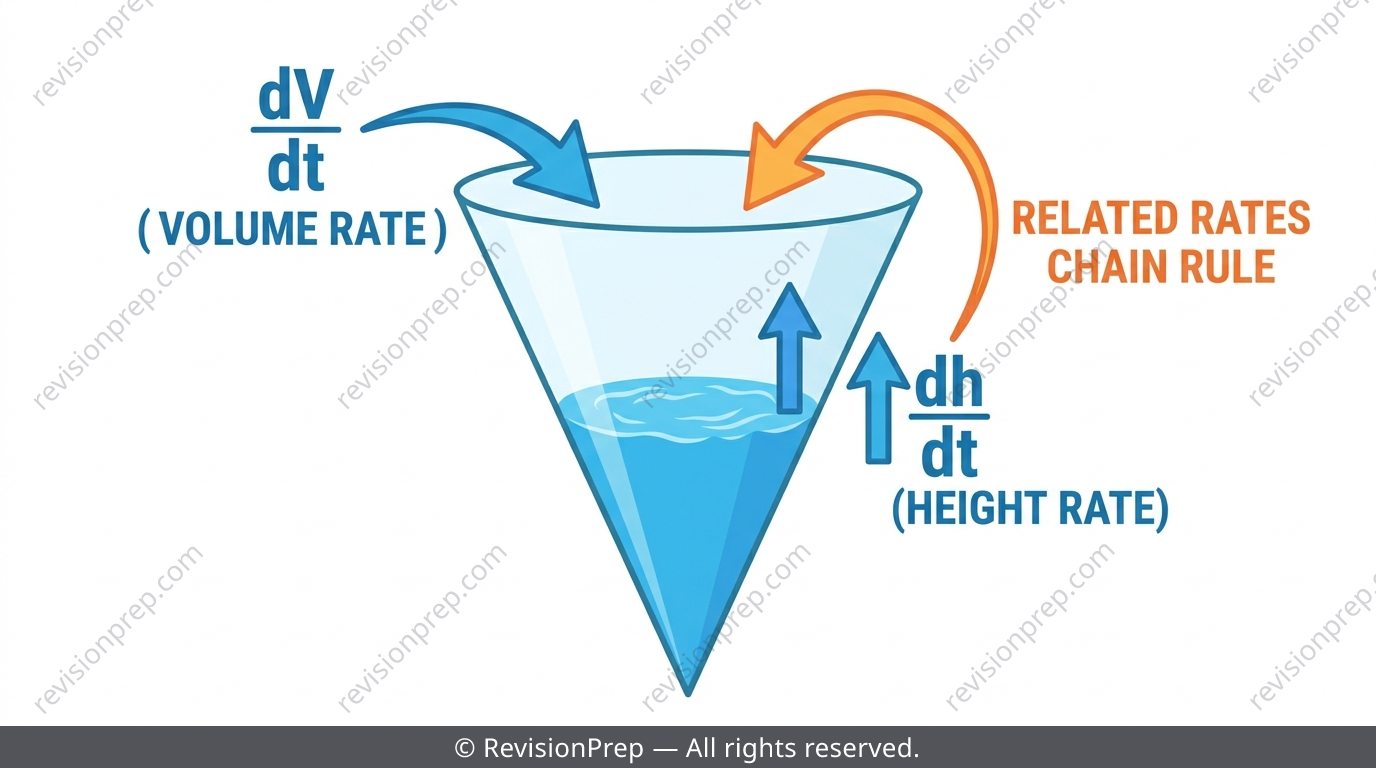
HL adds derivatives of , , and all three inverse trig functions to the SL toolkit. Implicit differentiation lets you differentiate both sides of an equation in and with respect to , treating as a function of throughout. Related rates problems chain two rates of change together, such as , so you can find how fast one quantity changes from how fast another one does.
Exam tip
In related rates problems, identify every rate given and every rate asked for first, then decide which chain-rule link connects them — writing the template before substituting numbers avoids sign and unit errors.
Mini summary
HL differentiation adds inverse trig derivatives, implicit differentiation, and related-rates chaining on top of the SL rule set.
Stationary Points, Inflection, and Optimisation
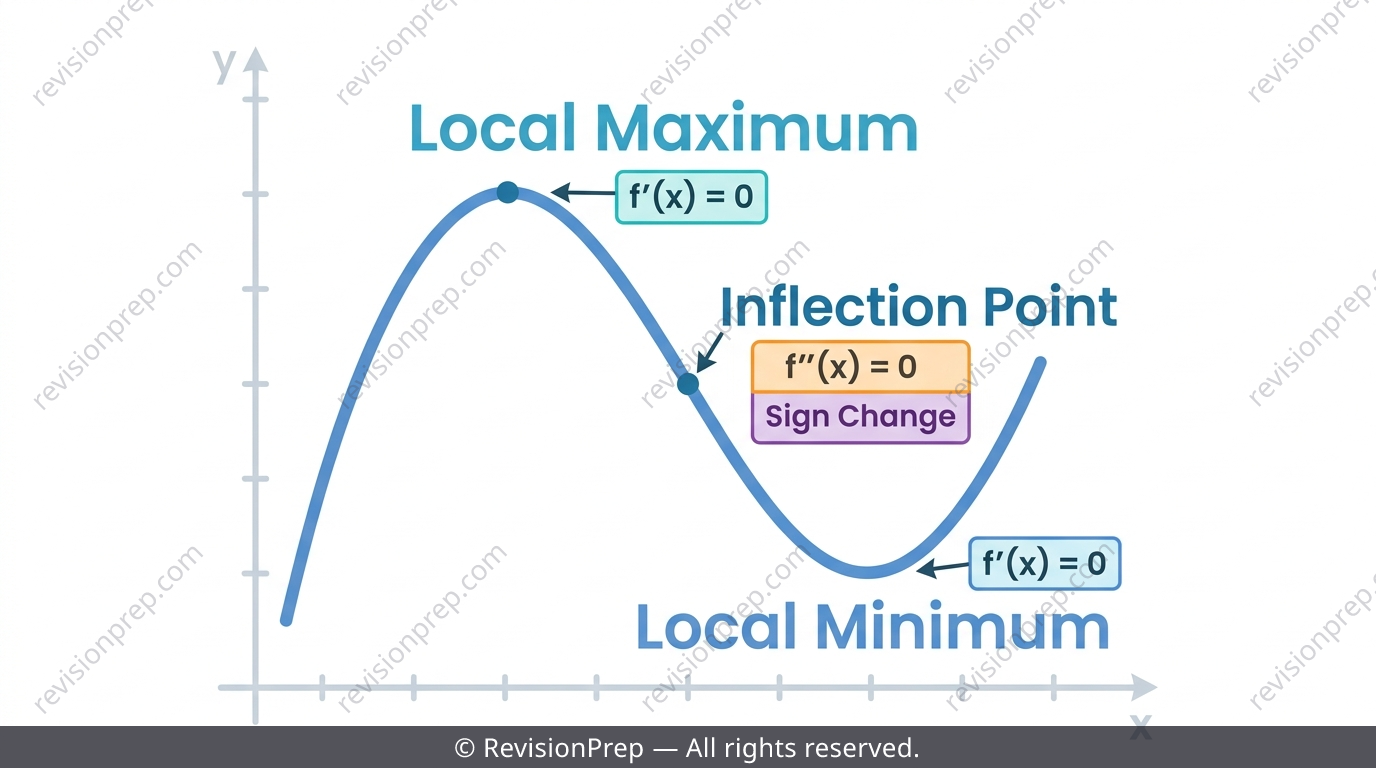
A stationary point occurs where , giving a horizontal tangent that could be a local max, local min, or horizontal inflection point. A point of inflection is where concavity changes — where changes sign either side of it, so the tangent crosses the curve. Optimisation problems (like minimising the surface area of a can with fixed volume) require you to eliminate one variable using the given constraint before differentiating.
Exam tip
Substitute the constraint to eliminate a variable first — differentiating a two-variable expression while silently holding one variable 'constant' is the most common optimisation error at HL.
Common mistake
Differentiating an expression like surface area while forgetting to substitute the volume constraint first, which leaves an extra variable hiding in the derivative.
Mini summary
Stationary points and inflection points come from and respectively; always eliminate a variable using the constraint before optimising.
Integration and HL Differential Equations
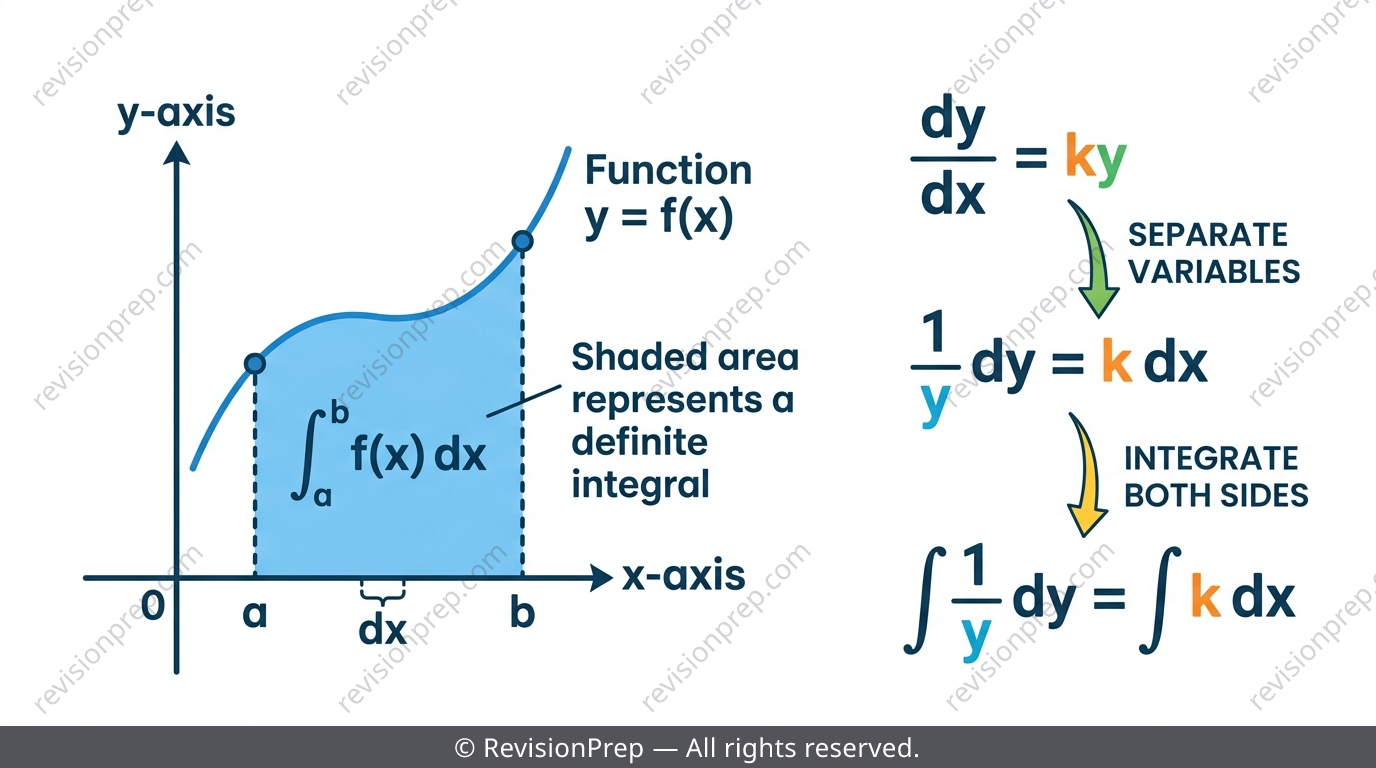
Integration is the reverse of differentiation, and once you can integrate, you can find areas and volumes generated by curves. HL pushes this further into differential equations — equations involving itself — which you solve by separating variables, using substitution, or applying an integrating factor. This strand ties derivatives and integrals together to model how quantities change over time, and it's a favourite source of HL-only long-response questions.
Mini summary
Integration reverses differentiation to find areas and volumes; HL differential equations combine both skills to model change.
Quick formula sheet
Practice questions
- Evaluate by factoring first.
- State the three conditions required for a function to be continuous at .
- Differentiate using the product rule.
- Use the squeeze theorem to find , stating the bounding inequality explicitly.
- Find for using implicit differentiation.
- A stone dropped into a pond creates a circular ripple whose radius grows at 3 cm/s. Find the rate of change of the area when the radius is 10 cm.
- For on and on with , find the relationship between , , , and for continuity at 0.
- A closed cylindrical can must hold . Find the radius that minimises total surface area and justify that it is a minimum.
- Using the definition of the derivative, find for (with defined for continuity), without using L'Hôpital's rule.
Frequently asked questions
How much of IB Maths AA HL is calculus?+
Calculus makes up roughly 26% of HL teaching hours, making it the single largest HL topic. It's examined across both Paper 1 and Paper 2 and almost always anchors at least one Section B long-response question.
What are the three conditions for continuity in IB Maths AA?+
A function is continuous at if exists, the two-sided limit at exists, and that limit equals . All three must hold — checking only that the branch limits agree isn't enough.
Is differentiability the same as continuity?+
No. Differentiable functions are always continuous, but continuous functions aren't always differentiable — corner points are the classic HL example where a function is continuous but not differentiable.
Which differentiation topics are HL-only?+
HL adds derivatives of , , and inverse trig functions, plus implicit differentiation and related rates problems, on top of the SL rule toolkit.
What's the biggest mistake students make in optimisation problems?+
Forgetting to substitute the given constraint to eliminate a variable before differentiating. Differentiating with a hidden extra variable is the most common HL optimisation error.
Are differential equations examined at SL?+
No, differential equations are an HL-only strand. You solve them by separating variables, substitution, or using an integrating factor, combining derivative and integral skills together.
Get the full IB Maths AA HL Calculus revision notes
Related articles