
Number and Algebra: Sequences, Polynomials & the Marks Examiners Actually Drop
The five ideas behind almost every Paper 1 and Paper 2 algebra question in IB Maths AA.
Quick facts
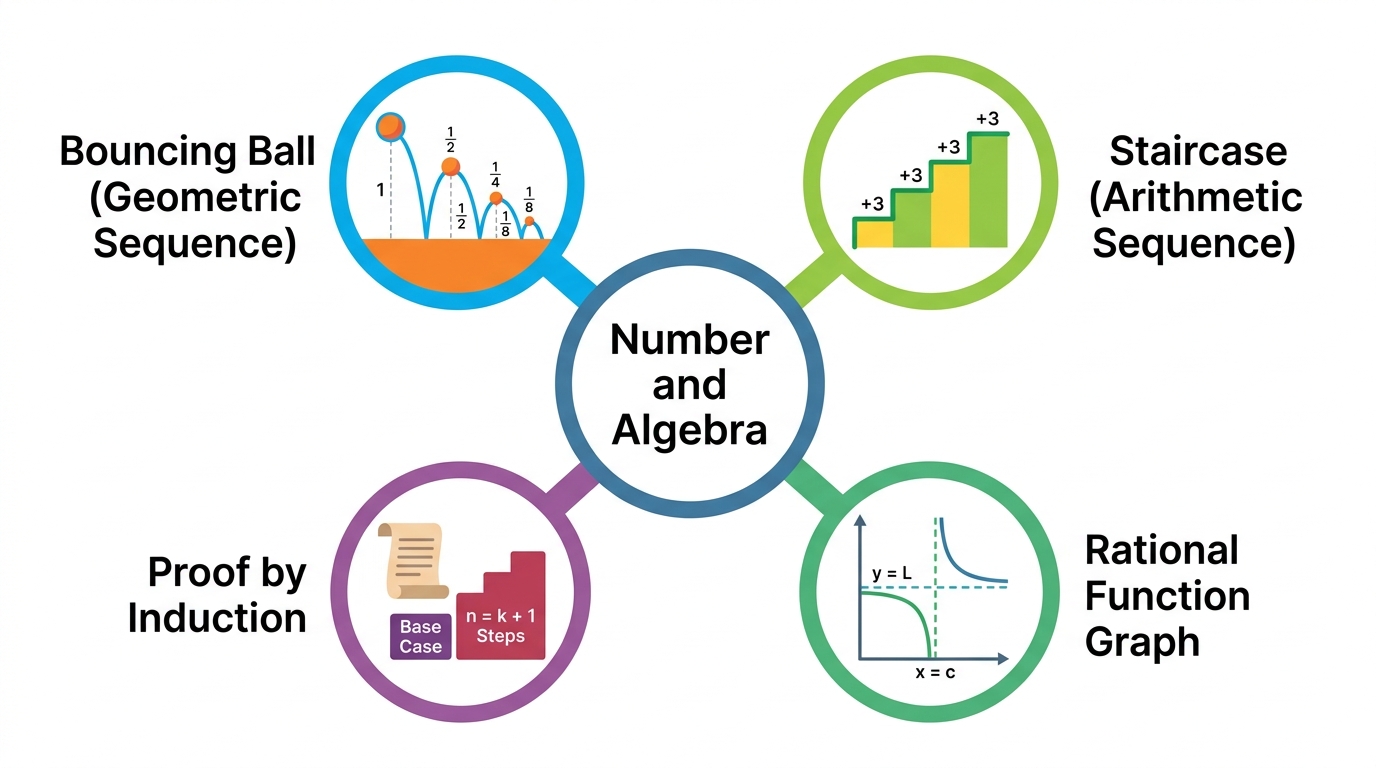
Number and Algebra ties together some of the most exam-frequent ideas in IB Maths AA: arithmetic and geometric sequences, the sum to infinity, proof by induction, and the algebra linking a polynomial's coefficients to its roots. Sequences and series appear almost every year in both Paper 1 and Paper 2, often stacked with 'show that' derivations or GDC-heavy equations. Polynomials and rational functions extend the same logic to continuous graphs — where roots become factors and asymptotes reveal a function's long-term behaviour. This teaser walks through the five concepts that generate the most marks (and the most dropped marks): sequence formulas, sum to infinity, induction proofs, Vieta's formulas, and asymptote rules. The full revision note covers every formula, worked trap, and mark scheme detail in depth.
What you’ll be able to do
Arithmetic Sequences: Constant Difference
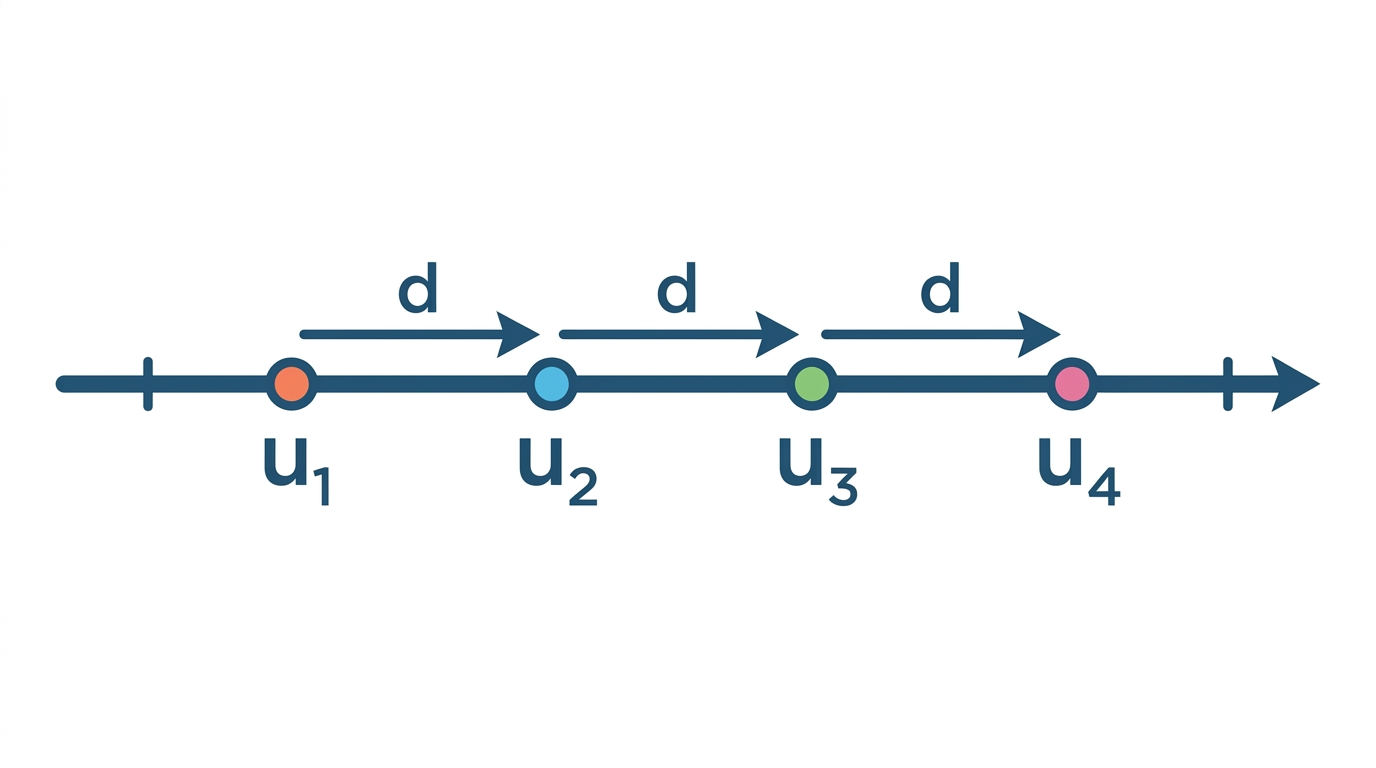
An arithmetic sequence adds (or subtracts) the same amount every step — think a car depreciating by a fixed dollar amount per year. The nth term is , and note it's lots of , not , since already contains zero jumps. When a question gives you two terms or two sums, expect simultaneous equations to find and .
Exam tip
Once you know the last term, use instead of re-deriving — it's faster and avoids sign errors.
Mini summary
Constant difference, linear growth — .
Geometric Sequences and the Sum to Infinity
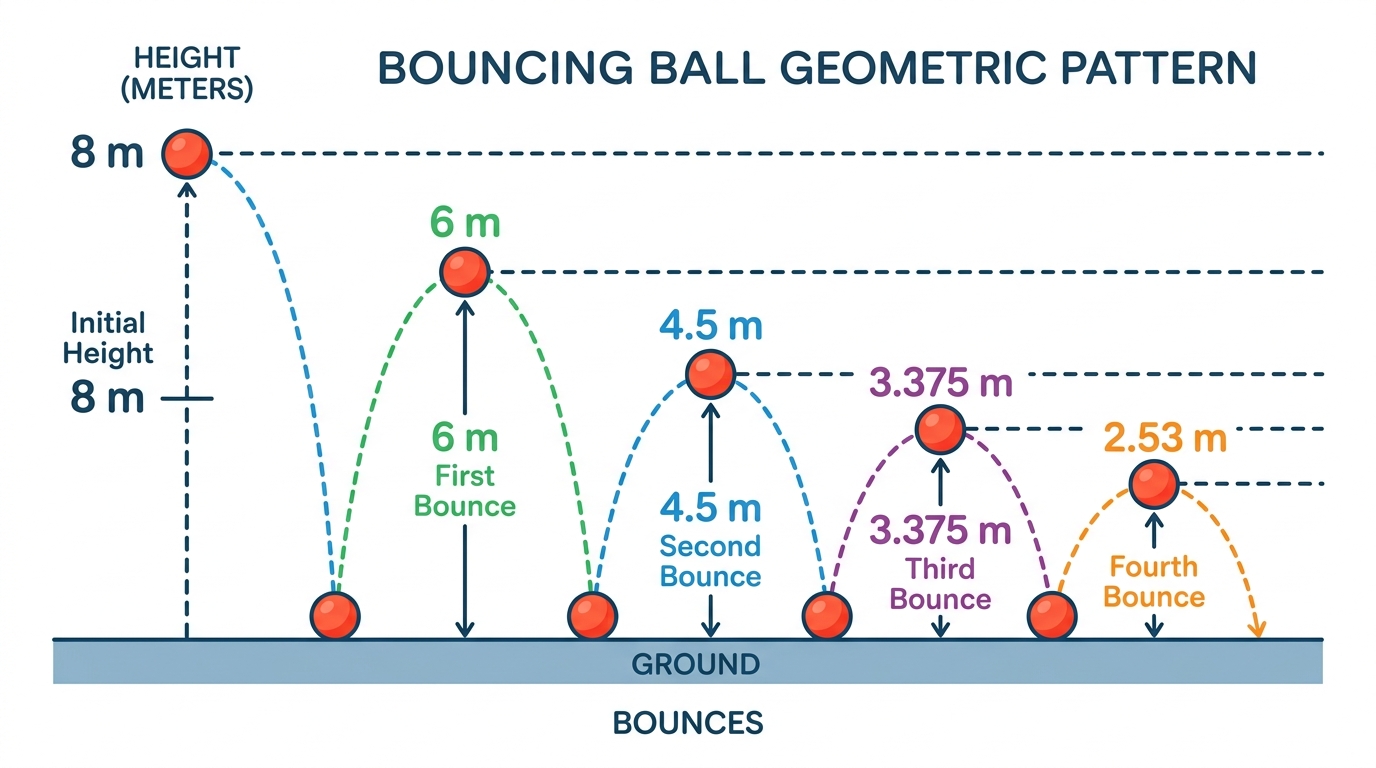
A geometric sequence multiplies by a constant ratio each step — a ball rebounding to a fraction of its drop height, or compound interest. The nth term is , and the sum of the first terms can be written two ways: . If , the terms shrink to nothing and — the only formula here with a condition attached.
| Feature | Arithmetic | Geometric |
|---|---|---|
| Pattern | Constant difference (add/subtract) | Constant ratio (multiply) |
| Growth type | Linear | Exponential |
| nth term | ||
| Sum to infinity | Never exists | Exists only if |
Common mistake
Doubling the very first drop height in a bouncing-ball question — only bounces after the first impact go up-and-down, the initial drop is single-direction.
Mini summary
Constant ratio, exponential growth or decay — only exists for .
Proof by Mathematical Induction (HL)
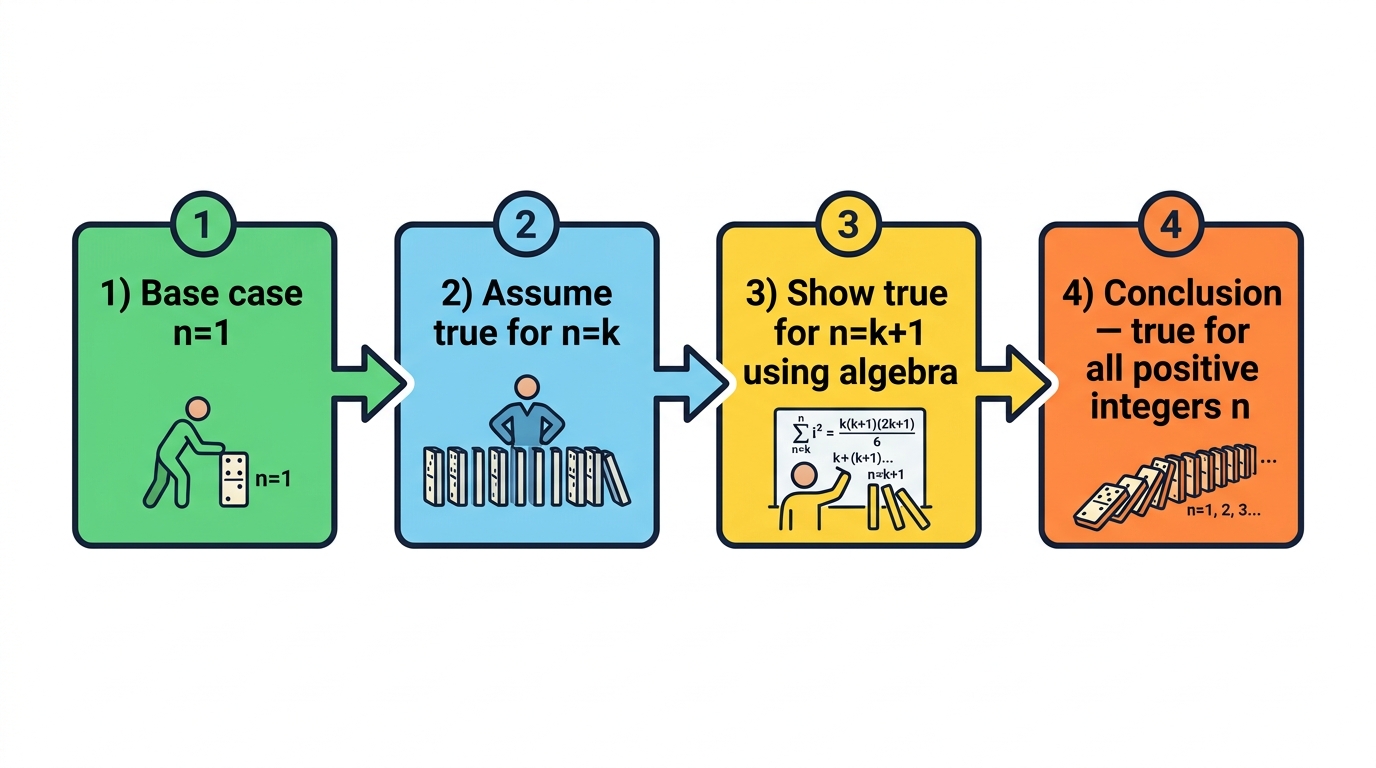
Induction is how examiners force you to justify a general formula for a sequence rather than just quoting it. A complete proof needs four separately mark-worthy parts: a base case, an explicit assumption for , algebra showing the result holds for , and a concluding sentence tying it all together.
Common mistake
Missing the base case or skipping the final concluding sentence — each costs a mark independently of whether the algebra is correct.
Mini summary
Base case, assumption, step, conclusion — all four are graded separately.
Remainder Theorem, Factor Theorem & Vieta's Formulas
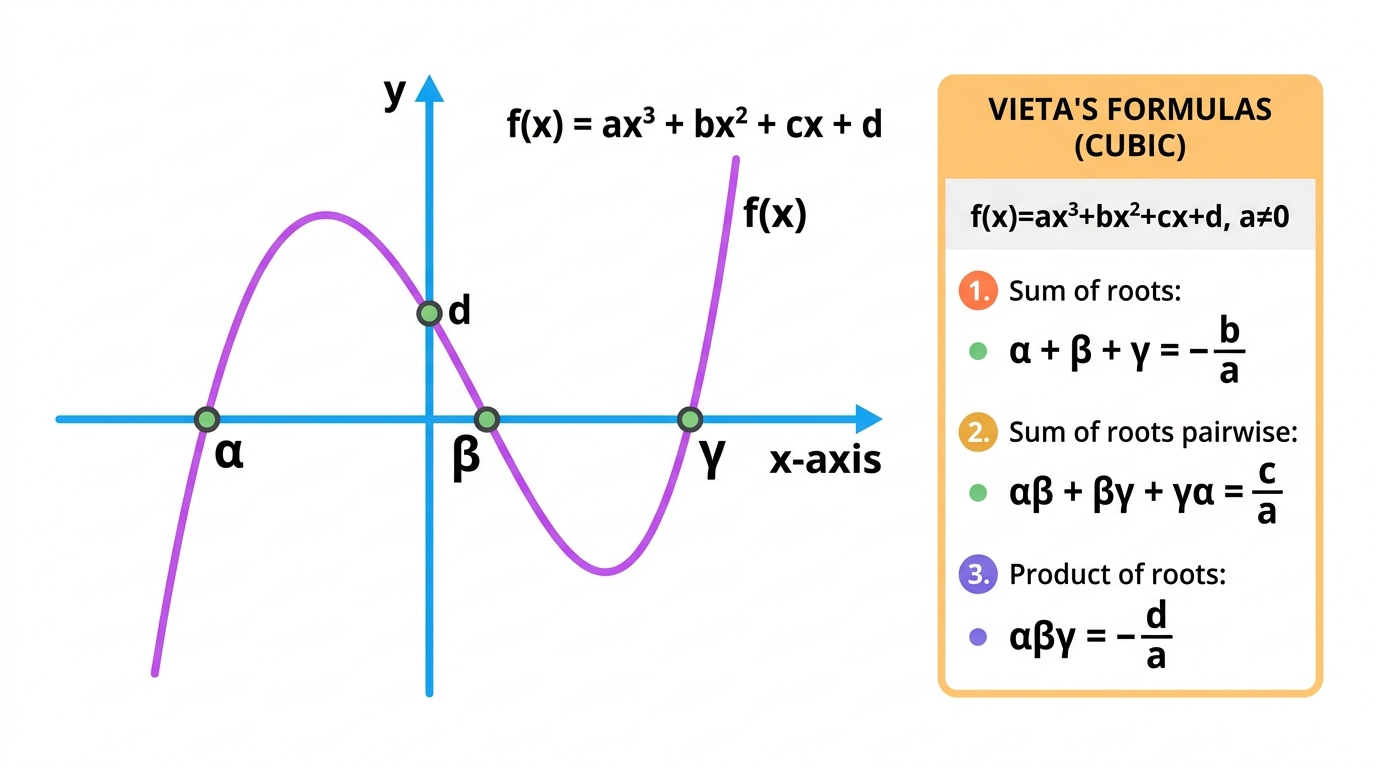
The remainder theorem says dividing by leaves remainder — substitute, don't divide, if that's all you need. The factor theorem is the special case where , confirming is a factor. Once roots are known, Vieta's formulas extract combinations of roots directly from the coefficients: for a cubic, , , .
Common mistake
Assuming the sign pattern in Vieta's formulas is always positive — it alternates (, then , then ), and the pairwise-product sign is often lost.
Mini summary
Substitute for remainders, set for factors, use Vieta's for root combinations without solving.
Rational Functions and Asymptotes
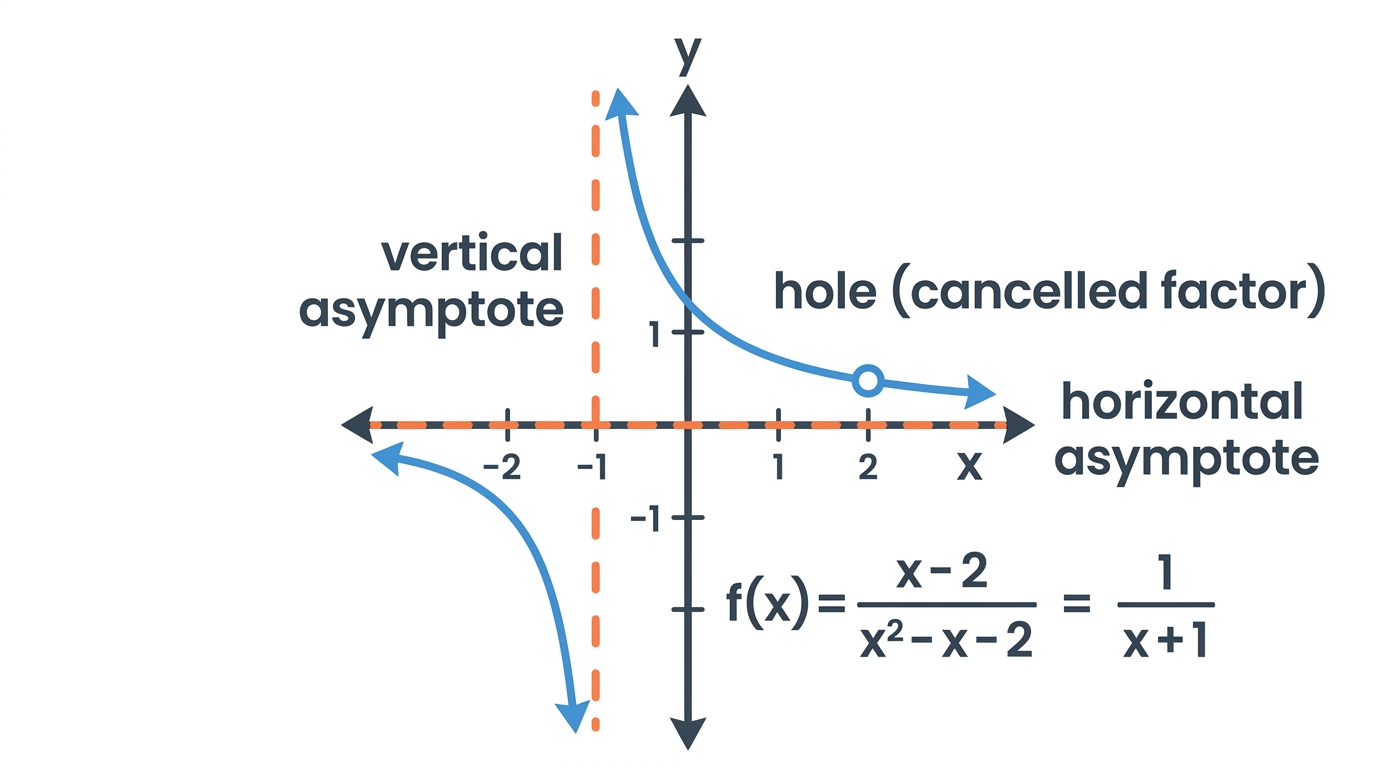
A rational function's long-term shape depends on comparing the degrees of numerator and denominator, while its short-term blow-ups happen wherever the denominator hits zero. A vertical asymptote occurs at only if that denominator factor doesn't cancel with the numerator — if it does, you get a hole instead. Horizontal asymptotes follow degree comparison, and an oblique asymptote appears when the numerator's degree is exactly one more than the denominator's.
Exam tip
Fully factorise both numerator and denominator before naming vertical asymptotes — any common factor is a hole, not an asymptote.
Mini summary
Factorise first: common factors give holes; uncancelled denominator zeros give vertical asymptotes; degree comparison gives horizontal/oblique ones.
Quick formula sheet
Practice questions
- Find the 10th term of an arithmetic sequence with and .
- A geometric sequence has and . Find .
- State the condition on for a geometric series to have a sum to infinity.
- An arithmetic sequence has and . Find and .
- Show that is a factor of and factorise fully.
- Find the equations of all asymptotes of .
- Prove by mathematical induction that for the recurrence , , for all .
- A ball is dropped from 10 m and rebounds to of its previous height each bounce. Find the total distance travelled until it comes to rest.
- For with roots , find in terms of .
Frequently asked questions
What's the difference between arithmetic and geometric sequences?+
Arithmetic sequences add a constant difference each step (linear growth); geometric sequences multiply by a constant ratio each step (exponential growth or decay).
When does a geometric series have a sum to infinity?+
Only when , so the terms shrink towards zero. The formula is , and you must state the condition to get full marks.
Is proof by induction tested at SL?+
No, induction is an HL-only technique in IB Maths AA. It's used to prove general formulas for sequences and other statements involving all positive integers.
How do I know if a rational function has a vertical asymptote or a hole?+
Fully factorise the numerator and denominator. If a factor is common to both, it cancels and creates a hole; any uncancelled denominator zero gives a vertical asymptote.
What are Vieta's formulas used for?+
They let you find combinations of a polynomial's roots (like their sum or product) directly from its coefficients, without solving the equation.
Why is the remainder theorem useful?+
It lets you find the remainder of by simply substituting into , avoiding long division when you don't need the quotient.
Get the Full Number and Algebra Revision Note
Related articles