
Geometry and Trigonometry
Turn coordinates and triangles into IB Maths AI marks without the sign errors
Quick facts
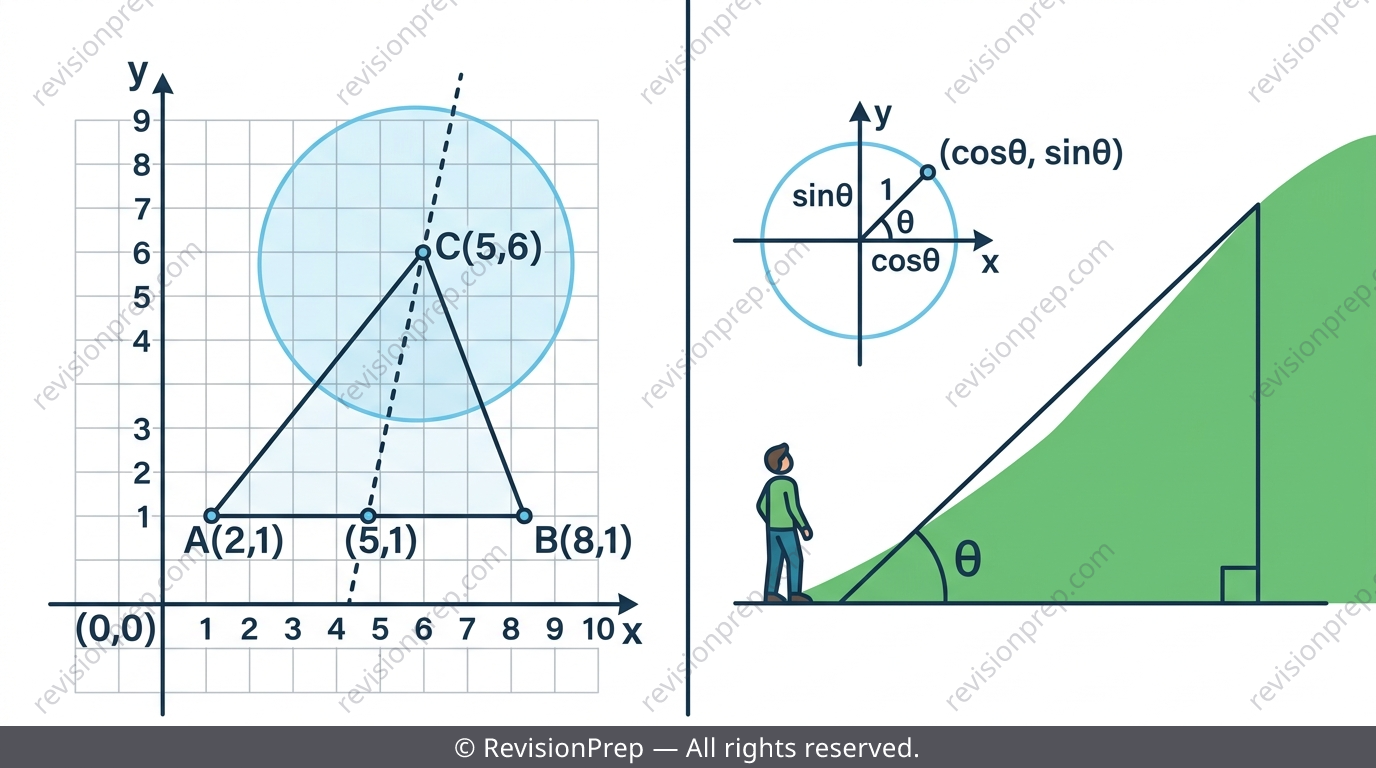
IB Maths AI geometry and trigonometry rewards students who can spot which formula a question wants and then apply it without a sign slip. This topic sits at the heart of Paper 1 and Paper 2, worth around 23% of AI HL marks, and it blends coordinate geometry — distance, midpoint, perpendicular bisectors, triangle area — with trigonometric ratios that extend beyond the right-angled triangle into the unit circle. Once you can convert a real-world scene like a sprinkler, a flight path, or a survey plot into coordinates or a labelled triangle, the rest is careful substitution. This teaser covers the five ideas that generate the most exam marks: distance and midpoint, the perpendicular bisector as a locus, triangle area from coordinates, SOHCAHTOA with elevation and depression, and why cosine can be negative in obtuse triangles. The full revision notes go deeper with every worked example and formula.
What you’ll be able to do
Distance and Midpoint: Points into Lengths
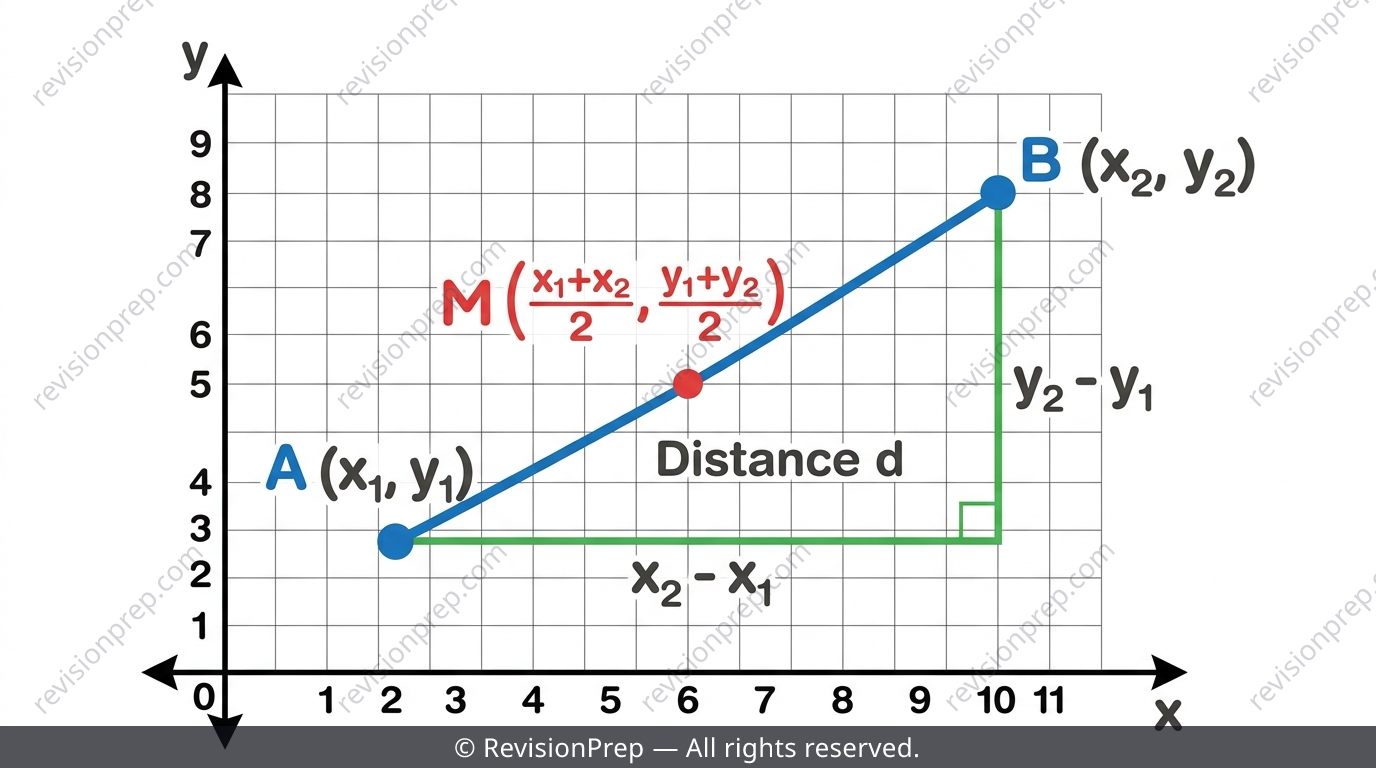
The distance formula is just Pythagoras rotated onto a coordinate grid: , and in 3D you simply add a term for problems like an aircraft's position given as in km. Midpoint is an average, not a difference — it's , and mixing that up under pressure is a frequent slip. Both formulas are formula-booklet safe, so the real skill being tested is reading the coordinates correctly out of a diagram or word problem.
Exam tip
Both distance and midpoint formulas are given in the booklet — spend your memory budget on the formulas that aren't, like perpendicular bisectors and circle equations.
Common mistake
Subtracting instead of adding coordinates when finding a midpoint.
Mini summary
Distance = rotated Pythagoras; midpoint = an average of coordinates, not a difference.
Perpendicular Bisector as a Locus
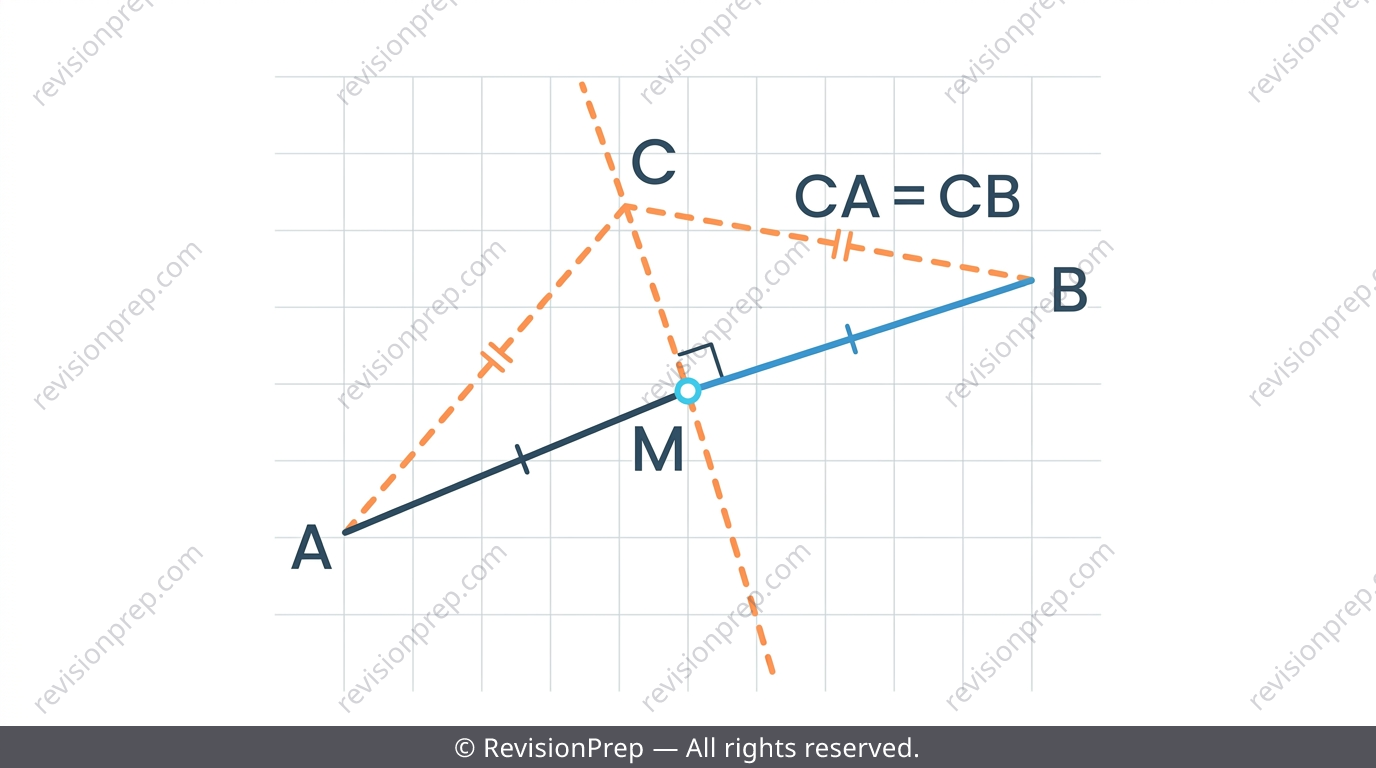
Examiners test the perpendicular bisector of as the set of ALL points equidistant from and — not just 'a line at 90° through the midpoint.' To build it: find the midpoint of , find the gradient of , take the negative reciprocal for the perpendicular gradient (), then substitute the midpoint into . If a triangle is isosceles with , point automatically lies on this bisector — a one-line 'hence' argument that scores well without rebuilding the whole line equation.
Exam tip
Write down first, then compute as a separate line before substituting — this stops the sign error before it happens.
Common mistake
Using the gradient of itself, not its negative reciprocal, as the perpendicular gradient.
Mini summary
A perpendicular bisector is a locus of equidistant points, built from midpoint + negative reciprocal gradient.
Triangle Area Straight from Coordinates
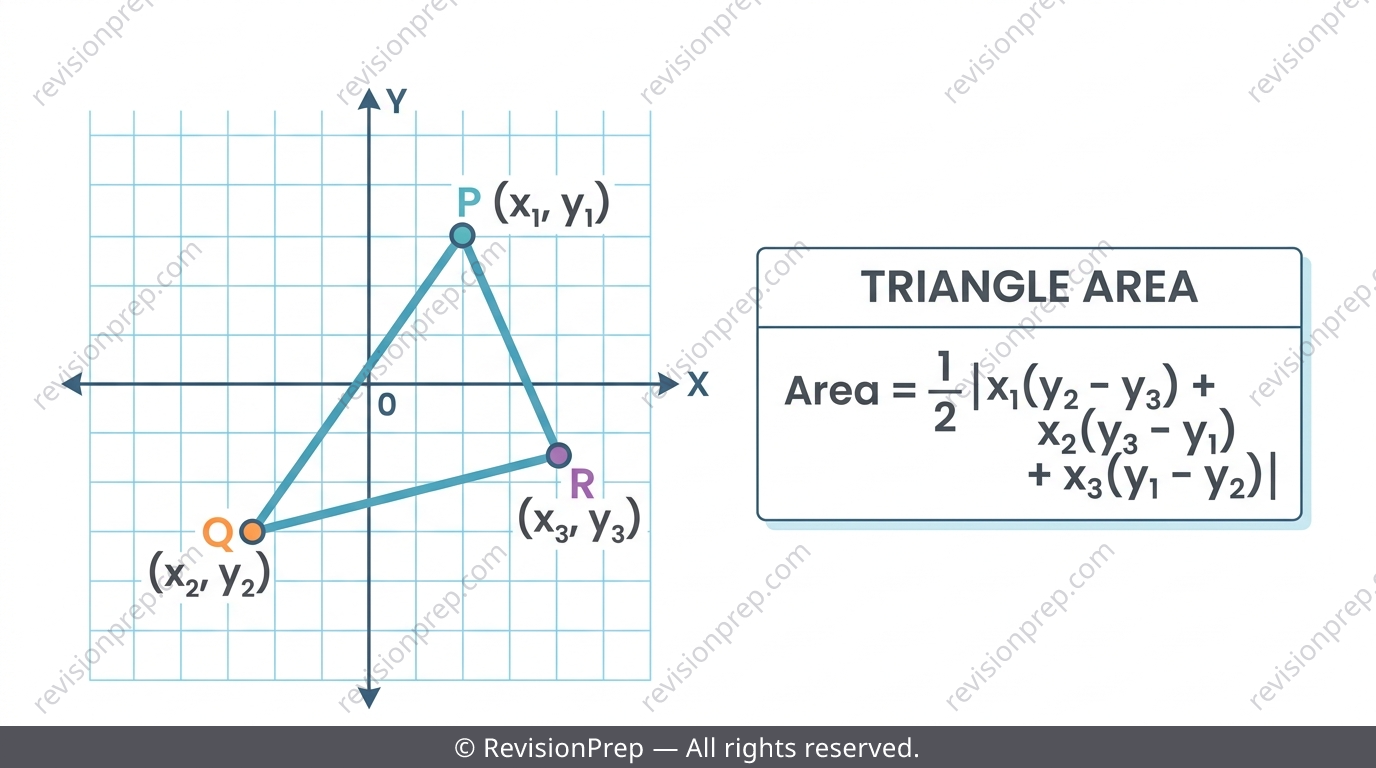
The shoelace formula gives a triangle's area directly from three vertices, but it is NOT in the formula booklet, so memorise it or fall back on the cosine-rule route. At HL, the same result comes from the 2D vector cross product, , tested alongside the Vectors topic. Running Area base × height BACKWARDS is also a clean way to find a perpendicular distance from a point to a line once the area and base length are known.
Exam tip
If a part says 'hence', examiners expect you to reuse the previous answer — skipping that step can lose marks even with a correct final number.
Common mistake
Recomputing a perpendicular distance directly instead of using an already-found area when a question says 'hence'.
Mini summary
Shoelace formula (or the HL vector cross-product) turns three vertices into an area in one line — memorise it, it's not in the booklet.
SOHCAHTOA, Elevation and Depression
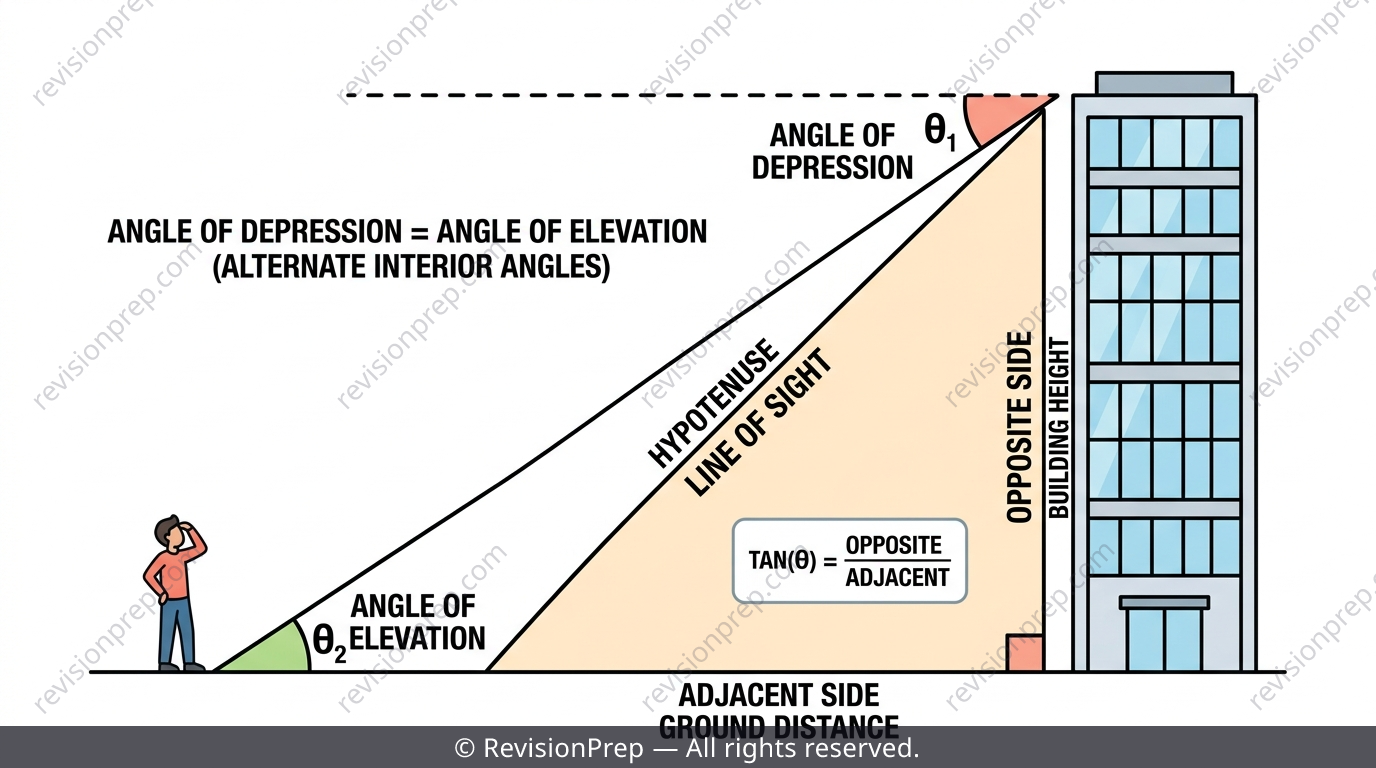
SOHCAHTOA still runs right-angled triangle problems: , , , but a genuine right angle must exist first. Angle of elevation is measured UP from the horizontal, angle of depression DOWN from it, and the two are equal by alternate angles when the horizontal lines are parallel — which is why a 'looking down from a rooftop' problem is the same triangle as 'looking up from the ground'. Pythagoras is the silent partner here, usually needed to find a missing side before an angle can even be calculated.
Exam tip
If your angle answer looks physically absurd (a plane descending almost vertically), that's a strong clue the sides were swapped in the ratio.
Common mistake
Flipping the opposite and adjacent sides in the tangent ratio, giving an unrealistic angle (like an 80° aircraft descent).
Mini summary
Right-angle-only ratios (SOHCAHTOA) plus Pythagoras solve elevation/depression problems; elevation and depression angles are equal by alternate angles.
The Unit Circle and Obtuse Angles
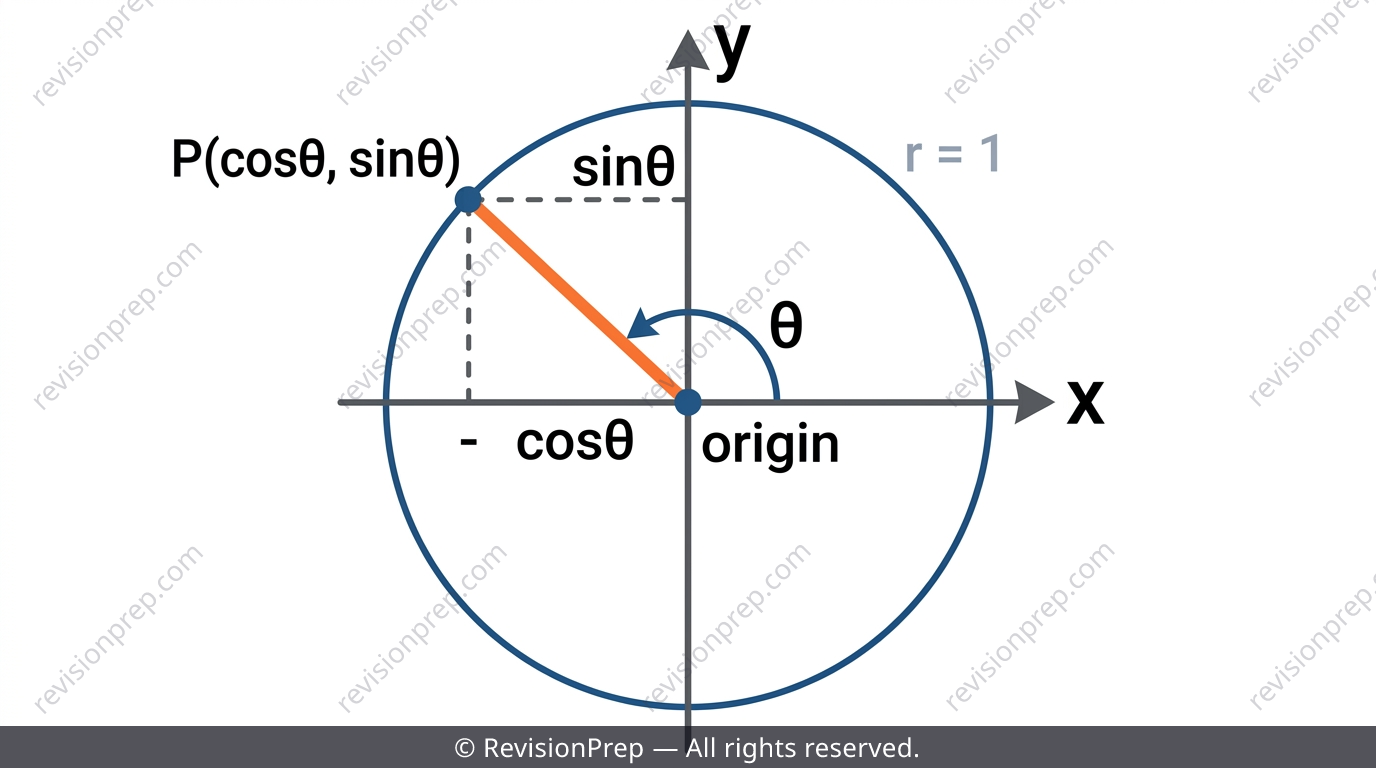
For the sine and cosine rules to work on real, often obtuse, triangles, and must be defined beyond –: on the unit circle, is the -coordinate and is the -coordinate of the point at angle anticlockwise from the positive -axis. The key consequence: but — sine stays positive in the second quadrant, cosine flips sign, which is exactly why can return a negative value and still describe a valid obtuse angle. The identity falls straight out of this circle, and radians ( radians ) show up increasingly often at HL.
Exam tip
Before starting any trig question, sanity-check your calculator mode by confirming — a five-second habit that prevents an entire question going wrong.
Common mistake
Leaving the calculator in the wrong angle mode (degrees vs radians), which produces a wrong but plausible-looking decimal.
Mini summary
The unit circle extends sine and cosine to any angle; cosine goes negative for obtuse angles, sine doesn't — that's the whole point.
Quick formula sheet
Practice questions
- Find the distance between the points and .
- Find the midpoint of the segment joining and .
- State the exact value of and .
- Find the equation of the perpendicular bisector of the segment joining and .
- A ladder leans against a wall making a angle of elevation with the ground and reaches m up the wall. Find the length of the ladder.
- Points , , form a triangle. Find its area using the shoelace formula.
- A circle has centre and passes through the point . Write down its equation, then determine whether the point lies inside, on, or outside the circle.
- Given a triangle with an obtuse interior angle whose cosine rule calculation returns , find to 1 decimal place and explain why the negative value is valid.
- Triangle has , and . Find the exact area of the triangle, then hence find the exact perpendicular distance from to line .
Frequently asked questions
What is the distance formula in IB Maths AI?+
It's in 2D, or add a term for 3D coordinates — it's Pythagoras applied to a coordinate grid and it's given in the formula booklet.
How do you find a perpendicular bisector in IB maths?+
Find the midpoint of the segment, find its gradient, take the negative reciprocal for the perpendicular gradient, then substitute the midpoint into .
Why can cosine be negative in the cosine rule?+
Because on the unit circle is the x-coordinate of the point at angle , which is negative in the second quadrant — so obtuse angles genuinely have negative cosine values, and that's still a valid triangle.
What's the difference between angle of elevation and angle of depression?+
Elevation is measured upward from the horizontal to a higher object; depression is measured downward from the horizontal to a lower object. They're equal by alternate angles when the two horizontals are parallel.
Is the shoelace formula given in the IB formula booklet?+
No — the triangle-area-from-vertices formula must be memorised, or you can find the area using the cosine rule followed by instead.
How much of the AI HL exam is geometry and trigonometry?+
It's roughly 23% of AI HL papers, examined across both Paper 1 and Paper 2, making it one of the highest-weighted topics in the course.
Get the full IB Maths AI Geometry and Trigonometry notes
Related articles