
Geometry and Trigonometry
Coordinate geometry, the unit circle, and the sine and cosine rules for IB Maths AI SL Topic 3
Quick facts
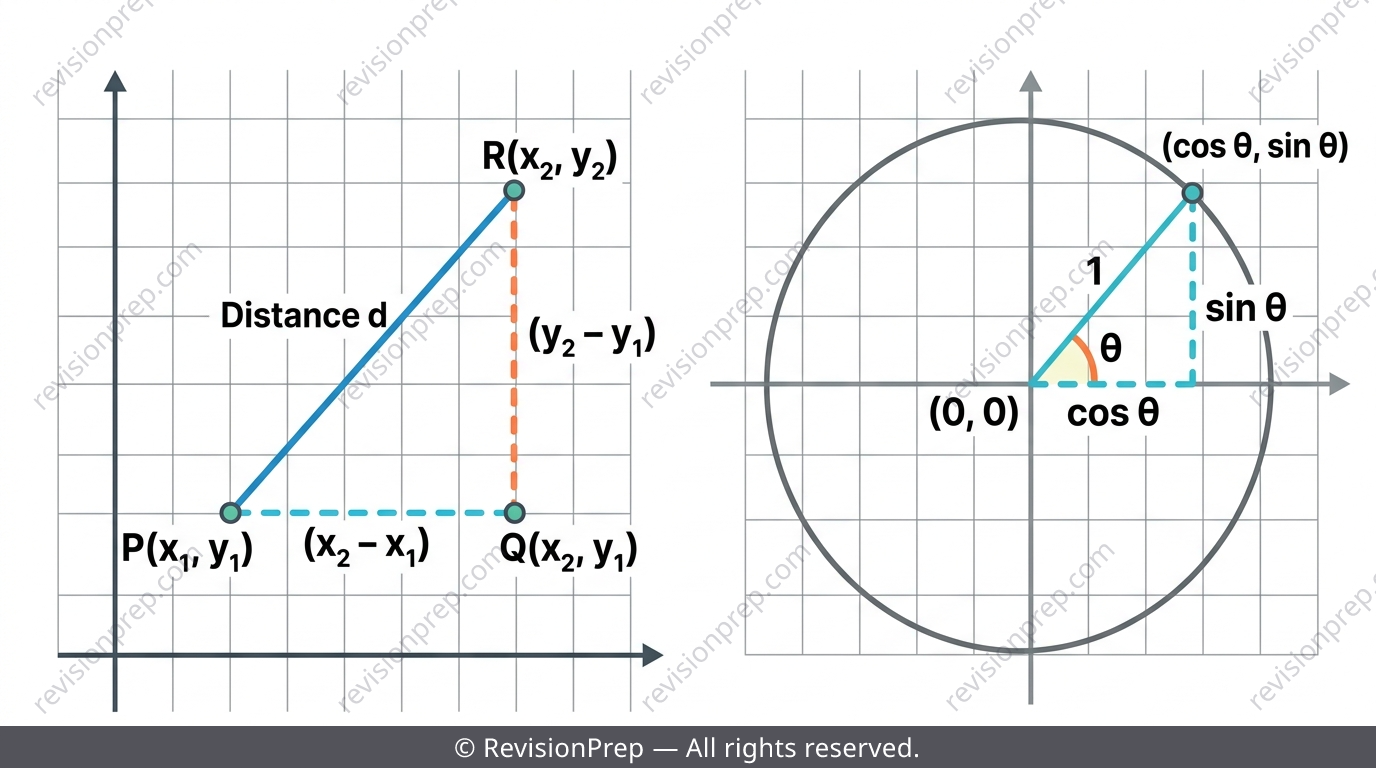
IB Maths AI SL Geometry and Trigonometry is all about applied problems: how far apart two points are, what angle a triangle makes, how big a plot of land is. The formula booklet already gives you the distance formula, midpoint, sine rule, cosine rule and the area-from-vertices formula — so the exam isn't testing memory, it's testing whether you can match the right tool to the data you're given. This topic covers coordinate geometry (distance, midpoint, gradient, area from vertices), trig ratios and identities extended beyond right-angled triangles using the unit circle, and the sine and cosine rules that solve any triangle. It appears in both the non-calculator Paper 1 and the calculator-based Paper 2, often inside real-world contexts like surveying, bearings and land plots. This teaser covers the five ideas worth locking down first — the full revision note goes deeper with more worked examples.
What you’ll be able to do
Coordinate Geometry: Distance, Midpoint and Gradient
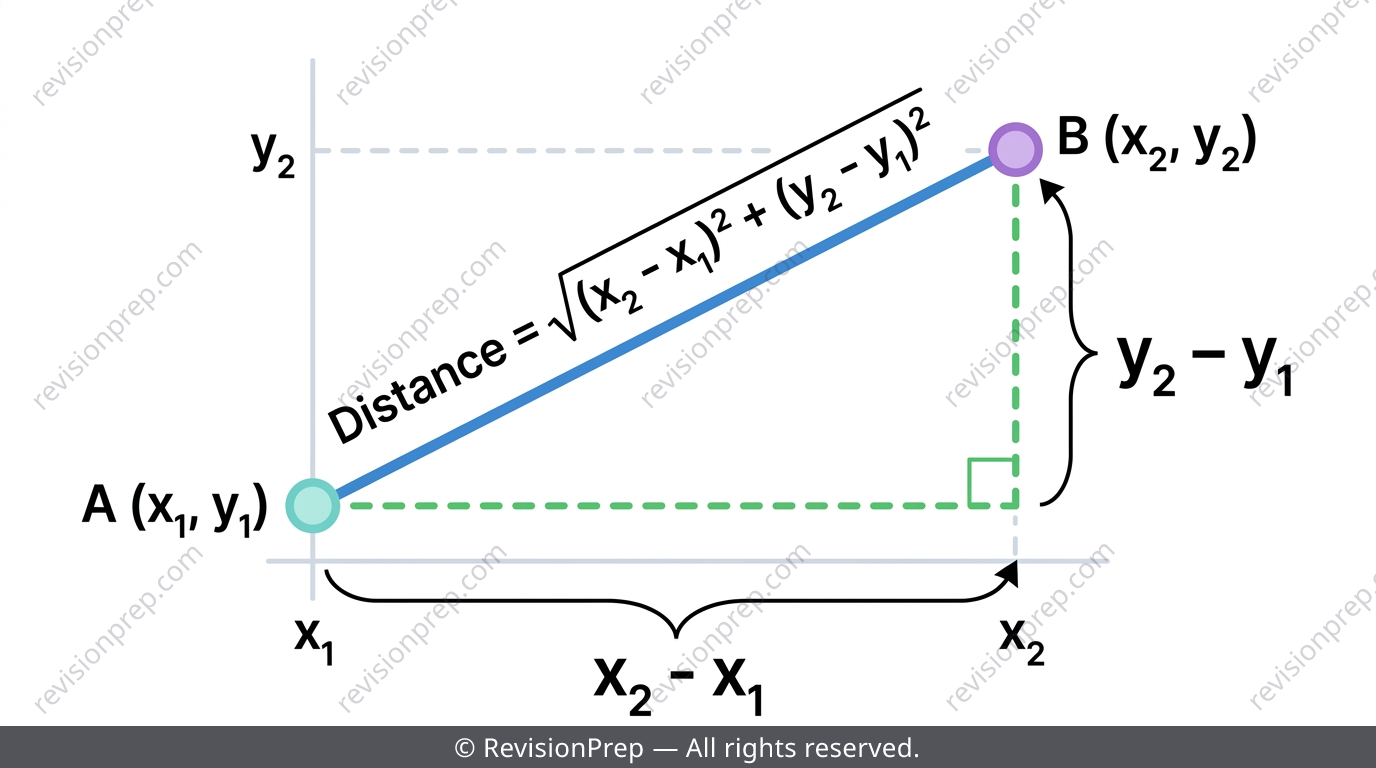
Distance is just Pythagoras applied to the horizontal and vertical gap between two points — think of it as 'Pythagoras in disguise' rather than a separate rule to memorise. Midpoint is nothing more than averaging the x-coordinates and averaging the y-coordinates. Gradient compares vertical change to horizontal change, and its parallel () and perpendicular () conditions let you prove geometric properties without measuring anything on a diagram.
Exam tip
For parallelogram-style questions, identify which pairs of vertices are actually the diagonals before equating midpoints — the diagonals of a parallelogram bisect each other, so their midpoints are equal.
Common mistake
Pairing the wrong sides as diagonals in a parallelogram question (e.g. treating and as diagonals instead of and ) — always trace the vertex order first.
Mini summary
Distance = Pythagoras between two points; midpoint = average of coordinates; gradient conditions prove shape properties.
Area of a Triangle from Coordinates (Shoelace Formula)
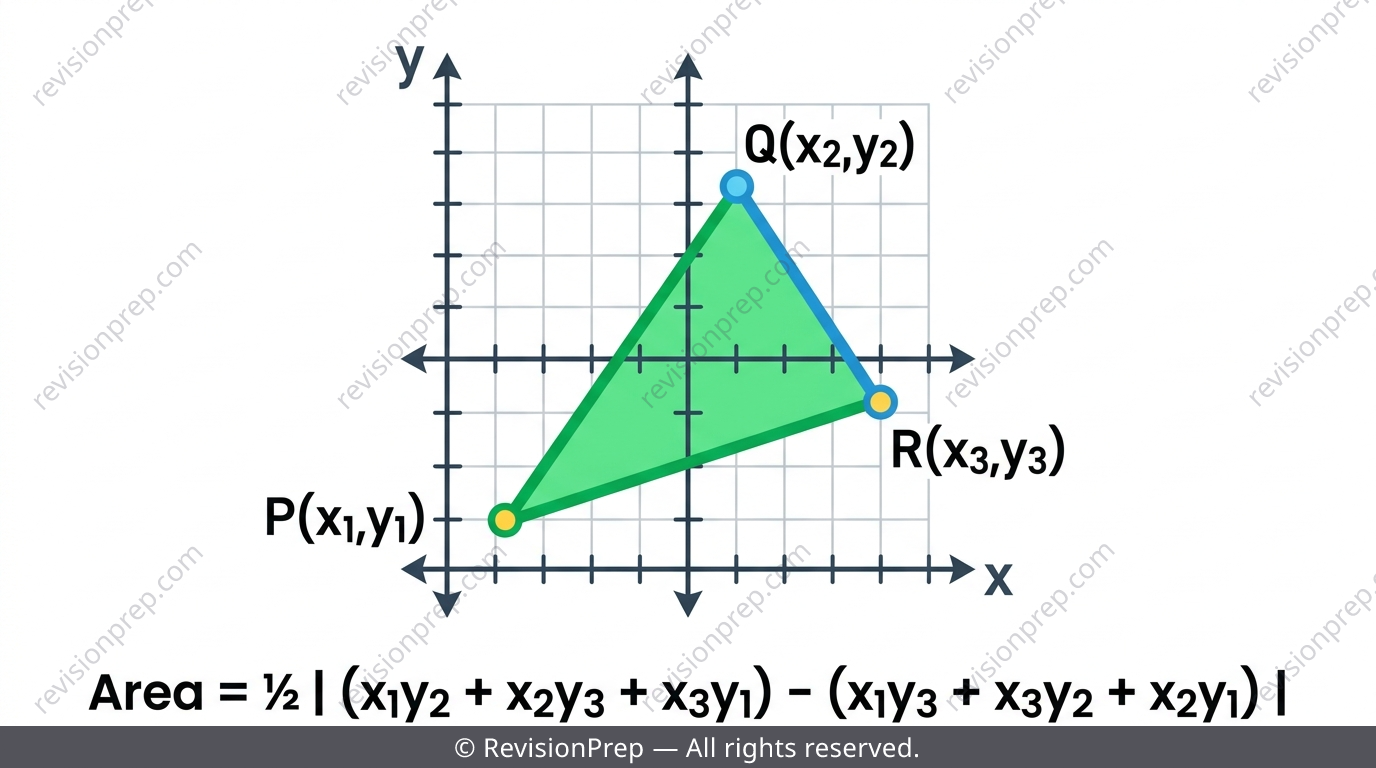
When you only know a triangle's vertices, splitting it into base and height is slow — the area-from-vertices formula in the booklet does it directly from the coordinates. It's the shoelace formula, and it always needs both the multiplier and the modulus bars at the end, since areas can't be negative.
Exam tip
Write the formula out in full — modulus bars and included — before substituting any numbers, so you can't accidentally drop them partway through.
Common mistake
Forgetting the modulus sign or the multiplier in the area-from-vertices formula.
Mini summary
The shoelace formula finds triangle area straight from coordinates — always keep the and the modulus.
The Unit Circle and Trig Identities Beyond 90°
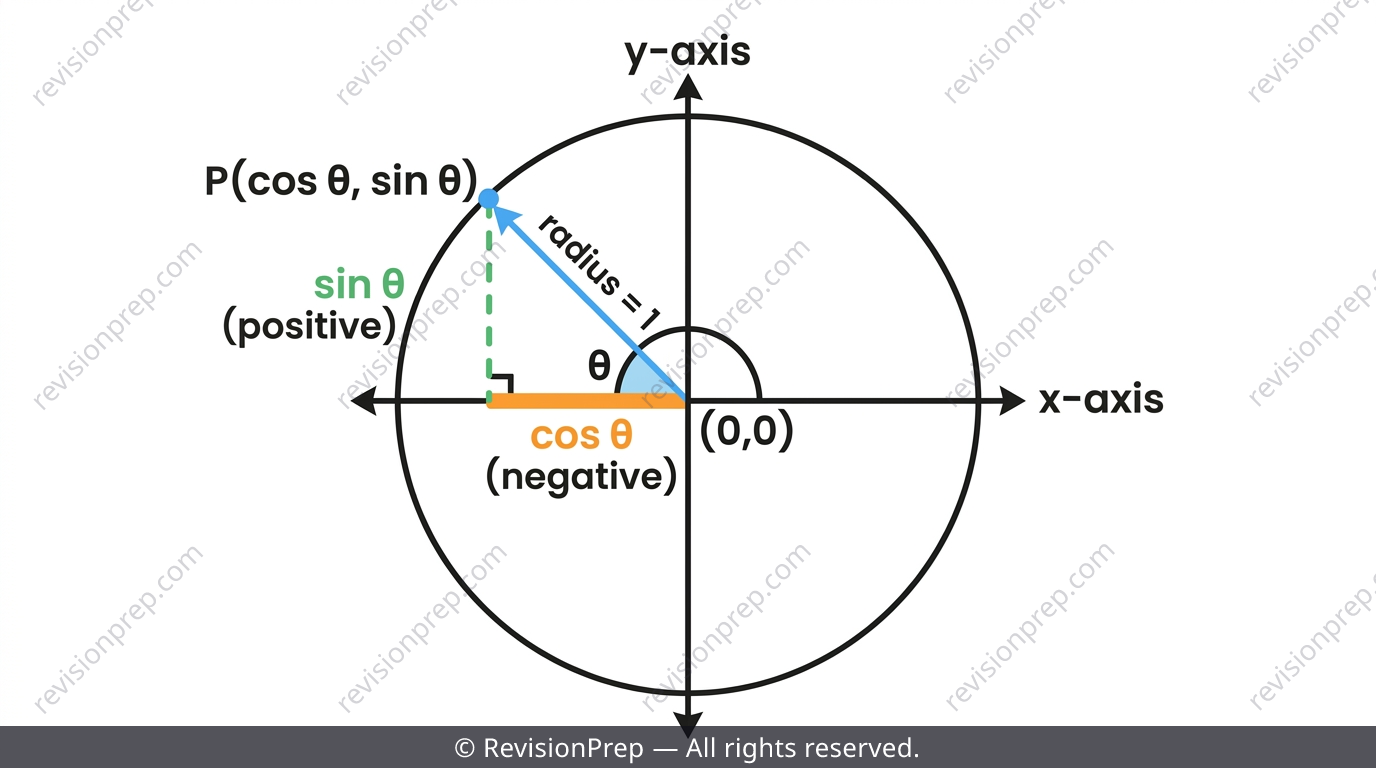
SOH CAH TOA only works inside a right-angled triangle, but the sine and cosine rules need trig values for angles up to 180°. The unit circle fixes this: a point at angle anticlockwise from the positive x-axis has coordinates , which is the definition your calculator actually uses. Between 0° and 180°, sine is always positive, while cosine is positive for acute angles and negative for obtuse ones — that sign is often the entire point of a question.
Exam tip
Check your calculator's angle mode (degrees vs radians) before the very first calculation of any trigonometry question, not just at the start of the exam.
Common mistake
Using to find sine or cosine but keeping both signs instead of using the given angle range to pick the correct one.
Mini summary
The unit circle extends sine and cosine past 90°; sine stays positive up to 180°, cosine flips negative.
The Sine Rule and the Ambiguous (SSA) Case
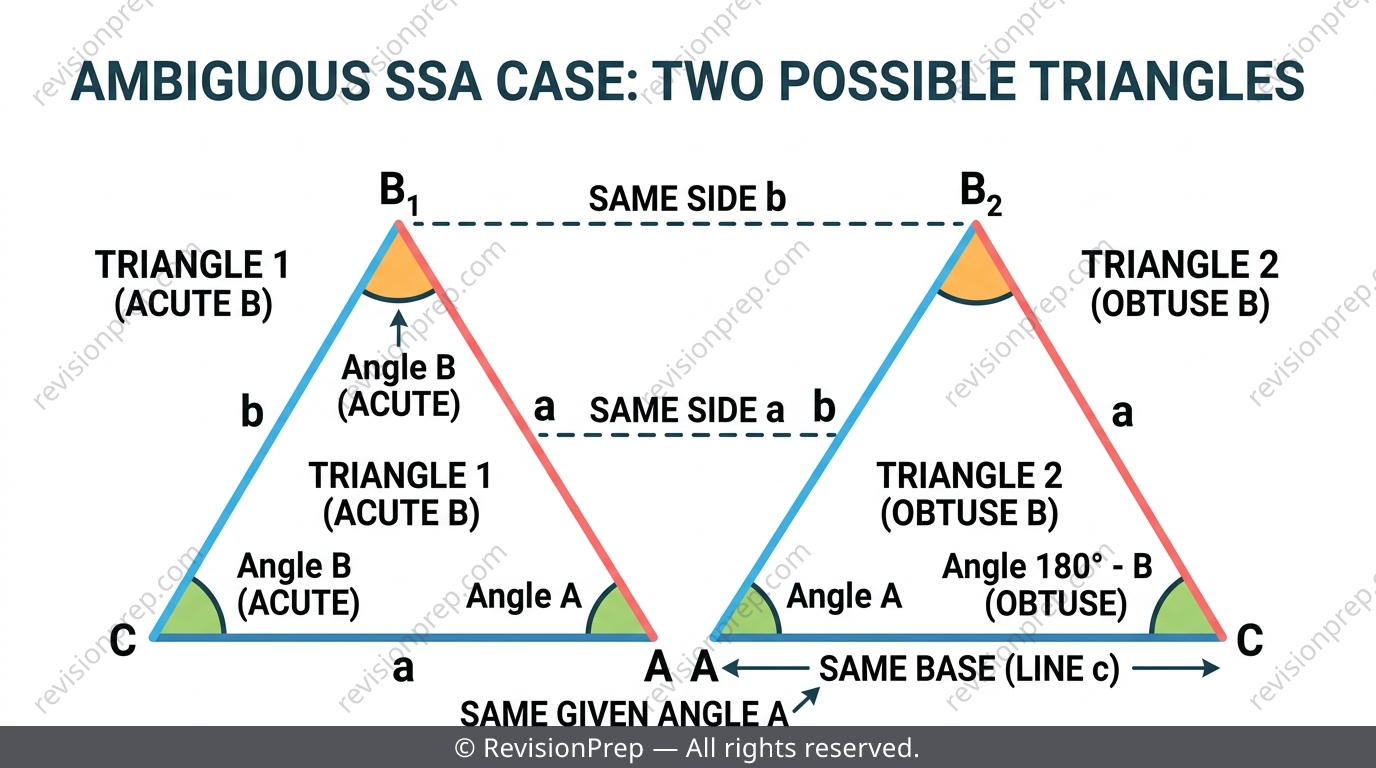
Most triangles in real applications — surveying, bearings, land plots — aren't right-angled, so the sine rule steps in whenever you have a matched angle-side pair (an angle and the side opposite it) plus one more piece of information. The catch is the ambiguous SSA case: the same data can sometimes produce two valid triangles, so you must always check whether is also a legitimate angle before discarding it.
Exam tip
With SSA data, always test the obtuse supplement of your calculator's answer and check the three angles still sum to less than 180° before accepting or rejecting it.
Common mistake
Giving only the calculator's first (acute) answer for and ignoring the possible second triangle.
Mini summary
Sine rule needs a matched angle-side pair; SSA data can give two triangles, so always check the supplementary angle.
The Cosine Rule and Area Without Height
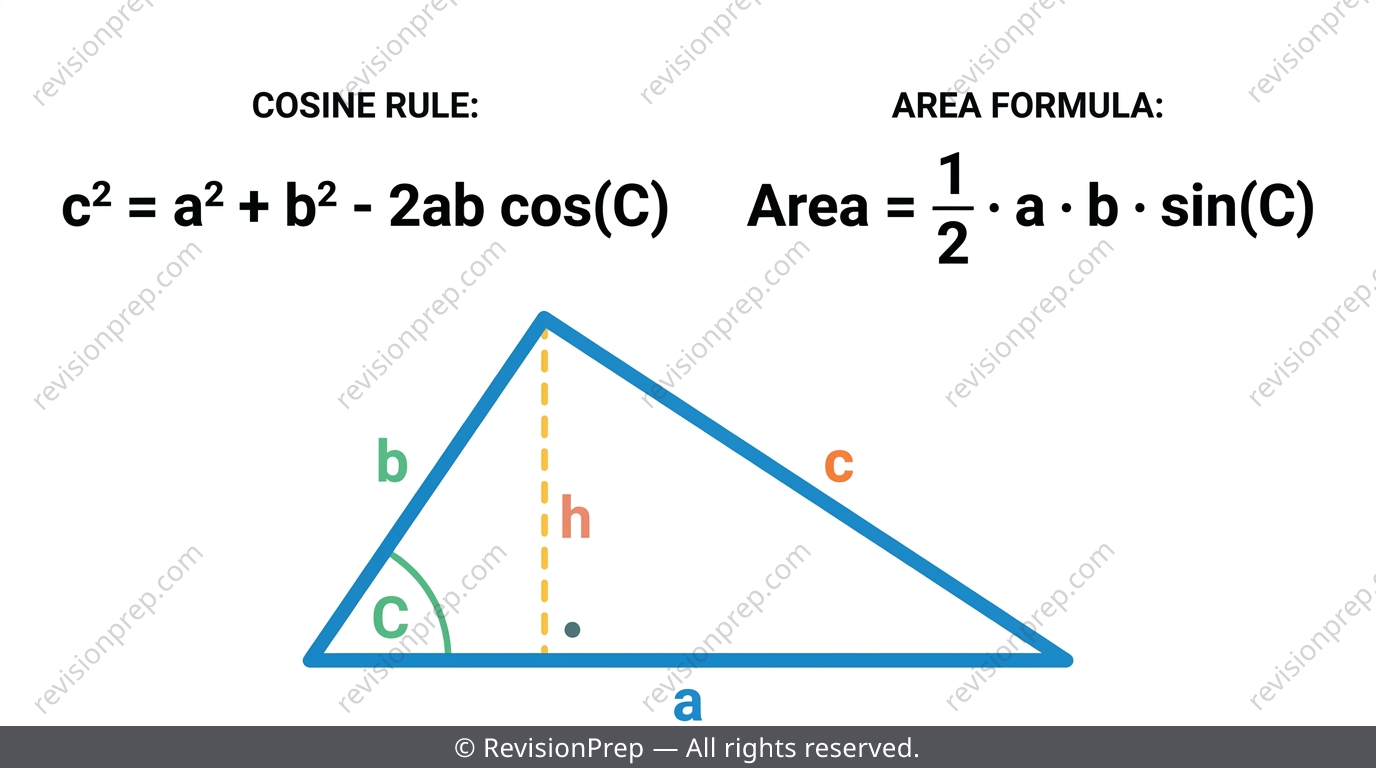
The cosine rule never needs a matched angle-side pair — it works with all three sides (to find an angle) or two sides and the included angle (to find the third side), covering exactly the triangles the sine rule can't. When you know two sides and the included angle, finds the area directly, with no need to calculate the height separately.
Exam tip
Your calculator's inverse cosine already returns the correct obtuse angle directly from a negative cosine value — don't 're-correct' it.
Common mistake
Assuming the cosine rule always produces an acute angle and manually adjusting a valid negative cosine result.
Mini summary
Cosine rule handles SSS and SAS triangles; two sides plus the included angle also gives area instantly.
Quick formula sheet
Practice questions
- Find the distance between the points and .
- Find the midpoint of the line segment joining and .
- State the exact value of .
- Find the gradient of the line through and , then find the equation of the line perpendicular to it passing through .
- Triangle has , and angle . Find the area of the triangle.
- Given with obtuse, find the exact value of .
- A triangle has vertices , , and area . Find the possible values of .
- In triangle , , and angle . Find all possible values of angle .
- A quadrilateral has vertices , , and such that is a parallelogram. Find the coordinates of .
Frequently asked questions
How do I know whether to use the sine rule or the cosine rule?+
Use the sine rule when you have a matched angle-side pair (an angle and the side opposite it) plus one more piece of data. Use the cosine rule when you know all three sides, or two sides and the included angle — it never needs a matched pair.
What is the ambiguous case in the sine rule?+
It's when SSA data (two sides and a non-included angle) can produce two different valid triangles. Always check whether the supplementary angle also fits before ruling it out.
Why is sine always positive between 0° and 180°?+
On the unit circle, angles from 0° to 180° stay in the upper half where the y-coordinate (sine) is never negative. Cosine, however, switches from positive to negative once the angle passes 90°.
Do I need to memorise exact trig values for 30°, 45° and 60°?+
Yes — they come from simple 30-60-90 and 45-45-90 triangles and are worth knowing by heart rather than deriving under exam time pressure.
How much of IB Maths AI SL exams cover Geometry and Trigonometry?+
It's roughly 19% of the AI SL syllabus and appears in both the non-calculator Paper 1 as shorter questions and the calculator-based Paper 2 as longer contextual problems.
Why does the area-from-vertices formula need a modulus sign?+
The coordinate calculation inside the formula can come out negative depending on vertex order, but area must always be positive — the modulus bars guarantee that.
Master Geometry and Trigonometry with the full DP Maths AI revision notes
Related articles