
Algebra and Expressions
Master like terms, notation, substitution and word problems for MYP 1 Maths
Quick facts
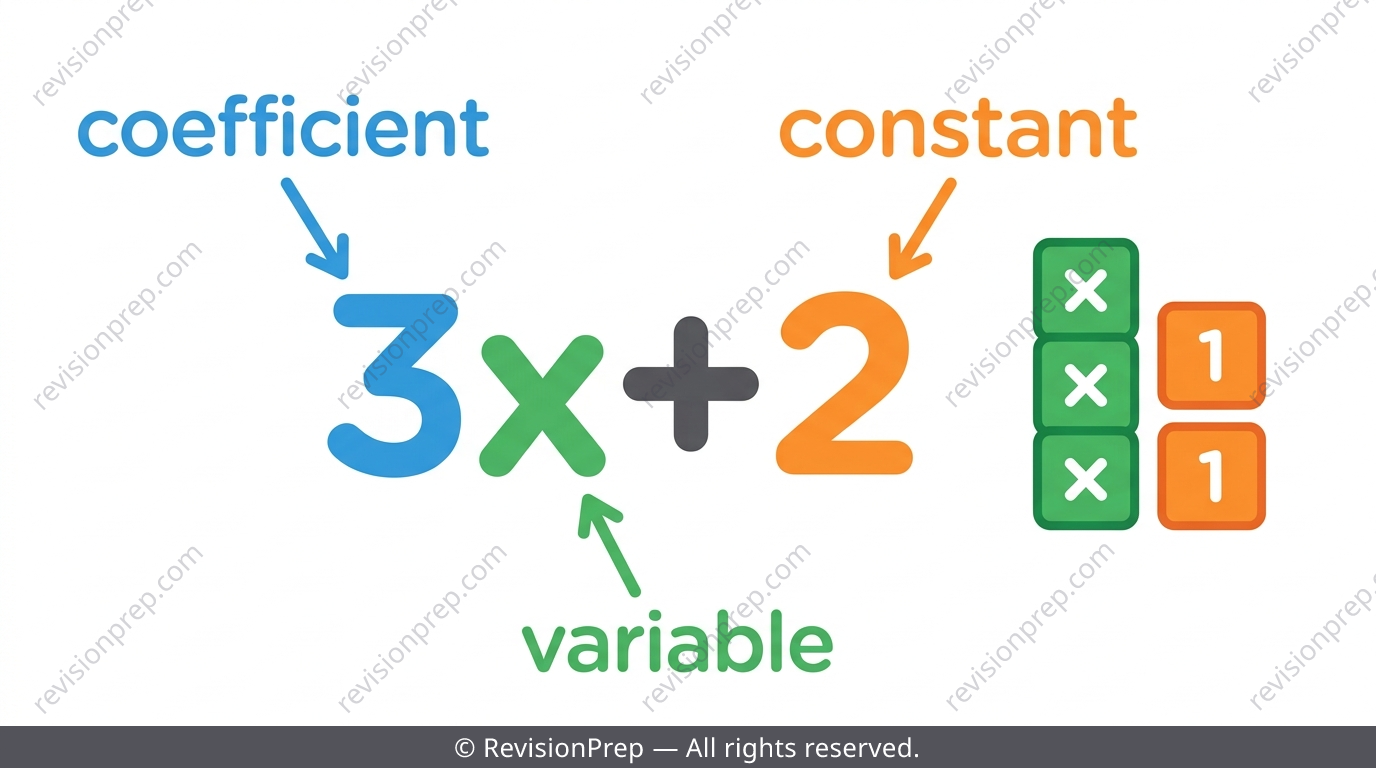
Algebra and expressions is the foundational MYP 1 maths topic where letters start standing in for numbers — and it shows up in every unit test and Criterion A/B investigation from here on. Once you understand that an expression like is just a compressed instruction, the rest becomes much easier to manage. This teaser walks through the five ideas examiners test most: combining like terms without silently dropping signs, following algebra's strict writing conventions, turning word problems into expressions, substituting values correctly (including tricky negatives), and telling variables apart from constants. Each section flags the exact trap that costs students marks, so you can avoid it before it happens. For the full worked examples, formula breakdowns and step-by-step practice, the complete revision note is linked at the end.
What you’ll be able to do
Combining Like Terms Without Losing Marks
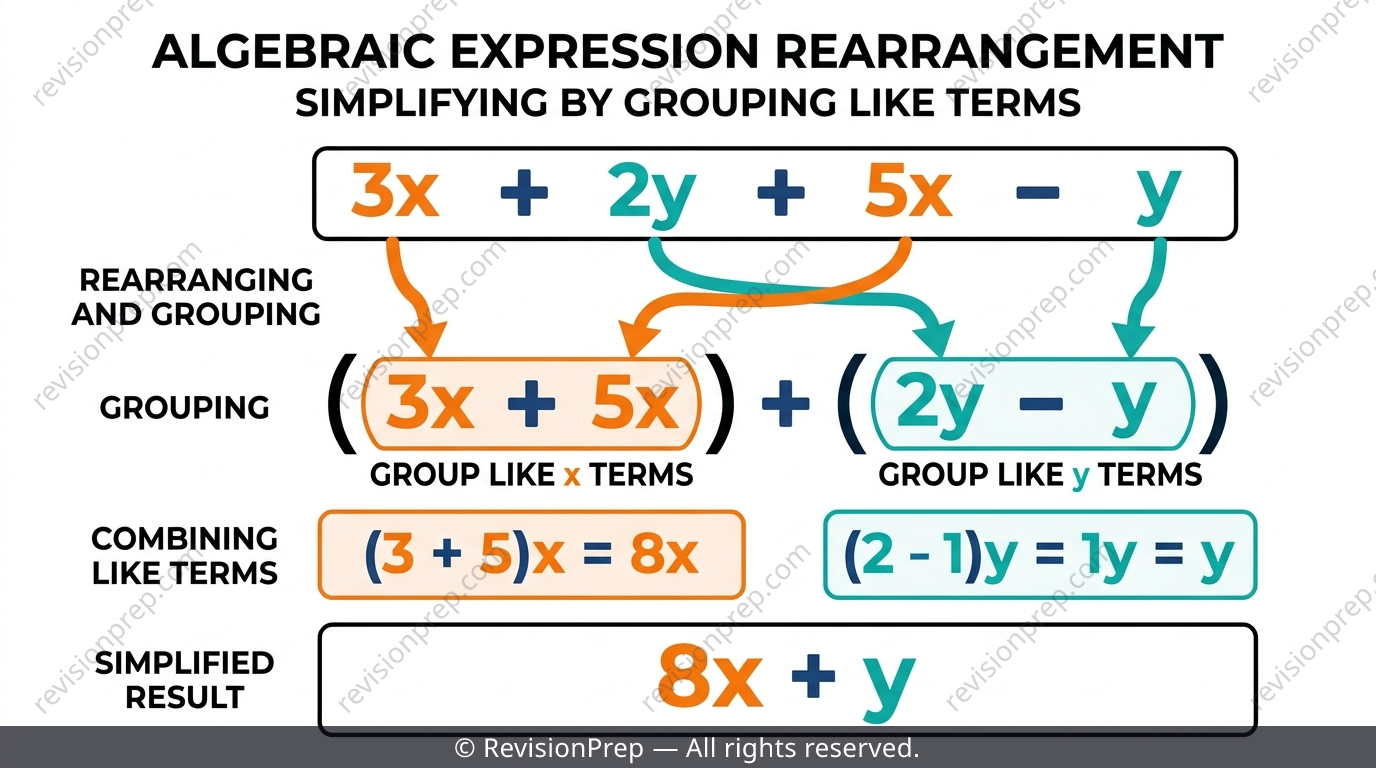
Like terms have exactly the same letter raised to exactly the same power — and combine, but and never do. Rearrange first so matching letters sit together, then add or subtract only the coefficients; the letter itself never changes. An expression is 'fully simplified' only once no two remaining terms share a variable part.
| Terms | Like or Unlike? | Why |
|---|---|---|
| 3x and 5x | Like | Same letter, same power |
| 3x and 3x² | Unlike | Same coefficient but different power |
| 4x and 2z | Unlike | Different letters |
Exam tip
On 'show each step' questions, one mark is for rearranging/combining shown explicitly, and one is for the correct final expression — never jump straight to the answer.
Common mistake
Treating as if it disappears (e.g. writing instead of ) silently drops a whole term and loses the accuracy mark even if the method looks fine.
Mini summary
Only combine terms with identical letters and powers — grouping first prevents dropped signs.
Algebra's Writing Rules
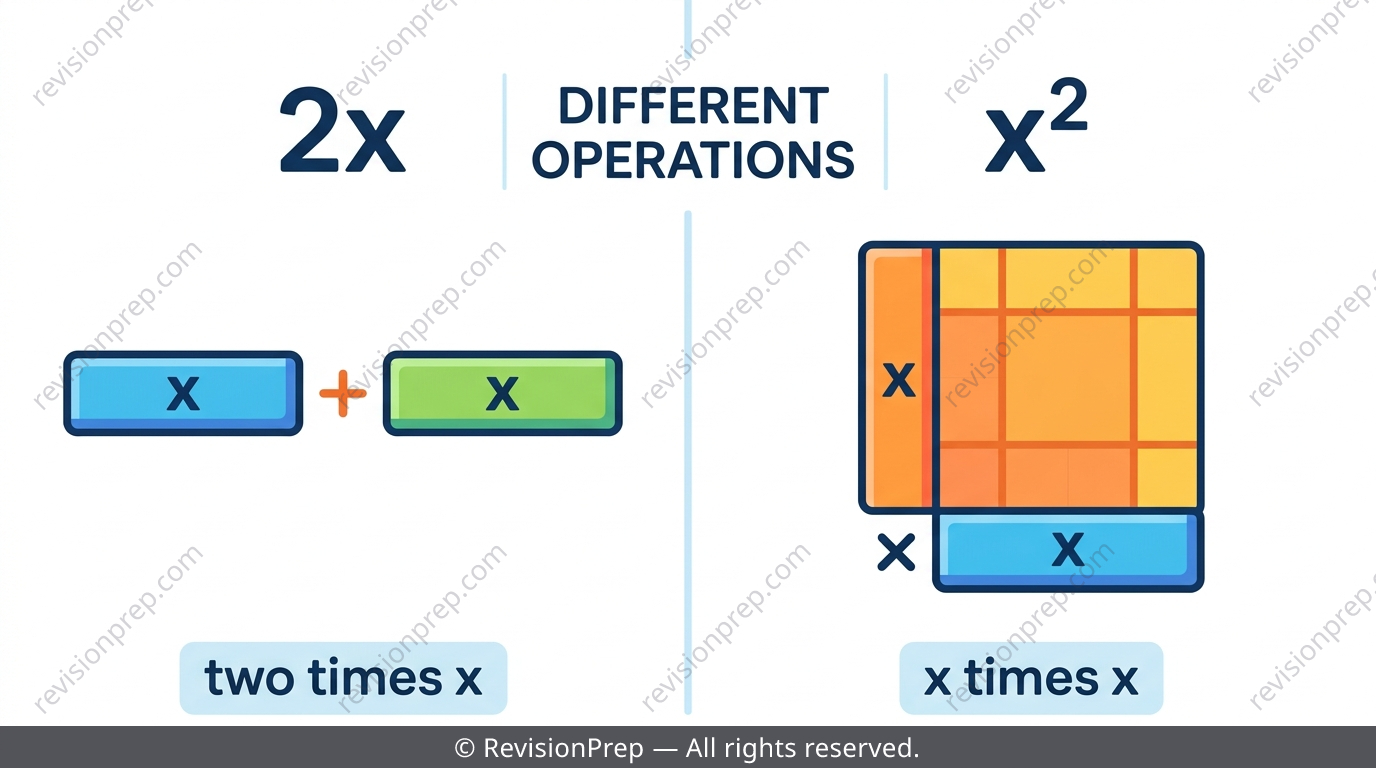
Algebra has a strict shorthand: is written , is written , and becomes — a power, not a coefficient. Division is always shown as a fraction in a final answer, never left with a ÷ symbol. These conventions aren't optional style; markers expect them by default.
Exam tip
Say powers out loud to avoid confusion: means 'x times x', while means 'two times x' — they are never interchangeable.
Common mistake
Mixing up 'double x' with 'x squared', e.g. treating as when tidying an expression.
Mini summary
Coefficient in front, no × symbol, division as a fraction — the default rules for writing algebra.
Turning Word Problems into Expressions
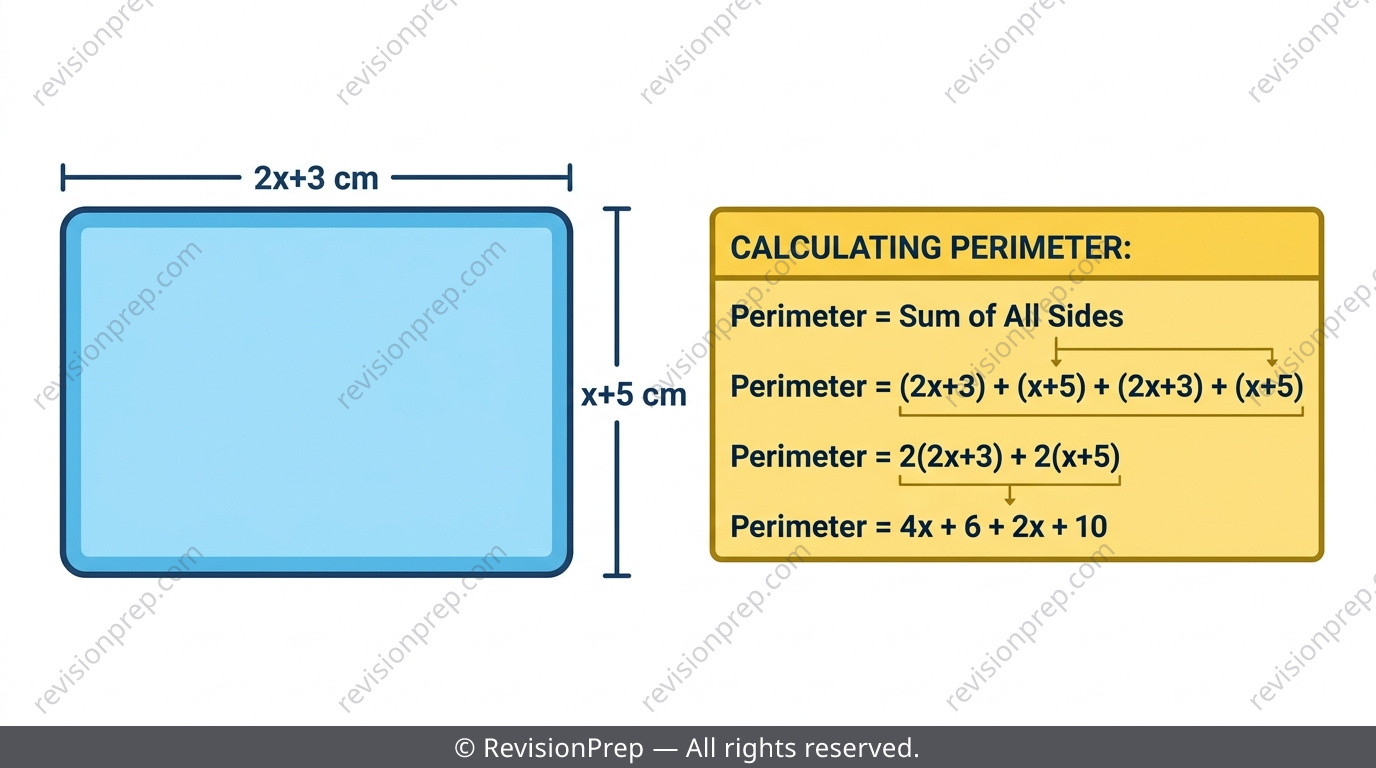
Start every word problem by writing 'let = ...' to define what the letter stands for — this sentence is often worth its own mark. Translate each phrase into algebra ('twice the width' becomes ), simplify using like-terms rules, then re-attach units and answer the actual question asked.
Exam tip
In perimeter or area problems, simplify inside brackets before multiplying out, and always distribute across every term in a bracket.
Common mistake
Doubling only one side of a rectangle, or forgetting to distribute a multiplier across both terms in a bracket — e.g. landing on instead of the correct expanded form.
Mini summary
Define the letter, translate the story, simplify, then re-attach units before answering.
Substituting Values Into Expressions
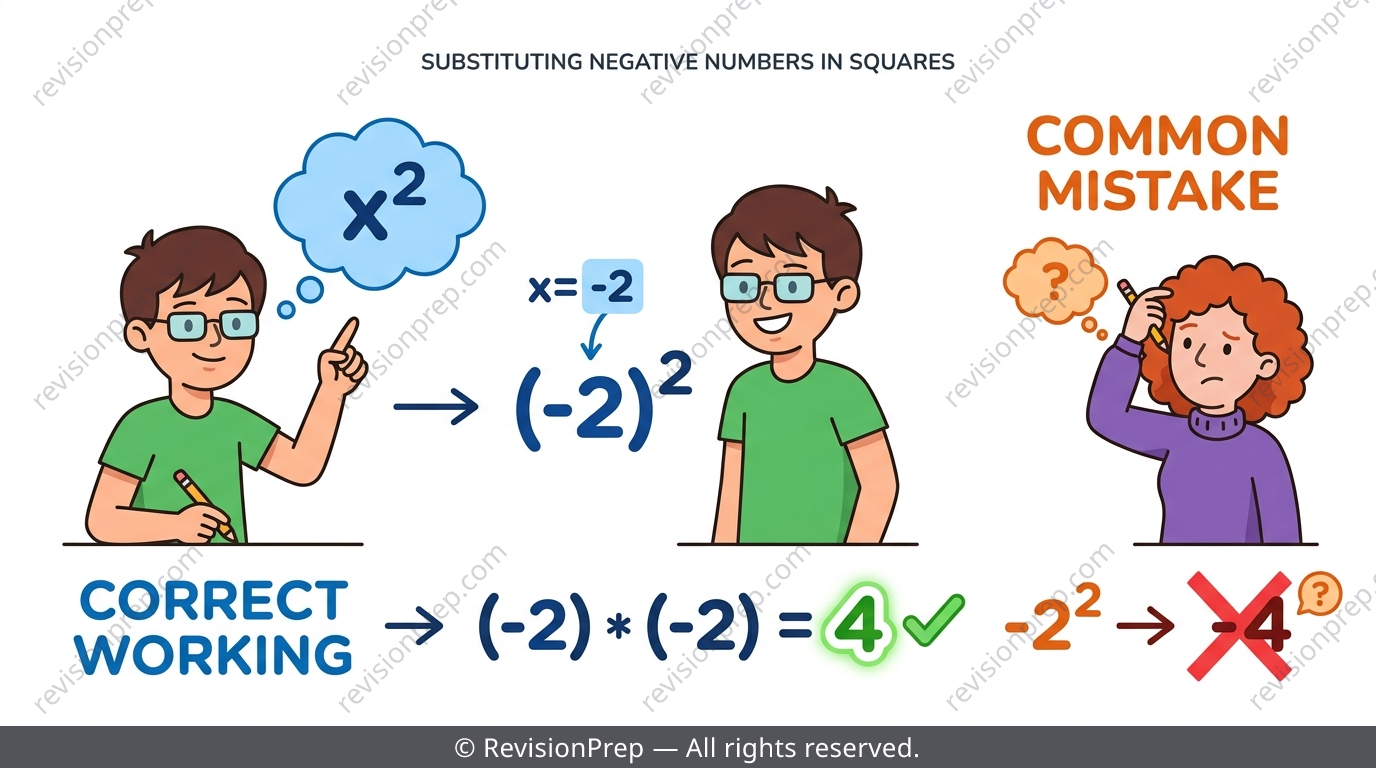
Substitution means replacing every occurrence of a letter with its given value — write as first rather than skipping straight to the result. Brackets protect negative values, so substituting into must be written , never . If a letter appears more than once, every occurrence must be replaced.
Exam tip
Follow BIDMAS exactly after substituting — multiplying before adding matters just as much as it does with plain numbers.
Common mistake
Adding before multiplying, e.g. computing instead of , which gives a completely wrong answer from ignoring BIDMAS.
Mini summary
Substitute with brackets, replace every occurrence, then apply BIDMAS carefully.
Variables vs Constants
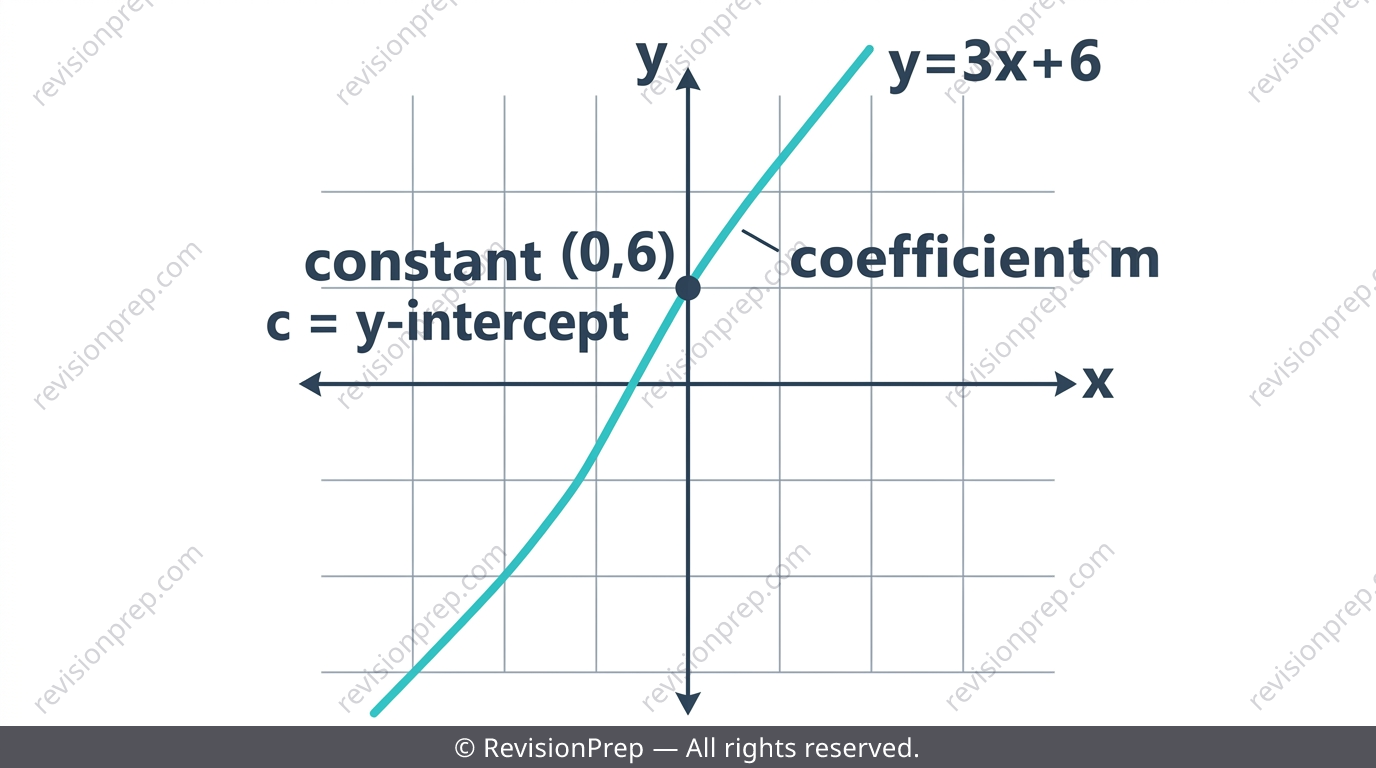
In , and are variables that change together, is the coefficient of , and is a constant that never changes. A constant never has a letter attached; a coefficient always sits directly in front of one. On a graph of , the constant is exactly the -intercept, where .
Exam tip
Two variables in the same equation don't have to change at the same rate — the coefficient controls that rate.
Mini summary
Coefficients scale variables; constants stay fixed and mark the y-intercept on a graph.
Quick formula sheet
Practice questions
- Simplify .
- Write using correct algebraic notation.
- Identify the coefficient and constant in .
- Simplify and explain why the result cannot be simplified further.
- A rectangle has sides cm and cm. Write a simplified expression for its perimeter.
- Substitute into , showing brackets around the substituted value.
- Simplify and identify the trap a student might fall into with the term.
- A toy car moves from point A(1,2) to point B(4,8) on a distance–time graph. Calculate its speed using the gradient.
- Explain, using an example, why and can never be combined into a single term.
Frequently asked questions
What is the difference between a term and an expression?+
A term is a single number, letter, or product of numbers and letters separated by + or -. An expression is made of one or more terms combined together, with no equals sign.
How do I know if two terms are like terms?+
Like terms must have the exact same letter raised to the exact same power. and are like terms, but and are not, even though they share a coefficient.
Why can't I combine $4x$ and $2z$ into one term?+
They have different letters, so their variable parts don't match. Only terms with an identical letter and power can be combined — different letters mean the expression is already fully simplified.
How do I substitute a negative number correctly?+
Put the value in brackets before applying any power or operation, e.g. substitute into as , never .
What's the difference between a coefficient and a constant?+
A coefficient is the number multiplying a letter, like the 3 in . A constant is a fixed number with no letter attached, like the 6 in .
Why is 'let x = ...' important in word problems?+
Defining what the letter represents is often its own mark in longer questions, and it keeps your algebra tied clearly to the real-world quantity you're modelling.
Get the Full MYP 1 Algebra and Expressions Revision Notes
Related articles