
Geometry – Properties of Shape
The shape vocabulary and rules every later MYP geometry unit is built on.
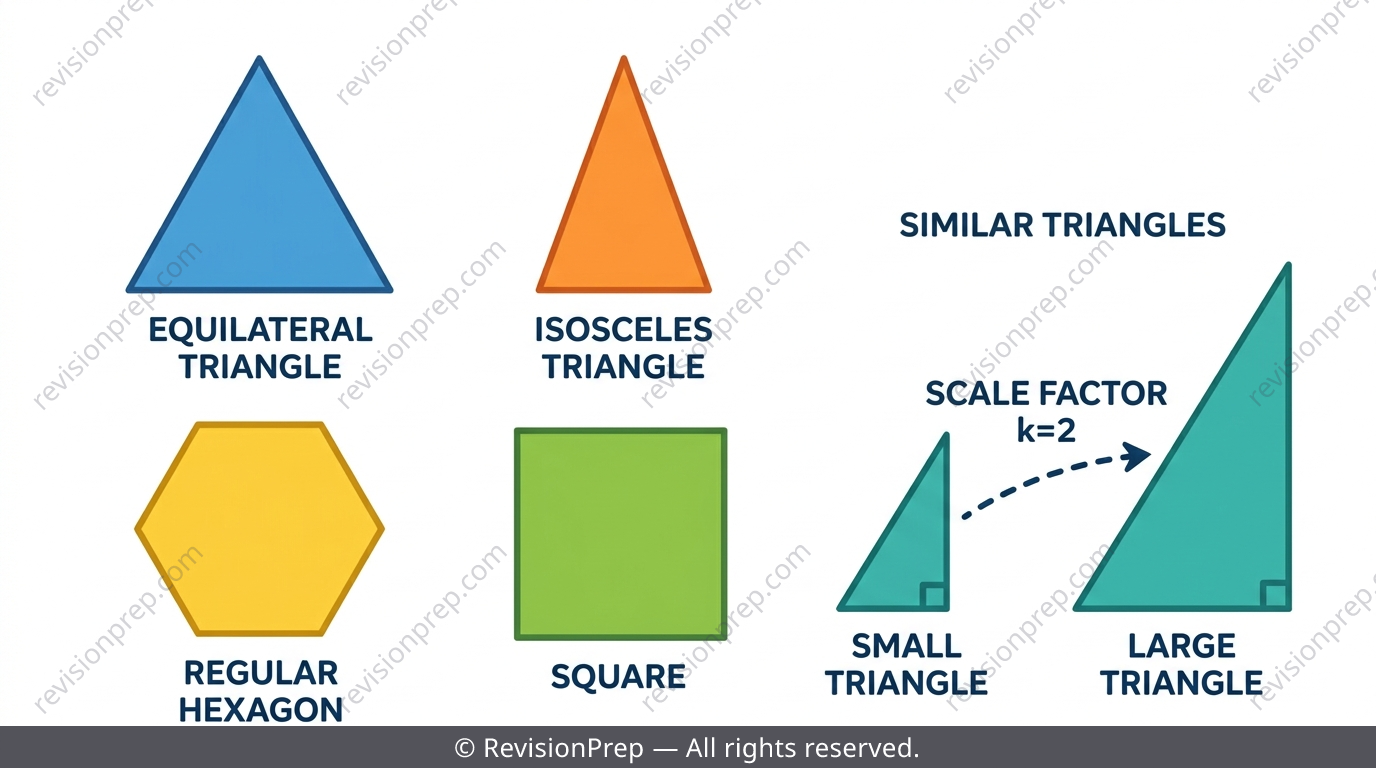
Quick facts
Every later geometry topic in IB MYP — Pythagoras, transformations, trigonometry — assumes you can already classify a triangle, spot a line of symmetry, and prove two shapes are congruent or similar without a protractor. This is exactly what MYP 1 Geometry: Properties of Shape trains, and it's why examiners rarely ask you to just calculate — they ask you to describe or explain, which means naming the correct property and quoting the evidence for it. This teaser walks through the five ideas worth locking down first: triangle and polygon classification, symmetry and tessellation, and the crucial distinction between congruent and similar shapes. Master these and Criterion A and Criterion D geometry tasks become far less intimidating. For the full breakdown — definitions, worked examples, and every formula — the complete revision notes are linked below.
What you’ll be able to do
Classifying Triangles and Polygons
Every triangle gets two separate labels: one by its sides (equilateral, isosceles, scalene) and one by its angles (acute, right, obtuse) — and both can apply to the same triangle at once. A regular polygon has all sides AND all angles equal, while an irregular one breaks at least one of those rules. The interior angle sum only depends on the number of sides — never on regularity — but dividing to find a single angle only works if the polygon is regular.
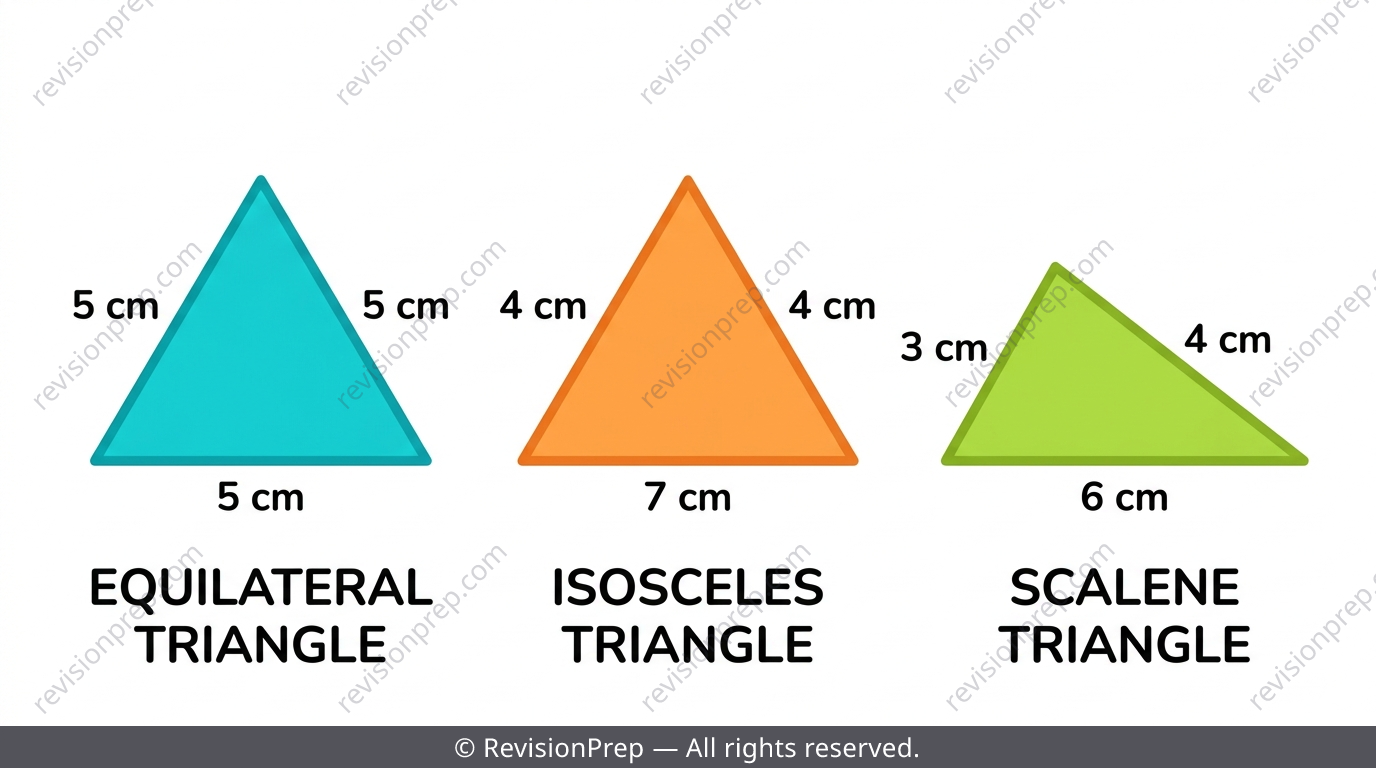
| Type | Side rule | Angle consequence | Example |
|---|---|---|---|
| Equilateral | All 3 sides equal | All angles = 60° | 5 cm, 5 cm, 5 cm |
| Isosceles | Exactly 2 sides equal | Angles opposite equal sides are equal | 4 cm, 4 cm, 7 cm |
| Scalene | No sides equal | No angles equal | 3 cm, 4 cm, 6 cm |
Exam tip
For any 2-mark 'describe how you know' question, give TWO ingredients: the numeric fact from the question and the named property it satisfies. One alone caps you at 1/2.
Common mistake
Saying a triangle 'looks isosceles' without quoting the actual side lengths — always write the numeric comparison explicitly, e.g. '4 cm = 4 cm, so two sides are equal.'
Mini summary
Classify by sides and angles independently; interior angle sum is for any polygon, regular or not.
Line and Rotational Symmetry
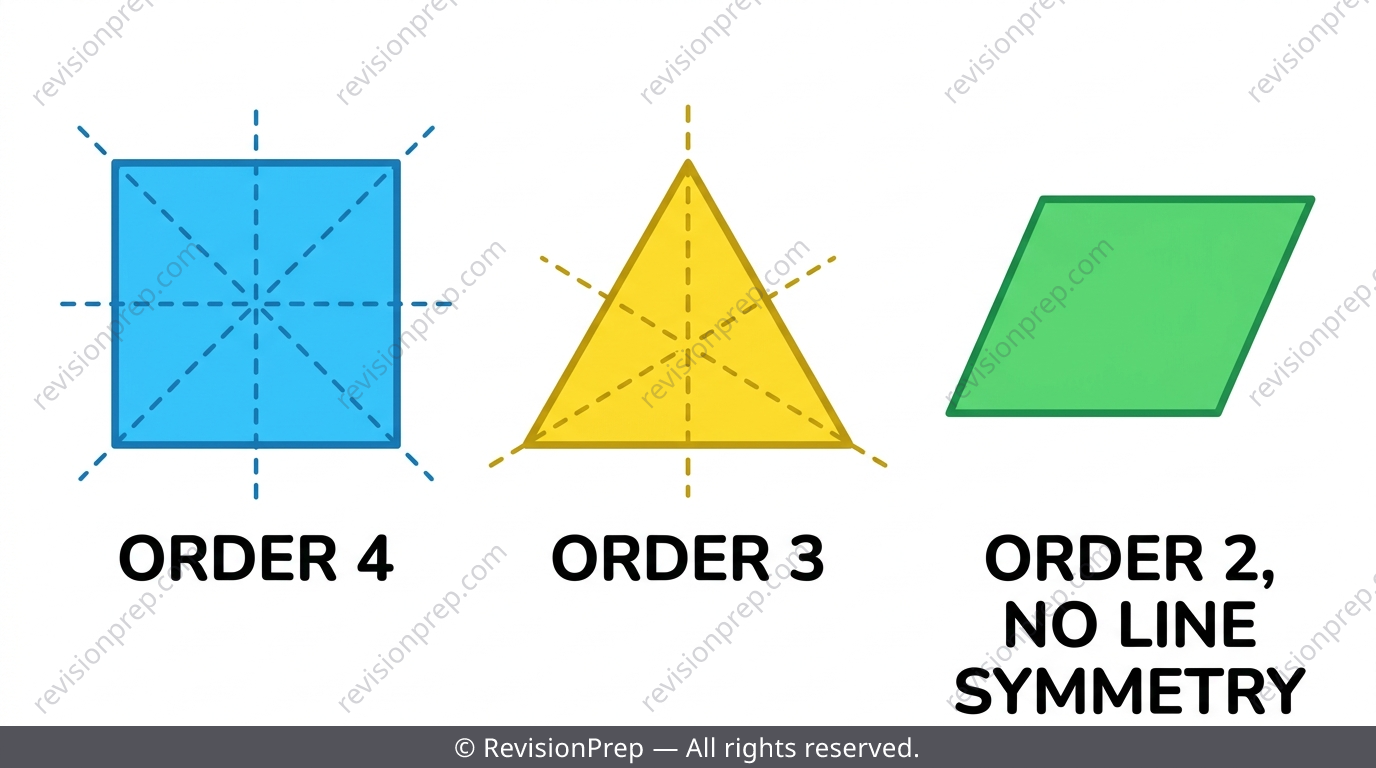
Line symmetry means a mirror line splits a shape into two identical halves. Rotational symmetry describes a shape mapping onto itself during a turn less than 360°, and its order counts how many times this happens in one full turn. A regular n-sided polygon always has n lines of symmetry and rotational order n, but irregular shapes break that pattern — a non-square parallelogram has no line symmetry at all yet still has rotational symmetry of order 2.
Exam tip
When a shape only maps onto itself after a full 360° turn, call it 'rotational symmetry of order 1' — never say 'no rotational symmetry'.
Common mistake
Writing 'no rotational symmetry' for a shape that only matches itself at the complete 360° turn.
Mini summary
Regular n-gon → n lines of symmetry and rotational order n; irregular shapes need checking individually.
Tessellations
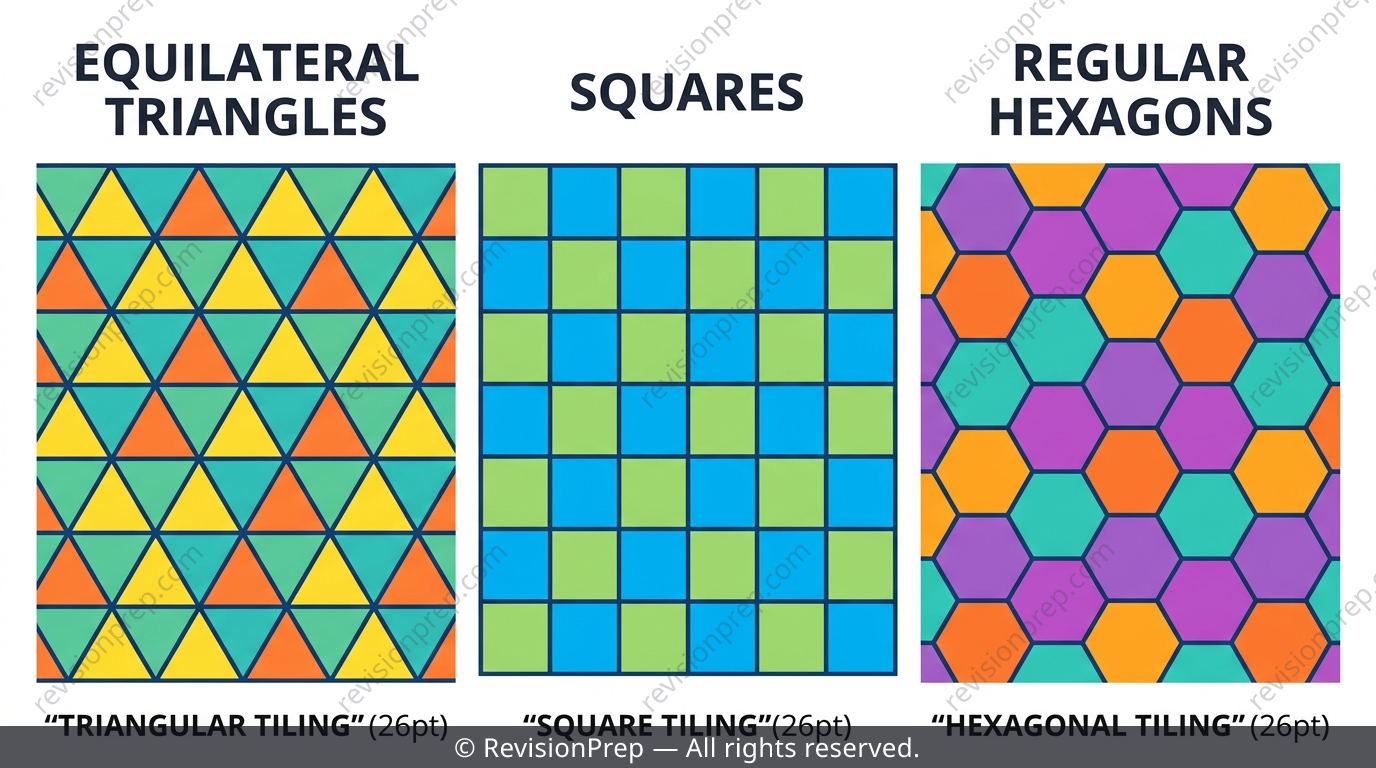
A tessellation covers a flat surface with repeated shapes leaving no gaps and no overlaps. Only three regular polygons can tessellate on their own: equilateral triangles (60°), squares (90°), and regular hexagons (120°) — because each of these interior angles divides evenly into the 360° needed at every meeting point.
Mini summary
Tessellation alone only works when the interior angle divides exactly into 360°: 60°, 90°, and 120° are the magic numbers.
Congruence: Same Shape, Same Size
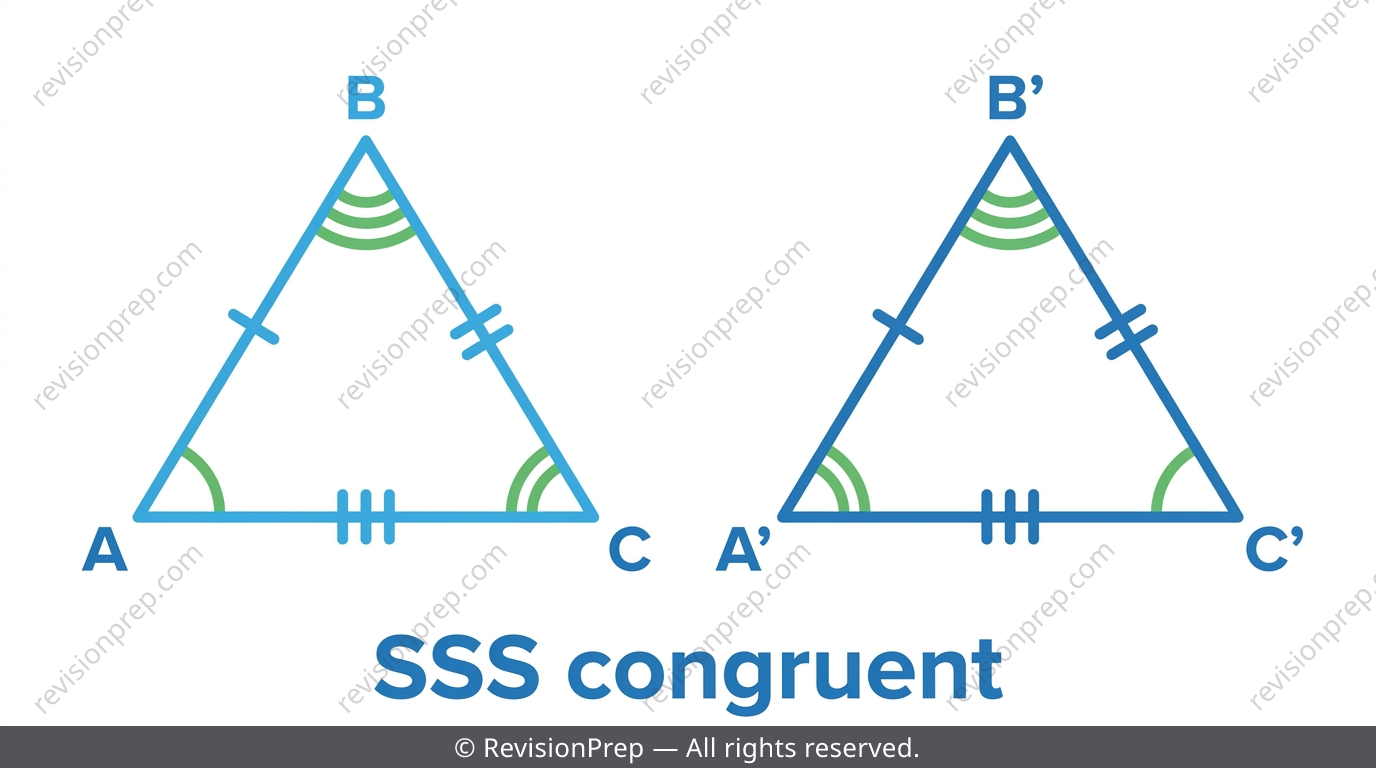
Congruent shapes are identical in every way — same side lengths, same angles — even if one has been reflected, rotated, or moved. Four tests prove triangle congruence: SSS (all three sides match), SAS (two sides plus the included angle match), ASA (two angles plus the included side match), and RHS (right angle, hypotenuse, and one other side match).
Exam tip
Match vertices in the order they're named (like triangle PQR vs XYZ) — this tells you exactly which sides and angles correspond before you apply a test.
Mini summary
Congruent = identical in shape and size; SSS, SAS, ASA and RHS are your four proof tools for triangles.
Similarity and Scale Factor
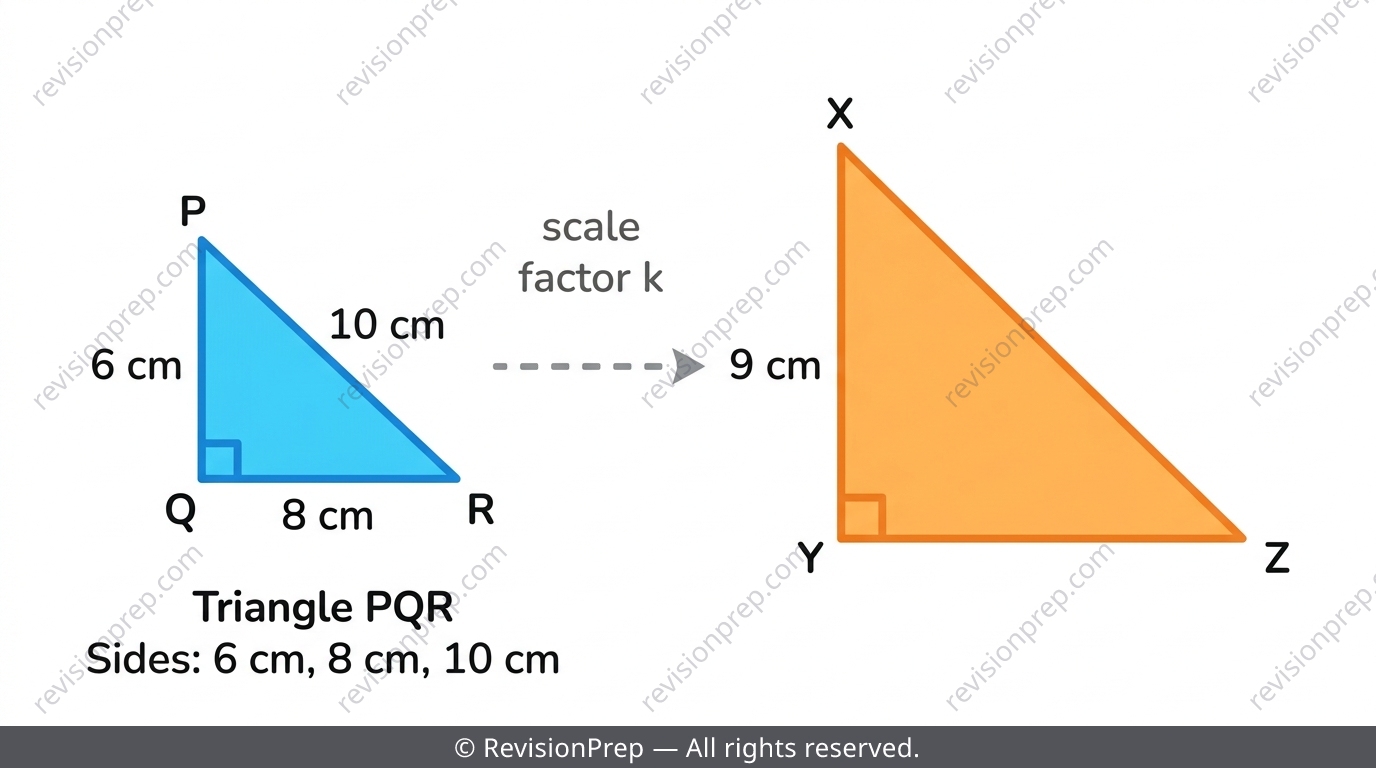
Similar shapes share the same shape but not the same size: every angle matches, and every pair of corresponding sides sits in the same fixed ratio, the scale factor . Two matching angles (AA) is enough to prove triangles similar, since the third angle is forced by the 180° angle sum. A common trap: if lengths scale by , enclosed area scales by , not .
Exam tip
Always write corresponding vertices in the same order across both shape names — it's the only reliable way to pair sides correctly.
Common mistake
Matching sides just because the numbers 'seem to fit' rather than matching them by the order of the letters in each shape's name — this gives a completely wrong scale factor.
Mini summary
Similar = same shape, different size; scale factor multiplies lengths, while multiplies area.
Quick formula sheet
Practice questions
- Classify a triangle with sides 6 cm, 6 cm, and 6 cm by its sides.
- State the number of lines of symmetry in a regular hexagon.
- Name the congruence test that uses two sides and the included angle.
- Calculate the sum of interior angles of a regular octagon.
- Explain why a non-square parallelogram has rotational symmetry but no line symmetry.
- Two similar triangles have a scale factor of 3. If the smaller triangle's area is 5 cm², find the larger triangle's area.
- A polygon's exterior angles each measure 24°. How many sides does it have, and must it be regular?
- Triangle ABC has sides 5 cm, 12 cm, 13 cm. Triangle DEF is similar with DE corresponding to AB, and DE = 15 cm. Find EF and FD.
- Using angle properties, explain why only equilateral triangles, squares, and regular hexagons can tessellate alone.
Frequently asked questions
What is the difference between congruent and similar shapes?+
Congruent shapes are identical in shape and size — every side and angle matches exactly. Similar shapes share the same shape and equal angles, but their sides differ by a fixed scale factor.
Can a triangle be both isosceles and right-angled?+
Yes. Side classification (equilateral/isosceles/scalene) and angle classification (acute/right/obtuse) are independent, so both labels can apply to the same triangle.
Why doesn't the 'each interior angle' formula work on irregular polygons?+
That formula assumes every angle is identical, which is only true for regular polygons. Irregular polygons still follow the total sum formula , but individual angles can differ.
Which shapes can tessellate by themselves?+
Only equilateral triangles, squares, and regular hexagons tessellate alone, because their interior angles (60°, 90°, 120°) divide evenly into the 360° needed at each meeting point.
How do I find a missing side in a similar shape?+
Match corresponding sides using the order the vertices are named, work out the scale factor from a known pair, then multiply the original length by .
What does rotational symmetry order actually mean?+
It's the number of times a shape maps exactly onto itself during one complete 360° turn. If it only matches at the full turn, the order is 1, not 'none'.
Get the full MYP 1 Geometry revision notes
Related articles