
Ratio, Proportion & Percentages
MYP 1 Maths made clear: proportion, multipliers, and the reasoning traps examiners actually test
Quick facts
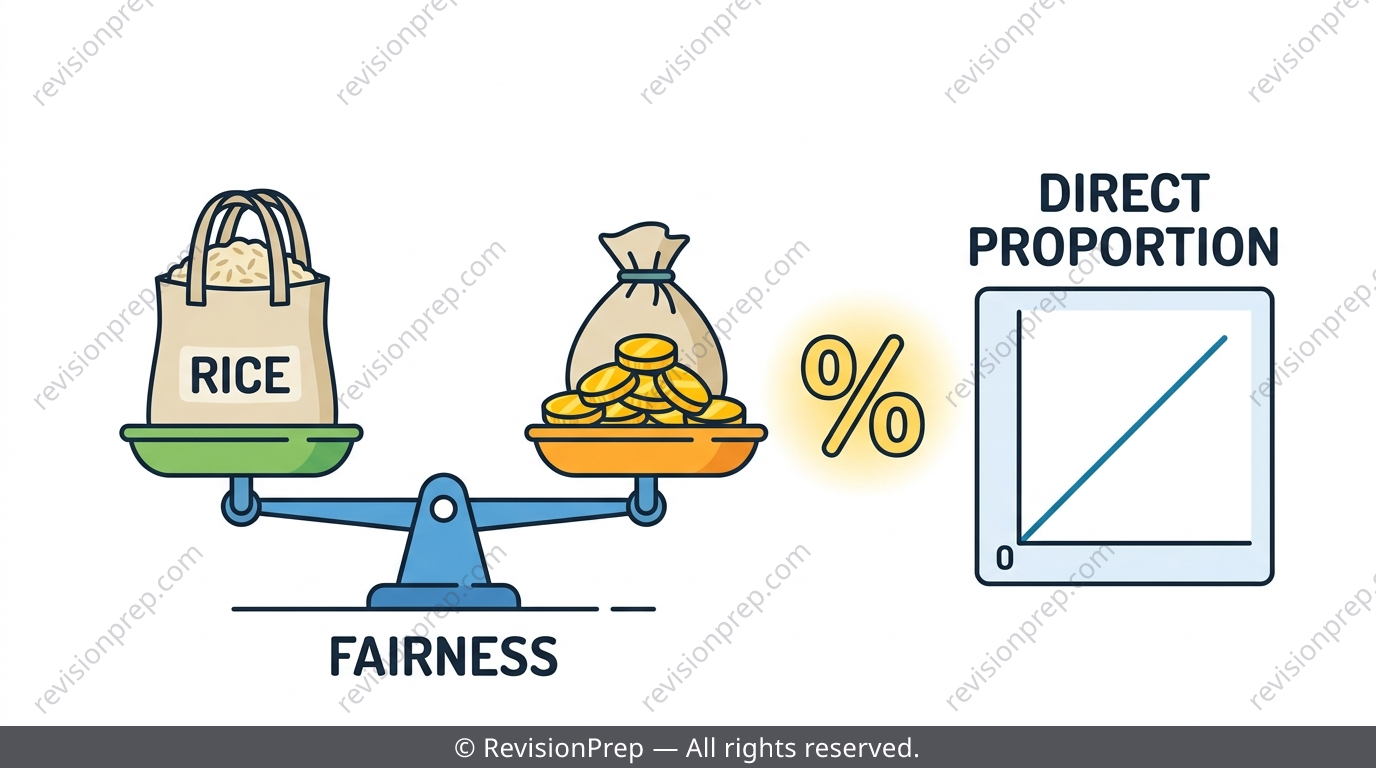
Ratio, proportion and percentages are the maths behind everyday fairness — splitting a bill, resizing a recipe, or checking if a 'sale' is really worth it. In MYP 1 Maths, this topic sits at the heart of the Number strand and turns up in almost every unit test, because it tests reasoning as much as calculation. The 'calculate' parts of a question are usually the easy marks; it's the 'explain why' or 'justify' parts — where Criterion C marks are won or lost — that catch students who can compute but can't say why a method works. This teaser walks through the five ideas that matter most: direct and inverse proportion, the unit rate that powers both, simple versus compound percentage change, the multiplier method, and reverse percentage problems. Master these five, and the rest of the topic falls into place.
What you’ll be able to do
Direct vs Inverse Proportion
Two quantities are in direct proportion if their ratio stays the same — double one, the other doubles too. They're in inverse proportion if their product stays constant — double one, the other halves. Most 'cost of x kg' or 'pay for x hours' questions at MYP 1 are direct proportion, because a fixed unit price or hourly rate never changes.
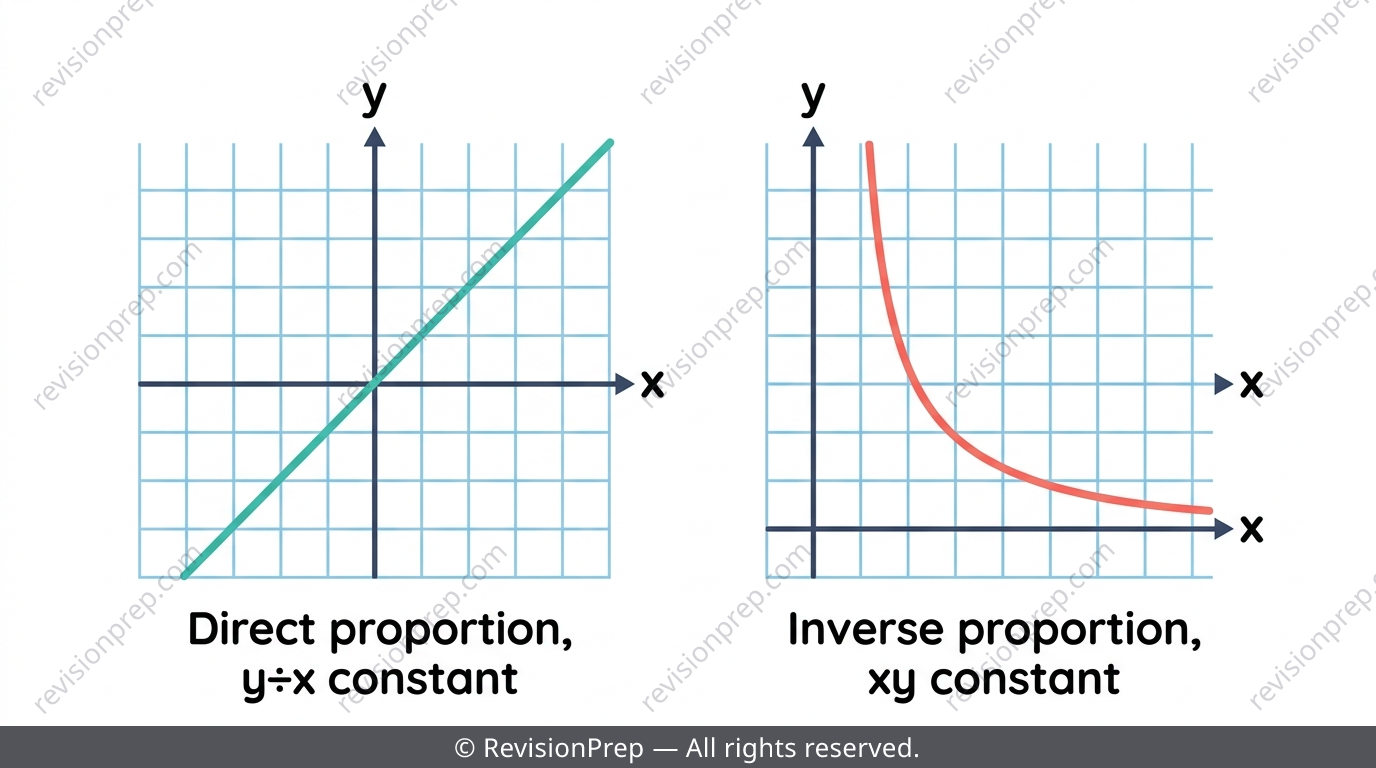
| Type | What stays constant | Graph shape |
|---|---|---|
| Direct proportion | Straight line through the origin | |
| Inverse proportion | Curve, never touches either axis |
Exam tip
When asked to justify direct proportion, don't say 'the total goes up' — that's true for lots of relationships. Say the RATE () stays the same, and show two divisions to prove it.
Common mistake
Assuming 'total cost rises when you buy more' proves direct proportion — it doesn't, since the rate could still be changing.
Mini summary
Direct = constant ratio, straight line through origin; inverse = constant product, curve away from both axes.
Unit Rate & the Constant k
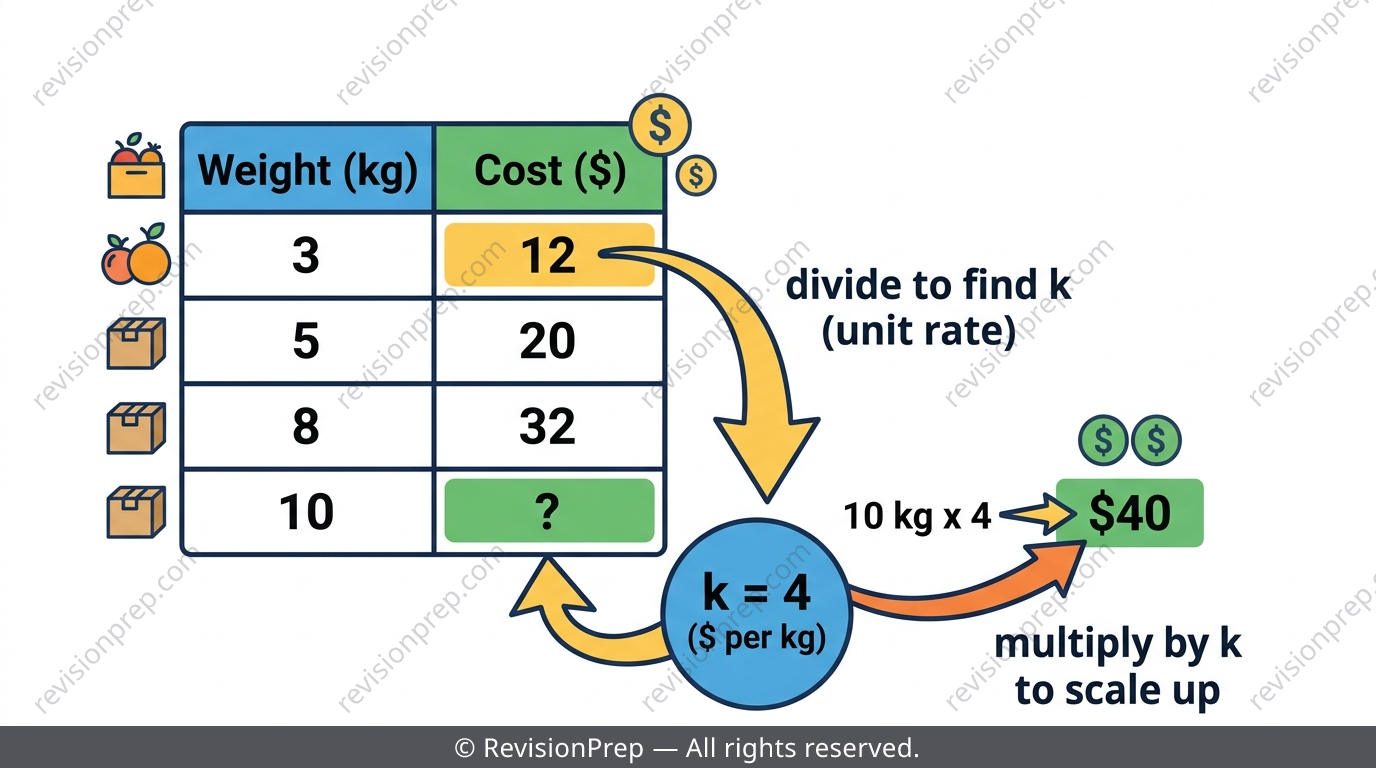
The constant of proportionality IS the unit rate — cost per kg, pay per hour, distance per litre. Find it by dividing one matching pair of values (), then multiply to scale up or down to any new amount. Before extrapolating to a value outside your table, always check against a second pair — a single point can hide a typo.
Exam tip
On 'calculate' questions, write the division as its own line, even if you can do it mentally. The method mark is specifically for showing this step — a bare final answer with no working can score 0/2 if it's wrong.
Common mistake
Picking a data point that isn't actually on the proportional line and using it to find , which throws off every later calculation.
Mini summary
Find from one verified pair, sanity-check it with a second pair, then scale confidently.
Simple vs Compound Percentage Change
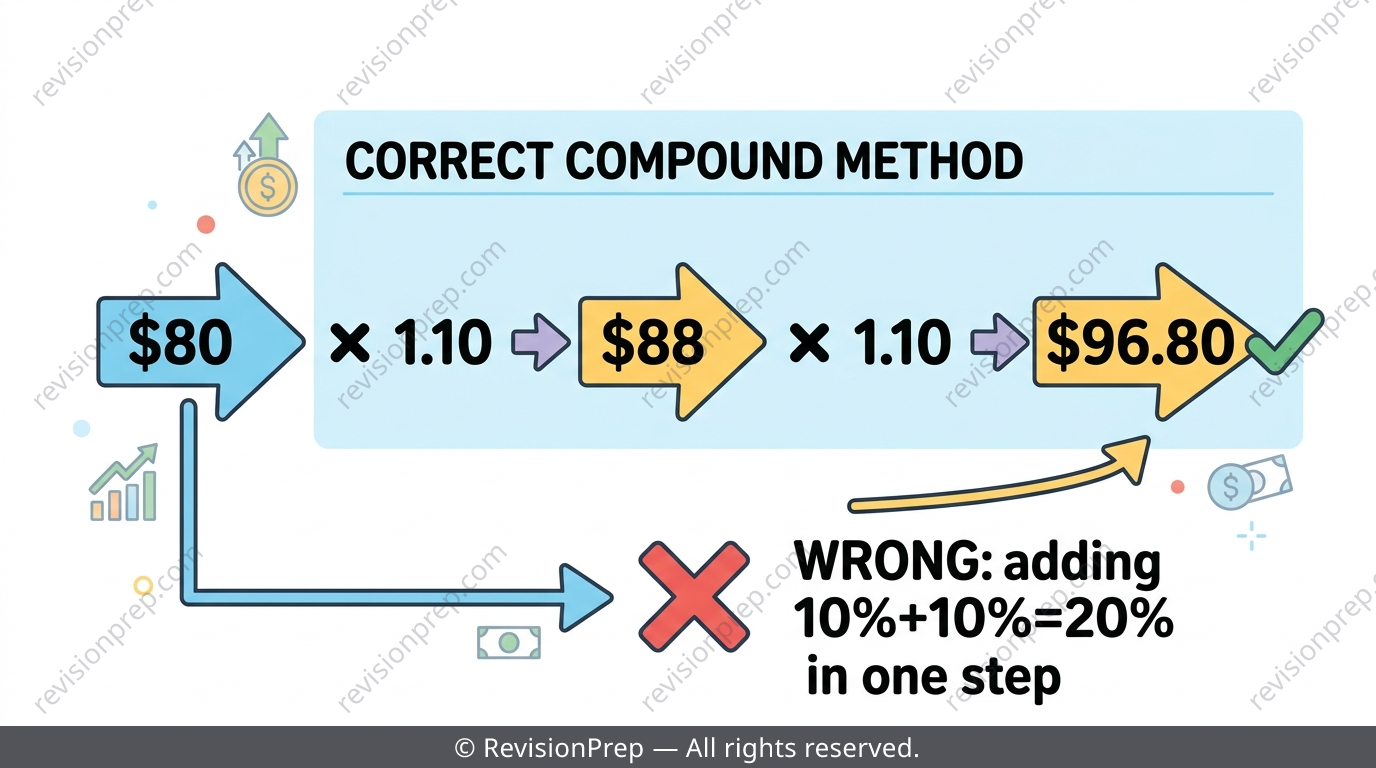
A simple percentage change is applied once to the original amount. A compound change is applied repeatedly, and each new application acts on the most recent amount — not the original. This is the single biggest trip-up in the whole topic: students add the percentages together (10% + 10% = 20%) instead of chaining the multipliers.
Exam tip
Whenever you see 'increases by p%, then increases again by p%', chain the multipliers: . Never add the percentage figures.
Common mistake
Adding repeated percentages together (treating 10% then 10% as one 20% change) instead of multiplying .
Mini summary
Simple = one multiplier once; compound = the same multiplier applied times, using .
Percentage Increase/Decrease: The Multiplier Method
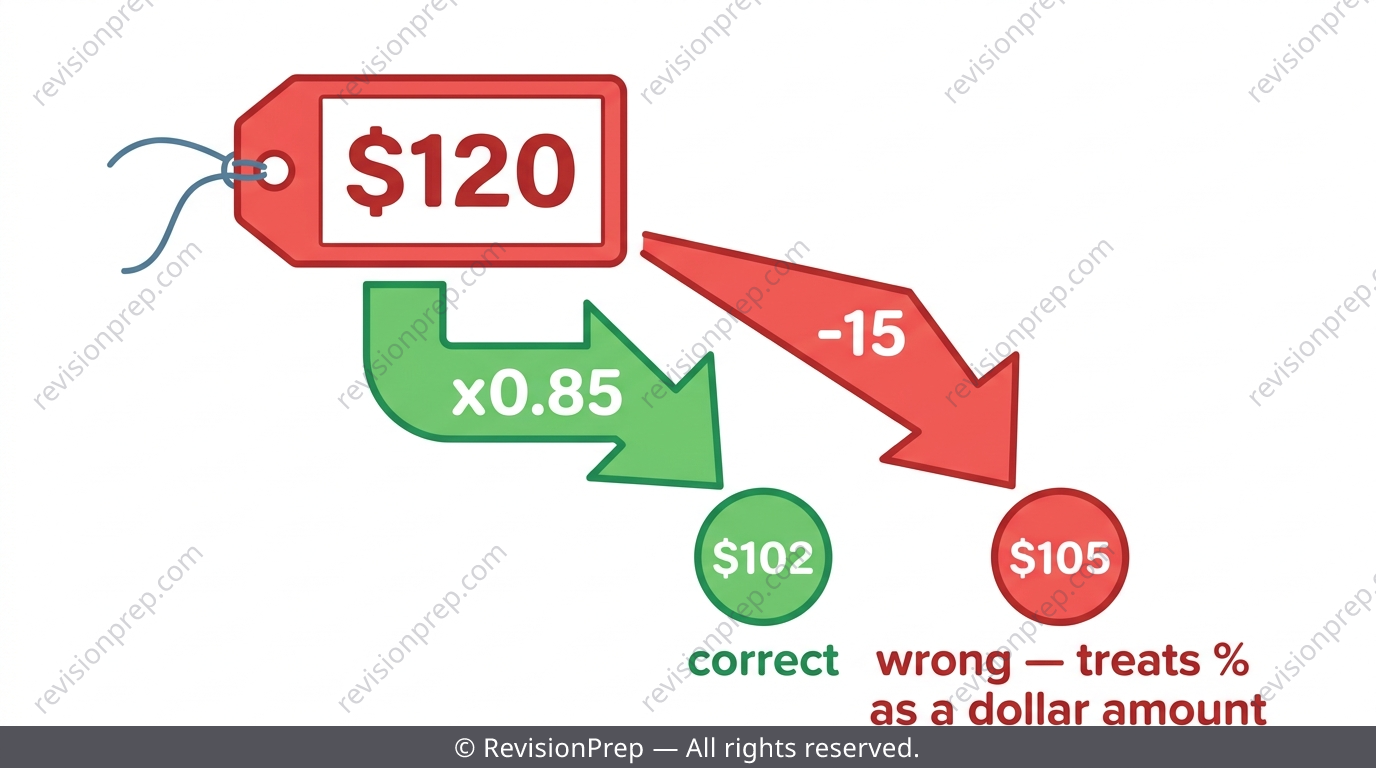
The safest way to change an amount by a percentage is the multiplier method: multiply by to increase, or to decrease. This avoids the classic two-step trap where students forget to add/subtract the calculated percentage, or worse, subtract the percentage number itself as if it were a dollar amount.
| Change | Multiplier |
|---|---|
| Increase by | $1 + p/100$ |
| Decrease by | $1 - p/100$ |
Exam tip
For 'find the percentage change' questions (given before and after), divide the change by the ORIGINAL value, then ×100 — not by the new value.
Common mistake
Subtracting the percentage figure directly from the price (e.g. $120 - 15 = 105$) instead of finding 15% of $120 first and subtracting that ($120 - 18 = 102$).
Mini summary
Convert the percentage to a multiplier first, then apply it to the whole original amount in one step.
Reverse Percentage Problems
Reverse percentage questions give you the value AFTER a percentage change and ask for the original. The number you're given is not the original — it's already the original multiplied by the multiplier — so you must divide by the multiplier, never add or subtract the percentage from the given value.

Exam tip
Set up before you touch a calculator — writing this line down protects your method marks even if the arithmetic slips.
Common mistake
Trying to reverse a percentage by adding or subtracting the percentage from the given (already-changed) value instead of dividing by the multiplier.
Mini summary
New value ÷ multiplier = original — division undoes the multiplier, it doesn't reverse-add the percentage.
Quick formula sheet
Practice questions
- 6 kg of apples costs $12. Find the cost of 1 kg, then the cost of 9 kg.
- Find 20% of $150.
- Increase $60 by 5% using the multiplier method.
- A $50 jacket is reduced by 12%. Find the new price, showing the multiplier used.
- A quantity increases by 10%, then increases again by 10%. Find the overall multiplier and explain why it isn't simply 20%.
- Given pairs (3h, $45) and (7h, $105), find the pay rate per hour and predict the pay for 10 hours.
- After a 15% increase, an item costs $92. Find the original price, showing your equation before calculating.
- A population grows by 8% each year for 3 years. Write the compound formula and explain what each part represents.
- A classmate claims a data point fits a direct proportion table without checking it. Explain, using two verified ratios, how you would prove or disprove this claim.
Frequently asked questions
What's the difference between direct and inverse proportion?+
In direct proportion, the ratio stays constant — both quantities increase or decrease together. In inverse proportion, the product stays constant — as one increases, the other decreases.
Why doesn't a rising total cost prove direct proportion?+
Totals can rise for many reasons. Direct proportion specifically requires the RATE (unit price, unit rate) to stay the same — you must check this by dividing at least two pairs of values.
Why can't I just add percentages together for repeated changes?+
Because each repeated change acts on the newest amount, not the original. Adding (like 10%+10%=20%) under-counts the real effect — you need to chain the multipliers instead, e.g. .
How do I solve a reverse percentage question?+
Divide the given (already-changed) value by the multiplier — never add or subtract the percentage from the given number, since it isn't the original amount.
What's the quickest way to avoid percentage mistakes?+
Always convert the percentage into a multiplier first and apply it to the whole original amount in one step. This avoids the common error of subtracting the percentage number as if it were a dollar value.
Where do most marks get lost in this topic?+
In the explain/justify parts of questions (Criterion C), not the calculations. Students often calculate correctly but fail to explain why a relationship is proportional or why chaining multipliers is necessary.
Get the full MYP 1 Ratio, Proportion & Percentages notes
Related articles