
Patterns, Sequences & Algebraic Thinking
Spot the rule, name it, use it — the foundation of every MYP algebra unit that follows.
Quick facts
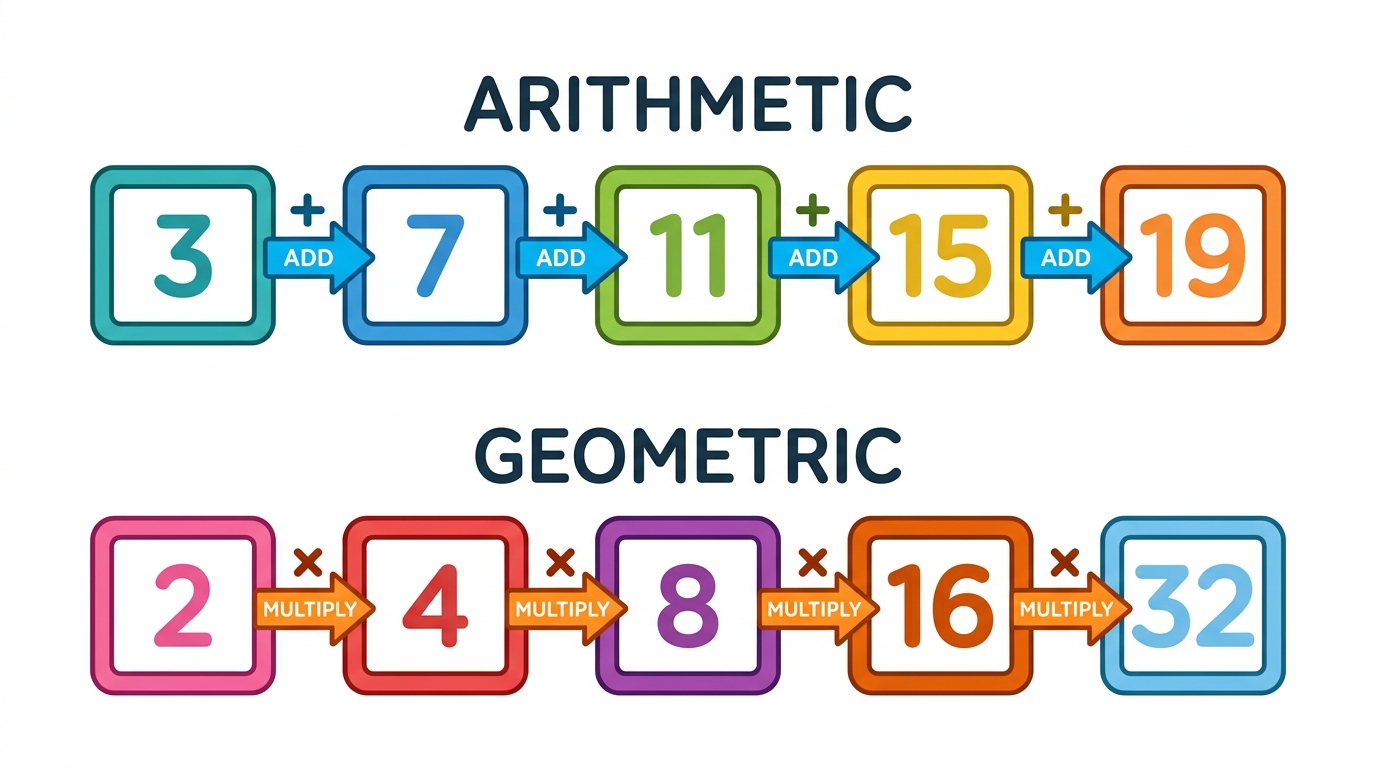
Every number pattern hides a rule, and MYP 1 maths is all about learning to find it, name it, and use it with confidence. Whether it's an arithmetic sequence growing by a constant common difference, a geometric sequence multiplying by a constant common ratio, or a trickier quadratic-type pattern, the same three moves apply: spot the rule, name it, then use it to predict or check terms. Exam questions rarely stop at 'what's the next number' — they ask you to describe how you know, build an algebraic expression like , or judge whether a claimed term (like Day 20's total) is actually correct. This teaser walks through the five ideas that matter most for Criterion A and Criterion B tasks, with the traps students fall into and how to avoid them. The full revision notes on RevisionPrep go deeper with every worked example.
What you’ll be able to do
Arithmetic vs Geometric Sequences
An arithmetic sequence always ADDS (or subtracts) the same common difference, , to get the next term — like 5, 8, 11, 14 where . A geometric sequence always MULTIPLIES by the same common ratio, — like 2, 4, 8, 16 where . The key skill is checking at least two consecutive gaps before deciding which type you're dealing with, since one matching gap proves nothing.
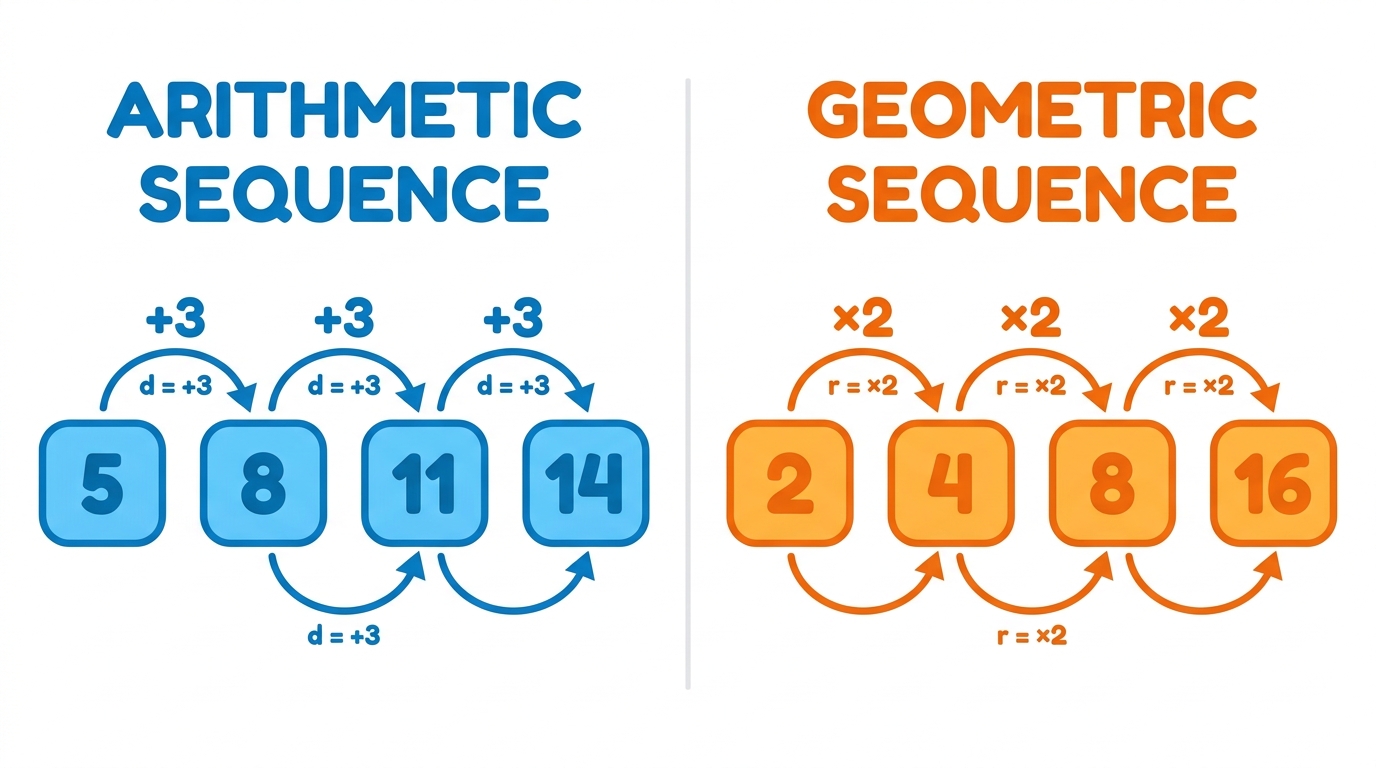
| Feature | Arithmetic sequence | Geometric sequence |
|---|---|---|
| Rule between terms | Add/subtract constant d | Multiply/divide by constant r |
| Example | 5, 8, 11, 14 (d=3) | 2, 4, 8, 16 (r=2) |
| nth term formula |
Exam tip
Always calculate at least two gaps, not one, before naming a sequence arithmetic or geometric.
Common mistake
Assuming any sequence that increases must be arithmetic — going up isn't the test, a constant gap is.
Mini summary
Arithmetic = constant difference; geometric = constant ratio. Test more than one gap before labelling.
General Rules and nth Terms
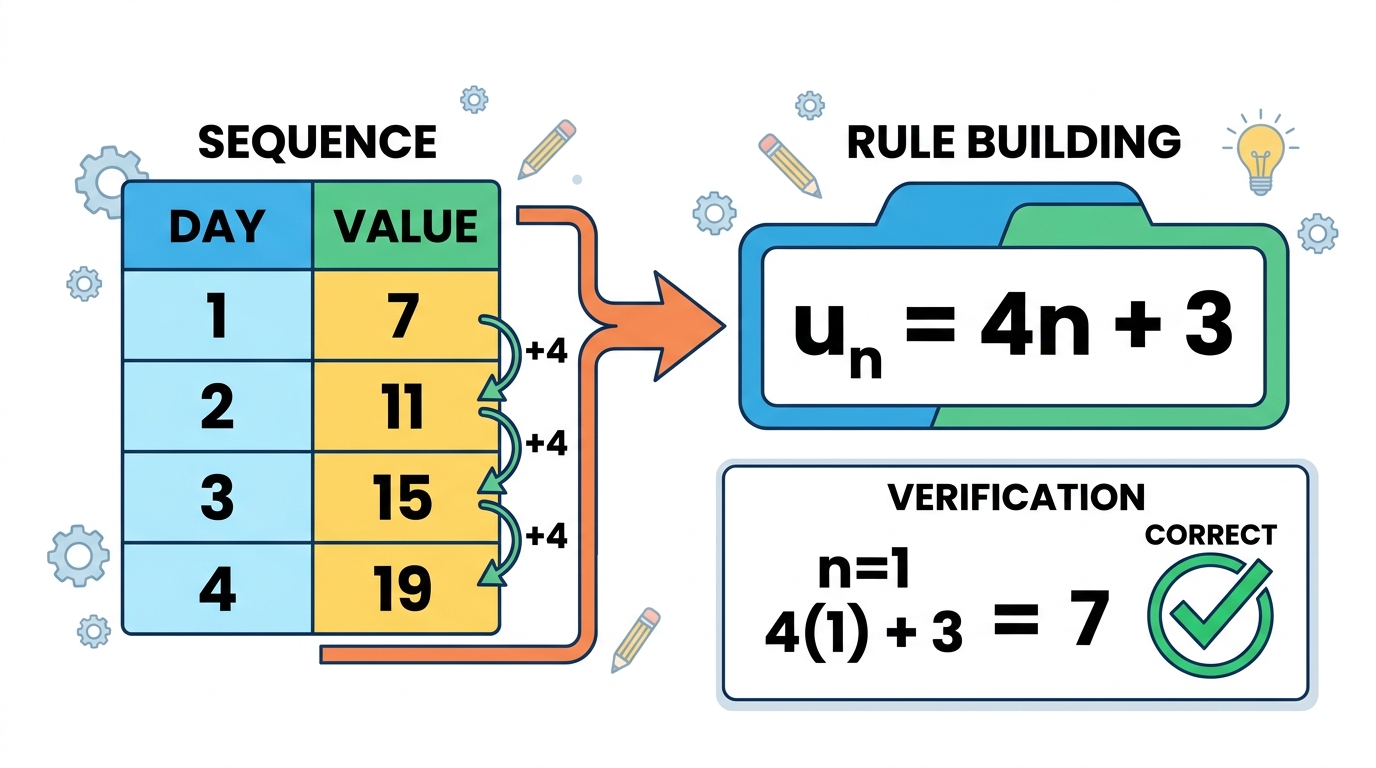
A term-to-term rule (like 'add 4 to the previous term') is great for continuing a sequence but slow for finding the 50th term. A position-to-term rule such as lets you jump straight to any term by substituting n. Build it by multiplying n by the common difference, then adjusting with a constant so n=1 matches the real first term — and always test the rule against a known term before using it to predict further.
Exam tip
Build the nth term rule once, then substitute — markers award the mark for showing the substitution, not just stating the final number.
Common mistake
Using the term number directly as a multiplier without checking it against term 1 (e.g. assuming Day 20 = 20×4 = 80, forgetting the +3 adjustment).
Mini summary
nth term rule = common difference × n, adjusted by a constant — always verify against a known term first.
Turning Patterns into Algebraic Expressions
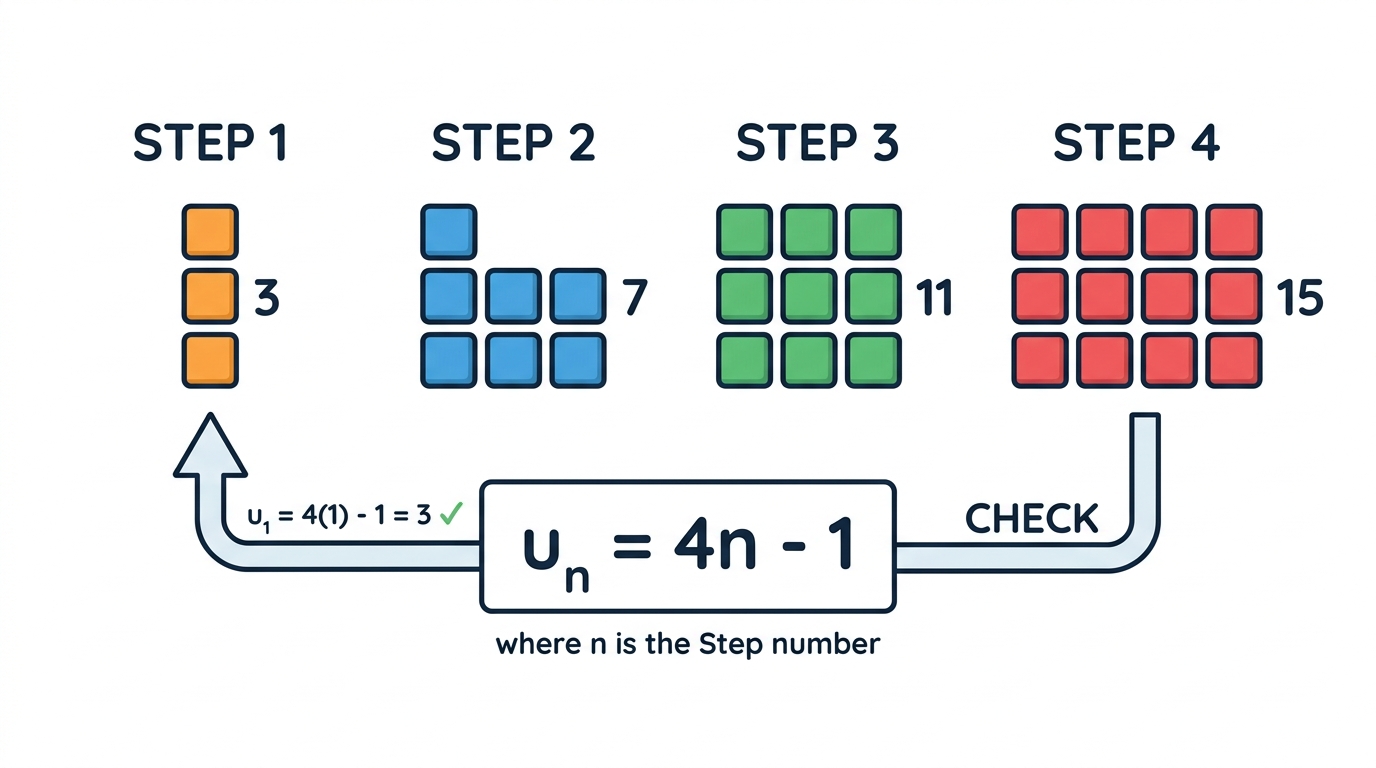
Writing a pattern as algebra means swapping 'step number' for a variable, usually n, so one expression works for every case. The coefficient of n always equals the common difference, and the constant term is whatever makes n=1 match the first real term. An expression like only becomes a usable rule once you write in front of it.
Exam tip
Test your finished expression against at least one known term (ideally two) before finalising it as the rule.
Common mistake
Treating the coefficient alone (like '4n') as the complete rule without adjusting for the starting value.
Mini summary
Coefficient = common difference; constant = whatever makes n=1 fit. Expression ≠ formula until 'u_n =' is added.
Sequences as Real-World Models
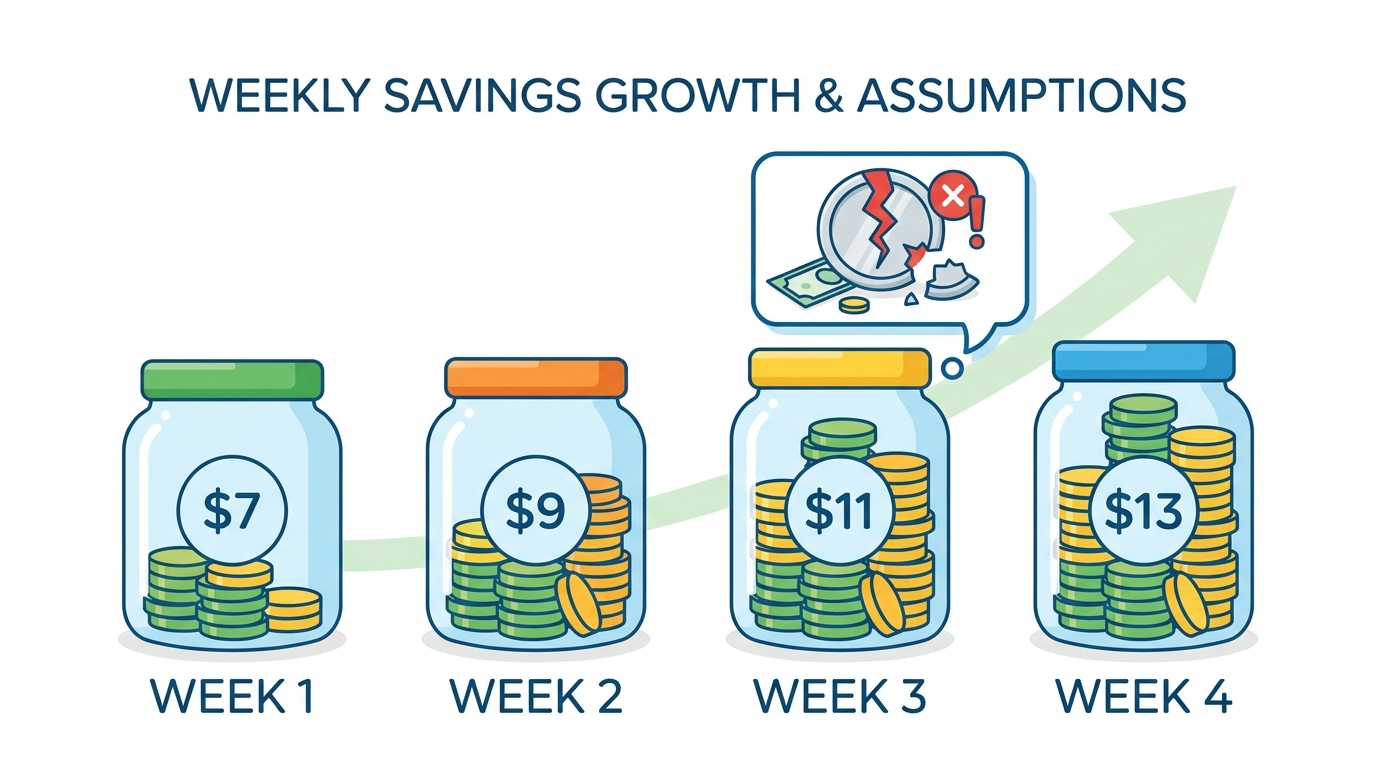
Sequences model real situations like savings, population growth, or ticket sales, but a clean rule is a simplification, not a guarantee. Recognising the type of real-world pattern — fixed weekly top-ups (arithmetic) versus compounding interest (geometric) — tells you what's actually being modelled. Exam questions often ask you to critique the model, so a vague answer like 'life is unpredictable' won't earn marks.
Exam tip
When asked why a model might not match reality, name one specific event that would break the constant pattern.
Common mistake
Giving a generic reason (e.g. 'things change') instead of a specific, sequence-linked one, like an unexpected expense breaking a fixed weekly saving.
Mini summary
Real-world sequences are models — always separate what the rule predicts from what might actually happen.
When Patterns Aren't Arithmetic
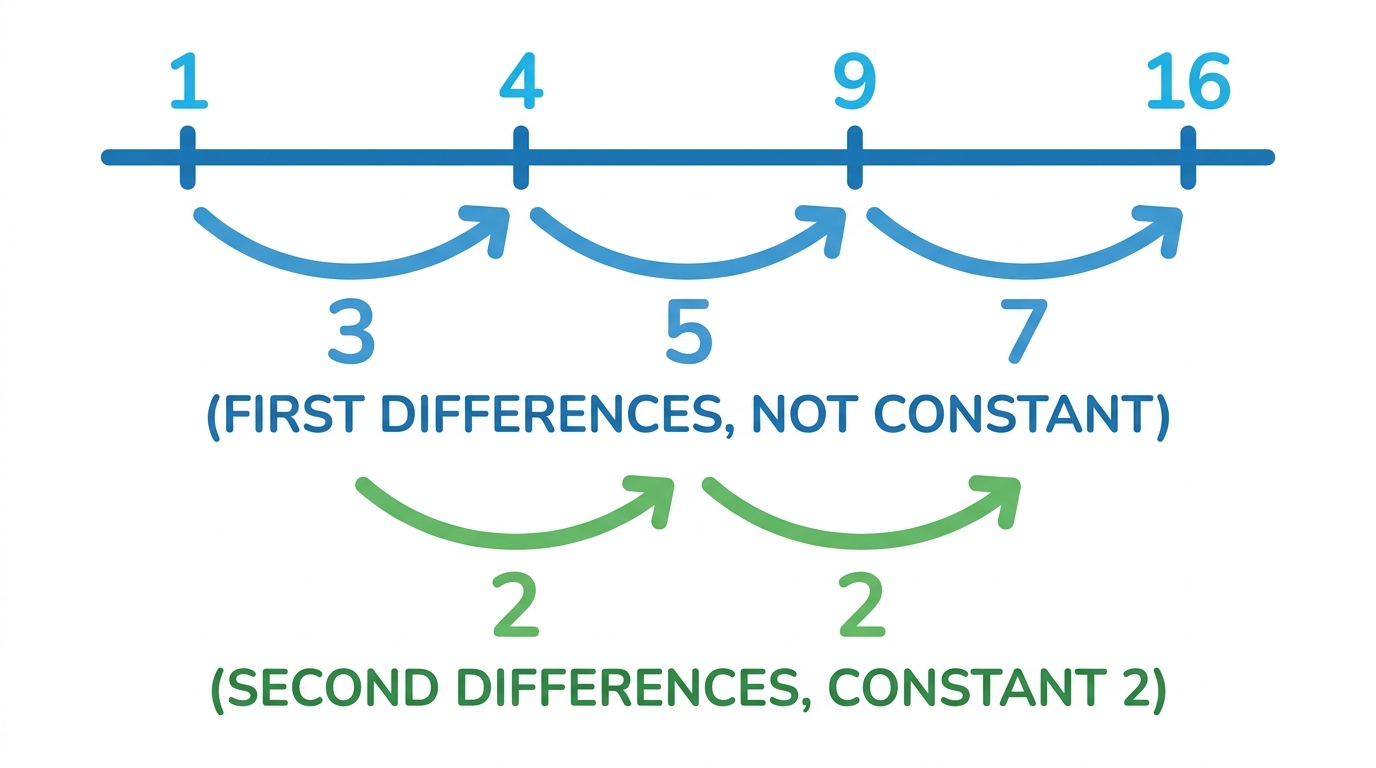
Not every pattern has a constant first difference. When the gaps between terms themselves change by a constant amount, the pattern is quadratic-type rather than linear, and a single common difference or ratio won't describe it. Spotting this early stops you from forcing an arithmetic or geometric label onto a pattern that behaves differently.
Exam tip
If the first differences aren't constant, check whether the second differences are — that signals a quadratic-type pattern.
Common mistake
Trying to force a non-constant-difference pattern into the arithmetic nth term formula.
Mini summary
Constant first differences = arithmetic; changing first differences = look for a quadratic-type pattern instead.
Quick formula sheet
Practice questions
- Identify the common difference in the sequence 6, 10, 14, 18.
- State whether 3, 9, 27, 81 is arithmetic or geometric, and give the common ratio or difference.
- Write the first four terms of an arithmetic sequence with a=2 and d=5.
- Build the nth term rule for the sequence 9, 13, 17, 21 and use it to find the 10th term.
- A pattern has 4, 9, 14, 19 tiles at Steps 1–4. Write an algebraic expression for the number of tiles at Step n.
- Explain, using the words 'term' and 'common difference', how each term connects to the one before it in 7, 12, 17, 22.
- A shop sells 8, 13, 18, 23 items on Days 1–4. The owner claims Day 15 will sell 78 items. State whether she is correct, giving a reason.
- A sequence starts 5, 12, 21, 32. Explain why it is not arithmetic, and describe what type of pattern it might be instead.
- Mia saves $10 in Week 1 and adds $4 each week. Give one specific reason this model might not match her real saving habits.
Frequently asked questions
What's the difference between an arithmetic and a geometric sequence?+
Arithmetic sequences add or subtract the same common difference each time; geometric sequences multiply or divide by the same common ratio each time.
How do I find the nth term of an arithmetic sequence?+
Use , where a is the first term and d is the common difference, or build the rule as (common difference)×n adjusted by a constant.
Why isn't every increasing sequence arithmetic?+
Because 'increasing' only tells you the direction, not the size of the gap. You must check that the gap between consecutive terms stays exactly the same before calling it arithmetic.
How do I turn a pattern into an algebraic expression?+
Set the coefficient of n equal to the common difference, then adjust with a constant so that n=1 gives the correct first term, e.g. .
What should I write for 'give a reason a model might not match reality'?+
Name one specific, plausible event that would break the constant pattern, such as an unexpected expense or a missed week — a generic comment like 'things change' won't earn the mark.
What if the first differences in a sequence aren't constant?+
Then the sequence isn't arithmetic — check whether the second differences are constant instead, which signals a quadratic-type pattern.
Get the full MYP 1 Patterns & Sequences revision notes
Related articles