
Cells and Living Systems
MYP 2 Sciences: cell theory, organisation levels, specialised cells and plant vs animal cells, simplified.
Quick facts
Cells and Living Systems is the foundation of MYP 2 Sciences — every later biology unit builds on it. This topic asks you to see life as a hierarchy: cells cooperate to form tissues, tissues combine into organs, and organs work together as organ systems inside a whole organism. You'll compare plant and animal cells, link specialised cell structures to their functions, and contrast unicellular organisms that do everything alone with multicellular organisms that share the workload through cell differentiation. Examiners consistently catch students out on two things — explaining complexity through cooperation rather than organelle count, and forgetting the structure-to-function 'link' word in descriptive answers. This teaser walks through the five ideas most likely to appear in your unit test or data-response task, then points you to the full revision notes for worked examples, labelled diagrams and practice mark schemes.
What you’ll be able to do
Cell Theory: The Idea Behind Everything
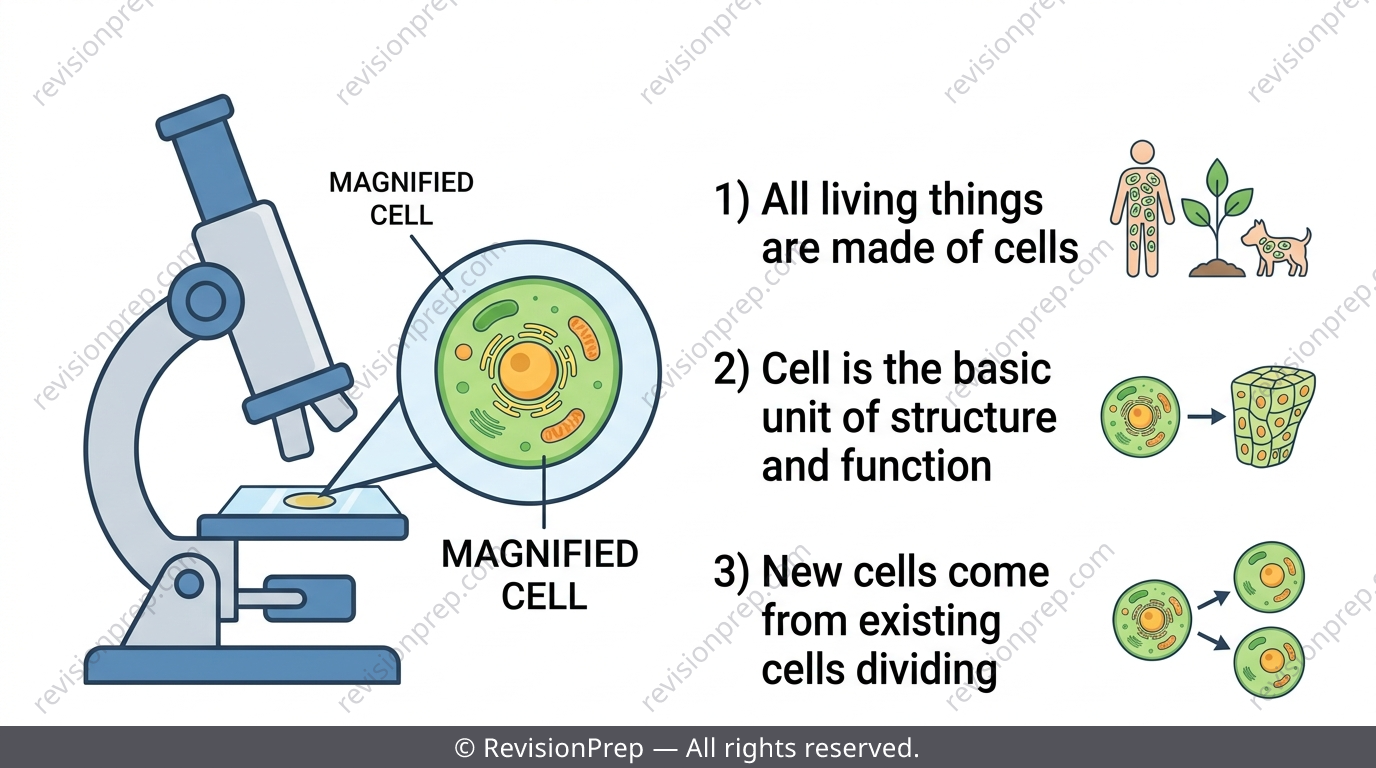
Cell theory says all living things are made of cells, the cell is the basic unit of life, and new cells only come from existing cells dividing. This one idea explains why microscopes matter so much in biology — most of what cell theory describes is invisible to the naked eye. Every other concept in this unit, from tissues to organ systems, is really cell theory scaled up.
Exam tip
If a question asks 'why is the cell important to living things?', reference cell theory directly rather than describing organelles.
Mini summary
All life is built from cells, and cells only come from other cells dividing.
Levels of Biological Organisation
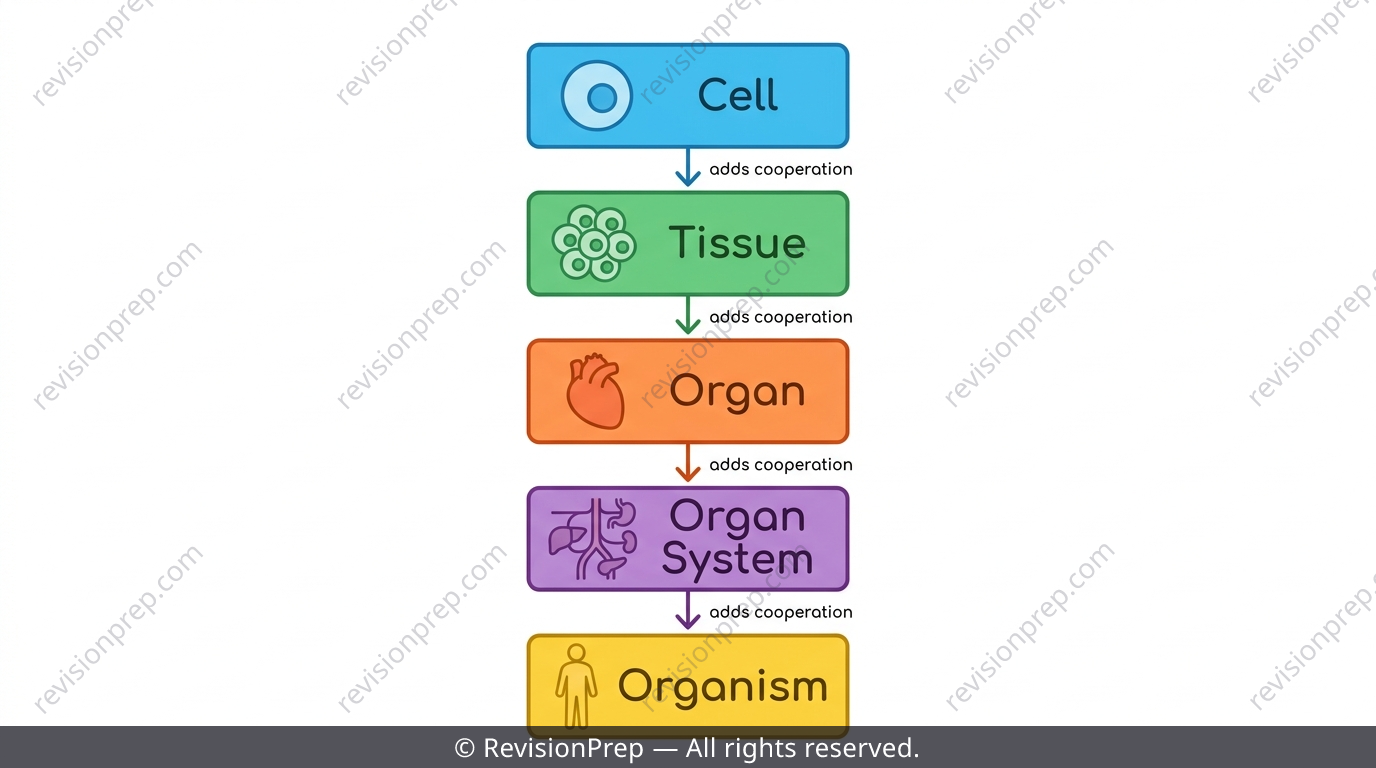
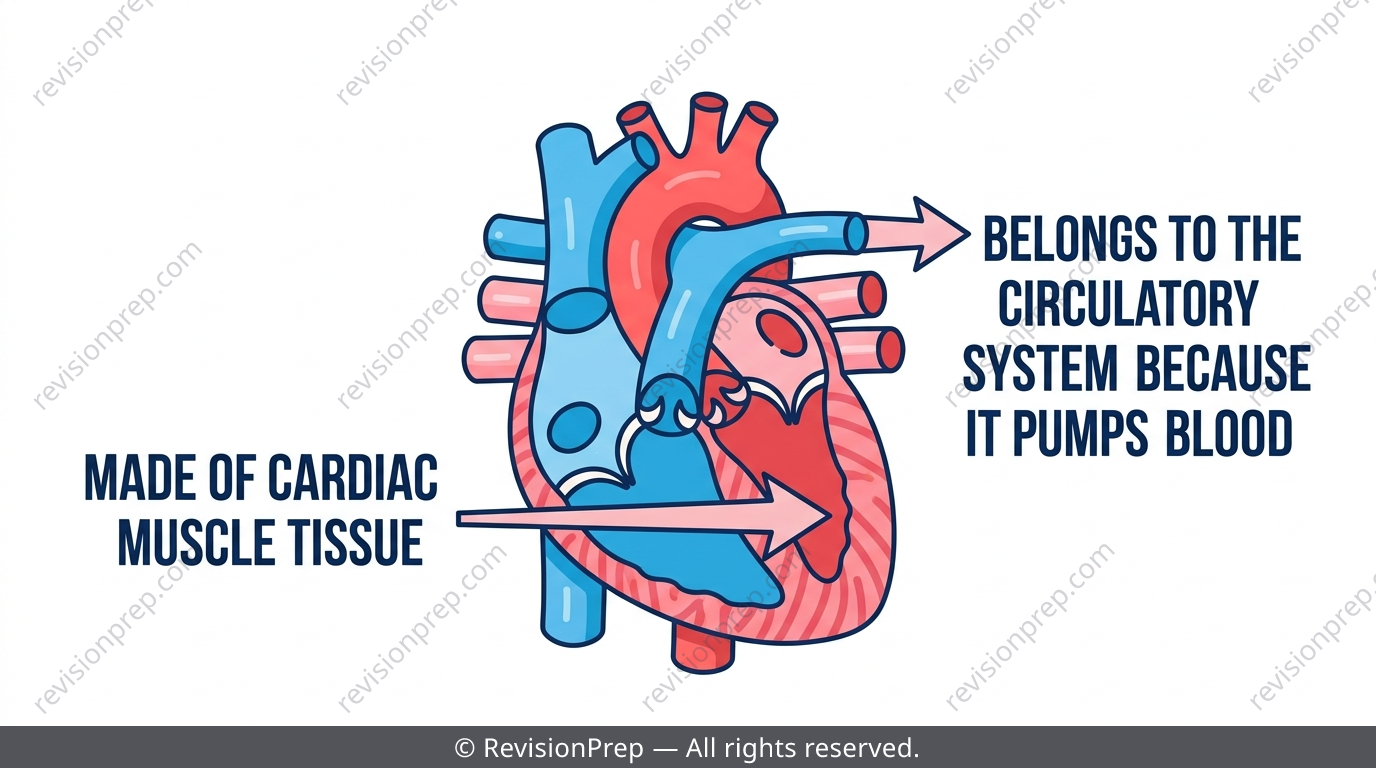
Living systems are built in stages: cell → tissue → organ → organ system → organism, and each stage gains a new ability through cooperation, not just extra size or organelles. A single cardiac cell can contract, but only thousands of them working as cardiac tissue produce a coordinated squeeze; only when tissues combine into the heart does pumping happen. Crucially, an organ's system depends on its FUNCTION — the heart is muscle tissue but belongs to the circulatory system because of what it does.
| Level | Definition |
|---|---|
| Cell | Smallest unit that can carry out life functions alone |
| Tissue | Group of similar cells working together for a shared function |
| Organ | Two or more tissue types working together for a specific job |
| Organ system | Group of organs carrying out a broad body function |
| Organism | Complete living thing made of one or more organ systems |
Common mistake
Saying a tissue is 'more complex' than a cell because it 'has more organelles' — the real reason is cooperation between many cells, not anything different inside one cell.
Mini summary
Each level adds cooperation; system membership is decided by function, not tissue type.
Specialised Cells: Structure Matched to Job
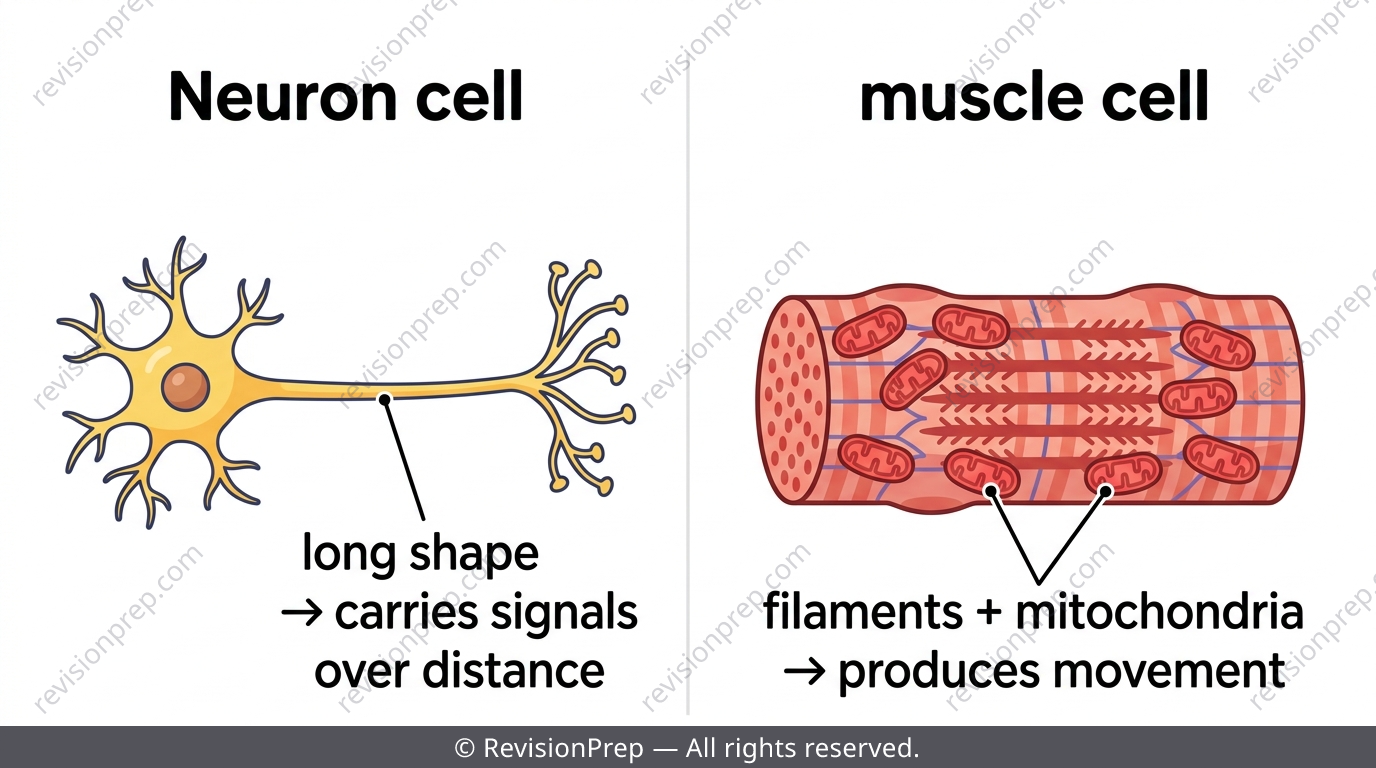
Specialisation means a cell's shape and organelle content are matched precisely to one job, at the cost of doing other jobs. A neuron stretches into a long branched shape purely to carry electrical signals, while a muscle cell packs in contractile filaments and mitochondria for movement — neither could swap roles. Cells specialise by losing organelles (a red blood cell loses its nucleus), gaining organelles (a sperm cell gains extra mitochondria), or reshaping entirely (a neuron elongates).
| Cell | Key structural feature | Function it enables |
|---|---|---|
| Nerve cell (neuron) | Long, branched shape | Carries electrical signals over distance |
| Muscle cell | Packed contractile filaments + mitochondria | Produces movement using energy from contraction |
| Red blood cell | No nucleus, biconcave shape | Maximises space to carry oxygen |
| Sperm cell | Extra mitochondria, tail | Powers swimming to reach the egg |
Exam tip
Always attach a connective word — 'so that', 'which means', 'allowing' — between the structure and the function. Naming the structure alone earns partial marks at best.
Mini summary
Specialisation is a trade-off: extreme efficiency at one job, in exchange for losing the ability to do others.
Plant Cell vs Animal Cell
Plant and animal cells share the same core toolkit — nucleus, cytoplasm, cell membrane, mitochondria and ribosomes — because both need to control their contents, release energy and build proteins. Plant cells add three extra structures as a package: a rigid cell wall for support, chloroplasts to trap sunlight, and a large permanent vacuole for turgidity. Animal cells can still have small, temporary vacuoles — the real difference from plants is size and permanence, not simple presence or absence.
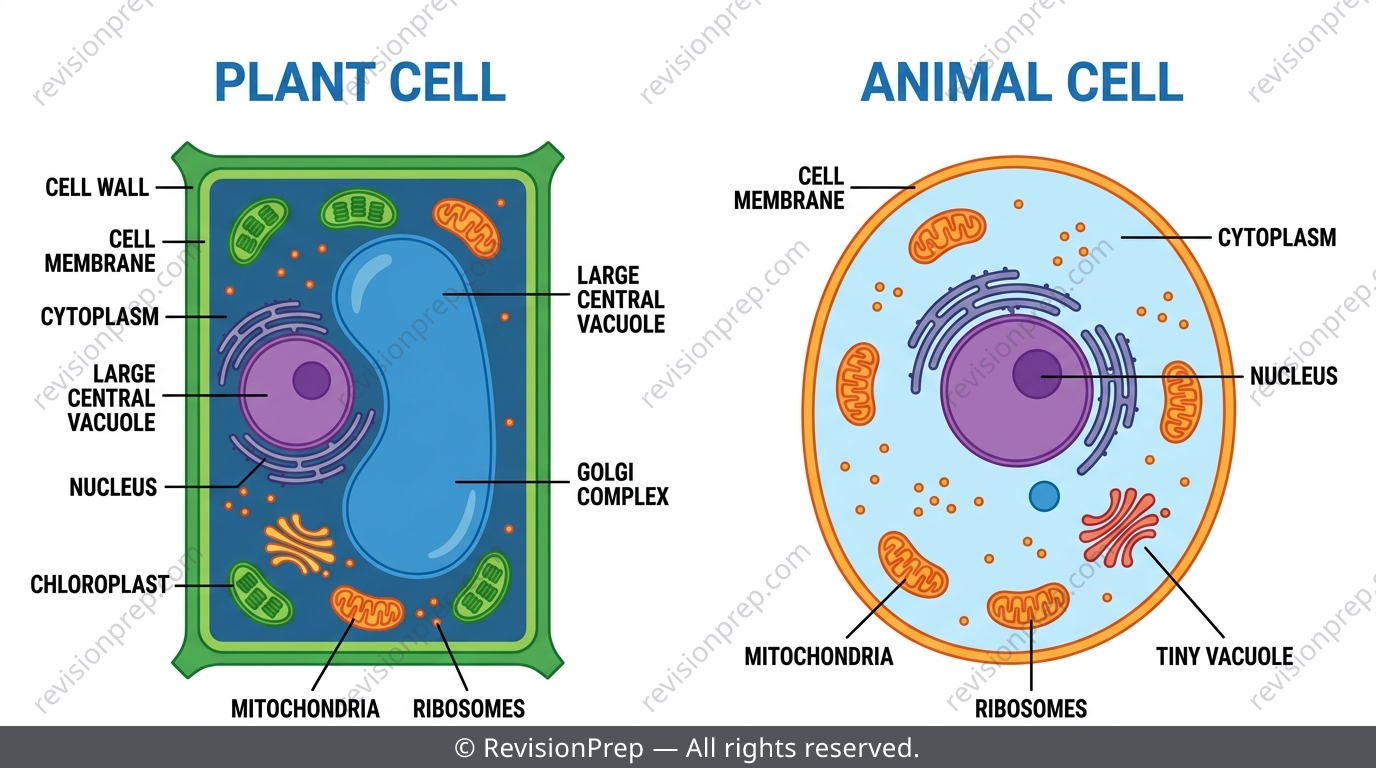
| Feature | Plant cell | Animal cell |
|---|---|---|
| Cell wall | Present, rigid | Absent |
| Chloroplast | Present | Absent |
| Vacuole | Large, permanent | Small, temporary (if present) |
| Nucleus, mitochondria, ribosomes | Present | Present |
Common mistake
Drawing a cell wall around an animal cell outline, or claiming animal cells 'don't have mitochondria' — both are common diagram-labelling errors.
Mini summary
Memorise the plant-only trio — wall, chloroplast, large vacuole — as one linked package, not three separate facts.
Unicellular vs Multicellular Organisms
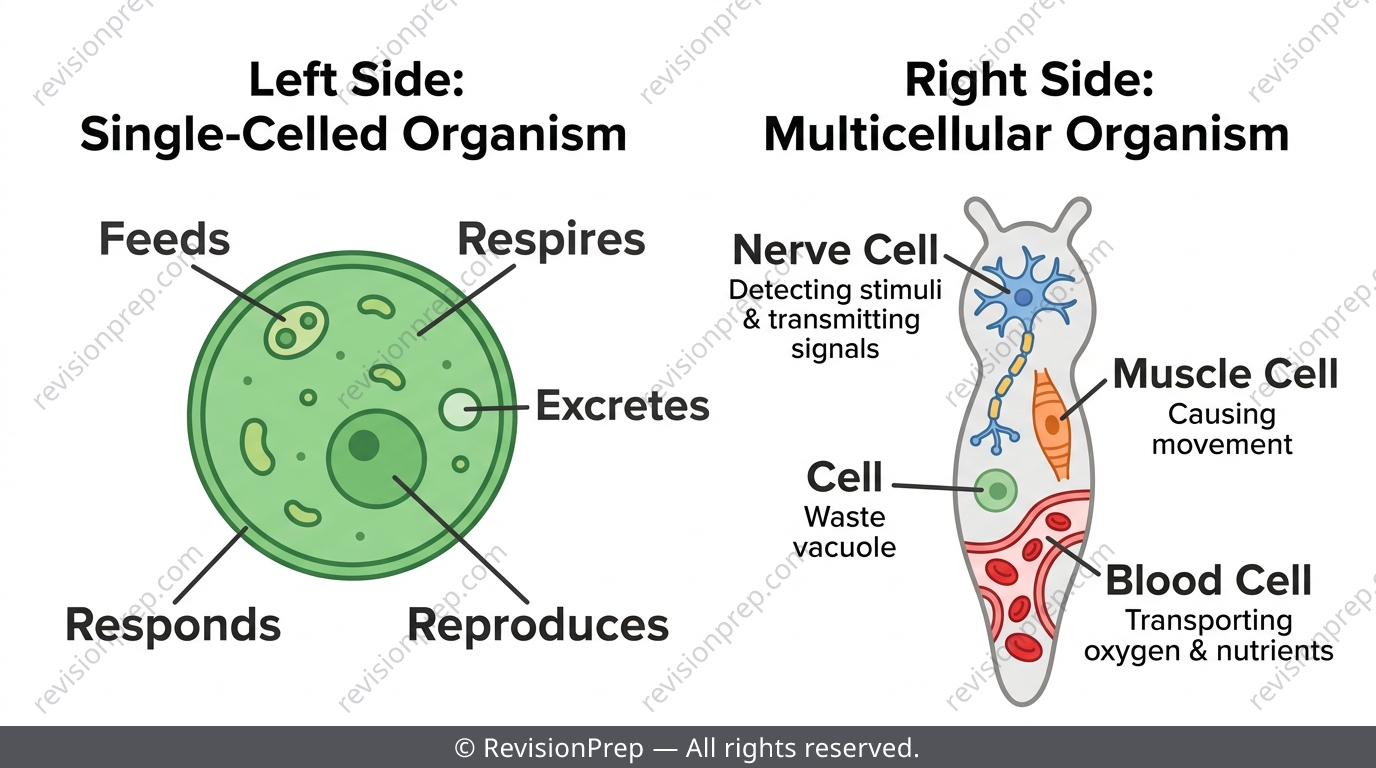
A unicellular organism is a complete living thing packed into just one cell — that single cell must feed, respire, excrete waste, respond to surroundings and reproduce entirely on its own. A multicellular organism spreads these jobs across many specialised, cooperating cells through cell differentiation, which lets it grow larger and more complex, but also means damage to a few cells usually doesn't kill the whole organism the way it would for a unicellular one.
Mini summary
One cell doing everything vs. many specialised cells sharing the workload — that's the whole distinction.
Practice questions
- State the order of the four main levels of biological organisation, from cell to organ system.
- Name two organelles found in both plant cells and animal cells.
- Give one life function a unicellular organism's single cell must perform on its own.
- Explain why a tissue is considered more complex than a single cell.
- Describe how the structure of a red blood cell relates to its function.
- Identify the three structures found in plant cells but not animal cells, and explain why plants need them.
- Arrange muscle cell, cardiac muscle tissue, heart, and circulatory system in order of biological organisation, and explain how each level connects to the next.
- A researcher measures oxygen consumption in three mouse tissues before and after running. Explain how you would decide which tissue shows the greatest relative increase in metabolic rate, and why this matches its specialised function.
- Using two different specialised cells as examples, explain the trade-off involved in cell specialisation.
Frequently asked questions
What is the correct order from cell to organism?+
Cell → tissue → organ → organ system → organism. Each level adds cooperation between the units below it, not just extra size.
What is the difference between a tissue and an organ?+
A tissue is a group of similar cells doing one shared job, while an organ is made of two or more different tissue types working together for a specific job.
Why do plant cells have a cell wall but animal cells don't?+
Plants are stationary and need rigid structural support since they can't move to avoid damage, so they evolved a cell wall. Animal cells rely on movement instead, so they don't need one.
What is cell theory in simple terms?+
Cell theory states that all living things are made of cells, the cell is the basic unit of life, and new cells only arise from existing cells dividing.
What is the difference between unicellular and multicellular organisms?+
A unicellular organism performs every life function within a single cell, while a multicellular organism divides these jobs among many specialised, cooperating cells.
Do animal cells ever have vacuoles?+
Yes — animal cells can have small, temporary vacuoles. The real difference from plant cells is that plant vacuoles are large and permanent.
Master Cells and Living Systems with the full MYP 2 revision notes
Related articles