
Matter and Its Properties
From atoms to mixtures: classify substances, master atomic structure and pick the right separation technique.
Quick facts
Matter and Its Properties is the foundation unit of IB MYP 2 Sciences, and it's where you learn to think like a scientist rather than just describe what you see. You'll classify substances as elements, compounds or mixtures using evidence — not appearance — and learn why chemical symbols follow strict international rules. You'll zoom into the atom itself, meeting protons, neutrons, electrons and the atomic number that defines every element. From there, you'll learn to choose the correct separation technique for any mixture, and finally judge whether a physical or chemical change has actually occurred. Every one of these ideas is tested through a specific 'test' or piece of evidence, which is exactly the skill examiners reward across Criteria A, B and C. This teaser hits the five most important ideas — the full revision notes go much deeper with worked examples.
What you’ll be able to do
Elements, Compounds and Mixtures
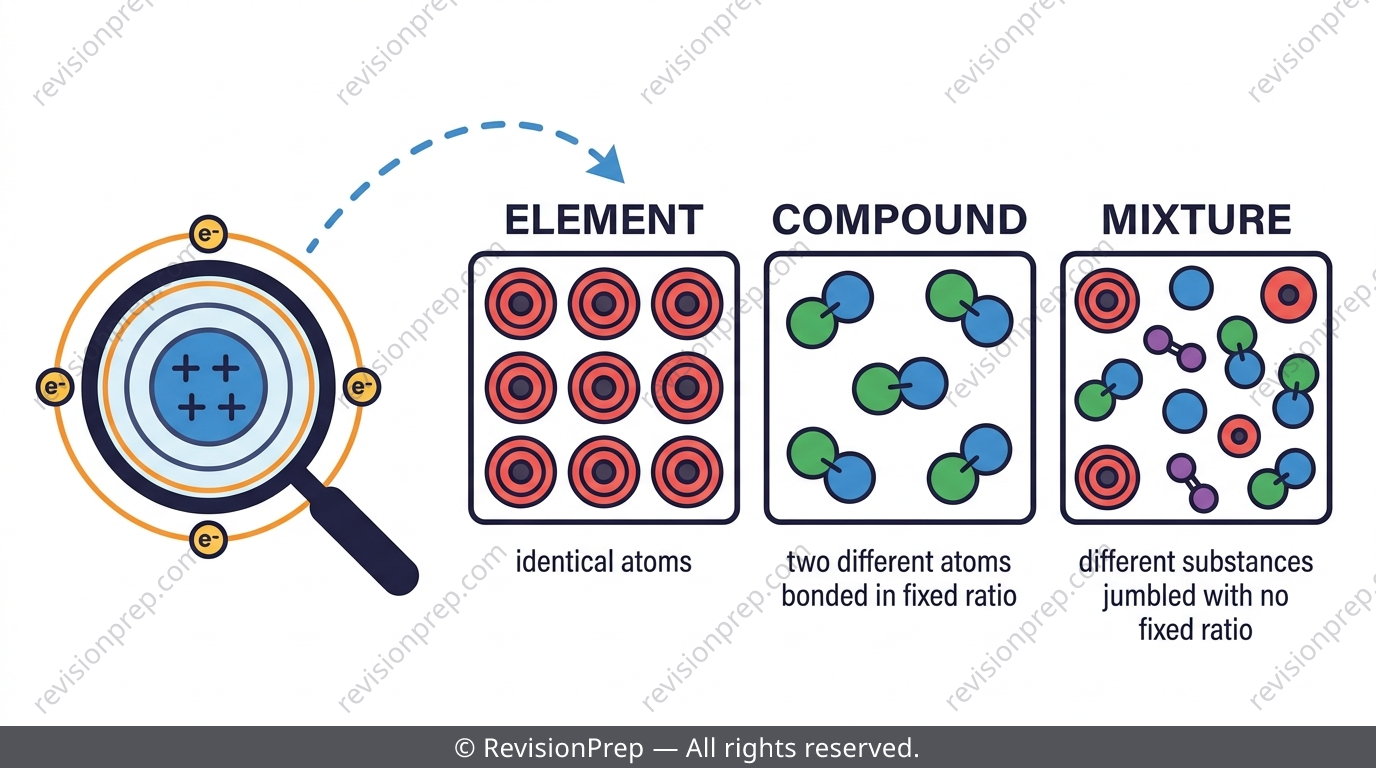
All matter is either an element, a compound or a mixture — and the category is decided by what happens when you try to break the substance apart, never by how it looks. Elements are 'as simple as it gets' and carry a unique internationally agreed symbol like for lead. Compounds are elements chemically locked together in a fixed ratio, so their properties are completely different from the elements that formed them — sodium and chlorine make table salt. Mixtures are just physically combined, keep each part's own properties, and can always be pulled apart again using a physical method, however uniform they look.
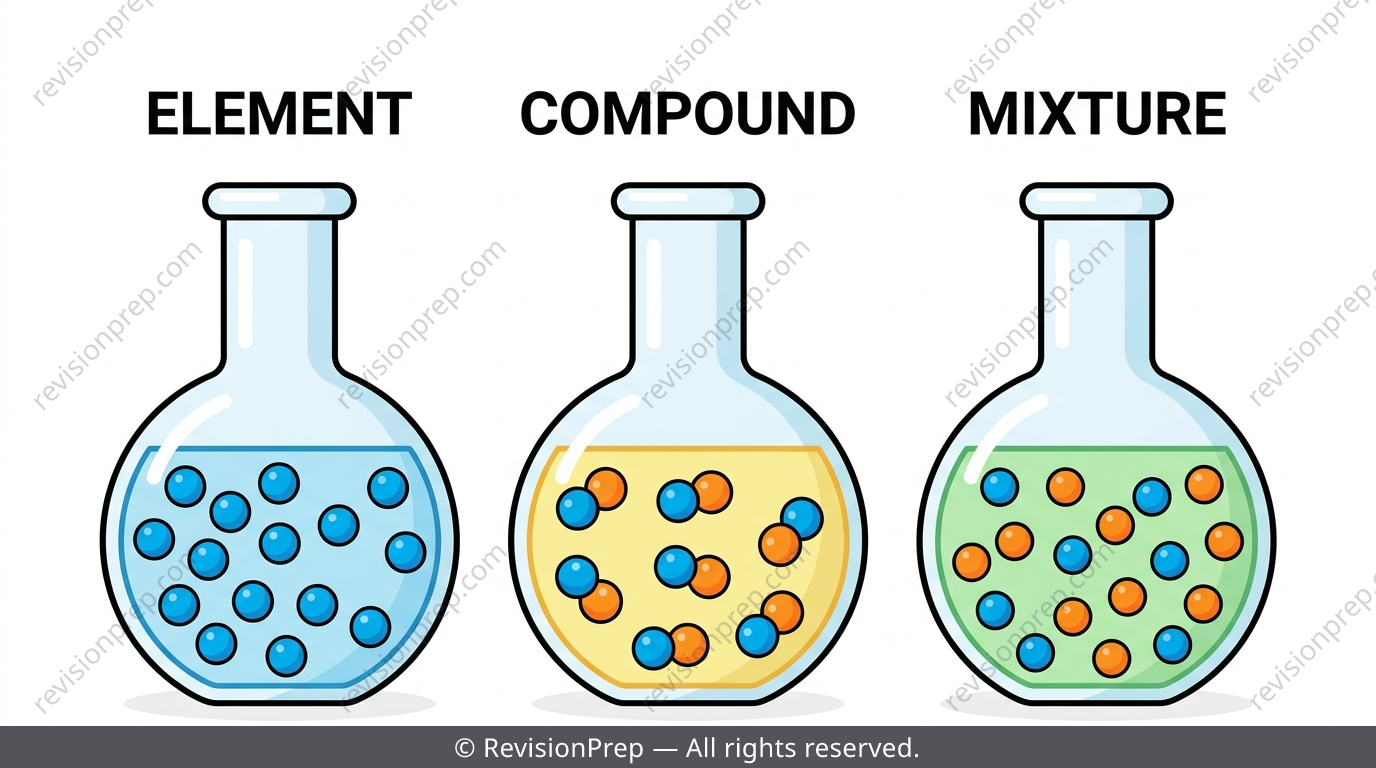
| Feature | Element | Compound | Mixture |
|---|---|---|---|
| Made of | One type of atom | Two+ elements, fixed ratio | Two+ substances, no fixed ratio |
| Broken down by | Cannot be broken down chemically | Chemical means (heat, electrolysis) | Physical means only |
| Properties | Its own | New, different from parts | Each part keeps its own |
Exam tip
Decide element vs compound using decomposition behaviour only — never colour, state or texture.
Common mistake
Assuming a smooth, uniform mixture (like an alloy or fully dissolved salt water) must be a compound because it looks like one substance.
Mini summary
Element, compound and mixture are defined by bonding and separability — not appearance.
Atomic Structure Basics
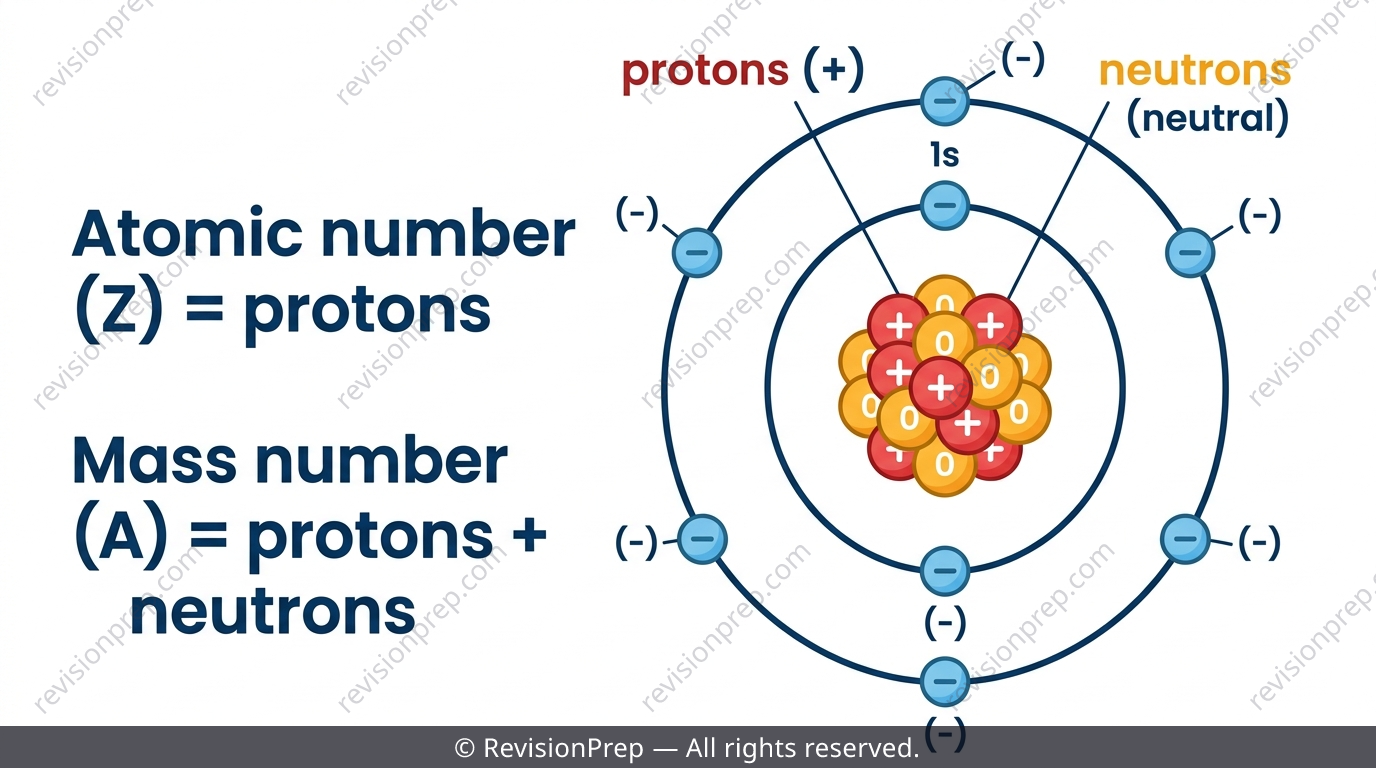
Every element is defined by its atomic number — the number of protons in the nucleus. The nucleus holds protons and neutrons and carries almost all the mass, while electrons orbit in shells and carry the negative charge. Mass number is protons plus neutrons, and because neutron count can vary, atoms of the same element can exist as different isotopes.
Exam tip
If you're given mass number and atomic number, rearrange to find the number of neutrons.
Common mistake
Confusing atomic number (protons) with mass number (protons + neutrons) when reading a periodic table entry.
Mini summary
Atomic number = protons = identity; mass number = protons + neutrons.
Chemical Symbols: The IUPAC Rules
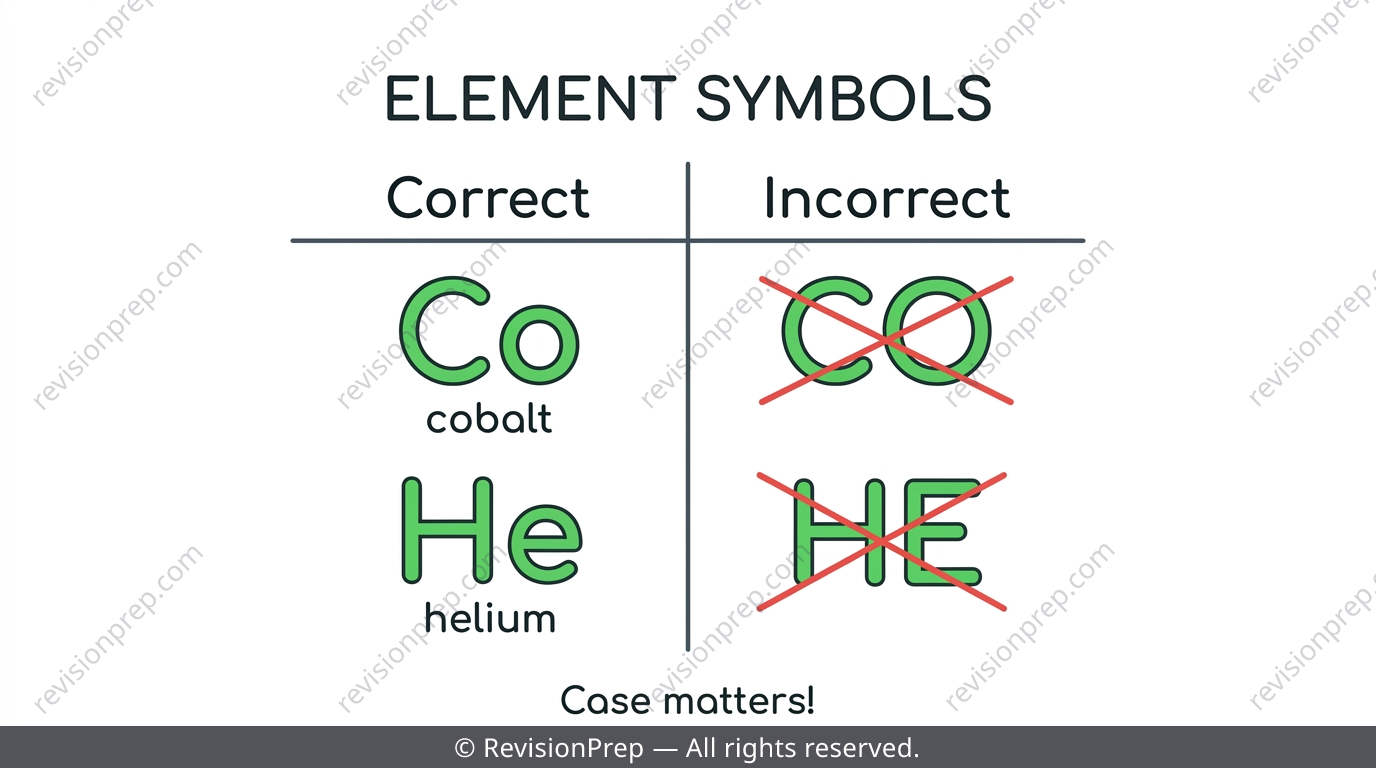
Chemical symbols are an international language agreed by IUPAC so scientists everywhere read the same data, regardless of local language — always means lead and always means mercury. Every symbol is one capital letter, optionally followed by one lowercase letter, and no two elements ever share a symbol. Case matters completely: 'Co' means cobalt, but 'CO' means carbon monoxide.
Exam tip
Mark schemes only accept the exact capital + lowercase pattern — get the case wrong and the answer scores zero, even if you clearly know the element.
Common mistake
Writing two capital letters, like 'CO' for cobalt instead of 'Co', or 'HE' for helium instead of 'He'.
Mini summary
One capital, one optional lowercase, never shared, case always matters.
Separation Techniques
Every separation technique exploits exactly one physical property difference between substances in a mixture, and matching the right technique to the right property is the key exam skill. Filtration uses particle size to separate an insoluble solid from a liquid. Evaporation removes a dissolved solid by boiling away the solvent (which is lost as vapour), while distillation does the same job but recovers the liquid too by condensing it. Chromatography separates dissolved substances by how strongly each one is attracted to the paper versus the solvent.
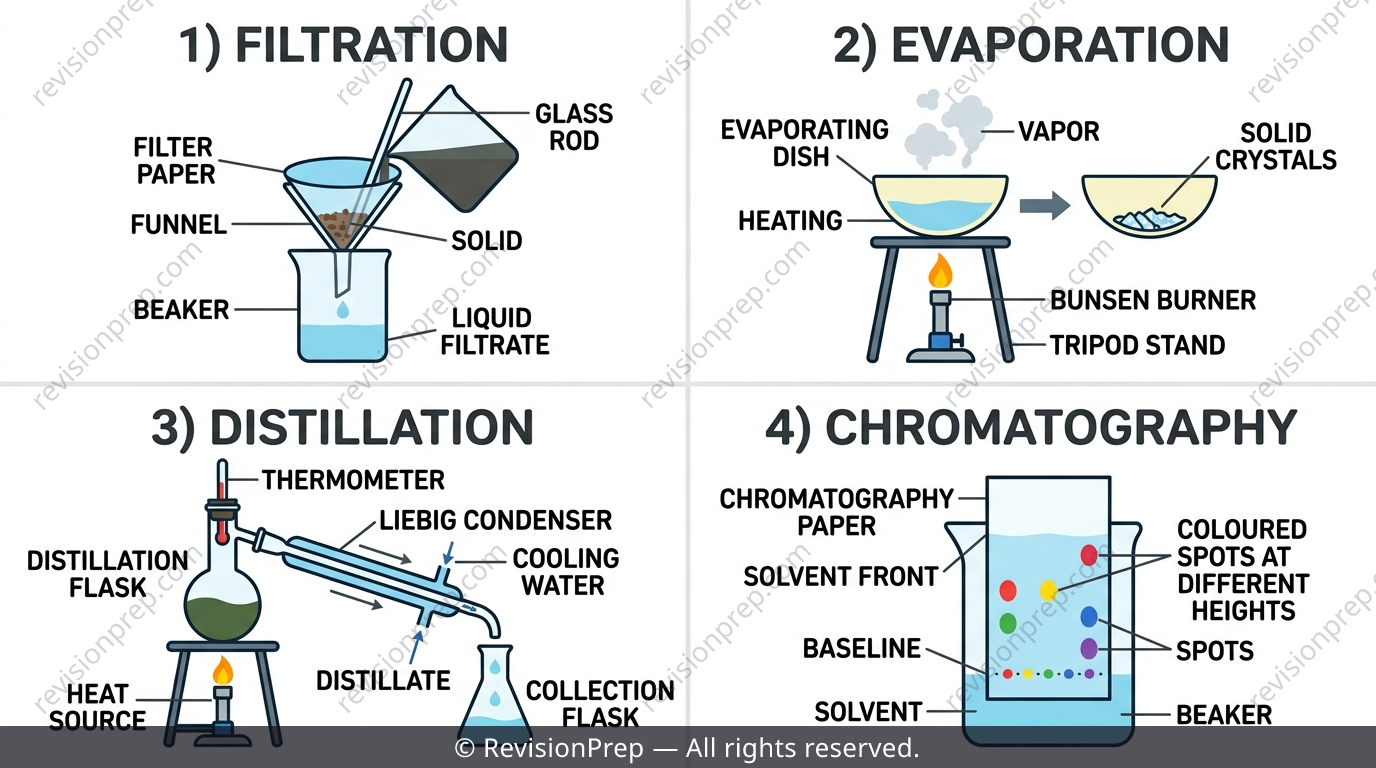
| Technique | Property Used | Recovers Solvent? |
|---|---|---|
| Filtration | Particle size | Not applicable |
| Evaporation | Boiling point/volatility | No — lost as vapour |
| Distillation | Boiling point | Yes — condensed and collected |
| Chromatography | Attraction to paper vs solvent | Not applicable |
Exam tip
Always name the specific physical property being exploited, not just the technique — that's usually the reasoning mark.
Common mistake
Naming the correct technique but forgetting to state the property difference it relies on, losing the explanation mark.
Mini summary
Match the technique to the property: size (filtration), boiling point (evaporation/distillation), attraction (chromatography).
Physical vs Chemical Change
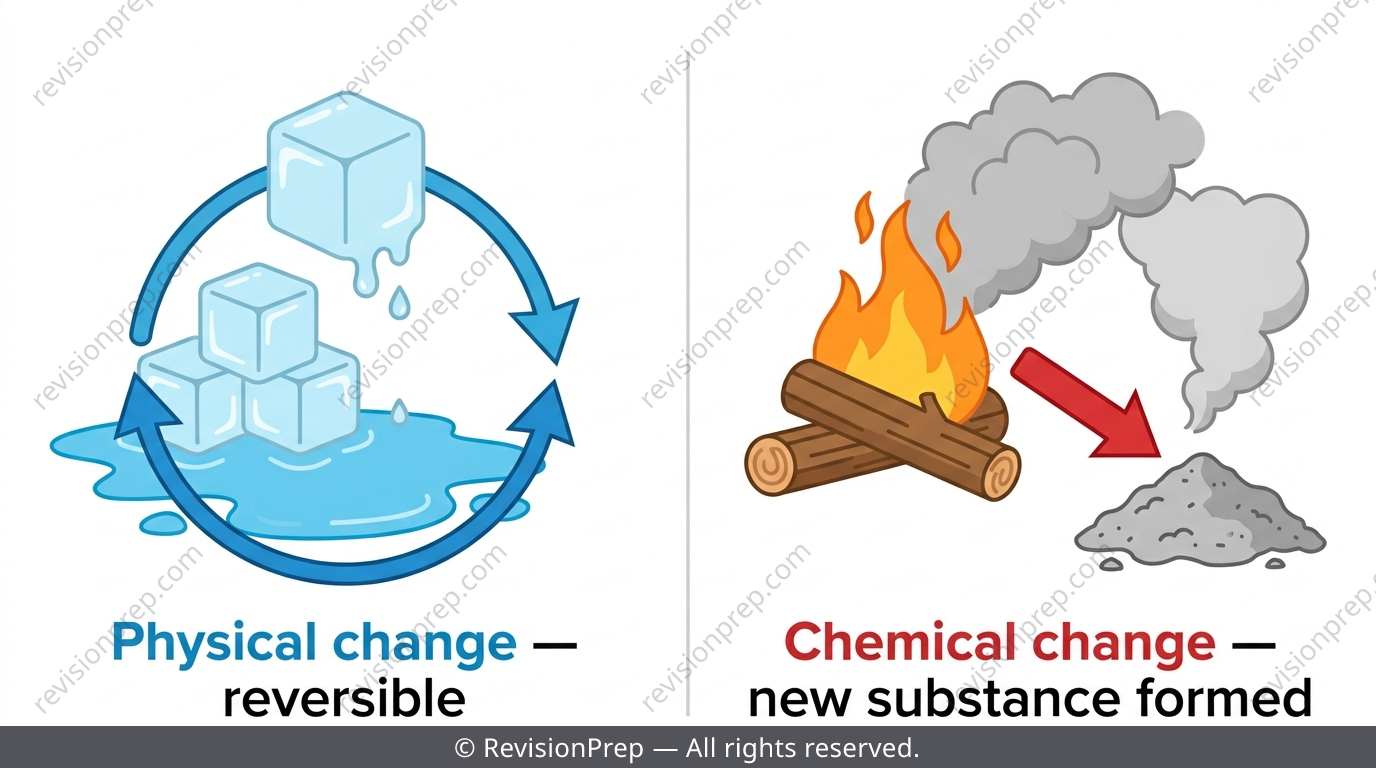
Deciding whether a change is physical or chemical always comes down to evidence, not appearance: has a genuinely new substance formed? Signs like decomposition by heat, entirely new properties appearing, or the change being irreversible point to a chemical change, while a change that can be reversed and keeps the original substance's identity is physical. This is the same 'test, not a look' logic used to classify elements, compounds and mixtures.
Exam tip
Look for the keyword evidence in the question — reversibility, new properties, or decomposition — before deciding physical or chemical.
Common mistake
Judging a change as chemical just because it looks dramatic (colour change, gas produced) without checking whether it's actually reversible or a new substance formed.
Mini summary
Physical change = reversible, same substance; chemical change = new substance formed, usually irreversible.
Quick formula sheet
Practice questions
- Define the terms element, compound and mixture in your own words.
- State the atomic number and mass number for an atom with 6 protons and 6 neutrons.
- Write the correct chemical symbol for helium and explain why 'HE' is incorrect.
- A substance decomposes on heating into two new substances. Is it an element or a compound? Justify your answer.
- Describe how you would separate a mixture of sand, salt and water, naming each technique used and the property it exploits.
- Explain why sodium chloride has completely different properties from sodium metal and chlorine gas.
- Two atoms of the same element have different mass numbers. Explain what this tells you about their neutron numbers, and name this relationship.
- A student claims that because a solution looks completely uniform, it must be a compound. Evaluate this claim using the definitions of compound and mixture.
- A test tube of liquid boils at exactly 100°C and cannot be broken down by heat. A second liquid boils at 78°C and decomposes into two gases on strong heating. Classify each liquid, explaining your reasoning from the evidence given.
Frequently asked questions
What is the difference between an element, a compound and a mixture?+
An element is one type of atom that can't be broken down chemically. A compound is elements chemically bonded in a fixed ratio, breakable only by chemical means. A mixture is substances physically combined in no fixed ratio, separable by physical methods, with each part keeping its own properties.
How can I tell if a substance is an element or a compound just from data?+
Check whether it can be decomposed into simpler substances by chemical means like heating or electrolysis. If it decomposes, it's a compound; if it can't be broken down further, it's an element. Never rely on colour or state.
Why do chemical symbols follow strict capitalisation rules?+
IUPAC rules ensure every symbol is one capital letter plus an optional lowercase letter, so no two elements share a symbol and scientists worldwide read the same data. 'Co' (cobalt) and 'CO' (carbon monoxide) mean completely different things.
What's the difference between atomic number and mass number?+
Atomic number is the number of protons and identifies the element. Mass number is protons plus neutrons in that particular atom, and can vary between isotopes of the same element.
How do I choose the right separation technique for a mixture?+
Identify the specific physical property that differs between the substances — particle size for filtration, boiling point for evaporation or distillation, or attraction to paper for chromatography — then match the technique to that property.
How do I know if a change is physical or chemical?+
Look for evidence: has a new substance formed with new properties, and is the change irreversible or caused by decomposition? If yes, it's chemical; if the change is reversible and the original substance remains, it's physical.
Get the Full MYP 2 Matter and Its Properties Notes
Related articles