
Algebra and Expressions
Master simplifying, expanding, factorising and substituting for MYP 3 Maths
Quick facts
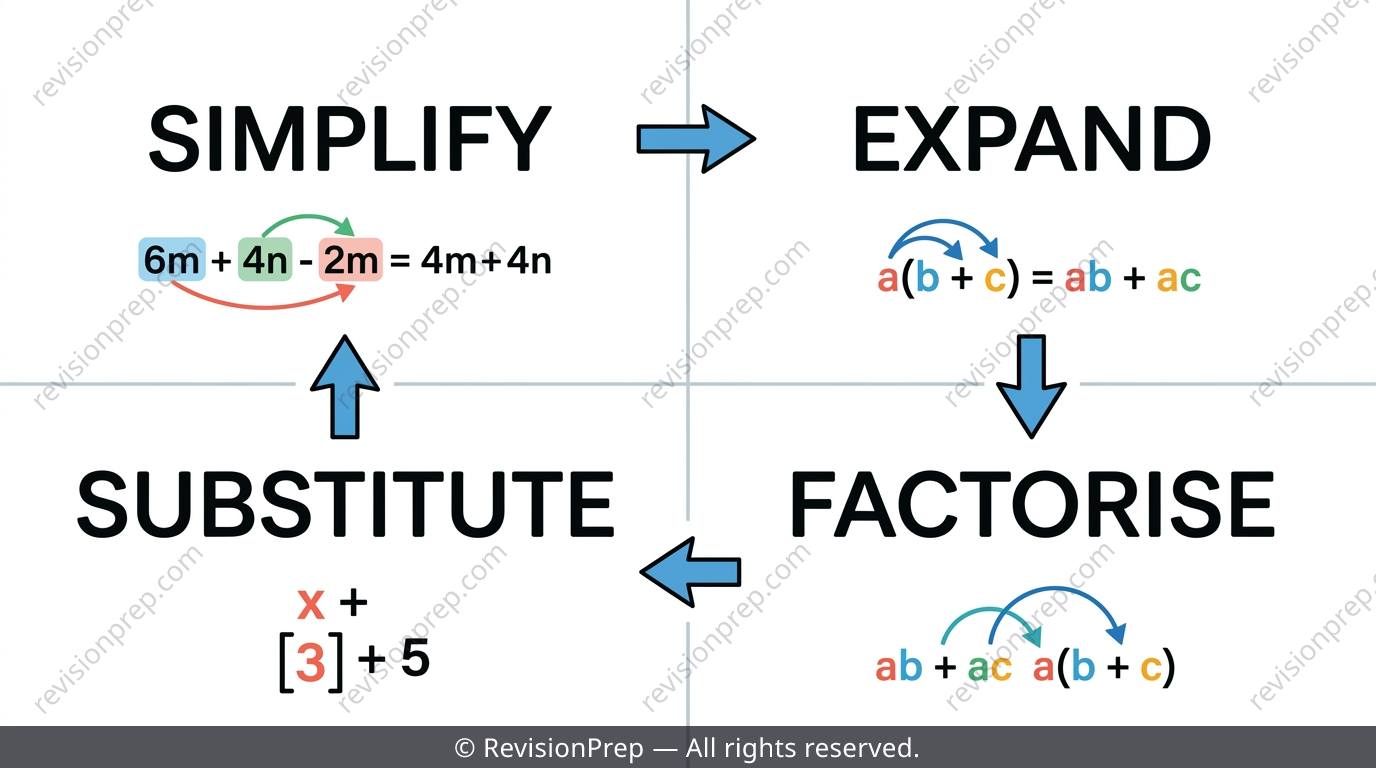
Algebra and Expressions sits at the heart of MYP 3 Number and Algebra, and it comes back in almost every unit test you'll sit this year. The good news is that everything in this topic — from tidy simplifying to tricky word problems — comes down to just four moves: simplify, expand, factorise, and substitute. Once you can recognise which move a question is asking for, the algebra itself barely changes, even when the context does. MYP examiners are especially interested in whether you can justify your working, not just produce a correct final line, so this teaser highlights the reasoning steps and common traps alongside the mechanics. Use it to check you've got the five essentials solid, then head to the full revision notes on RevisionPrep for worked examples, extra practice, and detailed examiner guidance.
What you’ll be able to do
The Four Moves Behind Every Algebra Question
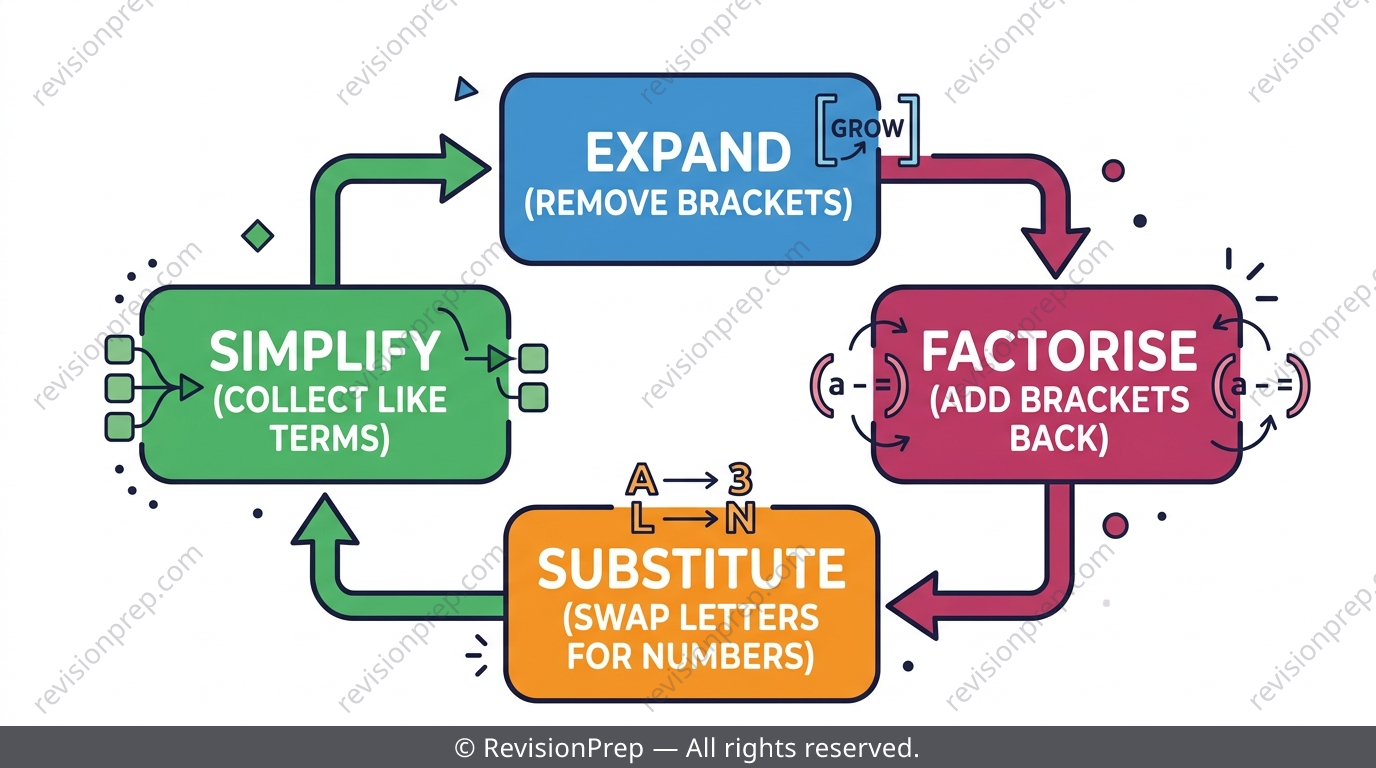
An algebraic expression has no equals sign, so it can never be 'solved' — only simplified, expanded, factorised, or evaluated. Almost every question in this topic, including word problems and sequences, is really just one of these four moves applied to a new context. Recognising which move is being asked for is often the biggest hurdle, since the algebra itself stays the same. MYP examiners also expect you to justify or explain a step, not just perform it correctly.
Exam tip
Before you start writing, ask yourself which of the four moves the question wants — simplify, expand, factorise, or substitute — since this decides your whole approach.
Mini summary
Every algebra question is built from simplify, expand, factorise, or substitute — spot which one first.
Simplifying and Rearranging Expressions
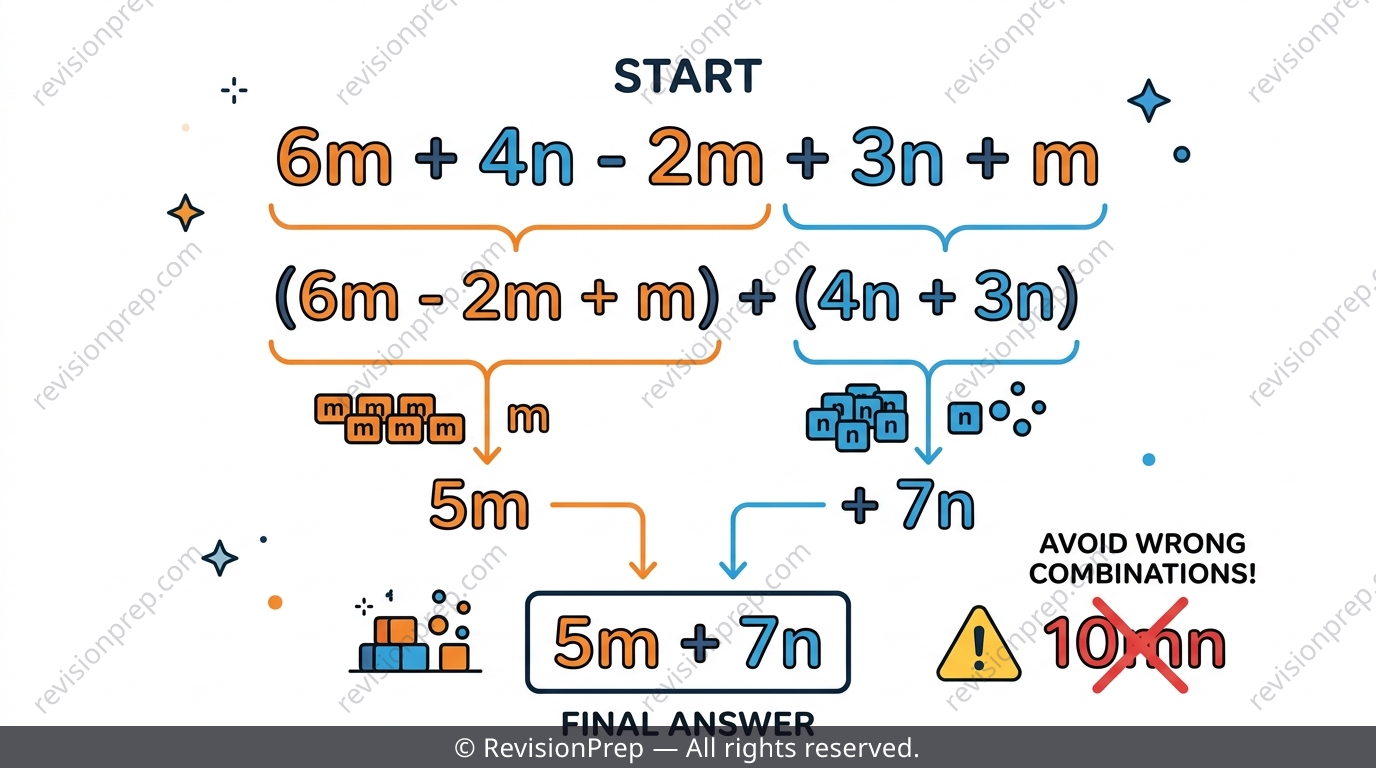
Simplifying means combining every pair of like terms — terms with identical letters and identical powers — into one, leaving the fewest possible terms. A lone letter like has a hidden coefficient of , so it must be counted in its group, and constants combine separately from any variable group. Rearranging terms is only valid if each sign stays glued to the term directly after it.
| Rule | Example |
|---|---|
| Constants group separately |
Exam tip
For 'show your steps' questions worth 3+ marks, physically write the groupings in brackets, e.g. , before adding — skipping this can cost method marks even with a correct final answer.
Common mistake
Writing or — different letters can never combine into one term.
Mini summary
Only identical letters with identical powers combine; a lone letter counts as coefficient 1.
Expanding and Factorising Single Brackets
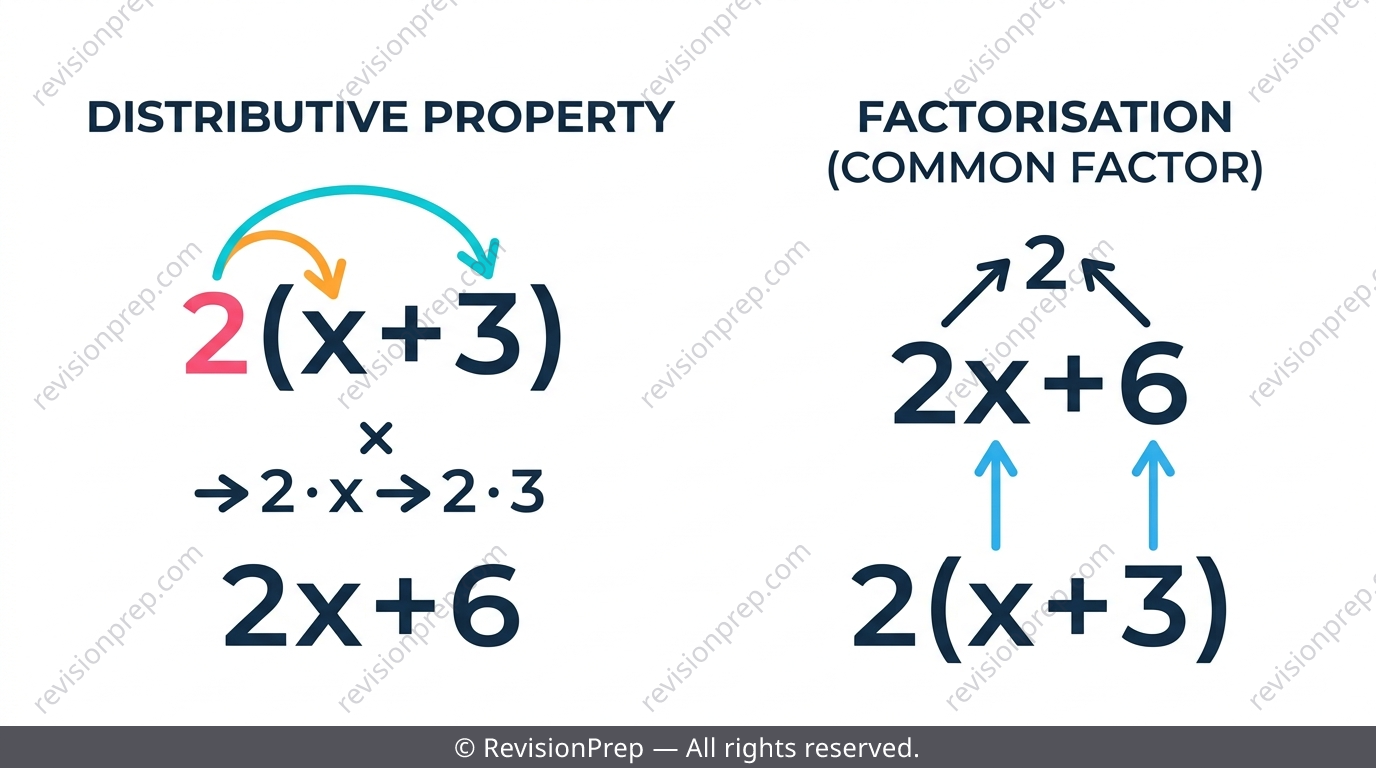
Expanding uses the distributive law: the term outside the bracket must multiply every single term inside, not just the first one. Factorising reverses this — find the highest common factor (HCF) of all terms, write it outside a bracket, then divide each term by it. Perimeter and area word problems often combine both skills: expand first, then collect like terms.
| Move | Formula |
|---|---|
| Expand | |
| Expand (subtract) | |
| Factorise |
Exam tip
Draw two small arrows from the outer number to each term inside the bracket — this catches missed multiplications every time.
Common mistake
Multiplying only the first term inside a bracket, e.g. treating as instead of .
Mini summary
Expand: multiply into every term. Factorise: pull out the HCF first.
Using Algebra in Word Problems
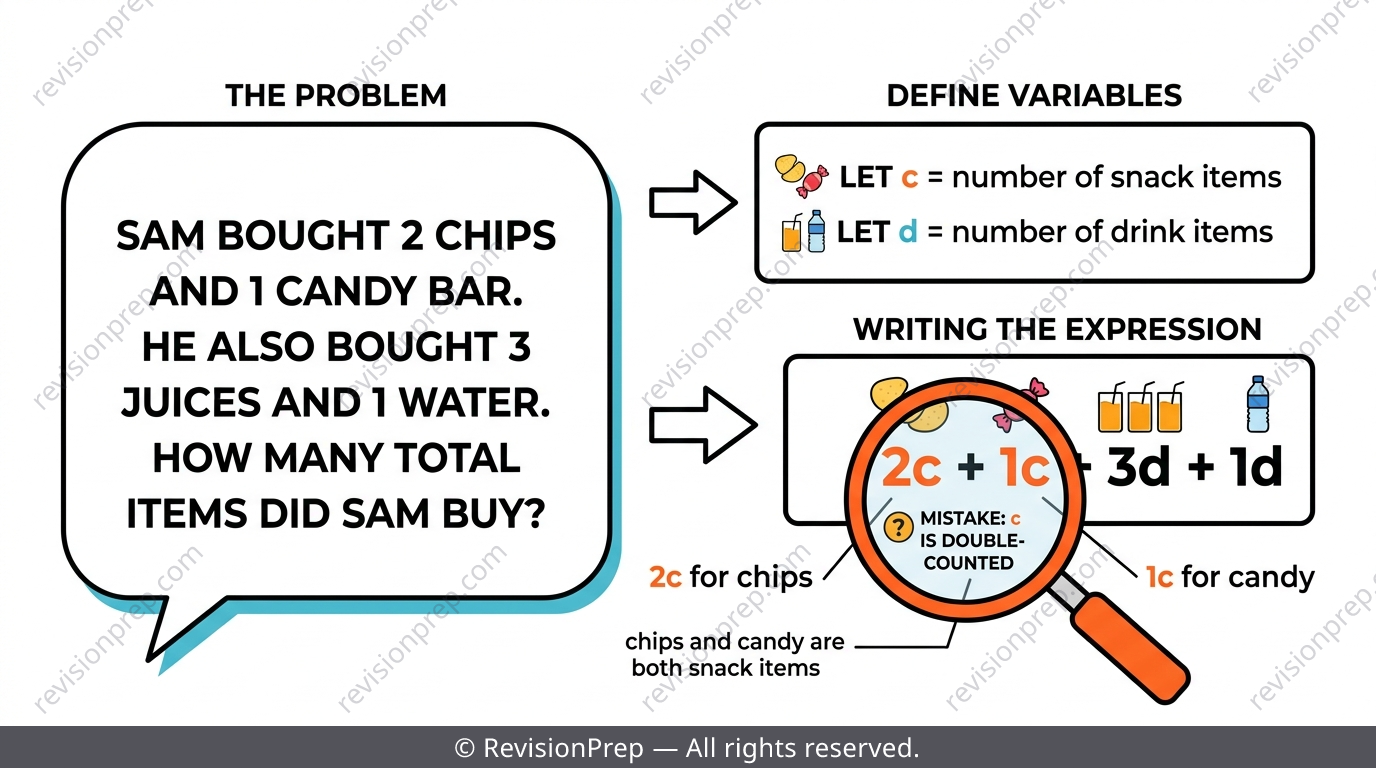
Turning a word problem into algebra means choosing a variable that captures exactly one quantity, then translating the situation correctly using it. Always state what your letter represents in words, even if the question already defines it — this is often checked for marks. A single variable can only carry one price or rate at a time; bundling two different prices into the same letter double-counts instead of modelling correctly.
Exam tip
'Calculate' and 'Identify' command terms in word problems still expect a written sentence defining your variable — skipping it can lose communication marks even with correct algebra.
Common mistake
Assuming a correctly simplified expression automatically means the underlying model is valid — always check both the arithmetic and the modelling logic.
Mini summary
Define your variable in words, and never let one letter represent two different prices.
Substitution into Expressions and Formulae
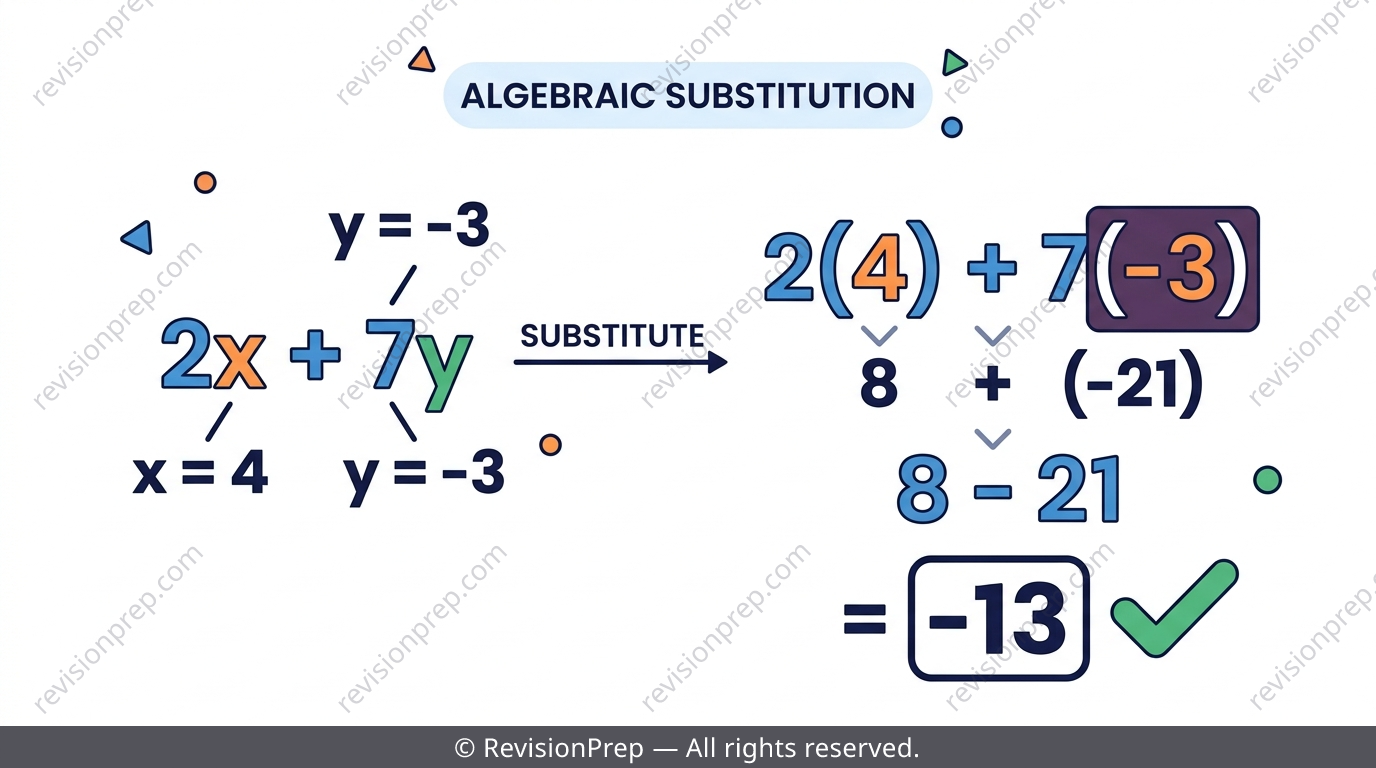
Substituting means replacing every occurrence of a variable with its given value, then applying the normal order of operations. Always wrap negative values in brackets before multiplying — this single habit prevents almost every substitution error. Simplifying an expression first, before substituting, reduces the number of arithmetic steps and the chance of a slip.
Exam tip
Getting the same numerical answer from two expressions doesn't prove they're equivalent 'for all values' — full marks need the algebraic simplification as the actual justification, with the number only as supporting evidence.
Common mistake
Forgetting to bracket a negative value before multiplying, which flips the sign of the result.
Mini summary
Bracket negatives before multiplying, and simplify first to cut down on arithmetic errors.
Quick formula sheet
Practice questions
- Simplify .
- Expand .
- Substitute into and evaluate.
- Simplify , showing your grouping steps.
- Factorise by finding the HCF.
- A rectangle has sides cm and cm. Write a simplified expression for its perimeter.
- A student claims is equivalent to for all values of and . Justify whether this claim is correct using both simplification and a numerical check.
- Let represent the total number of pens sold at $2 each and pencils sold at $1 each. Explain why writing the total cost as may not correctly model the situation, and propose a corrected model.
- Factorise and then expand your answer to verify it matches the original expression.
Frequently asked questions
What's the difference between an expression and an equation?+
An expression has no equals sign and can only be simplified, expanded, factorised, or evaluated — it can never be 'solved' because there's nothing to solve for on another side.
How do I know if two terms are like terms?+
Like terms must have exactly the same variable(s) raised to exactly the same power; only their coefficients are allowed to differ.
Why does a lone letter count as coefficient 1?+
A letter written without a visible number, like , is understood to mean , so it must be included in its like-term group or your total will be short by one.
Why do I need brackets when substituting negative numbers?+
Wrapping a negative value in brackets before multiplying prevents sign errors, which are the most common mistake in substitution questions.
Can one variable represent two different prices in a word problem?+
No — a single variable can only carry one rate or price at a time; bundling two differently priced categories into one letter double-counts the total instead of modelling it correctly.
How can I check my factorising is correct?+
Expand your factorised answer back out — if it matches the original expression exactly, your factorising is correct.
Ready to master Algebra and Expressions for MYP 3?
Related articles